- A national debate begins beneath the surface
- How Japan reached the November decision
- Groundwater is local, but it does not follow city boundaries
- The history behind Japan’s caution: sinking land
- From private wells to a shared water cycle
- Kumamoto: how a city works to replenish its water
- Semiconductors, farms and households: competing needs, common evidence
- The unanswered questions behind a proposed national system
A national debate begins beneath the surface
A community can live above an aquifer without knowing how much water moves through it. Wells supply farms, factories and homes; springs sustain landscapes; and rain that falls in one municipality may recharge groundwater drawn in another. That hidden geography is the challenge behind a Japanese government announcement on November 20, 2026.
The Ministry of Land, Infrastructure, Transport and Tourism, or MLIT, announced that the National Land Council’s Water Resources Development Subcommittee had approved the establishment of a new Groundwater Subcommittee (地下水部会) in a written meeting. Its purpose is to investigate the extent of groundwater extraction and consider how a more consistent national approach to conservation and sustainable use might work.
The announcement points to changing water demand, potential climate effects on aquifer recharge, public concern about extraction by foreign nationals and others, and gaps where municipalities lack relevant ordinances. It is an institutional step, not a completed change to national law: no uniform pumping limit, new nationwide well-licensing rule or enforcement date was announced.
How Japan reached the November decision
The road to the new panel began earlier in 2026. On January 23, a ministerial policy package addressing the acceptance and coexistence of foreign nationals called for consideration of nationally consistent information about groundwater extraction, including nationality-related information. In March, MLIT and the Cabinet Secretariat’s water-cycle policy office convened an expert study group on appropriate groundwater conservation and use.
After four meetings, that group released recommendations on August 4. The central proposition was that Japan needs better information about extraction and a practical mechanism for managing groundwater, potentially including legislation. The November subcommittee is intended to turn that work into an examination of the basic design of a possible system.
The political origin of the initiative deserves careful handling. A concern raised in government policy is not proof that widespread harmful pumping by a particular nationality has occurred. The material available does not demonstrate such a nationwide pattern. A scientifically useful system must ask how much water is taken, from which aquifer, under what conditions and with what effects—whatever the nationality of the operator.
Groundwater is local, but it does not follow city boundaries
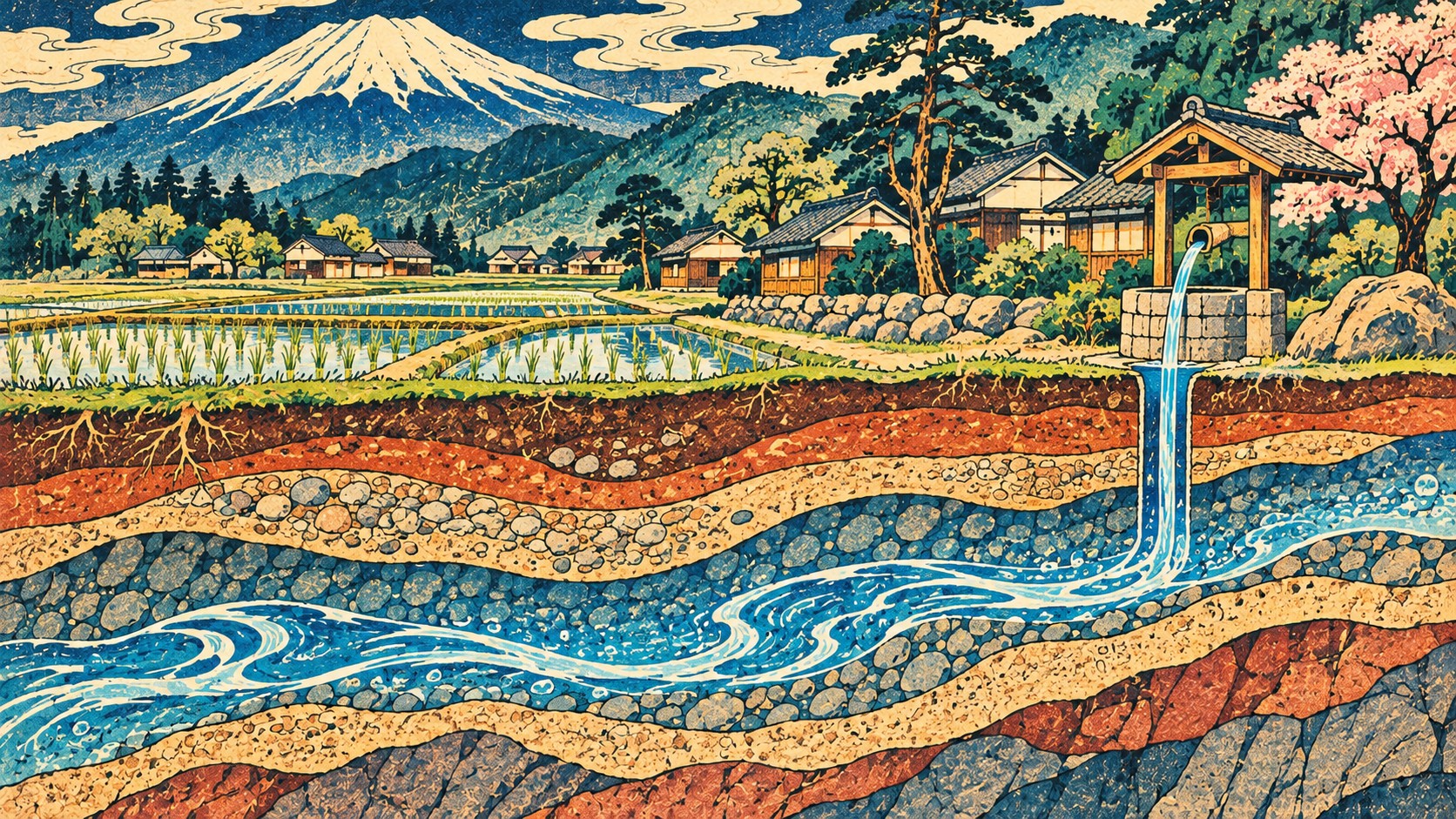
Groundwater is water held and moving through pores and fractures in soil and rock. Rain and snowmelt enter the ground in recharge areas; water may then travel slowly through aquifers before emerging at a spring, joining a river or being pumped from a well. The aquifer boundary often differs from the map of municipal jurisdictions.
That matters for governance. A factory may be located far from the fields through which an aquifer is replenished. Paved surfaces, changes in crop cultivation and a shifting climate may alter how much water soaks underground. Pumping can lower groundwater levels, but the effects depend on the geology and on extraction and recharge over time. A single national threshold cannot capture every local aquifer equally well.
Sound management therefore requires several kinds of evidence: well locations and quantities, groundwater-level monitoring, water chemistry, rainfall, recharge zones and interactions with surface water. It also requires institutions capable of sharing observations across local borders and explaining decisions to residents and water users.
The history behind Japan’s caution: sinking land
Japan learned the risks of intensive groundwater pumping during industrialization. MLIT traces observed land subsidence in southern parts of the Kanto Plain to the late nineteenth century and in Osaka to the early twentieth century. Postwar industrial growth greatly expanded the use of groundwater, and sinking ground and saltwater intrusion became serious regional problems.
Lower pressure in water-bearing sediments can cause compressible layers to compact. Once the land subsides, the change can be difficult or impossible to reverse. Japan responded through controls on some industrial and building-related groundwater withdrawals, municipal ordinances and the development of alternative sources such as industrial water systems.
Three areas—the Nobi Plain, the Chikugo–Saga Plain and northern Kanto Plain—became subjects of interministerial subsidence-prevention programs. Those measures helped moderate major subsidence, but ministries still regard continued monitoring and controls as necessary. Drought-driven changes in groundwater levels and coastal saltwater intrusion remain potential risks that require location-specific evidence.
From private wells to a shared water cycle
Japan’s Water Cycle Basic Act, which took effect in 2014, gave a clearer national expression to the idea that water—including groundwater—is part of a connected cycle and a valuable resource with substantial public importance. Amendments in 2021 more explicitly referred to groundwater in the law’s responsibilities and policy provisions.
That conceptual shift did not replace every local rule. Existing industrial groundwater laws and municipality-specific ordinances operate alongside a national framework that lacks one comprehensive uniform law governing all groundwater extraction. In some places, well owners must report or seek permission; elsewhere, comparable local information may be harder to obtain. A regulatory gap does not necessarily mean no other legal rule applies to a particular activity.
The new panel will have to reconcile two legitimate aims: enough consistency for national data and effective safeguards, and enough flexibility to respect differences in geology, local water culture and existing ordinances. Without both, a new rule could either miss important withdrawals or impose costs with little environmental benefit.
Kumamoto: how a city works to replenish its water
Kumamoto offers a vivid example of why groundwater is more than a hidden reserve. According to Kumamoto City, 100% of its municipal tap-water supply comes from groundwater. Volcanic geology shaped by ancient eruptions of Mount Aso helps water infiltrate and move underground, while irrigated rice paddies in the Shirakawa River basin play a major role in replenishing the regional aquifer.
Local cooperation is part of that system. Kumamoto City works with surrounding municipalities and agricultural organizations to promote seasonal flooding of rice fields in the middle Shirakawa basin, encouraging infiltration. A long-running agreement with Ozu and Kikuyo towns and farming partners was renewed in 2025. The city also requires rainwater infiltration facilities for certain development and building activity, recognizing that urban surfaces affect recharge.
Kumamoto is not a template that can be pasted onto every Japanese aquifer. Recharge effectiveness, land use and water-quality conditions vary. Its larger lesson is that sustainable use may require action far from the wells themselves—and coordination between users who would not otherwise think of themselves as part of the same water system.
Semiconductors, farms and households: competing needs, common evidence
Industrial development adds urgency to the discussion. In its August 2026 briefing, MLIT cited new water demand associated with facilities such as semiconductor factories. Modern manufacturing needs reliable process water; agriculture needs irrigation; communities need drinking water, sanitation and resilience during emergencies. Their requirements may become more difficult to balance when drought or land conversion affects available supply.
But new manufacturing is not, by itself, proof of unsustainable groundwater extraction. Facilities may use different water sources, recycle process water or operate under existing local safeguards. To evaluate a particular plant, a journalist or regulator needs data about its actual withdrawal, sources, reuse, discharge and the aquifer’s observed condition. Those facts cannot be inferred from an industry label alone.
More robust monitoring could help companies demonstrate responsible operations and allow communities to understand trade-offs before a shortage or land subsidence occurs. Policymaking should avoid the false choice between economic activity and conservation; long-term prosperity depends on protecting the resource that supports both.
The unanswered questions behind a proposed national system
Practical design will determine whether this initiative succeeds. Who must register wells? Which categories of use would be covered? How would small domestic and farm wells be treated? Would reporting be based on metered pumping volumes, estimates or a combination? Who would maintain the database, and how would the information be shared without exposing unnecessary personal or business details?
Other questions are hydrological rather than administrative. How will authorities distinguish a short drought-related drop in water level from long-term depletion? Could recharge projects be measured and independently verified? How would rules account for emergencies that require alternative water supplies? Local governments already possess valuable experience, and their capacity to collect and interpret data will be central.
As of the November 20 release, MLIT has not announced a new nationwide extraction cap, a finalized legislative proposal, the subcommittee’s first meeting date or a deadline for regulations to take effect. Those should be tracked through National Land Council agendas, local ordinances and official groundwater monitoring data. The immediate significance is that a resource long managed through a patchwork of systems is moving toward a broader public accounting—and the quality of that accounting will determine the value of any future rules.
Primary sources and reporting notes
Based on MLIT announcements of Nov. 20 and Aug. 4, 2026, Cabinet Secretariat guidance, Environment Ministry records and Kumamoto City primary materials. JAPAN.co.jp did not interview committee members. Establishing the panel does not enact new nationwide pumping restrictions or fees.