- The pages that outlasted a fire
- Why original manga matters
- An artist formed by the age of weekly manga
- The human inside the machine
- A Japanese artist in a global comic-book history
- Disaster preparedness for cultural collections
- Rebuilding Wajima is a longer undertaking
- A new chapter, not a finished recovery
The pages that outlasted a fire
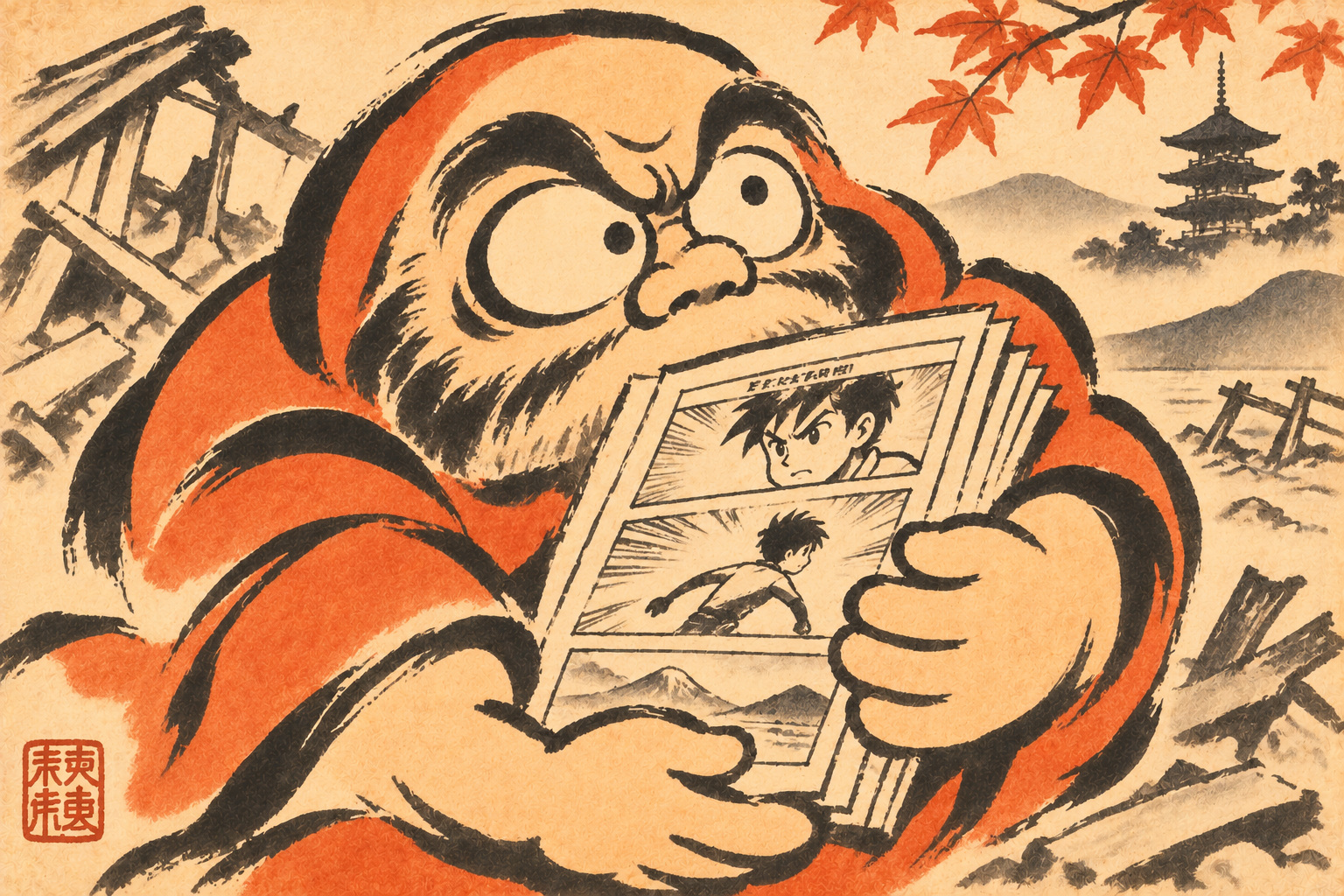
A comic can be printed again. The sheet on which its creator drew the original image cannot. That distinction gives a new exhibition in Kyoto an unusual urgency, nearly three years after the New Year's Day 2024 earthquake devastated communities across the Noto Peninsula.
Opening on November 28 at the Museum of Kyoto, Eternal Spirits — Go Nagai Go! Wonderland Revival brings together material associated with the manga artist's museum in his hometown of Wajima. Fire swept through the city's morning market district following the earthquake. The memorial museum was badly damaged, and the fate of its exhibits initially appeared grim.
On January 25, 2024, municipal officials inspected the interior. Dynamic Production subsequently reported that loaned drawings and figures remained. The Kyoto museum puts the number of original artworks recovered at 108 and credits fire-resistance measures with helping preserve them. The exhibition also introduces newly created manga, placing the work of a living artist alongside objects that survived the disaster. The recovery of the art is not new; its presentation in Kyoto is the reason to revisit the story now.
Why original manga matters
An original manuscript is evidence of a creative process. A printed page communicates a narrative, whereas the drawing from which it was reproduced may retain corrections, differences in line weight and traces of decisions made before publication. Such evidence can illuminate how a commercial illustration was produced as well as how an individual artist worked.
The museum's preview presents a restored Mazinger Z drawing and an image of a damaged Mao Dante original before treatment. These examples underscore an important distinction: escaping destruction does not mean escaping damage. Paper can be vulnerable to heat, smoke, moisture and later deterioration. The appropriate conservation treatment depends on the condition and materials of each object.
For a collector, the rarity of a sheet may determine its market value. For a conservator, it is also a physical object with a history that treatment should respect. For a community, it may carry memories of a museum visit or of a place that no longer exists in its former shape. Those different forms of value meet in Kyoto.
An artist formed by the age of weekly manga
Born in Ishikawa in 1945, Go Nagai apprenticed under Shotaro Ishinomori before making his professional debut in 1967 with Meakashi Polikichi. The following year, his Harenchi Gakuen began serialization in Shonen Jump. Its irreverent treatment of school life became a phenomenon, challenging prevailing expectations of children's comics.
His emergence coincided with a period in which mass-market weekly magazines and television increasingly shaped Japanese childhood. Serialized stories could reach readers at regular intervals, while animation introduced characters to households that might never have bought the original magazine. Nagai's career developed at the intersection of these media.
His work is not reducible to nostalgia for giant robots. Comedy, horror, science fiction and provocative social commentary coexist in his catalogue. Some themes and imagery remain controversial. A serious account of his influence needs to recognize both the imaginative freedom of his work and the debates that freedom generated.
The human inside the machine
Mazinger Z, launched in 1972, made the relationship between a pilot and an enormous robot central to its appeal. The machine is not simply a mechanical companion: its power is directed by a person. That premise created possibilities for storytelling about responsibility, vulnerability and the consequences of technological power, even within an adventure series.
Shueisha's Manga-Art Heritage project emphasizes how the manga, animated adaptation and merchandise were conceived in parallel. That commercial structure helped establish a durable market for giant-robot entertainment. Later creators developed the form in different directions, from military institutions to psychological conflict. It would be misleading to attribute the entire history of robot fiction to one artist, but Nagai's contribution is foundational.
Devilman, also introduced in 1972, explored a different kind of transformation, placing questions about human identity and monstrosity at the center of dark fantasy. Cutie Honey followed in 1973 with a transforming female protagonist. The television adaptations and manga versions should not be assumed to tell identical stories. Their differences reveal how a creative idea changes with its medium and audience.
A Japanese artist in a global comic-book history
The reach of Nagai's work can be seen in the audiences that encountered Grendizer far beyond Japan. Translation and television distribution made the characters part of childhood memories in other countries, often under local titles. The circulation of these stories helped build an international audience for Japanese animation long before the contemporary streaming economy.
France awarded Nagai the rank of Chevalier in the Order of Arts and Letters in 2019. In 2026 he entered the Will Eisner Comic Awards Hall of Fame, whose organizers recognize his influence across piloted-robot stories, transforming heroines and darker genres. That recognition places him within an international history of comics rather than solely within a Japanese entertainment industry.
For international readers, the Kyoto exhibition therefore offers a bridge between a familiar cultural export and its less familiar local roots. The artist whose imagined worlds traveled across borders comes from a town whose recovery now demands attention. Cultural recognition may create opportunities for solidarity, but it cannot by itself rebuild a local economy.
Disaster preparedness for cultural collections
The museum's survival story raises questions relevant to archives, libraries, galleries and private collections everywhere. A disaster plan must anticipate overlapping hazards: an earthquake can damage a building, a subsequent fire can threaten collections, and recovery may be complicated by water, interrupted transport or inaccessible storage.
After Ishikawa requested assistance from the Agency for Cultural Affairs on January 25, 2024, a coordinated cultural-property rescue and building-support effort began in February. The rescue scheme covers movable objects, while specialist assistance for damaged heritage buildings is organized separately. Ishikawa explicitly allows undesignated heritage to qualify for help, recognizing that an object's significance need not depend on formal legal designation.
These programs provide context, not evidence that they handled the Nagai museum recovery. The broader lesson is the importance of prevention as well as response. Inventories, off-site digital copies, appropriate storage and established relationships with trained conservators can reduce losses. Digitization preserves information but cannot replace the physical manuscript; and no collection is more important than the safety of the people who might recover it.
Rebuilding Wajima is a longer undertaking
Wajima's morning market was more than a place for visitors to shop. It supported livelihoods and everyday encounters between residents, vendors and customers. Restoring such a district requires rebuilding social and economic relationships as well as physical structures.
The September 2024 heavy rains compounded the damage caused by the earthquake. In February 2025, Wajima adopted a reconstruction plan that encompasses household recovery, livelihoods and urban regeneration. Those priorities help explain why reopening cultural attractions cannot be viewed separately from safe housing, reliable roads and viable local businesses.
Ishikawa's progress portal, updated September 30, 2026, records construction starts at 565 of 1,364 assessed public civil-engineering sites in the relevant Oku-Noto offices' jurisdiction. This is a measure of work initiated, not work completed or a comprehensive regional recovery percentage. Meanwhile, market traders continue to organize recovery events, including one advertised for November 8 with local food and seafood businesses. Readers interested in helping can consult the market and municipal websites rather than assuming every tourism activity benefits reconstruction equally.
A new chapter, not a finished recovery
The exhibition runs from November 28 through January 11, 2027, on the third floor of the Museum of Kyoto. Its opening-day program includes a scheduled conversation with Nagai about Kyoto legends, his manga Shuten Doji and his hopes for Noto. A charity auction of a new signed artwork is also planned, with net proceeds designated for Wajima City. The eventual donation is not yet known.
Visitors should consult the museum's official listing: the exhibition is scheduled to open at 10 a.m. and close at 6 p.m., with Friday hours extended to 7:30 p.m. Last admission is thirty minutes before closing. Monday closures apply except January 11, and the museum lists a year-end closure from December 28 through January 4.
The recovered works are an invitation to think about what survival means. They carry the history of an artist who helped transform popular entertainment, the labor of those who protected cultural objects and the memory of a community where those objects once lived. Their return to public view is worth celebrating, without confusing it with the completion of Wajima's recovery. The pages have survived; the city's next chapter is still being written.
Sources and further reading
- Museum of Kyoto — exhibition overview
- Official exhibition website
- Oricon — January 25, 2024 report on Dynamic Production statement
- Agency for Cultural Affairs — Go Nagai profile
- Shueisha Manga-Art Heritage — artist profile
- Toei Video — animation chronology
- Comic-Con — Eisner Hall of Fame
- Ishikawa Prefecture — cultural property rescue
- National Institutes for Cultural Heritage — rescue program
- Wajima City — reconstruction plan
- Ishikawa — recovery progress portal
- Wajima Morning Market — recovery event
- Exhibition — charity auction
- Exhibition — associated events