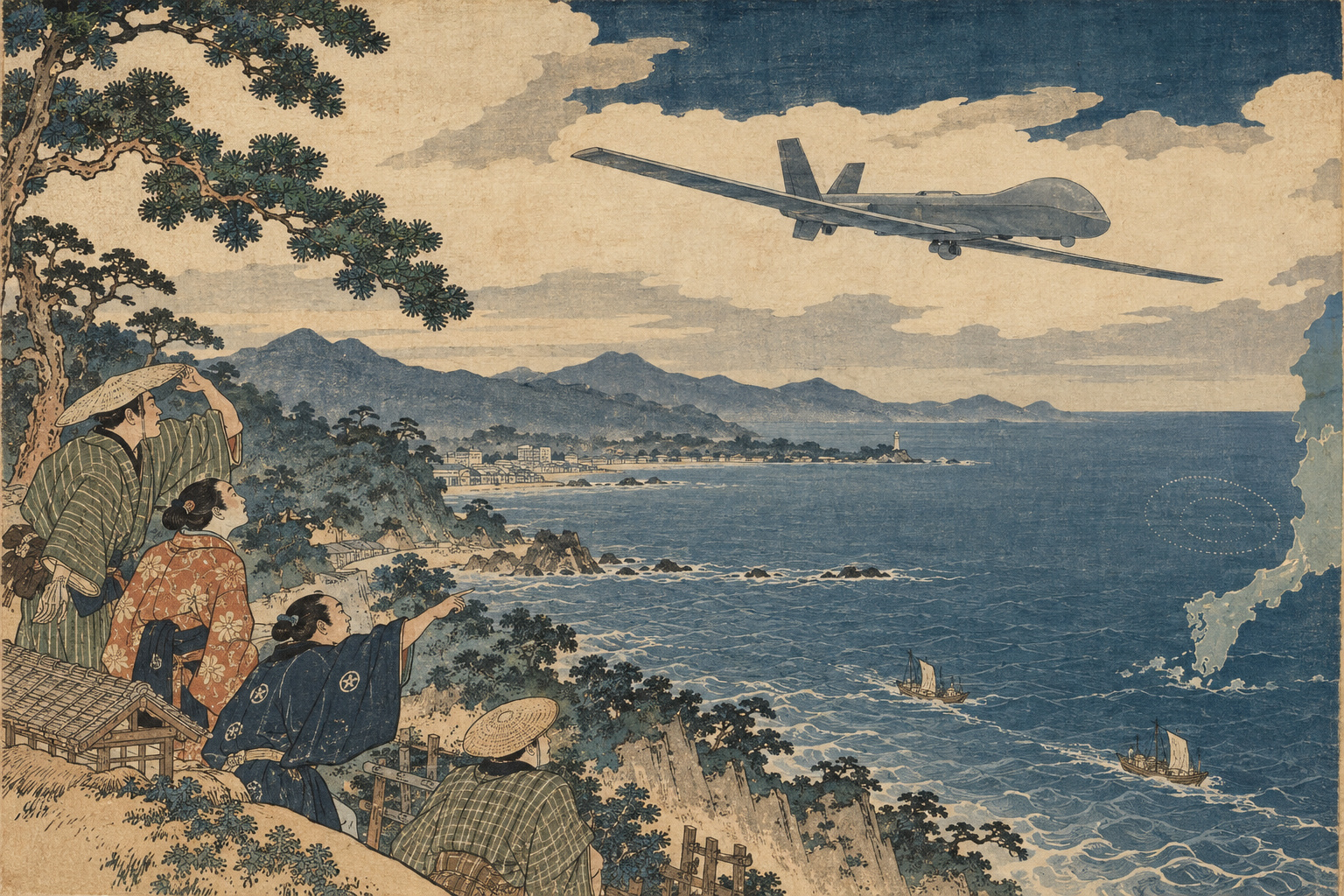
The first public description was a loss of contact. Within hours, Japan’s Air Self-Defense Force was saying that one of its three RQ-4B Global Hawk surveillance aircraft was presumed to have crashed into the Sea of Japan off Tottori Prefecture.
The aircraft left Misawa Air Base in Aomori at about 10:20 a.m. on September 15. From 12:55 p.m., the JASDF says, a connection problem developed with communications equipment. At about 12:58 p.m., the aircraft’s radar track disappeared roughly 50 kilometers north of Tottori. [1][2]
A Japan Coast Guard patrol vessel found floating material at about 2:19 p.m. A JASDF F-15J found debris six minutes later, and a U-125A search aircraft photographed it at about 3:12 p.m. By about 5:20 p.m., the service had assessed from the images that the material was from the missing aircraft and said the Global Hawk was presumed to have crashed. The cause remained under investigation. As of 5 p.m., the JASDF reported no damage outside the service. [2]
For Tottori, the story immediately became more local than a distant discussion of high-altitude intelligence collection. Prefectural authorities contacted four fisheries cooperatives to check vessels working offshore. Mainichi reported that 27 boats belonging to Tottori cooperatives were operating in the area and that no damage had been reported. What had been an aircraft at roughly stratospheric altitude became a possible debris hazard on a working sea. [9]
The official sequence establishes a communications-system connection problem beginning after 12:55 p.m., radar loss three minutes later, and debris later assessed as belonging to the aircraft. It does not establish that the communications problem caused the crash. No official evidence reviewed by Japan.co.jp identifies jamming, cyber interference, hostile action or a specific mechanical failure. [2]
| Time | JASDF account |
|---|---|
| ~10:20 a.m. | Aircraft departs Misawa Air Base. |
| From 12:55 p.m. | Connection problem with communications equipment. |
| ~12:58 p.m. | Radar track disappears about 50 km north of Tottori. |
| ~2:19 p.m. | Japan Coast Guard patrol vessel finds floating material. |
| ~2:25 p.m. | F-15J finds floating material. |
| ~3:12 p.m. | U-125A photographs the material. |
| ~5:20 p.m. | Images support identification as the aircraft; JASDF presumes a crash. |
Three minutes that do not yet explain the accident
The most consequential line in the JASDF’s second report is also the easiest to overread. A connection problem with communications equipment began after 12:55 p.m.; the track disappeared at about 12:58. [2] That chronology does not by itself establish causation.
An unmanned aircraft can sound synonymous with an autonomous aircraft. The Global Hawk is better understood as part of a remotely operated system. Japan acquired the RQ-4B as a system that includes remote-control ground equipment as well as the aircraft and sensors. Communications are therefore central to the mission system. [3][6] But a loss of communications can be a cause, a symptom or a parallel failure. Investigators have not publicly said which applies here.
Air Chief of Staff Gen. Yasuhiro Morita said the aircraft was not on a training flight when contact was lost, according to TV Asahi. [10] The service has not disclosed the mission. “Not training” should not be converted into speculation that it was watching a particular country, ship or military unit.
The search quickly became a joint air-and-sea operation
The JASDF’s second report lists two F-15Js, one U-125A, one UH-60J and one KC-46A among Air Self-Defense Force assets used in the search. The Maritime Self-Defense Force sent the destroyer Agano and the missile boat Hayabusa. The Coast Guard patrol vessel that found floating material added a civilian maritime-safety service to the operation. [2]
Recovery matters for more than accounting. Investigators need physical evidence to reconstruct what failed, while floating wreckage can create risks for vessels and fishing gear. As of the reporting cutoff, officials had not announced how much of the aircraft had been recovered, whether the main wreckage had been located on the seabed, or whether any navigation or fishing restrictions would be required.
For Tottori’s fishing fleet, the first question was simple: is everyone safe?
The local response shows why a defense accident at sea becomes a community story. Mainichi reported that Tottori Prefecture contacted four fisheries cooperatives after receiving notice of the incident. Twenty-seven cooperative vessels were operating offshore, and none had reported damage. A fisheries representative also warned about the possibility of collision with aircraft debris if wreckage remained afloat. [9]
No reported injury does not mean no continuing local consequence. Wreckage can drift. Search and recovery can overlap with fishing grounds and routes. If officials identify a debris field or exclusion area, crews need information that is useful at sea, not only a national-security summary.
The more sophisticated the military system, the simpler community-facing information should become: where the incident occurred, what has been found, whether vessels are at risk, and whether debris may still be in the water. None of that requires disclosure of the aircraft’s classified mission.
Why three Global Hawks mattered to Japan
Japan did not buy the RQ-4B as a tactical drone to fly briefly over a battlefield. It is a large high-altitude, long-endurance platform built to gather information across broad areas. JASDF lists a wingspan of 39.9 meters, a length of 14.5 meters, a maximum altitude of about 60,000 feet and endurance of about 36 hours. Its sensors can collect information on stationary ground targets at night and in adverse weather. [3]
Acquisition began in fiscal 2015. The first Japanese aircraft was delivered at Misawa on March 12, 2022. A dedicated operating organization followed later that year, and the arrival of the third aircraft in June 2023 completed the planned three-aircraft structure. [3][4][5]
The aircraft involved in the September 15 incident belonged to the Airborne Warning and Control Wing’s 502nd Squadron, according to the JASDF’s first report. Misawa public-affairs material from 2026 also identifies the 502nd as the RQ-4B squadron. [1][11]
If the aircraft is lost beyond repair, the physical inventory falls from three to two. That arithmetic is obvious; the operational consequence is not. The Defense Ministry has not published how many aircraft are normally mission-ready at once, what maintenance cycle each follows, or what surveillance tasking will change.
A decade-long investment in persistent surveillance
The policy idea predates the aircraft’s arrival by years. Japan’s fiscal 2015 defense budget included ¥15.4 billion for long-lead aircraft components and ground equipment for the Global Hawk system. The fiscal 2017 budget included ¥16.8 billion for assembly and related acquisition for one aircraft, plus separate support costs. [6][7]
Those figures are budget pieces, not a clean “price per drone.” Likewise, the U.S. government’s 2015 Foreign Military Sales notification estimated a possible package of three RQ-4 Block 30(I) aircraft, sensors, ground equipment, logistics and support at as much as $1.2 billion. It was an upper estimate for a package, not the value of the aircraft lost off Tottori and not necessarily Japan’s final program cost. [8]
The strategic purpose is clearer than the accounting. Japan’s defense white paper places the RQ-4B inside a broader effort to strengthen persistent intelligence, surveillance and reconnaissance as Chinese naval and coast guard activity and other regional military movements increase demand for wide-area monitoring. [5]
“Unmanned” removes one danger, not all consequences
There is one immediate advantage in an accident like this: there was no crew aboard to rescue. Losing the aircraft does not automatically mean losing aviators. That is one of the fundamental attractions of unmanned systems for long-duration missions.
But unmanned does not mean consequence-free. A large aircraft still becomes wreckage. Crewed fighters, helicopters, search aircraft and ships may still be needed to find it. The surveillance capability depends on sensors, communications, ground stations, maintainers, operators and airspace coordination, not just the airframe.
An unmanned aircraft is a way to keep people out of the cockpit. It is not a way to remove people, cost or community risk from an aviation accident.
It is too early to turn “three to two” into a readiness verdict
Because Japan had only three RQ-4Bs, the loss of one naturally raises questions about surveillance capacity. But military aviation is not a simple inventory equation. Aircraft rotate through maintenance and training, and a fleet’s useful capacity depends on availability, crews, ground systems and mission scheduling.
Japan.co.jp therefore does not conclude that the accident has created a specific surveillance gap. Nor is there evidence to conclude that two aircraft can absorb all planned work without consequence. The meaningful next indicators will be whether the remaining aircraft keep flying, whether inspections or temporary restrictions are imposed, whether other ISR assets substitute for the Global Hawk, and whether the government seeks a replacement.
The investigation has to examine a system, not just an airframe
The RQ-4B is an aircraft inside a larger remote-operations architecture. The official timeline’s reference to a communications-equipment connection problem means investigators will have to reconstruct what happened across the aircraft and its supporting systems. That does not imply the fault was on the ground, in the air, or in the communications link; officials have not identified the failed component.
The timing is notable because Japan’s own Global Hawk operation is still relatively young. The first aircraft was delivered in 2022 and the planned three-aircraft fleet was completed in 2023. The September incident is reported as the first case in which a JASDF Global Hawk has gone missing and been presumed crashed. [4][12]
A credible accident process now has familiar tasks despite the unusual platform: establish the timeline, recover evidence, examine technical and procedural factors, identify contributing conditions, and publish whatever safety findings can be released without compromising legitimate operational secrets.
What Tottori’s sea reveals about a high-altitude defense system
The Global Hawk was acquired to watch distant areas for long periods. Yet on September 15, the people who had the most immediate reason to think about it were fishing crews far from its home base in Aomori.
That is the other geography of national defense. An aircraft has a base, a communications network, an operating unit and a mission area. If something goes wrong, it also has a search area, coastal authorities, shipping routes and fishing communities.
The next chapter should be built from updates rather than theories: how much wreckage is recovered; whether the sea remains hazardous; whether fishing or navigation is affected; what investigators determine about the failure; and how Japan manages a surveillance fleet that was deliberately built around only three aircraft. The floating debris off Tottori has made both the strength and the vulnerability of remote high-altitude surveillance unusually visible.
Sources and references
- Japan Air Self-Defense Force: Radar loss of Misawa-based RQ-4B Global Hawk, first report (Sept. 15, 2026)
- Japan Air Self-Defense Force: Radar loss of Misawa-based RQ-4B Global Hawk, second report (Sept. 15, 2026)
- Japan Air Self-Defense Force: RQ-4B Global Hawk equipment profile and specifications
- JASDF Misawa Air Base: Delivery of the first RQ-4B Global Hawk (March 12, 2022)
- Japan Ministry of Defense, Defense of Japan 2024: persistent intelligence, surveillance and reconnaissance
- Japan Ministry of Defense: FY2015 budget, initial Global Hawk system acquisition
- Japan Ministry of Defense: FY2017 budget, RQ-4B Global Hawk acquisition
- U.S. Defense Security Cooperation Agency: Japan RQ-4 Block 30(I) Global Hawk proposed sale notification (2015)
- Mainichi report syndicated by TNC: Tottori checks fishing-vessel safety after Global Hawk loss (Sept. 15, 2026)
- TV Asahi: Air Chief Gen. Yasuhiro Morita says the aircraft was not on a training flight (Sept. 15, 2026)
- JASDF Misawa Air Base: 502nd Squadron RQ-4B presentation, FY2026 base-monitor program
- Kyodo report via Daily Sports: JASDF Global Hawk goes missing off Tottori, first such case since introduction (Sept. 15, 2026)
Evidence reviewed in the early hours of September 16, 2026, Japan time. The JASDF’s first and second incident reports control the timeline, unit identification, search assets, damage status and crash assessment. The Air Chief of Staff’s statement establishes only that the flight was not training; the mission itself has not been disclosed. The cause, main-wreckage location, recovery status, restrictions on the two remaining aircraft and any replacement decision were unconfirmed or unpublished at the reporting cutoff and are not stated as facts here. Analysis is Japan.co.jp’s unless otherwise attributed.