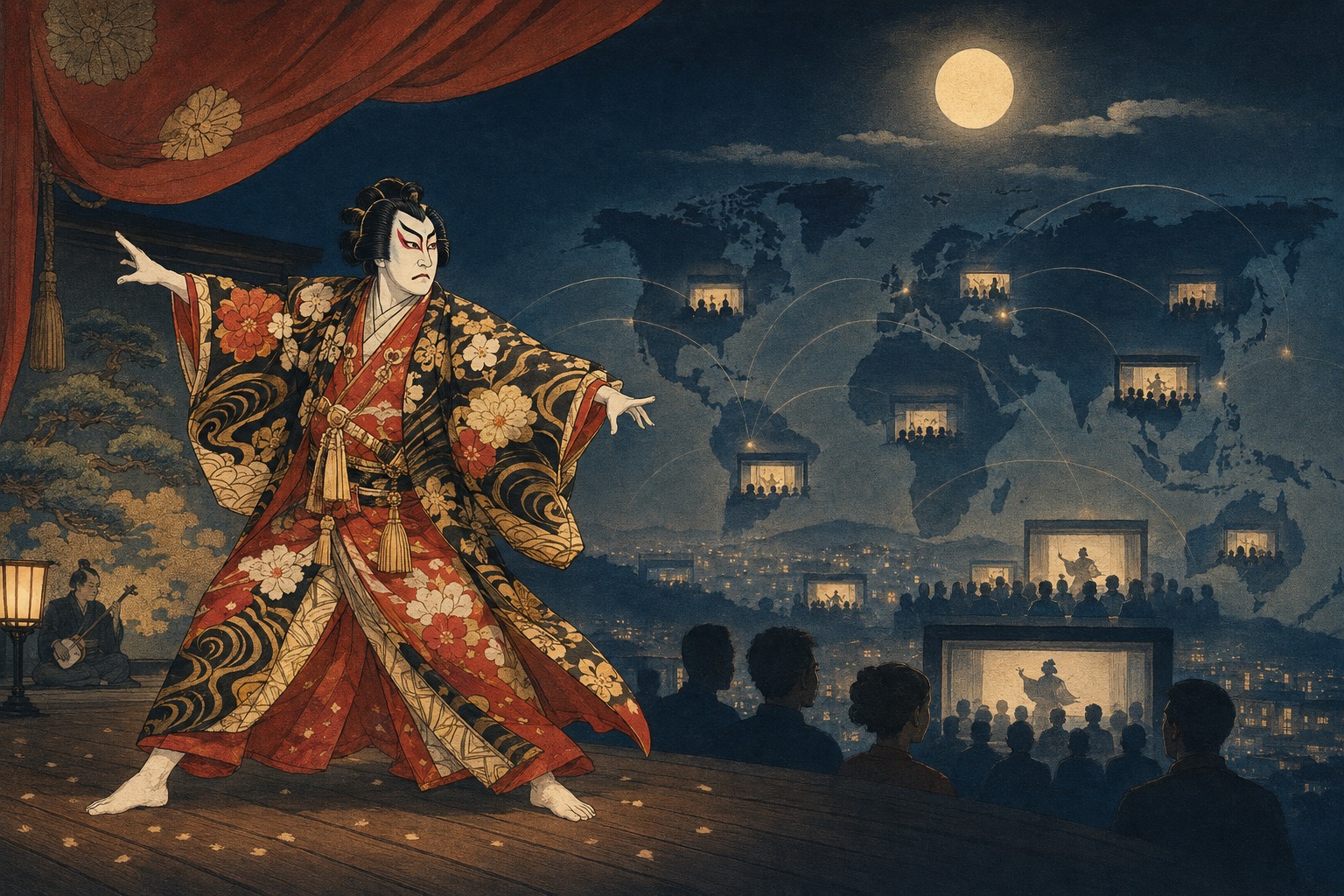
JFF Discover Kabuki Tour & Online begins online on August 5, 2026. Seven recorded Kabuki titles will rotate through May 12, 2027 on the Japan Foundation’s JFF Theater service, free with account registration in eligible territories. From October through November, Cinema Kabuki screenings and workshops will travel—with Shochiku’s cooperation—to the Philippines, Peru, Chile, Argentina, Brazil, Mexico and Egypt. Exact local venues and dates were not all published as of August 1; the announced country windows remain provisional.
Three doors into the same theatre
The project opens three different doors. The first is a cinema door. High-definition recordings made for Cinema Kabuki carry the framing, detail and sound of a stage production into a local movie theatre. The second is a workshop door. A participant can feel the weight and architecture of clothing actually used onstage, pose for a photograph, or try body painting inspired by the bold kumadori makeup associated with heroic and supernatural roles. The third is a digital door: seven performances, rotated online and translated into nine subtitle languages.
Each door solves a different problem. Cinema gives a distant audience a shared room, a large image and focused attention. Streaming defeats distance and scheduling. Workshops answer the screen’s greatest weakness: the body disappears into pixels. Kabuki costume is not simply decoration. A wig, sleeve, sash or trailing hem changes how an actor occupies space. Kumadori does not merely make a face colorful; its lines externalize force, temperament and moral energy.
The innovation is not that a 400-year-old art has finally become modern. Kabuki has been modern repeatedly. The innovation is the decision to let cinema, translation and touch do different parts of the work.
The route: seven countries, several kinds of encounter
The physical tour concentrates on countries where a full-scale Grand Kabuki company rarely appears. It does not pretend that a film is a live tour. Instead, the Japan Foundation and Shochiku have designed events around works that can introduce Kabuki’s dance, comedy, visual force and capacity for adaptation.
| Country and announced window | Screening | Participatory element |
|---|---|---|
| Philippines Early October; late November | Renjishi; later, both parts of KABUKI Nausicaä of the Valley of the Wind | Kumadori body painting and costume demonstration/photo experience with Renjishi; the Nausicaä program is screening only. |
| Peru Early October | Ninin Fuji Musume / Nihon Furisode Hajime | Kabuki costume demonstration and photo experience. |
| Chile Mid-October | Ninin Fuji Musume / Nihon Furisode Hajime | Kabuki costume demonstration and photo experience. |
| Argentina Mid-October | Ninin Fuji Musume / Nihon Furisode Hajime | Kabuki costume demonstration and photo experience. |
| Brazil Late October–early November | Renjishi and Migawari Zazen | Kumadori body-painting experience. |
| Mexico Early November | Renjishi | Kumadori body-painting experience. |
| Egypt Mid- to late November | Ninin Fuji Musume / Nihon Furisode Hajime | Kabuki costume demonstration and photo experience. |
The choices form a compact grammar lesson. Renjishi, written by Kawatake Mokuami, turns a parent-and-child bond into a spectacular lion dance; the filmed version released in 2008 was directed for cinema by Yamada Yoji. Ninin Fuji Musume places two celebrated onnagata performers inside an image of wisteria, grace and transformation. Chikamatsu Monzaemon’s Nihon Furisode Hajime moves from beauty toward mythic violence. Migawari Zazen is domestic comedy powered by deception and marital pursuit.
Then comes Nausicaä of the Valley of the Wind. Hayao Miyazaki’s environmental epic, adapted in full for Kabuki and filmed in two parts, is not a concession to people supposedly unable to appreciate tradition. It demonstrates what tradition actually is: a repertoire of inherited techniques strong enough to absorb an unfamiliar universe.
The online season: not one upload, but a rotating repertory
“Seven titles from August 5” can sound as if all seven will remain continuously available. They will not. JFF Theater is organizing a repertory in three rotations, with one introductory work—Welcome to the Kabukiza—remaining for the entire season. All announced windows begin and end at 11:00 a.m. Japan time.
| Streaming window | Titles | What they introduce |
|---|---|---|
| Aug. 5, 2026–May 12, 2027 | Welcome to the Kabukiza | A continuing orientation to the theatre, featuring Nakamura Toranosuke. |
| Aug. 5–Nov. 4, 2026 | The Stone Bridge | A lion-dance work recorded at Kabukiza in November 2024. |
| Nov. 4, 2026–Feb. 3, 2027 | Pulling the Carriage Apart The Five Thieves Heron Maiden | Aragoto power, Mokuami’s pictorial outlaw theatre and a haunting dance transformation. |
| Feb. 3–May 12, 2027 | The Maiden at Dōjōji Temple Battle of Ideas for Saké | A major dance lineage and the energy of a younger Asakusa cast. |
Viewing is free, but registration is required. “Worldwide” also needs precision. The announced 119-country footprint emphasizes Southeast Asia, South Asia, Latin America, the Middle East and Africa. Availability varies by territory and title, and content available inside Japan is limited. Viewers outside the eligible areas are directed to Shochiku’s paid Kabuki On Demand service.
Before Kabuki was heritage, it was disruption
The modern international presentation of Kabuki often surrounds it with the language of classical refinement. Its beginning was less polite. At the start of the seventeenth century, a woman known as Okuni—who presented herself as a shrine maiden from Izumo—became famous in Kyoto for kabuki-odori. The word was associated with the kabukimono, flamboyant outsiders whose clothes and behavior leaned away from convention. Women played men; fashionable scenes, dance, comic eroticism and the newly popular shamisen drew commoners, warriors and nobles.
Popularity brought regulation. The Tokugawa authorities banned women from Kabuki in 1629. Adolescent male troupes that replaced them were banned in 1652. Adult male Kabuki then developed more elaborate plots and a demanding actor system, while male specialists in female roles—the onnagata—turned an imposed restriction into one of the theatre’s defining artistic disciplines.
This history matters when a workshop invites an audience to encounter costume and makeup. Kabuki has never been a neutral museum of old Japanese behavior. It is an art built out of arguments about gender, celebrity, public order, commercial entertainment and who is permitted to appear before whom. Its stylization is not distance from social life. It is social life compressed into line, rhythm and pose.
An Edo theatre was already a machine
Streaming is new; mediation is not. Kabuki’s stage became one of the most technologically inventive performance spaces of the early modern world. The hanamichi carries an actor through the audience, turning an aisle into road, riverbank, corridor or supernatural passage. A suppon lift makes a spirit rise near the spectators. The seri raises actors and scenery from below. The mawaributai, developed in the later Edo period, rotates an entire scene in view.
These devices do not hide machinery in order to create seamless realism. They make transformation itself pleasurable. Stagehands dressed in black may be visible. A curtain’s pull and the accelerating crack of wooden clappers create time. A pose called a mie stops time. The audience is not asked to forget that it is in a theatre; it is asked to delight in the theatre’s power to change worlds openly.
That makes Kabuki unusually compatible with the camera and unusually resistant to it. A close-up can reveal the concentration of an eye, a painted line or the tension in a hand. Editing can guide a first-time viewer through a dense stage picture. Yet a camera also chooses on the viewer’s behalf. It cannot reproduce the shock of an actor appearing behind the seats, the collective shout of an actor’s house name, or the scale of a costume advancing down the hanamichi.
Survival has always involved rebuilding
Kabuki’s history is not a straight line from sacred origin to protected masterpiece. The Tokugawa government repeatedly regulated theatre districts and performance. In 1842, the Tenpō Reforms forced Edo theatres to the then-outlying Asakusa district. In the Meiji era, reformers tried to elevate Kabuki into a respectable national theatre suitable for officials and foreign dignitaries. Gaslight entered the theatre; historical accuracy became a program; the Emperor watched Kabuki in 1887. Audiences accepted some changes and rejected others.
Kawatake Mokuami crossed the Edo–Meiji divide by writing for the speech, movement and pictorial composition of particular actors. His thieves spoke in long musical lines and assembled into stage pictures so exact that a modern cinema camera almost seems anticipated. His Renjishi travels in the 2026 program; The Five Thieves enters the online rotation in November.
War brought literal destruction. Air raids burned Kabukiza and other theatres; performers died; the Allied Occupation temporarily prohibited works regarded as feudal or militaristic. Kabukiza reopened in 1951. The National Theatre opened in 1966 to preserve and promote traditional performance. UNESCO proclaimed Kabuki a Masterpiece of the Oral and Intangible Heritage of Humanity in 2005 and placed it on the Representative List in 2008.
Heritage status did not freeze it. Kabuki has continued to stage new writing, collaborate with contemporary directors and adapt manga and animation. Preservation in Kabuki is not the conservation of a single authoritative object. It is the continued transmission of roles, names, music, movement, stagecraft and judgment—followed by the decision to use them again.
From Moscow in 1928 to a phone in 2026
The first Kabuki performances outside Japan took place in the Soviet Union in 1928, led by Ichikawa Sadanji II. Shochiku records the first U.S. tour in 1960, connected to the centennial of the U.S.–Japan treaty relationship, and the first European performances in 1965 in West Berlin, Paris and Lisbon. It now counts more than 110 overseas Kabuki tours reaching 35 countries and 90 cities.
Those tours made presence the medium: actors, musicians, costumes, wigs, properties and stage specialists traveled together. They were diplomatically important and artistically expensive. They also tended to reach major capitals and institutions able to carry a production’s weight.
The screen created another route. Shochiku released its first Cinema Kabuki, Noda-ban Nezumi Kozō, in 2005. Cinema Kabuki is not a static archival camera placed at the back of a hall. Productions are recorded for theatrical exhibition, preserving a particular cast while using camera placement, sound and editing to create a second performance for the screen. The 2026 project extends that model: from Japanese stage to recorded performance, from recording to overseas cinema, and from cinema to workshop.
The pandemic did not invent digital culture—it accelerated it
The Japan Foundation was established in 1972 to conduct international cultural exchange. For decades, its basic tools were travel, venues, grants, language education, exhibitions and local institutional partnerships. Digital distribution became indispensable when COVID-19 closed borders and stages.
In February 2021, the Foundation launched STAGE BEYOND BORDERS to circulate Japanese theatre, dance, traditional arts and music with multilingual support. By March 2025, the initiative had accumulated 35 million views. JFF Theater, a separate film and video platform launched in August 2024, had more than 230,000 registered users by July 15, 2026. The site operates in 17 languages, has offered subtitles in as many as 19 and had streamed 71 films.
Those figures help explain why the Kabuki program is possible now. The institution no longer has to create a global delivery system for one heritage campaign; it can program Kabuki into a platform, user base and translation workflow already built through film. At the same time, the tour keeps the local offices and physical partnerships that distinguish cultural exchange from mere content distribution.
Why the Global South is not an afterthought
The geographic emphasis is deliberate. The Foundation says the project aims to make Kabuki more accessible in Global South regions where it remains less widely known. That changes the familiar map of Japanese cultural diplomacy. Paris, Rome and Cologne hosted a Shochiku onnagata program co-organized by the Foundation in spring 2026. The new project turns toward Manila, Latin America and Cairo, while the online program spreads further across Asia, Africa, the Middle East and Latin America.
Two stops carry explicit commemorative meaning. The Philippine events mark the 70th anniversary of normalized Japan–Philippines diplomatic relations. The Argentine program is part of commemorations for 140 years of Japanese immigration to Argentina. These are not blank markets awaiting Japanese culture. They are societies with their own histories of migration, war, diplomacy, theatre, gendered performance and Japanese communities.
A responsible cultural exchange therefore cannot stop at “showing Japan.” It must leave room for comparison and response. What does a Peruvian spectator see in the ceremonial transformation of costume? How does Egyptian performance history change the reading of an all-male form? What does Nausicaä’s ecological world mean in a region facing its own climate stresses? Subtitles transmit plot. Exchange begins when the receiving audience makes the work answer local questions.
Seven works, nine languages—and the politics of translation
Kabuki translation is unusually difficult because meaning is distributed across words, vocal delivery, inherited gesture, music, stage position, costume and an audience’s knowledge of familiar stories. A subtitle can explain that a thief is introducing himself. It cannot by itself convey why Mokuami’s rhythm makes the speech pleasurable, why the five bodies align into an image, or why a stage name shouted from the audience carries generations of association.
But translation does not need to reproduce every layer simultaneously to be worthwhile. Welcome to the Kabukiza supplies orientation. Curated rotations keep the first encounter from becoming an undifferentiated archive. The physical events add demonstration and touch. Nine subtitle languages acknowledge that “international” cannot continue to mean English alone.
There is still a limit. The streaming footprint is broad but licensed, registered and geographically selective. Internet quality, digital payment alternatives, disability access, local publicity and the time available to watch long-form performance will affect who actually enters. The meaningful measure will not be the number 119 by itself. It will be completion, return viewing, language use, local attendance and whether partner institutions can build another encounter after the campaign ends.
What should be watched after the curtain rises
- Discovery: Do audiences outside existing Japanese-culture circles find the program?
- Translation: Do subtitles and introductory materials clarify without flattening Kabuki’s ambiguity and rhythm?
- Participation: Do workshops create questions and local relationships, rather than functioning as photo opportunities alone?
- Continuity: Can cinemas, cultural institutions and educators reuse the interest after the tour leaves?
- Feedback: Does knowledge move back toward Japan, allowing host audiences to shape future programming?
The Japan Foundation reported that its film programs reached about 265,000 in-person viewers across 80 countries and regions in fiscal 2025. JFF Theater’s registered base gives Kabuki potential scale. Neither number guarantees encounter. Cultural diplomacy is strongest when it does not count only exposure, but records what people understood, disputed, remembered and chose to seek next.
The theatre does not become smaller when the screen turns on
A viewer in Nairobi, Jakarta or Buenos Aires may first meet Kabuki through a four-inch screen. Purists can describe that as loss—and something is lost. The theatre’s architecture, collective attention and living exchange between actor and house cannot be downloaded.
But Kabuki did not begin as an untouched classic waiting for perfect conditions. It began as a disruptive urban performance, survived prohibition by reinventing its performers, absorbed puppet-theatre narratives, engineered moving stages, negotiated Meiji respectability, rebuilt after war, entered cinema and adapted Miyazaki. Its continuity has never depended on refusing new media. It has depended on knowing which parts can change and which disciplines must be transmitted with care.
In 2026, the red lion mane will spin in one room while a subtitled dancer holds a pose in another time zone. Somewhere else, hands will adjust a stage-worn costume around a body that has never entered Kabukiza. These are not equivalent experiences. That is precisely why the project may work. The cinema creates attention. The stream creates access. The workshop creates memory. Together, they build a road back toward the living stage.
Sources and methodology
Japan.co.jp used the Japan Foundation’s July 2026 announcement and project page as the controlling sources for the program’s scope, participating countries, subtitle languages and workshop design. The full distributed release, reproduced by the Foreign Press Center Japan, supplied the country windows, film titles, streaming rotations, platform metrics and commemorative context. Historical claims were cross-checked against the Japan Arts Council’s educational archive, UNESCO’s heritage record and Shochiku’s corporate and overseas-performance histories. Published tour windows are reported as announced, not as confirmed venue-level schedules. Interpretive passages about mediation, translation and cultural diplomacy are Japan.co.jp analysis. The displayed exchange rate—1 U.S. dollar to 160.57 Japanese yen—was supplied with a timestamp of July 31 at 12:54 a.m. UTC, equivalent to 9:54 a.m. JST.
- Japan Foundation: Cinema Kabuki screenings, workshops and streaming announcement
- JFF Theater: JFF Discover Kabuki Online project page
- JFF Theater: English Kabuki streaming page
- Foreign Press Center Japan: Full distributed program, tour schedule and streaming roster
- Japan Arts Council: Kabuki’s beginning and development of adult-male Kabuki
- Japan Arts Council: Mokuami and Kabuki’s Meiji modernization
- Japan Arts Council: War, revival, UNESCO recognition and modern Kabuki
- Japan Arts Council: Kabuki stage mechanisms
- UNESCO: Kabuki theatre on the Representative List of Intangible Cultural Heritage
- Shochiku: Overseas Kabuki performance history
- Shochiku: Corporate chronology, first Cinema Kabuki and international milestones
- Japan Foundation: STAGE BEYOND BORDERS history and audience reach
- Metropolitan Museum of Art: Early Kabuki, popular culture and the 1629/1652 prohibitions
