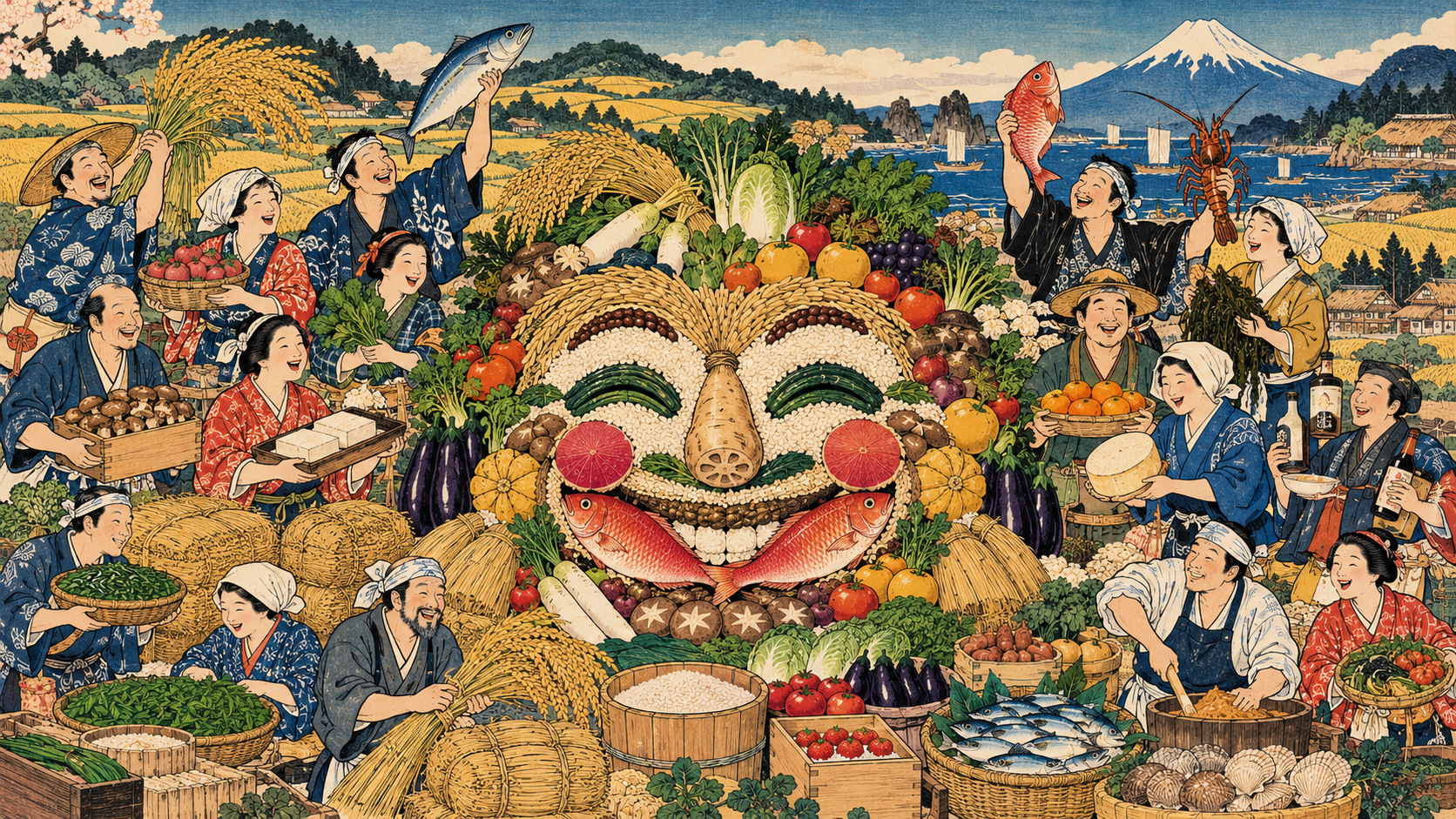
The question is not only how much food Japan grows, but how reliably it moves from producer to person.
Twelve winners, one revealing definition of food security
Japan’s Ministry of Agriculture, Forestry and Fisheries named 12 organizations in its second Food and Agriculture Connection Awards on October 26. The list is less a celebration of impressive crops than a portrait of what can fail between a farm and a dinner table. It includes a community refrigerator open around the clock, abandoned farmland brought back into production, a platform linking growers with buyers, and cattle-management sensors. The ministry will hold the awards ceremony on November 20; that ceremony has not yet occurred.
Why the awards matter beyond a ceremony
The awards are part of NIPPON FOOD SHIFT, a government initiative intended to reconnect consumers with how food is produced and delivered. Four categories cover stable supply, access to food, sustainable food systems, and development or dissemination of smart-agriculture technology. An expert panel selected winners, according to MAFF. These are ministry-selected examples, not independently audited proof that each business model has achieved its advertised social or commercial benefits.
Reviving a plum-growing landscape
Umehikari Co., Ltd. received the agriculture minister’s top award in the stable-supply category. The ministry points to an integrated model covering plum cultivation, processing and sales, alongside the recovery of abandoned fields and development of future producers. That combination matters: when growers control more of the route from harvest to customer, they may have more options to sustain a regional industry. It remains important to distinguish a promising structure from verified financial performance; the ministry’s short announcement does not provide standardized profitability or restored-acreage comparisons.
The import question starts with animal feed
The Yamaguchi grain-corn council, another stable-supply winner, is working on domestically grown feed corn and a processing facility using Japanese feed inputs. Retailers and restaurants also take part in a crop–livestock collaboration. Himuka Farm, the third recipient in the category, uses abandoned land to grow the aromatic citrus hebesu and develops sales channels. Both offer ways to mobilize land and local relationships; neither should be mistaken for a solution to Japan’s overall dependence on imported feed.
An always-open refrigerator changes what “access” means
The minister’s award for food access went to the Kitagase Area Management Association, which operates a community fridge stocked with donated foods for households needing support. According to the ministry, eligible users can access it 24 hours a day, 365 days a year. The distinctive idea is not simply redistribution; it is reducing the time constraints that can make ordinary food assistance hard to use. How consistently the program is stocked, whom it reaches, and its long-term finances would be worthwhile follow-up reporting.
Delivery workers and mobile groceries
Two further access winners expose different barriers. The Chikugo Ikiiki Delivery Challenge Association combines shopping-street stores with older delivery workers through the Silver Human Resources model. Nonprofit e-Work Ehime combines food banks, community pantries, food drives and mobile supermarkets. Food access is a problem of distribution, affordability, time and physical mobility—not merely the total quantity of food in a country.
Can better information make farming less wasteful?
Tech Vegitas received the minister’s award for sustainable food systems for a digital platform connecting producers, commercial buyers and distributors from the production stage. Better forecasts and communication could potentially reduce the gap between what growers produce and what buyers need. Yet a technology platform’s existence does not establish savings by itself. Independent evidence about adoption, transaction volumes, costs and food-loss outcomes would show whether the model scales.
Communities of young growers—and more time for cherries
The same category recognizes Toyamanome, an association of younger farmers in Toyama working with companies and on food education, and Yamagata Sanso, recognized for developing technology to prolong cherry freshness. These operate on different constraints: one on professional networks and learning, the other on the perishability that limits the distance and time fruit can travel. The ministry’s announcement does not independently quantify shelf-life gains or their commercial return.
Cattle sensors and crop-spraying robots
Farmnote took the agriculture minister’s award for smart agriculture. Its offering links cattle-management cloud software, behavioral sensors and genomic testing, with demonstrations at a group-affiliated farm and additional educational work. Yokota Farm is recognized for data-based farming and education, while Legmin develops autonomous pesticide-spraying robots and offers outsourced spraying services. The business question for farms is not whether a robot looks futuristic but whether capital costs, maintenance, labor savings and agronomic performance work together.
A policy shift nearly three decades in the making
Japan’s food policy has been reframed around resilience. The Food, Agriculture and Rural Areas Basic Act was substantially revised in June 2024, and a new basic plan under that amended law was adopted in April 2025. MAFF’s latest figures put fiscal 2025 calorie-based food self-sufficiency at 37%, down one percentage point, while the production-value measure was 66%, up two points. The measures capture different things. The calorie metric is especially sensitive to the types and energy content of foods supplied, while the value metric reflects market prices as well as domestic production.
Why local experiments cannot simply be copied
A staffed rural delivery route may depend on local volunteers or available workers; a community fridge needs donors and an operating organization; robot spraying needs suitable fields and economic scale. What succeeds in one region might not transfer unchanged to another. The most useful next reporting would compare the real costs, users served, farm income effects, changes in abandoned acreage, measured waste reduction and performance over several years.
The unanswered questions behind the applause
The awards help locate people attempting practical fixes, but they are not a league table of proven impact. Award-winning projects can still face financial, technical and operational limits. Japan.co.jp has not conducted independent on-site assessments or interviews with the 12 recipients for this report. Their activities and award categories are attributed to the ministry’s October 26 announcement and official award pages.
A test measured in ordinary meals
November 20’s planned ceremony will provide recognition. The harder test unfolds later: whether orchards stay in production, vulnerable households can reliably obtain groceries, food moves with less friction, and farms can adopt technology without undermining their economics. The most interesting message of these 12 awards is that a functioning food system is built as much through connections as through production.
Sources and verification
Winner names and activities are attributed to MAFF’s October 26 announcement. Individual outcomes have not been independently audited for this story.