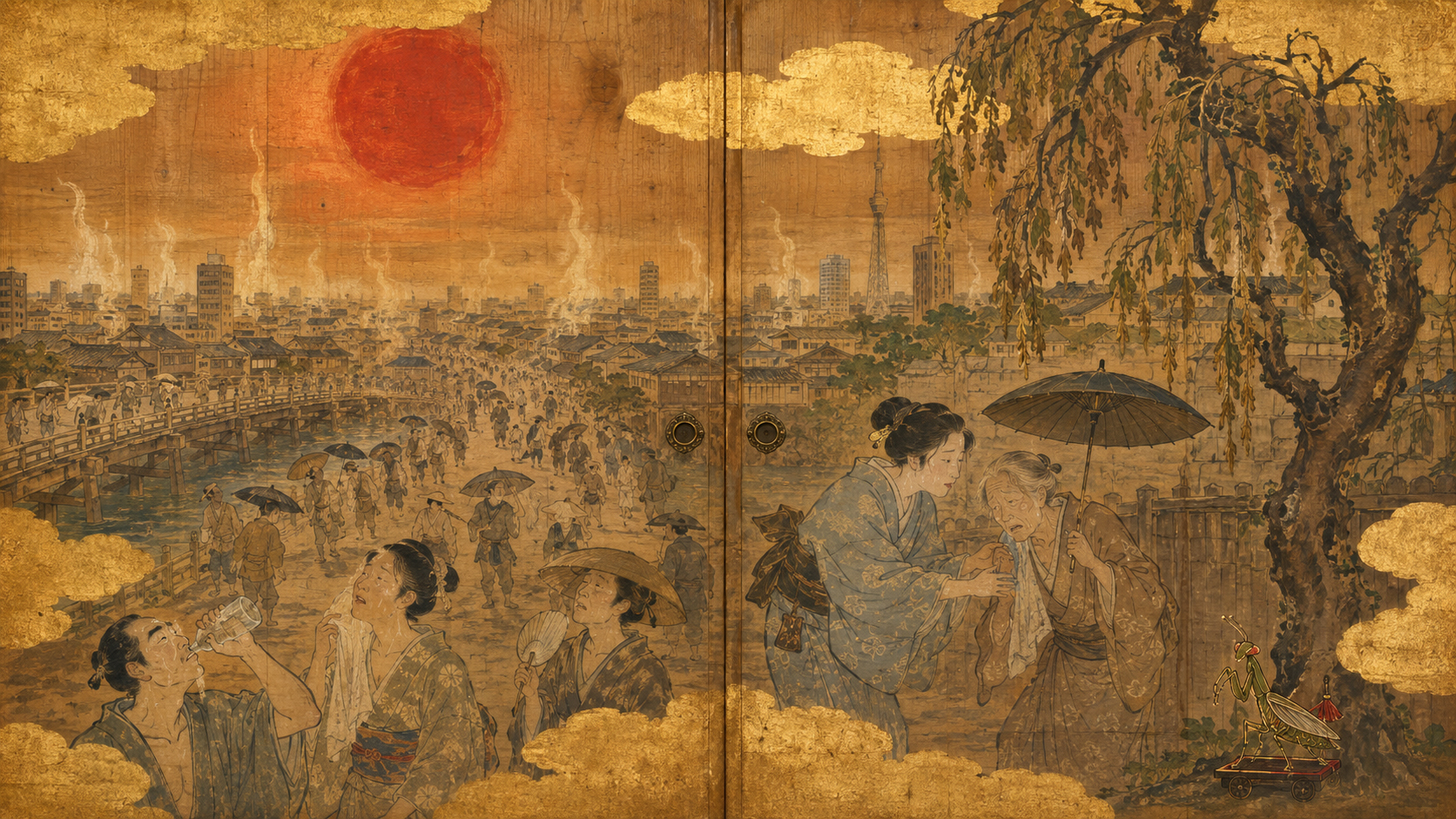
“More Than 100” Became 170 by Day's End
At 12:40 p.m. on July 14, the day's preliminary count crossed a symbolic threshold: 103 observation points had already reached 35°C, including Kuwana in Mie Prefecture at 37.5°C. That produced the early “more than 100” headline. Temperatures continued rising. JMA's completed daily table ultimately showed 170 extremely hot locations and 599 midsummer-day locations. The previous two days had each recorded 74 stations at 35°C or higher, so the geographic spread expanded sharply in a single day.
A “location” here is a weather station, not a municipality and not a measure of population exposure. The network is not distributed in proportion to population. Thus 170 divided by 914 means 18.6 percent of reporting stations, not 18.6 percent of Japan's residents. Conditions inside buildings, above asphalt, in factories and gymnasiums, or at stroller height can differ greatly from the official reading.
Japan's Heat Vocabulary: 25, 30, 35 and 40°C
| Japanese term | JMA definition | What it does not tell you |
|---|---|---|
| Natsubi (summer day) | Daily maximum of at least 25°C | Heat illness remains possible with humidity or exertion |
| Manatsubi (midsummer day) | Daily maximum of at least 30°C | The count includes hotter 35°C and 40°C days |
| Mōshobi (extremely hot day) | Daily maximum of at least 35°C | It is one peak value, not the duration of exposure |
| Kokushobi (brutally hot day) | Daily maximum of at least 40°C | Added to JMA's statistical display in 2026 |
| Nettaiya (tropical night) | Commonly, nighttime minimum of at least 25°C | A hot night blocks recovery before the next day |
Official air temperature is observed under standardized, shaded and ventilated conditions. A person beside black pavement, under a metal roof or on a windless building site receives much more radiant heat. Children and dogs are closer to hot ground. A shaded place with a sea breeze may impose a smaller burden at the same air temperature. Decisions based on the daily high alone miss these differences.
WBGT Asks Whether Sweat Can Do Its Job
The Wet Bulb Globe Temperature, or WBGT, combines humidity, solar and radiant heat, air temperature and wind. Outdoors, it is calculated as 0.7 × natural wet-bulb temperature + 0.2 × globe temperature + 0.1 × dry-bulb temperature. The wet-bulb component receives 70 percent of the weight because evaporation of sweat is the body's main cooling mechanism. When humidity is high, sweat remains on the skin instead of carrying heat away.
Japan's heatstroke alert is issued when the forecast daily maximum WBGT is expected to reach 33 or higher at any information point within the forecast area. The Environment Ministry classifies WBGT 31 and above as “dangerous.” The Japan Sport Association says exercise should in principle stop at that level except in special circumstances, and that children in particular should stop.
| WBGT | Guide for daily life and exercise | What a manager should decide |
|---|---|---|
| Below 25 | Risk is not zero; check hydration, health and acclimatization | Keep measuring the environment |
| 25–28 | Caution; increase breaks during strenuous exercise | Manage new, older and medically vulnerable people individually |
| 28–31 | Severe caution; avoid strenuous and endurance exercise | Shorten exposure and require frequent rest and cooling |
| 31 or higher | Danger; stop exercise in principle | Cancel, postpone or move work and events |
Alert Versus Special Alert
The ordinary heatstroke alert began nationwide in 2021 and is announced jointly by the Environment Ministry and JMA at 5 p.m. on the previous day and 5 a.m. on the day itself. Following a 2023 amendment to the Climate Change Adaptation Act, Japan introduced a higher heatstroke special alert in 2024. It is intended for exceptionally severe, widespread danger—when every information point in a prefecture is forecast to have a next-day maximum WBGT of at least 35.
The special threshold is deliberately rare. Its absence does not mean conditions are safe. An ordinary alert already calls for moving into cool environments, checking on older people and children, and stopping exercise in places that cannot be cooled. Under the amended law, municipalities may designate cooling shelters that open during a special alert.
The Human Heat Balance—and Why Collapse Can Seem Sudden
The body produces heat through metabolism and muscle activity. It releases heat through skin blood flow, radiation, convection and evaporation of sweat. When the air or ground is hotter than the skin, humidity is high and wind is weak, those exits close one by one. The heart must send blood toward the skin while preserving pressure for the brain and muscles. Sweat removes both water and salt. Eventually circulation, the brain, kidneys, liver and clotting system can fail.
Early signs include dizziness, faintness, muscle pain or cramps and heavy sweating. Headache, nausea, exhaustion or impaired judgment signal a more serious stage. If a person is confused, unconscious, having a seizure, unable to drink independently or not improving with cooling, call 119. Heatstroke is a time-critical emergency. While waiting for an ambulance, move the person into air conditioning or shade, loosen clothing and continue cooling the neck, armpits and groin. Never force fluids on someone with impaired consciousness.
A Hot Night Carries Heat Debt into Tomorrow
A cool night allows core temperature, heart rate and dehydration to recover. Urban concrete and asphalt store daytime heat and release it after sunset. Street canyons reduce wind, while waste heat from air conditioners adds to the local load. Repeated humid tropical nights disturb sleep and leave the body carrying yesterday's heat debt into the following morning.
Cooling only in daytime is therefore insufficient. Check the room temperature and use air conditioning appropriately while sleeping. An upper floor, a west-facing room or the top floor of an old building can stay hotter than the outdoor air for hours. A fan helps sweat evaporate, but blowing extremely hot indoor air over the body is not enough. Combine it with air conditioning, shading and carefully timed ventilation.
Who Faces the Highest Risk?
Older adults may sense heat and thirst less clearly, sweat less effectively and have heart or kidney disease—or medications—that complicate temperature control. Infants have a larger surface area relative to body mass, warm quickly and cannot move or obtain water themselves. Pregnant people, people with chronic illness or disability, outdoor workers, athletes, people in heavy protective equipment and anyone not acclimatized to heat also face elevated risk.
Social circumstances create danger too: fear of electricity bills, broken cooling equipment in rental housing, living alone, losing wages by taking a break, or feeling unable to cancel a school activity. Heat illness is not merely a question of whether an individual carried a water bottle. It is also about housing, income, labor rights and whether someone checks in.
At Work, “Be Careful” Is Not a Safety System
In 2024, Japan recorded 1,257 occupational heat-illness cases involving death or at least four days away from work; 31 workers died. Construction and manufacturing together accounted for about 40 percent. Because serious cases often involved late discovery or delayed medical transport, revised occupational safety rules effective June 1, 2025 require employers supervising qualifying hot work to establish a system for early detection, define escalation and emergency procedures, and tell workers how to report symptoms.
Managers should measure WBGT at the actual site, schedule work-rest cycles, avoid lone working, and provide drinks, salt, cooling space, communications and a transport plan. Acclimatization takes several days and can take roughly two weeks. New workers, people returning from leave and everyone exposed immediately after the rainy season are especially vulnerable. “The worker said they were fine” is not a substitute for a system.
From 2018's “Disaster-Level” Heat to a 41.8°C Record
Japan has always had hot summers, but the frequency and scale have changed. During the July 2018 heat wave, Kumagaya reached a then-national record of 41.1°C, and JMA urged the public to regard the heat as a disaster. Hamamatsu tied 41.1°C in 2020. In 2025, Tamba in Hyogo Prefecture reached 41.2°C, then Isesaki in Gunma Prefecture set the current record of 41.8°C. Forty-degree days had become statistically important enough for JMA to add kokushobi, or “brutally hot day,” to its display in 2026.
The health toll has grown as well. Japan's Fire and Disaster Management Agency recorded 97,578 heat-illness ambulance transports in 2024, the most since national tabulation began in 2008. Final vital statistics from the health ministry show 2,160 heatstroke deaths that year, compared with 318 in 1995. These transport and mortality data cover different populations and definitions, so dividing one by the other does not produce a valid fatality rate.
One Day's Weather, a Century's Climate
The July 14 event had immediate meteorological causes: the Pacific high-pressure system, sunshine, descending air, regional winds and topography. It is not scientifically sound to attribute a single hot day to greenhouse gases alone. Climate change instead raises the platform on which heat waves occur. JMA finds that Japan's annual mean temperature rose at a rate of 1.44°C per century from 1898 through 2025; 2024, 2023 and 2025 had the three largest positive anomalies.
Even across 13 observation sites with relatively little urban influence, the annual number of 35°C days increased by 2.9 days per century from 1910 through 2025. The most recent 30-year period had about 4.2 times as many as the earliest 30 years. JMA projections indicate about 2.9 additional extremely hot days each year in a world with roughly 2°C of global warming and 17.5 additional days under a 4°C scenario. Emissions cuts limit how much more danger is added; adaptation protects people from heat already arriving. Japan needs both.
An Action Table for Homes, Schools and Travelers
| When | What to do |
|---|---|
| The night before | Check the next day's WBGT and alert, air conditioner, drinks, medication and contacts. Reschedule activity. |
| Morning | Check sleep, meals, urine color and health. Call an older relative or neighbor. Carry water. |
| Daytime | Move into air conditioning. Drink before thirst; replace salt after heavy sweating. Avoid being alone. |
| Sports or events | Measure on-site WBGT. At 31 or higher, stop in principle. Safety outranks tradition and schedules. |
| After returning | Do not dismiss headache, nausea or unusual fatigue. Cool, rehydrate and seek care if symptoms persist. |
| Night | Monitor the bedroom and cool it appropriately during sleep. Do not carry heat into tomorrow. |
Three Things to Remember
First, look beyond the forecast maximum: check the WBGT and temperature where you actually are. Second, if someone is confused, unable to drink or failing to improve with cooling, call 119 and keep cooling while help comes. Third, never leave the safety of an older person, child or outdoor worker entirely to their own self-assessment.
The 170 stations are not just red dots on a weather map. They are a signal to change school timetables, construction schedules, festivals, delivery routes, tourist plans, electricity support and welfare checks on people living alone. Treating heat as a disaster means abandoning tests of endurance and changing society's plans before the body reaches its limit.
Sources and Further Reading
- Japan Meteorological Agency: daily counts of midsummer, extremely hot and brutally hot locations — final July 14 count.
- Japan Weather Association: first day of 2026 with more than 100 extremely hot stations — midday report.
- Environment Ministry and JMA: Heatstroke Alert.
- Environment Ministry: how WBGT is observed and calculated.
- Environment Ministry: heat-illness first aid.
- Fire and Disaster Management Agency: heat-illness ambulance transports.
- Health Ministry: annual heatstroke deaths.
- Health Ministry: occupational heat casualties and the 2025 rule.
- Japan Sport Association: stop exercise in principle at WBGT 31 or higher.
- JMA: long-term change in Japan's annual mean temperature.
- JMA: long-term change in extremely hot days.
- JMA, Climate Change in Japan 2025: future extreme-temperature projections.
- World Health Organization: Climate Change, Heat and Health.