- An ordinary molecule and an extraordinary agricultural problem
- Why salts are so difficult for agriculture
- The scale of a slow-moving crisis
- The antioxidant machinery inside a leaf
- A connection between metabolism and gene regulation
- Nine years of Japanese research
- What the 2026 study adds
- Can a low-cost chemical become a low-cost farm technology?
- The experiments that would change the story
An ordinary molecule and an extraordinary agricultural problem
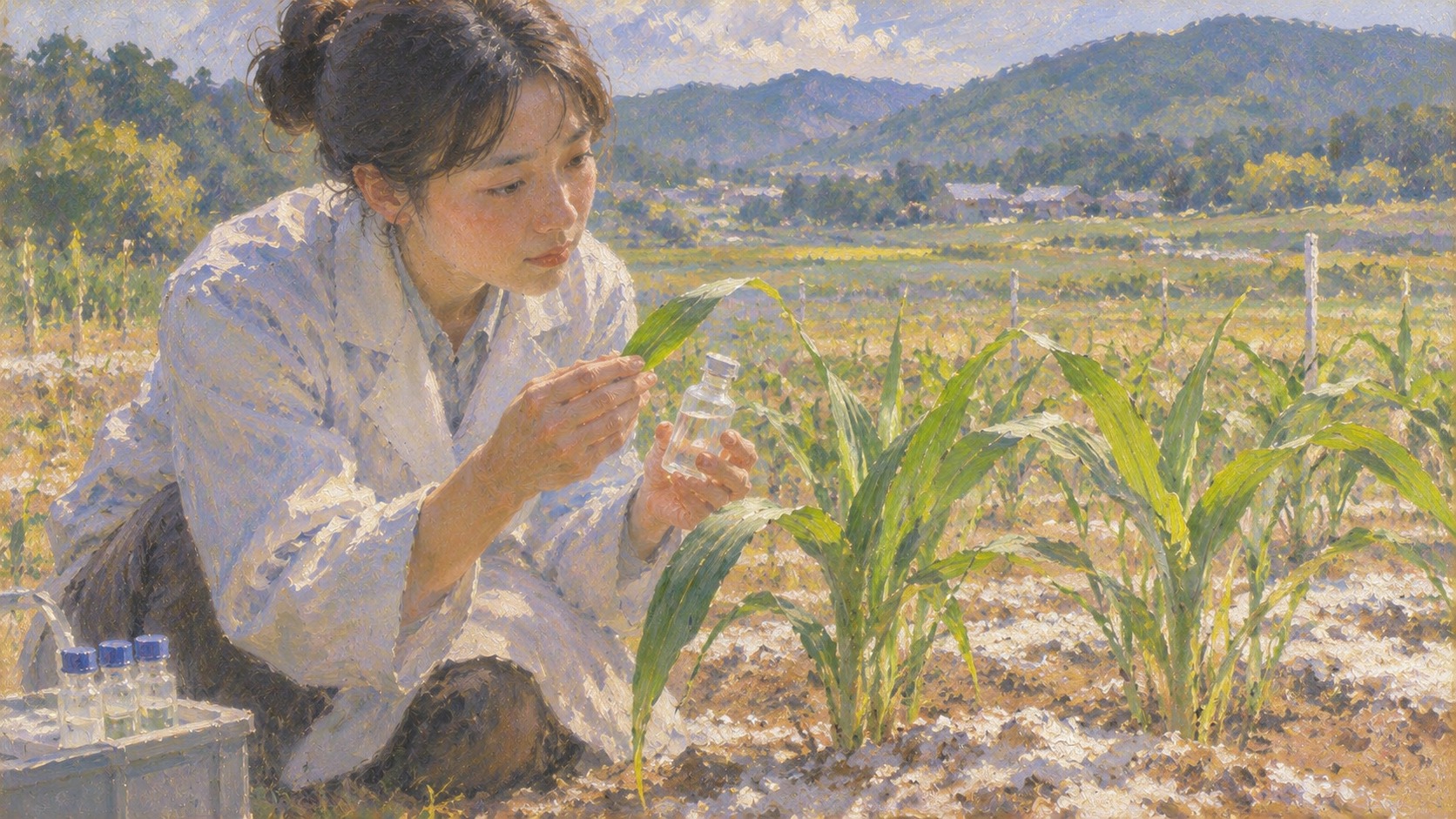
A plant growing in salty soil can suffer from a shortage of usable water even when the ground is moist. The apparent paradox is a consequence of the chemistry of water and dissolved salts. For farmers, it can mean poor establishment, damaged leaves and disappointing harvests. A Japanese-led research collaboration is investigating whether a familiar molecule can help plants cope with part of that burden: ethanol.
On November 27, Kindai University, RIKEN and Nagoya University announced a study identifying a regulatory pathway linked to salt tolerance in Arabidopsis seedlings. The accepted manuscript appeared in the Journal of Experimental Botany on November 13. Kota Urushihara is the first author and Kaori Sako, a Kindai lecturer specializing in plant molecular biology, is the corresponding author. The collaboration includes scientists affiliated with AIST and National Cheng Kung University in Taiwan. The immediate achievement is an explanation of plant biology, not a new agricultural product.
Why salts are so difficult for agriculture
Salinity creates at least two overlapping problems. Dissolved salts lower the availability of water to roots, slowing growth. As exposure continues, ions can accumulate in tissues and interfere with cellular functions. Plants differ in how effectively they exclude ions, store them in less vulnerable cellular compartments or adjust their internal water relations. A crop that handles one aspect of salinity well may remain vulnerable to another.
These problems can build over decades. Irrigation delivers dissolved minerals along with water. Evaporation leaves much of that mineral load behind, and inadequate drainage can prevent its removal. Coastal inundation and seawater intrusion introduce additional hazards. The amount of salt present, its composition, the soil structure and local water availability all influence which intervention makes sense.
The scale of a slow-moving crisis
FAO’s 2024 global assessment estimates that about 1.381 billion hectares, or 10.7 percent of global land, are affected by salts. This figure describes land of multiple types, not exclusively farmland. It encompasses problems that differ considerably between regions, including soils dominated by soluble salts and soils affected by excess exchangeable sodium. The distinction matters because a treatment that assists a plant does not necessarily repair soil structure.
Japan has its own experience of sudden salinization. The agriculture ministry recorded 21,480 hectares of farmland damaged by the 2011 tsunami. Recovery involved drainage, salt removal and repairs to agricultural infrastructure. The history illustrates the importance of restoring the environment in which crops grow. A chemical treatment that improves tolerance would still have to work alongside these physical measures.
The antioxidant machinery inside a leaf
Reactive oxygen species are not simply toxins. Plants use these reactive molecules in signaling, but excessive production can disrupt cellular structures. One important enzyme, superoxide dismutase, converts superoxide into oxygen and hydrogen peroxide. Other systems then process the peroxide. Protection depends on the balance between these reactions rather than on eliminating every reactive molecule.
The new paper identifies copper/zinc superoxide dismutase as part of the ethanol response. CSD1 and CSD2 encode forms of the enzyme, while CCS encodes a protein involved in supplying its copper cofactor. The study reports higher enzyme activity after ethanol exposure. Plants with defective CSD1 or CCS remained vulnerable and accumulated superoxide despite treatment. These comparisons make the antioxidant pathway more than a simple correlation with healthy-looking leaves.
A connection between metabolism and gene regulation
A gene is not always used at the same rate. DNA in the nucleus is associated with histone proteins, and chemical changes to histones can influence the accessibility and activity of genes. The researchers investigated telomere repeat binding proteins, known as TRBs, as regulators in this system. Chromatin immunoprecipitation associated TRB3 with the CSD1, CSD2 and CCS regions. A particular histone modification, H4K5 acetylation, increased there after ethanol exposure.
This raises a question about how a change in metabolism may influence chromatin. Acetyl-CoA produced during ethanol metabolism is a possible contributor, but the observed increase in acetylation does not establish a complete causal chain. The working model is that chromatin-associated regulation helps antioxidant genes respond to treatment. It is not evidence that ethanol edits DNA or creates permanently inherited salt tolerance.
Nine years of Japanese research
The story began before the current paper. A 2017 study by researchers associated with RIKEN and partner institutions examined Arabidopsis and rice. The authors linked improved tolerance under experimental salt exposure with ascorbate peroxidase activity and lower oxidative damage. In rice seedlings, treated leaves retained more green coloration under the particular laboratory conditions. That was an observation in young plants, not a harvest trial.
Another RIKEN announcement in November 2017 examined histone deacetylases and plant salt tolerance. The group’s 2022 drought research pursued a different but related question. It linked ethanol exposure to water conservation through stomatal closure and changes in metabolism, with experiments also involving rice and wheat. Those investigations illustrate why the team has continued to explore inexpensive compounds as possible tools for stress management. Results for drought cannot simply be transferred to salinity.
What the 2026 study adds
The current advance is in explaining which cellular machinery participates in the response. The use of expression measurements, enzyme activity tests, mutant plants and chromatin assays provides multiple types of evidence. The experiments address distinct questions: whether genes respond, whether the enzymes work differently, whether loss of a gene weakens the response and whether a regulatory protein associates with particular genomic regions.
This is important because an agricultural treatment must eventually be predictable. If scientists know which pathways contribute to protection, they can investigate whether crops possess comparable regulatory systems, whether different varieties respond differently and whether the response can be combined with conventional breeding. The findings are a starting point for those investigations, not their conclusion.
Can a low-cost chemical become a low-cost farm technology?
Ethanol is widely manufactured and distributed. That availability makes it an interesting candidate for research, especially where sophisticated inputs may be difficult to procure. In Kindai’s announcement, Sako identifies an applied research effort called EGAO, short for Ethanol-based Global Agricultural Optimization. It is an effort toward practical implementation, not proof that a validated farm treatment is already on sale.
A farmer pays for more than the molecule. Transport, formulation, application equipment, labor, storage and safe handling all influence cost. Ethanol can be harmful at unsuitable concentrations and may interact with soil organisms and other agricultural inputs. A practical intervention must deliver a reliable gain in harvest value under the conditions in which it is used. This article is not an instruction to apply alcohol or disinfectants to plants.
The experiments that would change the story
The next phase of evidence would ideally include controlled greenhouse studies in crops followed by replicated field trials across seasons, soils and salinity levels. Researchers would need to measure yield, quality, plant survival and any unintended effects, rather than rely exclusively on a short-term molecular response. The dose, timing and method of delivery would have to be optimized and assessed for safety and regulatory compliance.
A useful economic comparison would test the new approach against existing measures and in combination with them: suitable crop varieties, drainage, irrigation scheduling and soil management. A molecular discovery becomes a farming innovation when it can make a measurable, repeatable difference under real conditions. The Japanese collaboration has opened an intriguing avenue toward that goal by showing how an accessible compound can engage a plant’s own defenses.
Primary sources and references
- RIKEN — November 27 announcement (Japanese)
- Nagoya University — institutional research release (Japanese)
- 2026 original research, accepted manuscript
- Kindai University — detailed research release (Japanese)
- 2017 original salt-tolerance study
- RIKEN — histone deacetylases and salt tolerance (Japanese)
- RIKEN — 2022 drought research (Japanese)
- FAO — Global Status of Salt-Affected Soils (2024)
- Munns and Tester — Mechanisms of Salinity Tolerance (2008)
- Japan agriculture ministry — tsunami recovery (Japanese)
- Kindai University — Kaori Sako faculty profile (Japanese)
- RIKEN — background of ethanol research
- FAO — 2024 assessment announcement