- A successful arrival, not a flawless manoeuvre
- Why falling toward the Sun is so difficult
- From temporary capture to a lasting orbit
- A half-century of Mercury exploration
- Japan’s Mio: a ship’s wake in the solar wind
- A small planet with surprisingly large questions
- Engineering for an extreme environment
- What comes after arrival
A successful arrival, not a flawless manoeuvre
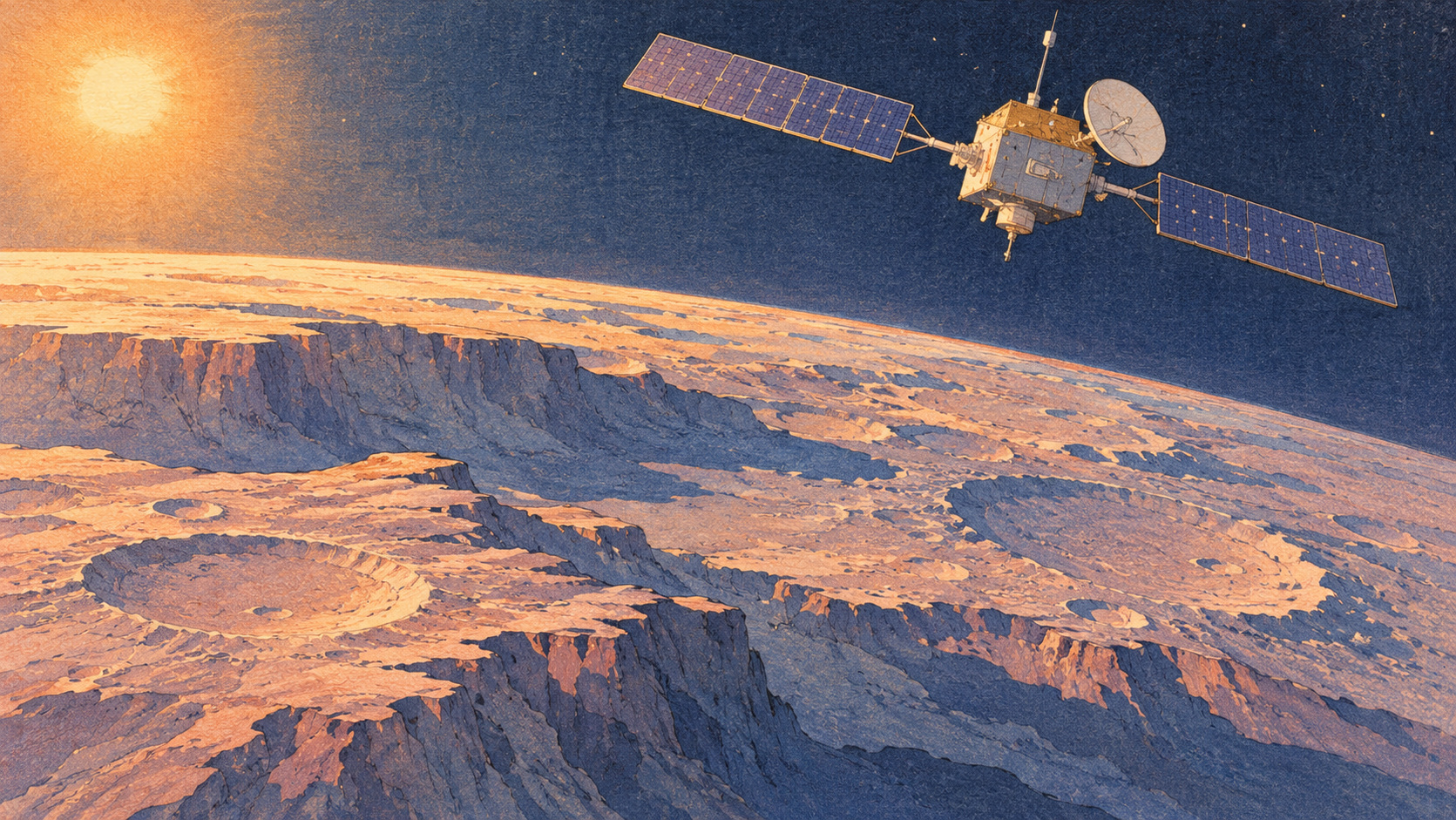
For eight years, BepiColombo had been shedding the energy that stood between it and Mercury. In the early hours of November 22 in Japan, its mission entered a decisive new phase. The European Space Agency (ESA) confirmed in an operational update dated November 23 that the European-Japanese spacecraft had secured a stable orbit, even though its first major braking manoeuvre at the planet ended early.
The operation began at 03:24 Japan Standard Time (18:24 UTC on November 21). A planned interruption in radio contact meant that controllers initially had to rely on the spacecraft's autonomous execution of previously uploaded commands. When communications resumed, the telemetry indicated that the spacecraft had switched to a protective safe mode. The intended 37-minute firing had delivered about 77 percent of the target velocity change. ESA and spacecraft manufacturer Airbus traced the interruption to software associated with orientation guidance and engine control.
The orbit was subsequently determined to have a period of approximately 75 hours, longer than the intended 58 hours. ESA says its engineers have adjusted the remaining manoeuvres without increasing their number. The precise underlying software defect remains under investigation. The achievement is therefore neither a failure nor an entirely nominal arrival: the spacecraft is gravitationally bound to Mercury, but important commissioning and deployment operations still lie ahead.
Why falling toward the Sun is so difficult
The paradox of Mercury exploration is that moving inward through the Solar System does not simply mean pointing a rocket toward the Sun. A spacecraft leaving Earth already travels around the Sun with Earth. To enter a smaller heliocentric orbit it must lose orbital energy. As it descends into the Sun's gravitational well, it tends to accelerate; unless the trajectory is carefully controlled, it encounters Mercury at a relative speed too high for the small planet to retain it.
Chemical rockets can change velocity quickly, but carrying enough propellant for the entire journey would impose a severe mass penalty. Electric propulsion provides a different compromise: it accelerates a small quantity of propellant to high exhaust velocity, producing modest thrust over long periods. BepiColombo used solar-powered electric propulsion during its cruise, alongside encounters with moving planets that altered its trajectory without requiring equivalent onboard fuel.
The nine gravity assists comprised one encounter with Earth, two with Venus and six with Mercury. Each encounter was designed as part of a chain rather than an isolated shortcut. A spacecraft can exchange orbital energy with a planet through gravity; the effect depends on the approach geometry. In this mission the goal was to remove energy and arrange a low-speed arrival, not to reach the destination in the shortest possible time.
From temporary capture to a lasting orbit
BepiColombo's trajectory exploited a region in which the combined gravity of the Sun and Mercury permits temporary capture at relatively low approach speed. ESA identifies this as the first use of weak stability capture for an interplanetary orbital arrival. The method is not a substitute for propulsion: without further intervention, the initial gravitational binding would not necessarily persist.
Once the cruise propulsion module was released on September 3, the European orbiter's chemical propulsion system took responsibility for the remaining flight corrections. Repeated firings close to Mercury allow the mission to reduce orbital energy efficiently and to assess the resulting trajectory before committing to the next manoeuvre. This architecture is particularly useful when a burn differs from its planned outcome.
The principle is important beyond this mission. A deep-space vehicle cannot be repaired by a technician standing beside it, and a command sent from Earth cannot instantly correct an unexpected event. Designing a sequence with room for adjustment can be as consequential as designing its individual components.
A half-century of Mercury exploration
Mercury was known to ancient skywatchers, yet it remained difficult to study even with telescopes because it appears close to the Sun. The first robotic visit came in 1974, when NASA's Mariner 10 passed the planet after encountering Venus. It returned in September 1974 and March 1975, revealing a heavily cratered surface and evidence of a planetary magnetic field. It was a flyby mission, not an orbiter.
Italian mathematician and engineer Giuseppe Colombo (1920–1984), known as Bepi, helped develop the trajectory that made repeated encounters possible. He also explained Mercury's unusual spin-orbit resonance: the planet rotates three times during two revolutions around the Sun. The present mission honors his contribution.
NASA's MESSENGER, launched in 2004, became the first Mercury orbiter in 2011 and operated until 2015. Its measurements transformed knowledge of the planet's composition, geological evolution and polar ice deposits. Yet a single spacecraft has limitations when trying to determine whether a changing magnetic measurement reflects movement through space or an actual change in the environment. BepiColombo's two-observer architecture addresses that limitation.
Japan’s Mio: a ship’s wake in the solar wind
Japan began considering a Mercury mission in 1997, more than two decades before the October 2018 launch from French Guiana. Its contribution is the Mercury Magnetospheric Orbiter, or MMO, formally named Mio (みお). The name evokes a navigable channel or the trace left by a vessel. JAXA also connects it with miotsukushi, historical markers used to guide boats, and with the wordplay of classical Japanese poetry suggesting wholehearted devotion.
Mio is designed to investigate the charged-particle environment and magnetic forces surrounding Mercury. Its instruments examine magnetic fields, charged and neutral particles, plasma waves, dust and the distribution of sodium in the planet's tenuous outer atmosphere. These measurements concern a region that is strongly influenced by the solar wind, a stream of particles released by the Sun.
ESA's Mercury Planetary Orbiter (MPO), in contrast, concentrates heavily on the planet itself: its surface, chemistry, shape and internal structure. Different orbital paths allow the two spacecraft to record complementary observations. A simultaneous measurement at two locations can provide information that repeated observations at one location cannot, particularly when the solar environment changes rapidly.
A small planet with surprisingly large questions
Mercury is an unusual laboratory for planetary evolution. Its metallic core occupies roughly 85 percent of its radius, according to NASA's description of the planet's structure. How such a metal-rich world formed remains unsettled. Models involving early collisions, the composition of the original building materials and the thermal history of the young Solar System must contend with measurements of volatile elements that survived on the surface.
Its magnetic field is equally intriguing. Mercury is much smaller than Earth, yet it retains an internally generated global field. A partially liquid, electrically conducting interior is implicated, but its precise structure and the processes that maintain the field are still scientific questions. Combining field measurements with observations of gravity, shape and tidal deformation can constrain models of the interior.
The surface presents a different puzzle: shallow depressions known as hollows may record the loss of volatile material. Comparing new observations with MESSENGER-era images could help determine whether these features have evolved. That is a question to be tested, not a discovery already made by the new mission. Likewise, although previous observations strongly support the presence of polar water ice, its distribution, origin and history warrant further study.
Engineering for an extreme environment
Mercury's proximity to the Sun creates demanding conditions for thermal control. Its surface experiences dramatic temperature differences, while a spacecraft must contend with sunlight, radiation emitted by the planet and changing illumination as it moves along its orbit. Heat management involves controlling both incoming energy and the routes through which excess heat can escape. JAXA's spacecraft incorporates measures to improve heat rejection; during the cruise it has also been protected by a dedicated sunshield.
The mission's earlier difficulties illustrate why resilience matters. In 2024 a power-delivery problem on the cruise module prevented full electric thrust. Engineers redesigned the trajectory rather than abandoning the mission, moving the planned arrival from 2025 to late 2026. This earlier issue is distinct from the software anomaly encountered during the November 2026 braking operation.
The spacecraft's present condition demonstrates the value of fault protection, but safety mode is not itself evidence that the underlying fault has been permanently resolved. Subsequent operations will test whether the revised plan continues to work as intended.
What comes after arrival
The spacecraft are still joined. The next planned milestone is their separation on December 9 in European mission reporting, corresponding to December 10 in Japan. The protective shield associated with Mio is scheduled to be discarded from MPO on December 16 in ESA's published timeline. Further adjustments should bring MPO to its intended scientific orbit in March 2027, with the routine scientific phase planned to begin in April.
These dates describe the agencies' current schedule, not completed achievements. The scientific instruments must be checked and calibrated before observations can be interpreted with confidence. The two-orbiter arrangement is expected to make Mercury the subject of a new kind of coordinated investigation, with measurements of the planet and its environment made together.
The mission's significance lies not merely in reaching a remote destination. Mercury is an accessible example of the processes that shape rocky planets near a star, and the collaboration brings together different engineering traditions and scientific priorities. For Japan, Mio is a chance to study a magnetic environment radically different from Earth's. The eight-year voyage has opened the door to those questions; answering them is the next voyage.
Primary sources and references
- ESA — 23 November operational update
- ESA — arrival schedule
- ESA — mission timeline
- JAXA — 国際水星探査計画
- ISAS — 水星磁気圏探査機「みお」
- JAXA — 「みお」の愛称選定理由
- JAXA — ミッションの背景
- ESA — Why does it take so long to get to Mercury?
- ESA — 2024 trajectory revision
- NASA — Mariner 10
- NASA — BepiColombo and previous missions
- NASA — Mercury facts
- ESA — Mercury science questions