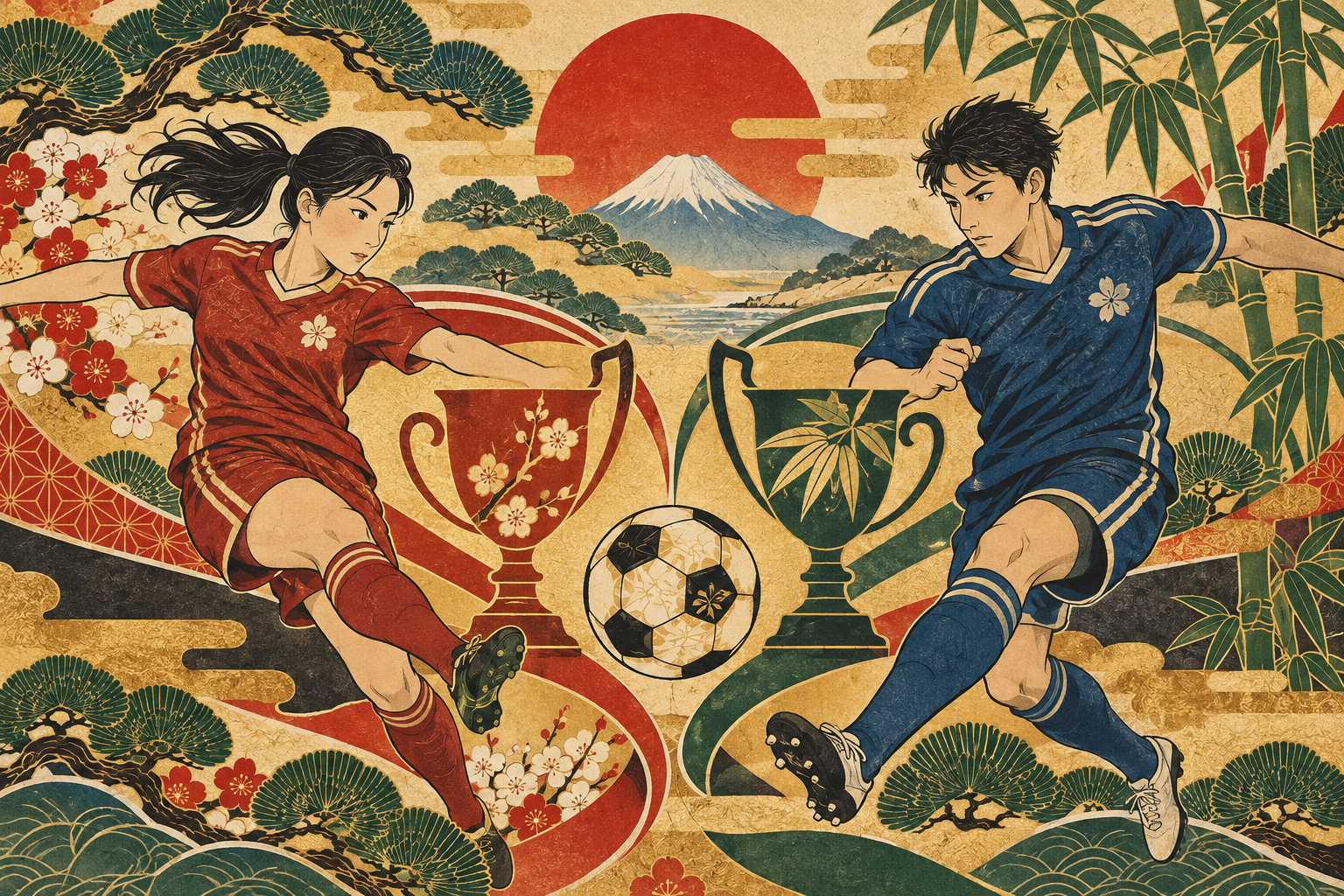
Japan’s football year will open with two national cup finals in one stadium. The Japan Football Association has scheduled the Emperor’s Cup and Empress’s Cup deciders for January 1, 2027, at MUFG Stadium, the National Stadium in Tokyo. Announced on September 18, the arrangement reunites the men’s and women’s finals on New Year’s Day for the first time in 15 years.[1][2]
The date carries an appeal beyond convenience. A national cup gathers clubs from different levels of the game into a single elimination tournament. Bringing the two finals together offers a concentrated view of that wider football landscape: professional teams, regional representatives and the routes connecting them. Whether the occasion creates lasting audiences will depend on what follows the celebrations.
What is returning—and what already returned
Three dates clarify the announcement. The last shared New Year’s Day finals were played on January 1, 2012, concluding the competitions designated as the 2011 editions. The men’s final most recently took place on New Year’s Day in 2021. The women’s final, meanwhile, was held at the National Stadium on January 1, 2026. The coming occasion therefore marks a six-year return for the men, a second successive New Year’s final at the stadium for the women, and a 15-year reunion for the two competitions.[1]
The edition numbers are the 106th Emperor’s Cup and the 48th Empress’s Cup. Both belong to the 2026 competition year, although their champions will be crowned in 2027. That distinction also explains why the JFA describes the previous joint occasion as the 2011 tournament while the actual matches occurred in 2012. Its historical records list FC Tokyo and INAC Kobe Leonessa as the respective winners of those editions.[1][5][6]
A tradition built over time
The Emperor’s Cup predates the New Year’s custom by decades. Its first edition was held in November 1921, shortly after the establishment of the organisation that became the JFA. Four teams took part, with Tokyo Shukyu-dan winning. The association traces the competition’s origins to a silver cup donated by England’s Football Association in 1919, which helped encourage the formation of Japan’s national governing body.[4][7]
The imperial trophy and the familiar date were later developments. The Emperor’s Cup began to be awarded to the national championship winner in 1951. The final moved to New Year’s Day in 1969, according to the JFA’s historical timeline. What now feels like an inherited seasonal ritual was a choice that acquired meaning through repetition.[4]
Other changes shaped who could pursue that trophy. The competition became open in 1972. In 1996, representation through nine regions gave way to representatives from all 47 prefectures. The cup’s national character consequently concerns participation as well as the prestige of its last match: local qualifying routes help connect a major final with football played far from its venue.[4]
Recent history also resists a simple story of an unbroken January tradition. The JFA’s retrospective schedule includes Emperor’s Cup finals in November and December. A return to January 1 restores a recognisable occasion, but the date itself does not establish every administrative reason behind the change.[1]
The women’s competition brings its own history
The women’s national championship has a substantial history of its own. The JFA’s list of winners begins with the 1979 edition, won by F.C. Jinnan. Its most recent completed edition, the 47th, was won by Sanfrecce Hiroshima Regina. The shared stadium will host the culmination of that continuing competition, with its own clubs, supporters and sporting stakes.[6]
In the September announcement, the JFA president described the previous women’s final, staged independently at the National Stadium on New Year’s Day, as evidence of the game’s potential. He presented the combined occasion as a way to introduce more people to women’s football, linking it to the association’s women’s strategy for 2026–2031 and its ambition to increase participation, viewing and support alongside national-team development.[2]
That is an institutional objective rather than a measured outcome. A prominent date can help people encounter a competition; it cannot ensure that they return. A more revealing test will be whether viewers learn which clubs the players represent, follow subsequent fixtures and attend matches closer to home. The shared occasion creates an opportunity to build that connection.
How 48 women’s teams reach the national stage
The Empress’s Cup field consists of 12 WE League teams, 12 teams from the first division of the Nadeshiko League, and 24 representatives selected through Japan’s nine regional associations. The 48-team structure places the leading league clubs within a wider national contest. WE League teams enter in the second round.[2][8]
The opening round is scheduled for November 14–15. Its venues include Iwagin Stadium in Morioka, J-Village Stadium in Fukushima Prefecture and Charme Stadium in Takahashi, Okayama Prefecture. The semifinals will be played on December 20 at Sanga Stadium by KYOCERA in Kameoka, Kyoto Prefecture. Tokyo is the destination of a tournament whose earlier stages take place across the country.[8]
For a prospective spectator, one practical detail deserves attention: admission is free from the first round through the quarterfinals. The semifinals and final are paid events. Someone attracted by the New Year’s announcement can therefore begin following the competition at an earlier match, rather than waiting for the televised conclusion.[8]
| Stage | Empress’s Cup | Emperor’s Cup |
|---|---|---|
| Last 16 | December 6, 2026 | December 9, 2026 |
| Quarterfinals | December 13 | December 23 |
| Semifinals | December 20 | December 27 |
| Final | January 1, 2027 | January 1, 2027 |
The women’s last-16 stage is officially designated the third round. Dates are from the JFA competition regulations.[3][8]
The men’s competition and a compressed finish
The Emperor’s Cup has 88 teams: 20 from J1, 20 from J2, the University of Tsukuba as the amateur seeded entry, and the 47 prefectural representatives. Its mix of professional and amateur entrants is a present-day mechanism, not simply a historical ideal.[3]
The closing schedule is concentrated in December. The round of 16 takes place on December 9, followed by quarterfinals on December 23 and semifinals on December 27. The finalists then have five days between the semifinal date and January 1. The corresponding interval in the women’s tournament is 12 days.[3][8]
Those gaps do not, by themselves, predict fatigue or determine who will win. They do make recovery and selection useful questions for spectators to follow as the draw narrows. A final is experienced as a single decisive match, but the teams arriving there carry the consequences of the preceding rounds.
For newcomers, the knockout format provides a straightforward point of entry: each tie decides who continues. The sporting interest can come from an established club defending its status, a lower-ranked opponent extending an unexpected run, or a team finding a different route to success from its league campaign. Those are possibilities inherent in the format, not predictions about this year’s finalists.
One broadcast occasion, two sporting stories
Both finals are to be broadcast live on NHK General TV, with simultaneous and catch-up distribution planned through NHK ONE. That extends the occasion beyond the stadium to households spending the holiday elsewhere in Japan.[1]
Shared exposure matters most when each competition remains intelligible on its own terms. Viewers need to know how the finalists qualified, which opponents they overcame and where their clubs play during the rest of the season. Those details give an unfamiliar team a place in a spectator’s mental map. They also offer a next step after the trophy presentation.
The same principle applies to assessing the arrangement. A prominent holiday and a national venue are concrete achievements in scheduling. Increased long-term attendance, broader participation or stronger support would be further outcomes requiring evidence. The announcement should be read as the opening of that possibility.
January 1, 2027, will draw on memories of a familiar football holiday while introducing a shared occasion to people too young to remember the last one. Its lasting value may lie in the matches it encourages them to watch afterward: another cup round, a local league fixture, or a women’s club they first noticed on New Year’s Day. Two champions will finish their journeys at the National Stadium. For some of their audience, following Japanese club football could begin there.
Sources and methodology
Schedules, official competition names, venues and entry structures were checked against Japanese JFA announcements and regulations; history was checked against JFA records. The president’s statement is paraphrased. Discussion of audience development and viewing perspectives is this article’s analysis.
- JFA: joint New Year’s finals announcement and historical dates, September 18, 2026
- JFA: 48th Empress’s Cup schedule, venues and president’s statement, September 18, 2026
- JFA: 106th Emperor’s Cup competition regulations
- JFA: Emperor’s Cup historical timeline
- JFA: Emperor’s Cup past winners
- JFA: women’s national championship and Empress’s Cup past winners
- JFA: Emperor’s Cup origins and trophies
- JFA: 48th Empress’s Cup regulations, format and admission categories