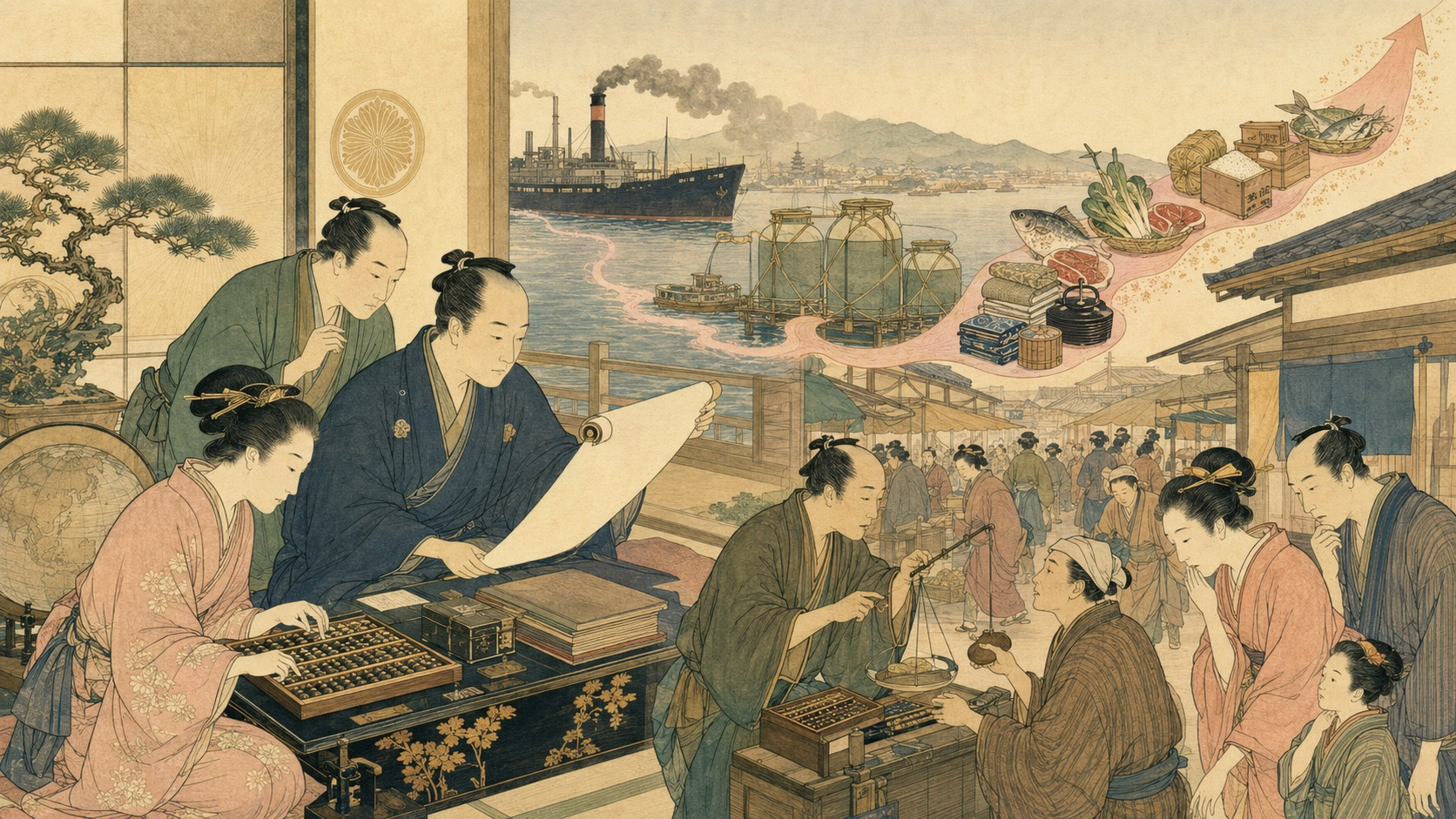
Raising a price was once the last thing a Japanese company wanted to do. It would shrink the package, replace the product, pressure a supplier or sacrifice its margin before changing the number on the shelf. Nearly three decades of low growth and deflation taught consumers and executives the same social rule: prices do not rise. Japan’s 2026 Annual Report on the Japanese Economy and Public Finance, released by the Cabinet Office on July 24, describes a country in which that rule is quietly—and broadly—breaking down.
The report’s subtitle is “Issues for a Full-Fledged Transition to a Growth-Oriented Economy.” It judges the recovery to be continuing gradually, supported by near-record corporate earnings and firm employment and income. But the escalation of Middle East tensions from late February drove up oil, naphtha and liquefied natural gas. Those costs are passing from import prices into domestic corporate prices and, with a lag, into consumer prices. In both basic-material and processing industries, purchase-price and sales-price assessments climbed more sharply than they did in the 2021–22 shock. Large companies and small ones are becoming readier to protect their margins by changing what customers pay.
That is not the same as saying Japan has entered uncontrolled inflation. Government relief held the all-item consumer-price increase to 1.5 percent in May and 1.7 percent in June. The Cabinet Office estimated May inflation at 2.8 percent after removing the effects of policy support. The white paper’s deeper message is that a quiet headline can coexist with a wider change underneath: costs are being passed on, wage costs are entering service prices and expectations are settling above the old deflationary norm. Whether that becomes a desirable wage-price cycle or merely a loss of purchasing power and national income to overseas energy producers remains unresolved.
The pipeline the white paper sees
Inflation is not one number. It is a route with time lags. Oil, gas, grain and metals first rise in world markets. A weaker yen magnifies the increase in import prices. The shock then reaches petroleum products, chemicals, pulp and paper, packaging, electricity and freight. Manufacturers, wholesalers, retailers and restaurants reset their selling prices. Only at the end does a household see the change in gasoline, food, delivery, hotel rooms, meals and repair bills.
| Stage | What appeared in 2026 | Why it matters |
|---|---|---|
| World markets | Benchmark crude prices roughly doubled at one point after the Middle East escalation; Dubai crude briefly approached $170 a barrel. Naphtha rose about 1.9 times and LNG about 2.1 times. | Energy Japan cannot produce domestically worsens its terms of trade and transfers income abroad. |
| Import and corporate prices | Purchase costs surged for petroleum and coal products, chemicals, and pulp and paper; pressure spread through processing sectors. | A firm that cannot pass on costs loses its margin. One that can pass them on reduces customers’ real purchasing power. |
| Retail goods | Among reasons for 2026 food increases, packaging materials showed the largest rise in citation versus 2025; labor costs also became more prominent. | Price increases are no longer explained by one raw material alone but by several overlapping costs. |
| Services | Prices in labor-intensive services have generally risen 2–3 percent since 2023. | Domestic wages, not only imported goods, are becoming part of the inflation process. |
| Expectations | Firms expected general prices to rise 2.7 percent in one year and 2.6 percent over both three and five years. | The assumption that prices will rise begins to enter contracts, wage talks and pricing plans. |
The report focuses on a pass-through diffusion index derived from the Bank of Japan’s Tankan survey: the sales-price judgment minus the purchase-price judgment. When the gap becomes less negative, firms may be recovering an ability to transfer input inflation to customers. In 2026, sales and purchase assessments moved together more forcefully than in 2021 across materials and processing industries and across company sizes. That recovery of pricing power is more structural than any single monthly CPI reading.
The Middle East shock: secure supply, insecure price
The latest disruption exposes the vulnerability that has shadowed Japan since the 1970s. The country imports almost all its crude oil and remains heavily dependent on the Middle East. After tensions intensified at the end of February 2026, Dubai crude briefly climbed toward $170 a barrel. Naphtha, the feedstock of the petrochemical chain, and the LNG and coal used for power generation also jumped. Tankers could arrive and the invoice could still become punishing.
The government and industry moved against physical scarcity. Japan held roughly 200 days of oil reserves on June 28. The share of replacement procurement secured rose from 25 percent in April to 60 percent in May, 80 percent in June and nearly 100 percent in July. Purchases from the United States exceeded ten times the volume of a normal month a year earlier. These buffers explain why the white paper judged the real-economy damage to be contained as of July.
Reserves and diversification cannot erase the world price. They solve a quantity problem, not a terms-of-trade problem. Prices of domestic oil and chemical products rose sharply, and the white paper expects higher import and corporate prices to pressure consumer prices “for some time.” Subsidies can delay the bill and flatten its peak. They cannot make the cost borne by an importing nation disappear.
Beneath the quiet 1.7 percent headline
National CPI data released by the Statistics Bureau on July 24 put June all-item inflation at 1.7 percent. The index excluding fresh food rose 1.6 percent, while the index excluding fresh food and energy increased 1.7 percent. Seen in isolation, rates below the Bank of Japan’s 2 percent target suggest inflation has faded.
But fuel, electricity and gas relief has lowered the displayed energy prices. For May—the latest month incorporated into much of the white paper—the all-item rate was 1.5 percent, the fresh-food-excluding rate 1.4 percent and the measure excluding fresh food and energy 1.8 percent. The Cabinet Office estimated that all-item inflation would have been 2.8 percent without the policy measures. “Inflation in the ones” and “inflation near three” can therefore describe the same economy, depending on whether the analyst is measuring the bill households paid or the underlying price before relief.
The relief has real value. It protects households and small businesses from a sudden shock and buys time for wages and contracts to adjust. But prolonged, universal subsidies enlarge the fiscal bill, weaken incentives to conserve energy and obscure the underlying pressure. The white paper’s practical implication is not to ignore headline CPI; it is to read it alongside policy-adjusted inflation, corporate prices, service prices and expectations.
When expectations make prices real
Tomorrow’s prices are not determined only by yesterday’s costs. They depend on what a manager expects to pay six months from now, what a labor union estimates next year’s living expenses will be and how landlords or contractors renew agreements. The white paper reports business inflation expectations of 2.7 percent one year ahead and 2.6 percent at both three and five years. Firms expected their own selling prices to increase 3.7 percent over the next year, a cumulative 5.1 percent over three years and 6.1 percent over five.
Household responses were far higher. In the Bank of Japan’s survey, the mean expected price increase over the next year was around 12 percent and the median around 10 percent. That is not a professional macroeconomic forecast. It is a perception shaped by frequent, salient purchases—food, gasoline and utility bills—and it records genuine pain. The market break-even inflation rate, by contrast, was around 2.1 percent. The three measures differ in level, but all show that the old presumption of endlessly flat or falling prices has retreated.
Expectations can reinforce themselves. Firms anticipating higher costs move first; employees demand compensation; labor costs return through service prices. If the process becomes unstable, however, households rush purchases before incomes catch up and long-term interest rates rise. The policy task is not to return expectations to zero. It is to anchor them near 2 percent.
Has the wage-price cycle become “good” inflation?
Japan’s 2026 spring wage settlements maintained an increase of about 5 percent including regular raises and roughly 3.5 percent in base pay. Hourly pay for short-time workers rose 6.18 percent. Real wages were 1.7 percent higher in May than a year earlier, a hopeful sign for the government’s goal of wage growth exceeding inflation. The 2–3 percent rise in labor-intensive service prices since 2023 also suggests that inflation has broadened beyond imported goods.
A passing grade for the virtuous cycle would still be premature. Pay varies by monthly salary, bonus, hours, employment status and company size. CPI swings when subsidies start and stop. One positive month for real pay does not recover all the purchasing power lost to the cumulative price rise since 2022. Retired households do not directly receive a spring wage settlement, and pension adjustments arrive with a lag.
The cycle the white paper wants is one in which firms lift productivity, share earnings through wages, households turn income into demand and demand supports investment. Imported costs can create the opposite loop: firms transfer the bill to defend margins and households respond by cutting consumption. Both stories are visible in Japan today. The contest between them is the central drama of the report.
Small companies can pass through costs and still be in danger
Cost pass-through is necessary for corporate health. If materials rise 20 percent while a company’s selling price is frozen, a thin margin can disappear. It matters that the white paper found pass-through improving among smaller companies: roughly seven in ten Japanese workers are employed by small and medium-sized enterprises. A nationwide wage cycle cannot survive if those firms cannot raise pay.
Yet the ability to increase a price is not the same as stronger competitiveness. If a dominant customer refuses to renegotiate and leaves a small supplier carrying energy, freight, interest and wage costs, the result can be insolvency or abandoned investment. If every cost is passed to households, demand may fall instead. Fair contracting and tax incentives help, but the durable solution is investment in labor-saving equipment, software, AI, skills and business succession that raises value added per worker.
The paper notes that corporate profits remain around record highs and that planned investment is moving toward maintenance, automation, digital and AI systems, and capacity expansion. But Japan’s potential growth averaged only the mid-zero-percent range over the last six years. If prices acquire developed-economy dynamism while productivity stays stuck in the deflation era, living standards will not improve.
The same CPI, a different household
National CPI belongs to no actual family. Food and energy take a larger share of low-income and rural budgets. Where a car is indispensable, gasoline has an outsized impact. A high-income household can absorb a price increase by saving less; a family with no margin must cut quantity or quality.
Higher interest rates split households again. A young borrower with an adjustable-rate mortgage faces a larger payment, while a deposit-rich retiree may finally receive meaningful interest. Inflation, meanwhile, reduces the real value of cash. The outcome depends on the mix of home ownership, mortgage debt, equities, wages and pensions.
For the same reason, consumption-tax reductions, cash transfers, fuel subsidies and social-insurance relief distribute gains differently. If a shock is concentrated in certain expenses and groups, targeted support can preserve price signals at a lower fiscal cost. The white paper’s household analysis brings distribution back into a debate too often reduced to one national percentage.
1947: the white paper was born in inflation’s ruins
The history of Japan’s economic white paper is itself a history of prices. Its predecessor, the 1947 Report on the Economic Situation, appeared amid destroyed supply, official controls, black markets, fiscal deficits and fierce postwar inflation. It famously diagnosed households, companies and the government as all being “in deficit.” The purpose was to show the public the economy’s severe reality. The 1949 Dodge Line used a balanced budget and monetary restraint to stop inflation, but stabilization also brought layoffs and corporate failures.
The 1956 white paper supplied the phrase “the postwar period is over.” It was less a victory cry than a warning: recovery could no longer provide easy growth, and modernization and productivity would have to create the next expansion. Seventy years later, the 2026 subtitle about a full transition to a growth-oriented economy echoes that dilemma. Once the price regime changes, what produces real growth?
Why 2026 is not the “wild inflation” of 1974
The first oil crisis left Japan’s deepest inflation scar. Oil alone did not cause it. Strong stimulus, rapid money growth and rising land and commodity prices had already heated the economy. Spring wage settlements exceeded 30 percent in 1974 and consumer prices rose by roughly 25 percent. The external shock entered a domestic economy already primed to amplify it.
The second oil crisis ended differently. Monetary restraint came earlier, wage bargaining was more measured, energy efficiency improved and expectations stayed lower. Japan avoided a second double-digit burst. The comparison established a lasting lesson: the same imported oil rise produces different inflation depending on domestic demand, wages, expectations and policy.
Japan in 2026 is not Japan in 1974. The output gap was only +0.5 percent in the first quarter, close to balance rather than overheating. Oil reserves are deep, procurement can be rerouted and energy efficiency is far higher. A 5 percent wage agreement is substantial but is not 30 percent. The danger is subtler: treating all pass-through as welcome proof of deflation’s defeat could convert an imported shock into persistent domestic inflation before real income is secure.
How three deflationary decades created a fear of prices
After the asset bubble burst, falling asset values, impaired banks, weak demand and cheaper imports pressed prices down. The 2001 white paper explicitly said Japan was experiencing “mild deflation.” Falling prices can look beneficial to a buyer, but they increase the real burden of debt. When nominal interest rates approach zero, deflation keeps real rates high. Firms facing stagnant sales hold down wages and investment, which weakens demand again.
Companies learned that a price increase could lose a customer. Employment preservation came before wage gains; cost cutting before repricing. Consumers waited for discounts and business customers demanded concessions. Deflation became a culture of negotiation, not merely a statistical condition.
In 2013 the Bank of Japan adopted a 2 percent price-stability target and quantitative and qualitative monetary easing. Negative rates followed in 2016 and later yield-curve control. The program strongly affected the yen, assets and employment, but durable wage and service-price inflation remained elusive. Pandemic shortages, Russia’s war against Ukraine, yen weakness and food and energy shocks finally attacked the price-freezing convention from outside.
The Bank of Japan’s narrowing path
On June 16, the Bank of Japan raised its short-term policy-rate target by 0.25 percentage point, guiding the uncollateralized overnight call rate to around 1.0 percent. Its next policy meeting is scheduled for July 30–31; as this article is published, no outcome has occurred. Markets are weighing whether the Bank will emphasize oil and pass-through or the damage to consumption and real income.
Move too slowly and expectations may drift from 2 percent, while yen weakness magnifies import costs. Move too fast and mortgage payments, business investment and SME finance could weaken the wage-price cycle just as it emerges. Interest rates do not produce crude oil or reopen a shipping lane. Monetary policy can only limit the second-round effects on demand and expectations.
This is why the Cabinet Office stops short of a final victory declaration. Japan is clearly not in deflation now. But the government’s standard for a formal exit also requires confidence that sustained price declines will not return. With the output gap near zero, an external shock could raise prices and depress real spending at the same time.
“Good 2 percent” and “bad 2 percent”
The cause matters even when the rate is identical. Inflation of 2 percent generated by productivity, healthy demand and higher-value products can lift nominal income and tax revenue, reduce the real burden of debt and support wages. Inflation of 2 percent generated by imported oil and a weak currency transfers income abroad and compresses consumption when wages lag.
Pass-through is neither inherently virtuous nor inherently harmful. Prevent it and firms fail, taking employment and investment with them. Allow only prices to rise and households fail. The bridge is productivity, wages, competition policy and targeted support. The white paper devotes so much attention to AI, software, automation, labor mobility and human capital because the exit from an inflation problem is not a return to price controls; it is stronger supply capacity.
Seven signals for the rest of 2026
- Policy-adjusted CPI: Does inflation converge toward 2 percent after removing fuel and utility relief?
- Service prices: Are wage-related increases matched by household income?
- Real pay and consumption: Does improvement last for several quarters rather than one month?
- SME pass-through: Do higher selling prices become profits, investment and wages rather than mere survival?
- Expectations: Do business, household and market measures stabilize near 2 percent?
- Oil and the yen: Does the import shock accelerate again, and does procurement diversification hold?
- Potential growth: Can AI, automation and capacity investment break the mid-zero-percent ceiling?
The 2026 white paper is neither an inflation victory lap nor a crisis proclamation. It is an operating manual for the transition from an economy unable to move prices to one able to do so. The shift is appearing simultaneously in company accounts, labor talks, supermarket shelves, restaurant menus and mortgage statements.
What Japan needed was never a price increase for its own sake. It needed the capacity to raise value, productivity and wages together. The faster pass-through of 2026 may show that this capacity is returning. Or it may show only that an imported bill is being redistributed through society. The answer will not be written in one month’s CPI. It will appear in real incomes, SME investment, service productivity and the level at which expectations finally settle.
Japan’s first white paper showed the public the “real state” of an economy in inflation’s ruins. The reality in 2026 is gentler, but the choice is still consequential. Japan can remain afraid of any moving price. It can allow prices alone to move. Or it can build an economy in which wages and productive capacity move first. Its post-deflation future will be judged by whether it can choose the third path.
Primary sources and methodology
This article cross-checked the 2026 white paper and its official briefing with primary material from the Statistics Bureau, the Bank of Japan and the Cabinet Office. The white paper is the government’s annual analysis; it is neither a Bank of Japan forecast nor a binding policy decision. June CPI was released on the same day as the report and is therefore distinguished from the white paper’s May analysis.
- Cabinet Office: FY2026 Annual Report on the Japanese Economy and Public Finance—complete contents
- Cabinet Office: official 2026 white-paper briefing (Japanese PDF)
- Cabinet Office: Chapter 1, the economy and effects of Middle East tensions (Japanese PDF)
- Cabinet Office: Chapter 2, household effects of prices and interest rates (Japanese PDF)
- Cabinet Office: Chapter 3, growth capacity and business investment (Japanese PDF)
- Cabinet Office: conclusion (Japanese PDF)
- Statistics Bureau: national CPI for June 2026
- Bank of Japan: June 16, 2026 change in the monetary-policy guideline (English PDF)
- Bank of Japan: the 2 percent price-stability target
- Bank of Japan: policy chronology from quantitative and qualitative easing (Japanese)
- Cabinet Office ESRI: the white paper’s origin and the 1947 Report on the Economic Situation (Japanese PDF)
- Cabinet Office: fifty years of postwar economic policy and the oil crises (Japanese)
- Bank of Japan: historical review of the 1970s oil shocks, prices and expectations (Japanese PDF)
- Cabinet Office: the 2001 white paper’s diagnosis of “mild deflation” (Japanese)