- The information that DNA sequencing alone cannot reveal
- How a chemical mark survives a round of replication
- A prediction made before the enzyme was identified
- Why the team built a protein rather than extracting it
- An enzyme with a built-in safety catch
- A second route complicates the picture
- The medical significance is a question, not a treatment
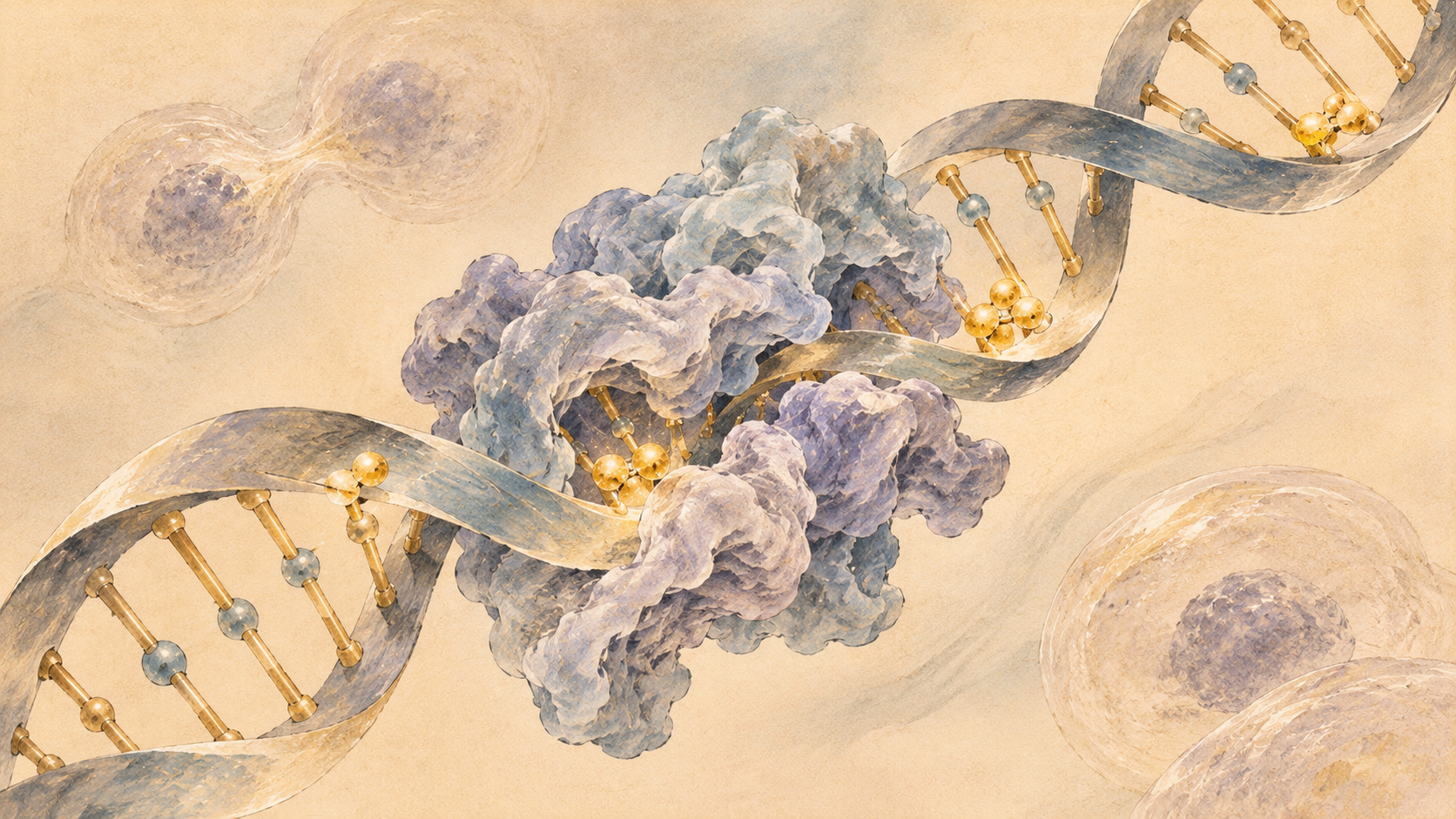
The information that DNA sequencing alone cannot reveal
A skin cell and a liver cell have strikingly different jobs, even though most of their inherited DNA sequence is the same. The difference depends in part on which genes are used and how that pattern survives cell division. A collaboration announced on November 24 by Kyoto, Tokushima and Nagoya universities offers a structural explanation for one part of that continuity.
The study, published online on November 10 in Advanced Science, centers on DNA methyltransferase 1, or DNMT1, and a chemically constructed molecular partner. Sae Suzuki and colleagues, including Hiroshi Murakami, Kyohei Arita and Gosuke Hayashi, combined chemical protein synthesis with structural biology. Author affiliations also include Yokohama City University. This report expands on the discovery introduced in JAPAN.co.jp’s November 26 news briefs.
How a chemical mark survives a round of replication
DNA methylation in mammals commonly involves adding a methyl group to cytosine at a CpG site. It does not change the sequence of DNA letters. Depending on its location, it can influence gene regulation, genome stability and other aspects of chromosome biology. It is one component of epigenetics, alongside mechanisms involving histones and chromatin organization.
When a DNA molecule is copied, each original strand becomes a template for a new one. A previously methylated site can therefore emerge with a chemical mark on the old strand but not the newly synthesized partner. This is called hemimethylated DNA. DNMT1 preferentially acts on such sites, helping restore the methylation pattern.
Cellular memory in this context is not recollection, nor proof that personal experiences are transmitted to descendants. It means that molecular states can persist through divisions within a cell lineage. Some methylation patterns are actively remodeled, notably during reproductive development.
A prediction made before the enzyme was identified
The history reaches back to the recognition of methylated cytosine in DNA in 1951. In 1975, Robin Holliday and John Pugh, and independently Arthur Riggs, proposed mechanisms by which methylation could carry regulatory information through replication. A maintenance enzyme was a crucial prediction of those ideas.
The isolation and molecular characterization of mammalian DNA methyltransferase in the 1980s turned that prediction into a research program. Scientists later identified enzymes such as DNMT3A and DNMT3B that are particularly important in establishing new methylation patterns. DNMT1, by contrast, is central to maintaining existing patterns, although their functions are not absolutely isolated.
Identifying the enzyme did not explain how it avoids acting indiscriminately. The next challenge was to understand the machinery that brings it to the right molecular neighborhood and controls access to its catalytic site. That is the historical question to which the Japanese study contributes.
Why the team built a protein rather than extracting it
A protein’s amino-acid sequence is only part of its identity. Chemical modifications attached after synthesis can determine how it interacts with other molecules. PAF15, a small protein associated with the replication machinery, can carry two separate ubiquitin molecules. Each ubiquitin is attached to a different site rather than forming a two-unit chain.
The resulting PAF15Ub2 contains 262 amino acids: 110 from PAF15 and 76 from each ubiquitin. The researchers assembled it from six peptide segments, including branched fragments, preserving the native linkages. This addressed a practical obstacle: obtaining a consistent molecular species for structural and functional studies.
In biochemical tests the synthetic partner associated with DNMT1 and enhanced its methyltransferase activity. That functional check matters because a molecule suitable for imaging is not necessarily biologically effective. Chemistry supplied a controlled specimen with which to ask a precise mechanistic question.
An enzyme with a built-in safety catch
DNMT1 has a regulatory region known as the replication foci targeting sequence, or RFTS domain. In an autoinhibited conformation, this region obstructs access to the catalytic machinery. Binding partners can help rearrange the enzyme so that DNA can be accommodated.
The team examined a complex of DNMT1, synthetic PAF15Ub2 and hemimethylated DNA using cryogenic electron microscopy. By combining images of many rapidly frozen molecular particles, researchers can reconstruct three-dimensional structures. Their active-state reconstruction showed the RFTS region displaced from the catalytic domain.
The structural result and biochemical measurements reinforce one another: they explain how the modified partner can relieve an inhibitory arrangement and stimulate the enzyme. The work is not a real-time movie of a molecule in a living cell. It captures a structural state under experimental conditions rather than every intermediate step of activation.
A second route complicates the picture
A 2020 Nature Communications study described two routes for bringing DNMT1 to chromatin: ubiquitin-modified PAF15 and ubiquitin-modified histone H3. The protein UHRF1 helps establish these signals. The work suggested that the routes could operate differently across replication timing and compensate for one another.
More recent evidence introduces an important qualification. A separate 2026 study found that removing PAF15 or interfering with its ubiquitination did not disrupt global DNA methylation or DNMT1 recruitment in the mammalian cells examined. Its authors instead emphasized histone ubiquitination.
There is no necessary contradiction between a protein being capable of activating an enzyme in a reconstituted system and that protein being dispensable in some cellular settings. Determining the balance between the pathways requires experiments across cell types and genomic regions. This is why the new structural result should be read as a mechanism of activation, not the sole explanation for cellular inheritance.
The medical significance is a question, not a treatment
Abnormal methylation patterns are associated with cancer, and methylation changes also accompany aging. This makes the regulation of DNA methyltransferases relevant to biomedical research. But healthy dividing cells depend on the same machinery, so indiscriminately increasing or decreasing its activity is unlikely to be a universal therapeutic strategy.
A structural model may eventually guide studies of molecular interactions, including efforts to identify compounds that alter particular regulatory contacts. Translating that opportunity into medicine would require evidence of selectivity, effects in living cells, safety and clinical benefit. None of those outcomes was established by this paper.
The broader achievement is methodological. Researchers can use chemical synthesis to isolate a precisely defined modification, test what it does and examine the resulting structure. This combination can help separate the many signals that govern complex biological systems. The Japanese study adds a concrete molecular explanation to a question scientists have pursued for half a century: how a dividing cell preserves part of its identity without rewriting its DNA sequence.
Related coverage: November 26 news briefs (Japanese)
Primary sources and references
- Kyoto University, November 24 announcement
- Nagoya University, research announcement and glossary
- Tokushima University, November 24 announcement
- Suzuki et al., Advanced Science (2026), full text
- Historical review of nucleic acid modifications
- Review of mammalian maintenance methylation
- Nishiyama et al., Nature Communications (2020)
- Study revisiting histone and PAF15 ubiquitination in mammalian cells
- Genetic studies on mammalian DNA methyltransferases