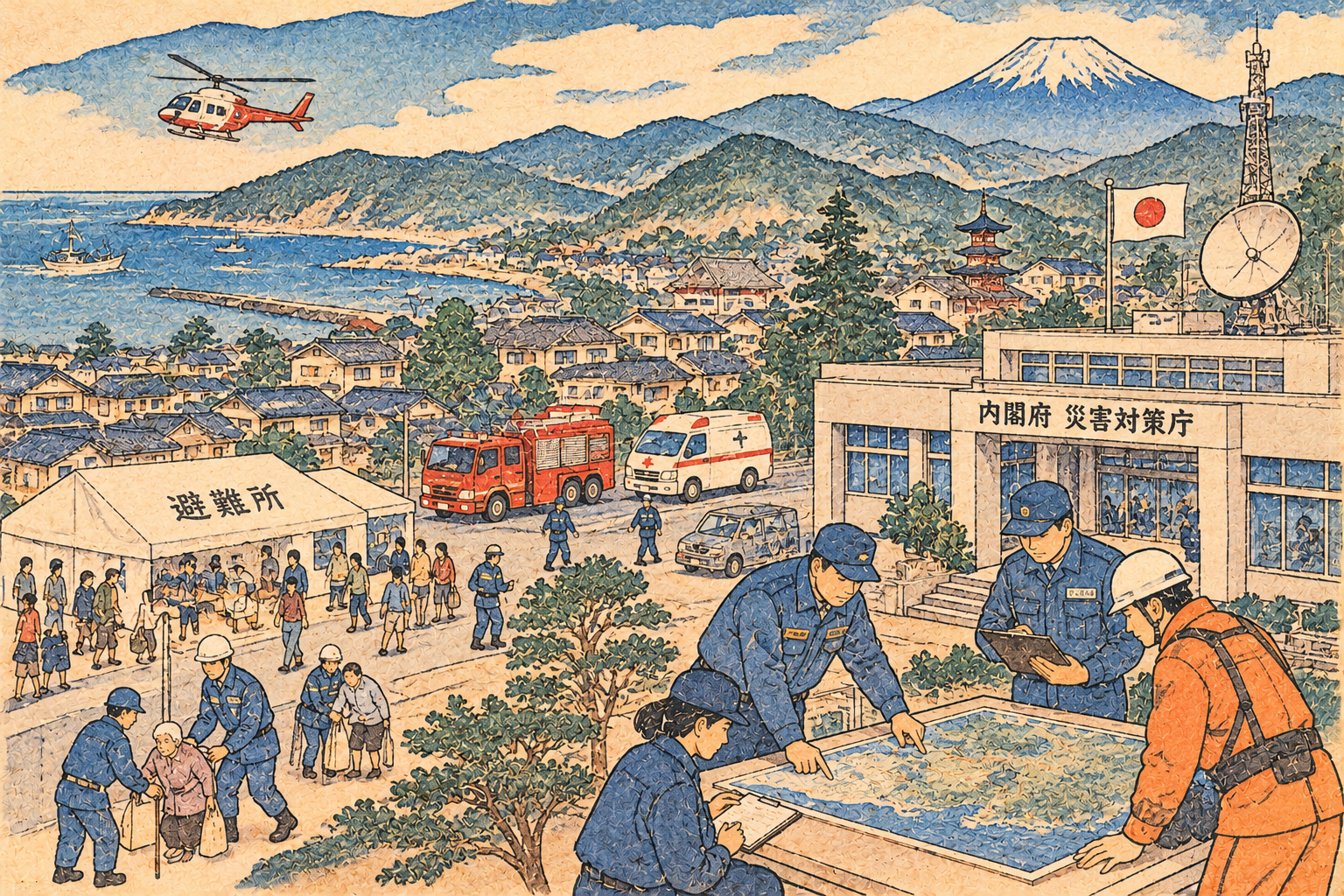
The real test is not the name on the door
When a major earthquake strikes, the most immediate questions are brutally practical. Who knows which roads are still open? Where can an older resident find a toilet that is accessible and clean? Can a hospital receive water, electricity and medical supplies when communications fail? And who is responsible when one ministry expects another to act?
Japan inaugurated a new National Disaster Management Agency on November 2, 2026, with Prime Minister Sanae Takaichi presiding at its opening. The government says it wants one permanent organization to connect preparation, emergency response, evacuation support and recovery. That is a consequential administrative change. It is not proof that assistance will arrive faster when the next disaster occurs.
What Japan has actually created
The agency rests on the National Disaster Management Agency Establishment Act, Act No. 61 of 2026, promulgated July 17 and brought into force for the agency’s launch on November 2. The law establishes the body under the Cabinet, charges it with supporting national disaster policy and coordinating work across government, and defines responsibilities extending from prevention to reconstruction.
On launch day, Takaichi appointed Goshi Hosono as the responsible minister, alongside a deputy minister and parliamentary vice-minister. The agency is not an American-style replacement for every emergency service. Japan’s municipalities, prefectures, firefighters, police, Self-Defense Forces and specialist ministries retain operational responsibilities. The practical challenge is to make their actions cohere rather than create yet another route through bureaucracy.
Why coordination becomes a life-or-death question
The word “command center” can sound abstract. Its meaning becomes clearer in an evacuation center. Health authorities may understand the medical need, transport officials may hold road information, utilities may know the state of the power network, and local government may know how many residents lack medication. Unless those pieces are assembled quickly, the response can fail even when each organization is working hard.
In her inauguration address Takaichi called for attention to gaps between ministries, faster decisions, improved shelters and a continuous path through recovery. Those are political instructions, not audited outcomes. Agency departments covering relief, food, living conditions, logistics, digital systems and reconstruction suggest where officials expect to focus, but the measurable results remain to be seen.
A system rebuilt after catastrophe
Japan's latest reform belongs to a long lineage. The 1959 Isewan Typhoon exposed the limits of fragmented response and helped prompt the Disaster Countermeasures Basic Act of 1961. That legislation established a more integrated approach to preparedness, emergency measures and recovery, including central planning and disaster-management councils. The idea that prevention must begin before a crisis is therefore not new.
The 1995 Great Hanshin-Awaji Earthquake exposed vulnerabilities in urban buildings, lifelines and initial response. The 2011 Great East Japan Earthquake and tsunami brought an immense, geographically dispersed disaster complicated by the Fukushima nuclear emergency and prolonged displacement. The 2024 Noto Peninsula earthquake again demonstrated how isolation, damaged routes and the everyday conditions of evacuation can complicate relief. Japan has repeatedly reformed after tragedy. The new question is whether institutions can learn fast enough before the next one.
Noto and the decision to build a permanent organization
Government planning documents link the proposal directly to lessons from Noto. A December 2024 Cabinet-level process set out an intention to strengthen prevention and operational coordination. The government doubled its Cabinet Office disaster-management staffing authorization from 110 to 220 in fiscal 2025 and increased funding for relevant operations before the agency itself opened.
Those figures establish a policy trajectory, not a cost-benefit finding. Staff added to a central office must still help an exhausted town official obtain a generator, move patients, coordinate volunteers or restore a water system. The value of a permanent agency will depend on whether it builds durable expertise and useful relationships with the people who actually run emergency operations.
The Nankai Trough figures are scenarios, not forecasts
A major reason for urgency is the threat of a megathrust earthquake along the Nankai Trough, off Japan's Pacific coast. In a government worst-case scenario published in March 2025, earthquake shaking and tsunami could cause as many as approximately 298,000 deaths under specified adverse assumptions. An estimated 2.35 million buildings could be destroyed or burned, with direct asset losses as high as about ¥224.9 trillion. These are modeled potential impacts, not a prediction of when a quake will occur or how many people will die.
The scale is extraordinary: multiple prefectures, coastal cities, industrial ports, transportation routes and energy infrastructure could be affected simultaneously. The agency's task is not to use the largest number as a warning slogan. It is to turn risk models into actions that change outcomes—seismic reinforcement, realistic tsunami evacuation, pre-positioned supplies, continuity plans and drills that reflect the needs of actual communities.
The hidden emergency after the initial impact
Surviving a collapsed building or avoiding a tsunami is only the first stage. A person may then spend days or weeks without adequate sanitation, bathing facilities, hot food, privacy, medical access or sleep. Japan's disaster experience has shown that conditions after evacuation matter profoundly, especially for older people, people with disabilities and those managing chronic illness.
The new agency's declared principles place life and human rights first, and its organization includes functions dedicated to shelter support, food, living conditions, supplies, transport and recovery. These are appropriate priorities. Success should be assessed through real measures such as access to usable toilets and safe sleeping arrangements, time to deliver assistance, continuity of treatment and the prevention of avoidable deterioration during displacement.
A national government that knows a local town
One less visible reform may prove especially important. Japan's “furusato disaster-management staff” initiative assigns national staff to build relationships with particular prefectures and support local preparedness before emergencies. The official recruitment description includes stockpiles, training, cooperation with NGOs and on-site assistance after a disaster.
The design aims to reduce the distance between Tokyo's policy machinery and the realities of smaller communities. It is particularly relevant to remote islands, aging rural towns and peninsulas with few routes in or out. Yet its effectiveness will need to be tested: Are local officials receiving help they can use? Do staff know the terrain and the vulnerable populations? Can they act when local communications and transport networks collapse?
Technology cannot substitute for trust
Digital mapping, weather data, satellites, drones and logistics platforms can make response faster. The agency has staff assigned to disaster digitalization and research and development. Japan's industrial and scientific sectors may contribute powerful tools, and the prime minister has explicitly positioned disaster technology as an area for international cooperation and business development.
But a dashboard without electricity, verified data or trained users can become an expensive ornament. Redundant communications, paper maps, local knowledge and tested procedures remain essential. Sensitive records about displaced residents also create difficult privacy questions. Agencies must show that data tools improve actual decisions, not simply that new software was procured.
A new market for disaster resilience?
The agency's published mission extends beyond emergency management to innovation and the development of disaster-related industries. That has implications for Japanese businesses working in construction, logistics, communications, power systems, sensors, medicine, temporary housing and water treatment. Reliable emergency systems can be useful exports, especially to other earthquake- and typhoon-prone countries.
The opportunity comes with a public-interest test. Procurement should reward proven performance, affordability and maintainability, not impressive demonstrations alone. Local governments will need to support equipment after the first installation, and citizens will need transparency about which solutions were purchased, what they cost and whether they worked in realistic exercises.
The questions the agency should be judged on
An announcement should be followed by a scorecard. Are municipalities completing and practicing evacuation plans? Is shelter accessibility improving? How long do critical supplies take to reach isolated communities in drills and real emergencies? Can citizens find a coherent path from emergency aid to housing and livelihood recovery? How are vulnerable residents included in planning?
Some of these measures already exist within government systems, while others may require common definitions across jurisdictions. Japan.co.jp has not independently verified a complete set of new nationwide performance indicators tied specifically to the agency's inauguration. Making results public would be one way to distinguish an operational reform from an organizational reshuffle.
The answer will be found far from Tokyo
The agency's headquarters sits in Nagatacho, the political center of Japan. Its success, however, will be decided in fishing towns, mountain valleys, high-rise neighborhoods, care homes, school gyms and hospitals, where the disaster itself and the disruptions afterward are experienced.
No institution can prevent an earthquake. A capable one can help communities avoid unnecessary losses, reduce the hardship of evacuation and recover with dignity. On November 2 Japan created a new office to pursue that goal. The next chapter will not be written at the inauguration ceremony. It will be written by what works before, during and after the next emergency.
Sources and reporting method
Document-based reporting using Japanese government statements, enacted legislation, agency documents and disaster-management white papers. No independent on-site interviews were conducted. Government ambitions are distinguished from verified results.
- Prime Minister’s Office: Inauguration and policy address
- Prime Minister’s Office: Ministerial appointments
- Agency: Establishment Act and implementing regulations
- e-Gov: National Disaster Management Agency Establishment Act
- Agency mission and operating principles
- Agency organizational structure
- Disaster Management White Paper: Isewan Typhoon and the 1961 Act
- 2025 White Paper: Planning the new agency
- 2026 White Paper: Nankai Trough damage scenarios
- Agency: Regional disaster-management staff program
- Government Public Relations: Agency launch and community preparedness
- Reporting on agency’s proposed organizational powers