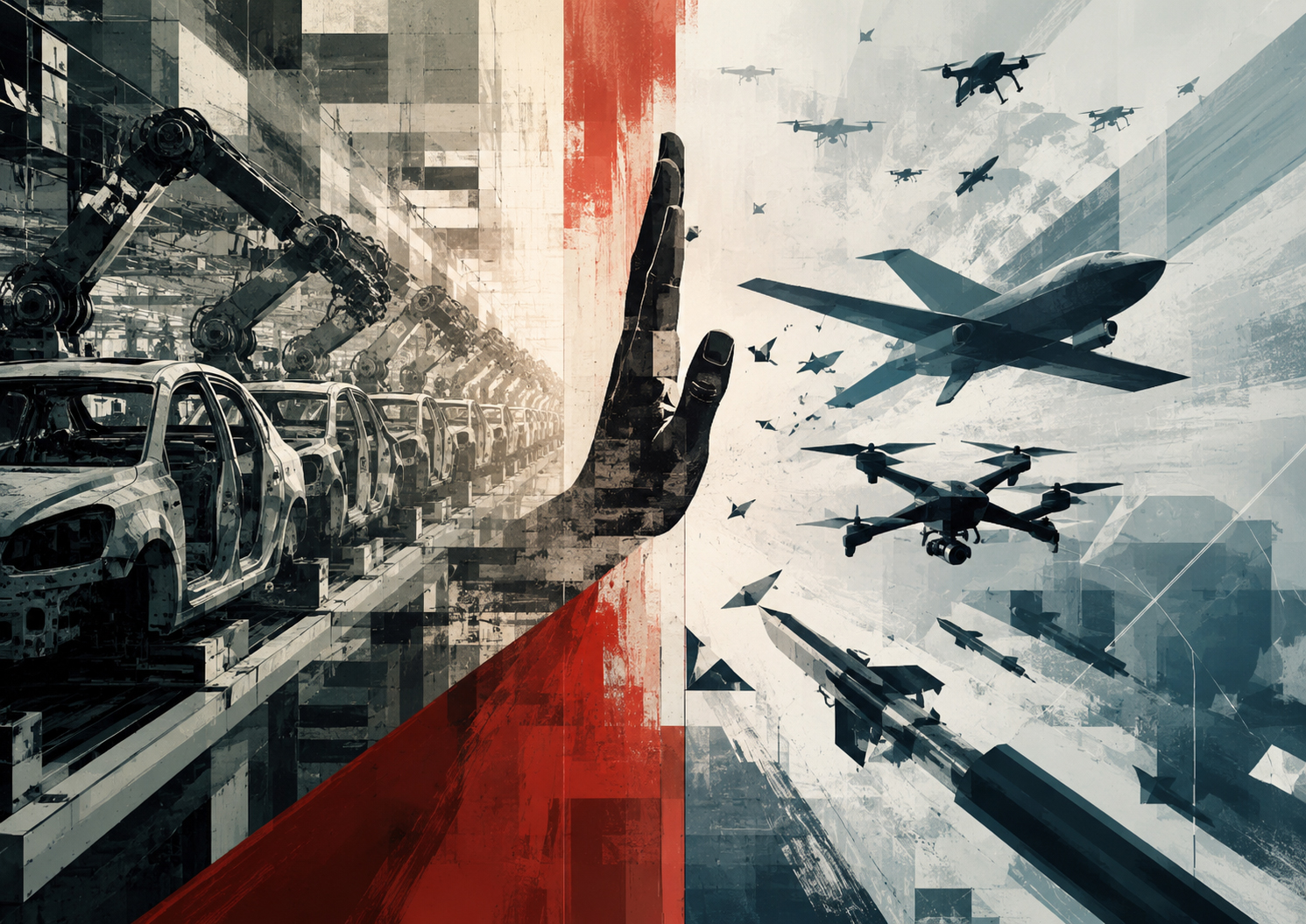
The seductive logic of converting a car plant
An idled automobile plant seems like an obvious answer to a sudden defense-production problem. It already has vast buildings, assembly space, skilled workers, logistics systems, power and transport links. Add soaring demand for military drones, and conversion appears almost effortless.
In June 2026, Reuters reported that U.S. defense company Anduril Industries was discussing the possible acquisition of Nissan’s Oppama plant to produce drones in Japan. Oppama is a landmark of postwar Japanese manufacturing, so the idea connected contraction in automobiles with expansion in defense.
In July, Mitsubishi Heavy Industries CEO Eisaku Ito rejected the simple version of that argument. Car plants are engineered to make tens of thousands or millions of standardized products. Military drone specifications can change constantly in response to battlefield conditions. A careless conversion, he warned, could spend taxpayer money building large volumes of equipment that is obsolete before production matures.
Japan’s unmanned-systems budget surges
The argument matters because Japanese spending on unmanned defense systems is rising rapidly. Procurement for unmanned vehicles was reported at ¥277 billion for fiscal 2026, up sharply from ¥111 billion a year earlier.
The Ministry of Defense is developing SHIELD, a layered coastal-defense network combining aerial, surface, underwater and ground unmanned systems. The fiscal 2026 budget allocates ¥100.1 billion for modular UAVs, several categories of small attack drones, ship-launched systems, anti-ship drones and radar-site defense UAVs.
When demand grows this fast, existing factories look attractive. New sites require land, permitting, power, workers and years of construction. But a usable building is not the same thing as a compatible production system.
A car factory is a machine for repetition
Modern automobile plants are optimized for standardized repetition. Pressing, welding, painting and final assembly move to takt time. Parts arrive through just-in-time networks, and dedicated tooling is matched to vehicle platforms and expected volume.
This works when specifications remain stable and annual output reaches tens of thousands of units. Engineering changes are possible, but they require new tooling, inspection, supplier coordination and work instructions.
Tactical drones operate under a different logic. Electronic warfare, frequencies, navigation, sensors, payloads, software and materials can change within months. Once an adversary develops a countermeasure, a previously effective design may lose value quickly.
Ukraine changed the meaning of scale
The war in Ukraine demonstrated the speed of drone adaptation. Reconnaissance quadcopters, FPV attack systems, long-range one-way aircraft, naval drones and interceptors evolved in short cycles.
Electronic warfare blocks frequencies and satellite navigation. Armor and protective nets change. Manufacturers respond by modifying antennas, control systems, navigation and payloads. Product life can be far shorter than an automobile model cycle.
Yet war also demands mass. Cheap drones are consumed by the tens of thousands and substitute for expensive missiles. The requirement is therefore neither prototyping nor mass production alone, but flexible mass production that can expand volume while continuing to change the design.
How to manufacture a moving target
Flexible production favors modular cells, digital work instructions, additive manufacturing, general-purpose machine tools, rapid software updates and frequent testing over rigid dedicated lines.
Standard interfaces can separate airframe, propulsion, sensors, communications and payloads so one module changes without redesigning the entire aircraft.
Military systems still require traceability, cybersecurity, export control and quality assurance beyond ordinary consumer products. A low-cost drone built around unknown electronics or insecure communications can compromise a mission.
MHI’s warning also serves MHI’s strategy
Mitsubishi Heavy’s argument is not neutral. It is Japan’s largest defense contractor, producing fighters, missiles, submarines, ships, space systems and guided weapons, and it wants a major position in the drone market.
In March 2026, MHI said it used Shield AI’s Hivemind Enterprise environment to move from AI development to UAV flight demonstration in eight weeks. Autonomy, coordination and integration with command systems are higher-value capabilities than simple airframe assembly.
MHI therefore presents drones as systems of sensors, communications, interception and command—not merely products to be stamped out in an empty factory.
The Anduril proposal represents another model
Anduril represents a different defense-industrial philosophy: software-led autonomous systems, shorter design cycles, private capital and large-scale manufacturing.
Using Oppama would not necessarily mean preserving its automotive line. The company could reuse buildings, labor, logistics and regional infrastructure while replacing the internal production system.
The real question is not whether an automobile building can be used. It is whether an automobile-style fixed line should be used. Buildings, utilities and quality personnel may transfer; dedicated presses, paint shops and model-specific tooling may not.
Why Japan’s defense industry became low-volume and expensive
Postwar Japan developed defense production under constitutional and political restraints. Mitsubishi Heavy, Kawasaki Heavy, IHI, Mitsubishi Electric, NEC and Toshiba remained primarily civilian companies, with defense representing only part of their business.
Aircraft production often relied on licensed U.S. designs, which preserved domestic engineering and manufacturing skills. MHI participated in programs including the F-86, F-104, F-4 and F-15.
But the Ministry of Defense was effectively the only customer, and exports were heavily restricted. Small production runs stretched across many years, raising unit costs and weakening the commercial appeal of defense work.
Export restrictions shaped the industrial base
Japan’s 1967 Three Principles on Arms Exports and the 1976 unified government view created near-total restrictions. Development costs had to be recovered from a small domestic market.
In 2014, the Abe government introduced the Three Principles on Transfer of Defense Equipment and Technology, permitting more cooperation and selected exports. In 2026, Japan made its largest postwar relaxation, allowing case-by-case exports of warships, missiles, combat drones and other systems.
Exports remain politically controversial, but larger production volumes can lower costs, retain suppliers and justify factory investment. A shift from domestic-only low-volume programs to sustained allied demand changes the economics of manufacturing.
The production base became ‘defense capability itself’
Japan’s 2022 security strategy and defense buildup plan expanded funding for long-range missiles, munitions, cyber, space and unmanned systems.
The 2023 Act on Enhancing Defense Production and Technology Bases allowed government support for supply-chain visibility, factory modernization, cybersecurity, succession and capital investment. MOD now describes the production and technology base as defense capability in itself.
The policy responds to supplier exits caused by unstable orders and low margins. The loss of one specialized small company can prevent an entire platform from being produced.
Workers may transfer more easily than equipment
Automobile plants employ people skilled in welding, machining, electronics, quality control, supply-chain management and continuous improvement. Those capabilities can be valuable in drone production.
Workers would still need training in classified information, aerospace quality, special materials, explosives and security trade controls. Defense production requires detailed tracking of drawings, components and software integrity.
Labor conversion may be more practical than equipment conversion. The policy objective should be to retrain people for new processes rather than preserve old lines.
Automotive suppliers still have a major role
Not everything in the automobile industry is unsuitable for drones. Batteries, motors, inverters, cameras, radar, communications, composites, precision machining and mass-quality systems transfer directly.
Japan is actively searching for dual-use startups and SMEs, not only traditional contractors. Civilian technologies—from wearable fibers to sensors and robotics—can be adapted for defense.
The best structure may be division of labor: automotive suppliers provide modules at scale, while defense primes and startups integrate secure software, mission systems and payloads.
Can low-volume excellence survive attrition warfare?
MHI’s case has a weakness. War requires volume, even when the product is imperfect. A force built only around expensive, exquisite systems may not survive attrition.
Ukraine demonstrated the battlefield value of inexpensive drones built with commercial components. Traditional acquisition cycles can take years, far slower than operational adaptation.
Japan needs two layers: advanced integrated systems and low-cost expendable mass. Building everything to aircraft standards becomes unaffordable; building everything to consumer standards produces vulnerability.
The interceptor-drone market
Japan is increasingly interested in drones that destroy hostile drones at lower cost than surface-to-air missiles.
Interceptors require fast tracking, computer vision, autonomous navigation, networking and resistance to electronic warfare. MHI has reportedly developed a prototype interceptor.
This market rewards system integration as much as airframe volume, which favors a company with experience in sensors, command networks and guided weapons.
Conditions for a successful conversion
- Separate the building from the line: Reuse land, utilities and logistics while removing unsuitable dedicated tooling.
- Use modular production: Cell-based systems must support several designs and frequent changes.
- Build a software factory: Control, autonomy and communications need continuous updates.
- Add rapid testing: Electronic warfare, weather, flight, cyber and safety testing must run continuously.
- Retrain workers: Bridge automotive quality skills into defense and aerospace certification.
- Serve multiple markets: Combine domestic procurement, allied exports and dual-use demand.
Japan.co.jp view: choose a production philosophy, not a building
The conversion of a car factory into a drone plant cannot be labeled success or failure in advance. MHI’s warning is valid: copying a fixed automotive line into a fast-changing military market risks producing yesterday’s design at industrial scale.
But Japan need not discard buildings, workers, quality culture or logistics. Conversion should mean replacing the old production logic with modular cells, digital design, software updates and rapid testing.
Japan’s defense industry traditionally built small numbers of high-quality, high-cost systems for one domestic customer. The drone era demands speed, quantity, adaptability and low cost alongside performance.
The Oppama debate is therefore larger than one real-estate transaction. It is a test of whether Japan can transfer the manufacturing strength of the automobile era into an age of unmanned and autonomous systems.
The real choice is not car factory versus purpose-built defense factory. It is whether Japan can build equipment that changes as quickly as the battlefield does.
Sources and further reading
- Financial Times, July 6, 2026: MHI’s warning on automotive-plant conversion and the ¥277 billion unmanned-systems budget.
- Reuters, June 25, 2026: Anduril’s discussions concerning Nissan’s Oppama plant.
- Japan Ministry of Defense fiscal 2026 budget: SHIELD and ¥100.1 billion for unmanned assets.
- Japan Ministry of Defense: Defense production and technology bases as defense capability.
- Mitsubishi Heavy Industries, March 17, 2026: UAV mission-autonomy flight demonstration using Shield AI’s environment.
- Reuters, April 21, 2026: Japan’s major relaxation of defense export rules.
- Reuters, January 22, 2025: Dual-use SMEs and Japan’s defense buildup.
- Mitsubishi Heavy Industries: Corporate history across shipbuilding, aircraft, automobiles and defense.