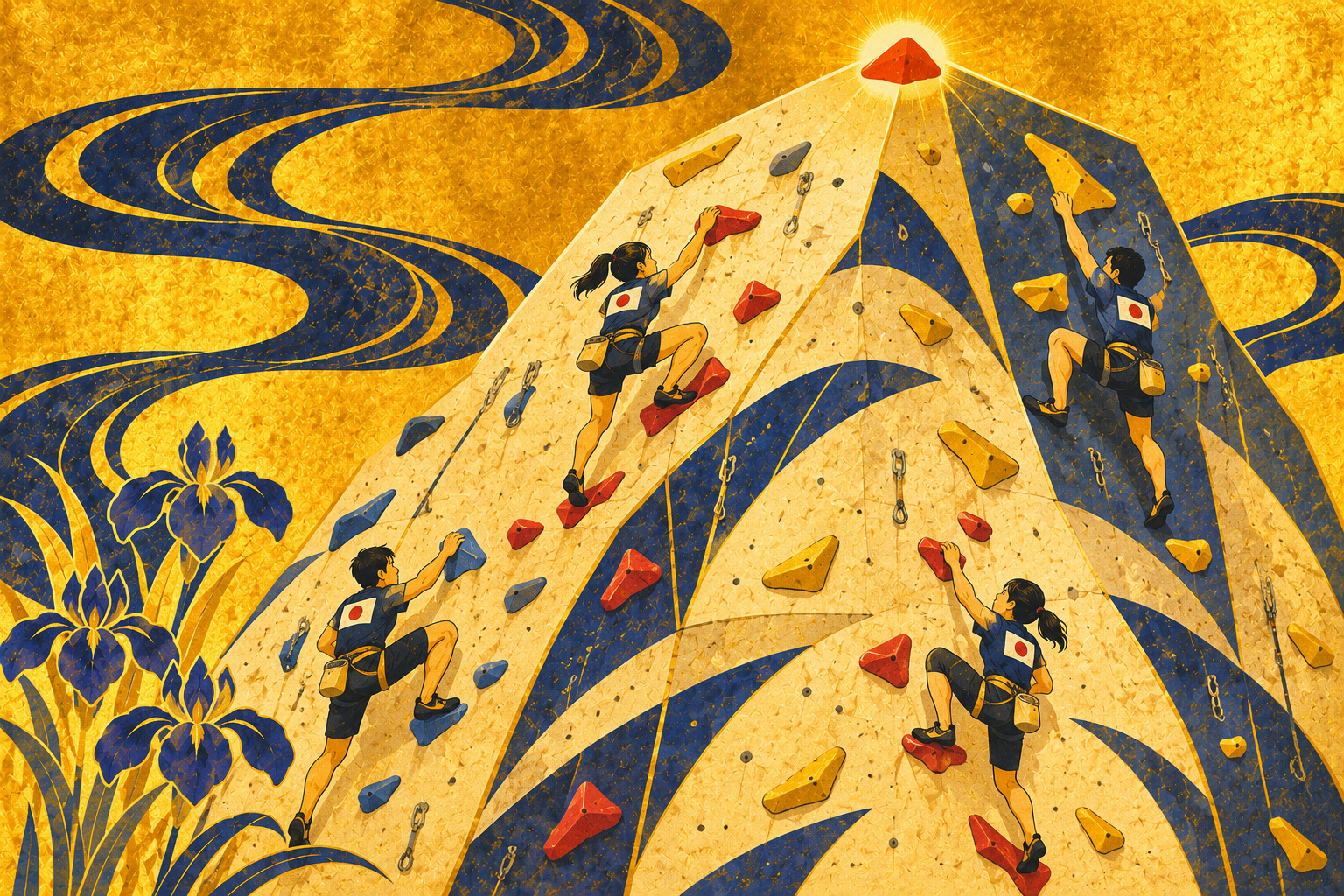
- Two golds, two quite different victories
- November 7: a Boulder team takes command
- What the Boulder numbers show—and do not show
- November 8: Lead qualification puts Japan behind
- Four performances turn the final around
- Why a team event changes the sport
- From natural rock to a Japanese competitive tradition
- The Olympic era—and a change coming in Los Angeles
- Fukuoka, teammates and the wider Asian competition
- What the double victory tells us
Two golds, two quite different victories
At an outdoor venue in Iizuka, Fukuoka Prefecture, two Japanese teams produced the same headline by strikingly different routes. On November 7, Japan defended its title in the mixed-gender Boulder team event. A day later, it overturned a qualification deficit to beat South Korea in Lead. The World Climbing Nations Grand Finale ended with the host country holding both trophies—a result that reflected not one superstar, but the strength of eight competitors and a pair of carefully structured teams.
The weekend was not an Olympic championship or a conventional individual World Cup. It was a season-ending international nations event in which men and women collectively accumulated points for their country. That distinction matters: the results reward the depth of a programme and the ability to read problems together, not simply the performance of one athlete. The definitive scorecards show Japan winning Boulder with 233.9 points to South Korea’s 188.8, and Lead with 157.5 to 125.0.
November 7: a Boulder team takes command
The Boulder squad brought together 安楽宙斗 (Sorato Anraku), 川又玲瑛 (Rei Kawamata), 中村真緒 (Mao Nakamura) and 関川愛音 (Melody Sekikawa). Japanese riders of this indoor wall were not merely trading turns. Each problem required technical interpretation: where to place a foot, when to shift a hip, when a dynamic move was more economical than a controlled reach.
In the final, the Japanese team made a decisive start, according to World Climbing, with three tops and a zone on the first Boulder. It then sustained the advantage, including success on a final mixed problem attempted by one man and one woman. The final totals were Japan 233.9, South Korea 188.8, United States 154.0 and Switzerland 114.2. That 45.1-point winning margin is meaningful within this particular event, but must not be mistaken for a universal performance gap across the international season.
What the Boulder numbers show—and do not show
The Japanese event report lists Sekikawa at 74.9 points, Kawamata at 74.5, Anraku at 49.7 and Nakamura at 34.8. These are contributions within this team format, not interchangeable measures of an athlete’s general world ranking. Boulder rewards completing short, difficult movement sequences; a “top” means successfully finishing the problem, while a “zone” is a designated intermediate hold.
Solving a problem requires technique and decision-making as well as upper-body strength. Attempts can matter in scoring, but the exact Nations Grand Finale format should not be casually substituted with Olympic scoring rules. What the Fukuoka results undeniably demonstrate is that Japan could obtain valuable contributions from both its men and women across distinct problems, including the mixed finale.
November 8: Lead qualification puts Japan behind
Lead presented a different assignment: ascend as far as possible on a tall roped route before time or endurance runs out. Japan’s quartet was 鈴木音生 (Neo Suzuki), 村下善乙 (Zento Murashita), 中川瑠 (Ryu Nakagawa) and 小池はな (Hana Koike). Each team sent a male and a female climber onto each of two routes; the points from all four performances determined the country’s total.
The morning round provided an unwelcome reminder of South Korea’s strength. South Korea led with 158.5 points; Japan qualified second on 157.0, followed by the United States with 136.0 and Switzerland with 126.5. Australia, fifth on 103.0, did not reach the final. Japan therefore entered the decisive round as a contender, not an assured champion.
Four performances turn the final around
For the final, Japan placed Murashita and Nakagawa on route A and Suzuki and Koike on route B. The Japanese competitors’ reported contributions were Murashita 46.0, Suzuki 48.0, Nakagawa 33.0 and Koike 30.5, a combined 157.5. South Korea finished at 125.0; the United States reached 105.0; Switzerland posted 96.5.
Suzuki reached the top of his route, the decisive individual highlight described in contemporary Japanese reporting. Yet framing the title as a single heroic climb would misstate the team’s work: Murashita established the early advantage, Nakagawa helped extend it, and Koike’s contribution secured the total. The federation’s account says the Japanese climbers won all four of their matchups in the final. An important comparison: Lead points are calibrated to the specific routes and cannot be directly added to, or measured against, Boulder points.
Why a team event changes the sport
Climbing is usually presented as a solitary contest against a wall. The mixed-team structure converts it into a collaborative problem: coaches must select athletes, assign routes and decide what information is worth transmitting between attempts. A climber’s observation can help a teammate avoid a wrong hold or a wasteful movement. In Japan’s Lead strategy, Japanese coverage notes the decision to send the men before the women on each route.
Team formats also make the women’s performances integral to the score rather than a separate event placed beside the men’s competition. A complete sporting explanation therefore requires attention to Nakagawa, Koike, Nakamura and Sekikawa alongside the better-known male climbers. The format is a specialized international event, however, not evidence that the Olympics have adopted a mixed-gender team medal.
From natural rock to a Japanese competitive tradition
Competitive climbing has its roots in mountaineering and free climbing, but its modern championship structure is comparatively young. The Japan Mountaineering and Sport Climbing Association dates the first international-scale World Cup to 1989 and the first World Championships to 1991. Japanese climber Yuji Hirayama earned a silver medal at that inaugural world championship, providing an early marker of the country’s potential.
In the 1990s, artificial-wall climbing gyms developed around Japan’s large cities and made difficult routes easier to train on repeatedly. Where outdoor climbing depends on access and weather, a manufactured wall permits repeatable movement practice, controlled difficulty and youth competitions. Such facilities are an important part of the infrastructure behind today’s athlete pipeline. But the Fukuoka results alone cannot establish how many gyms caused a particular medal or how much individual coaching contributed.
The Olympic era—and a change coming in Los Angeles
Sport climbing debuted at the Tokyo 2020 Games, contested in 2021, when speed, boulder and lead were combined in a single event for each gender. Japan’s Miho Nonaka took silver in the women’s combined event. At Paris 2024, speed had its own medal competition while Boulder and Lead remained combined, and Sorato Anraku earned silver in the men’s Boulder & Lead.
For Los Angeles 2028, World Climbing says Boulder, Lead and Speed are scheduled to become six standalone medal events, three for each gender. That new structure should reward athletes who specialize in one discipline and will create different selection and training challenges. Fukuoka’s mixed-team victories are best understood as a separate demonstration of Japan’s breadth—not a prediction of how many Olympic medals it will win.
Fukuoka, teammates and the wider Asian competition
The Grand Finale took place November 7–8 at the Chikuhō Green Park / Iizuka Sport Resort venue, making a regional Japanese setting the host of a high-level international showdown. South Korea finished second in both disciplines, demonstrating that the competition was not a purely domestic celebration. The American federation also confirmed two third-place finishes. Switzerland reached both finals, while Australia was eliminated in qualification.
The results suggest meaningful regional competition in training and route-reading, especially between Japan and South Korea. But it would be careless to infer that the order from one mixed-team weekend determines the global balance of elite climbers in every individual discipline. A useful next reporting step is to speak with coaches about the practical advantages—and limitations—of shared training facilities and multidisciplinary development.
What the double victory tells us
The common thread between the two Japanese teams was not identical physical skill. Boulder rewarded explosive problem-solving and movement creativity; Lead tested endurance, sequencing and the ability to preserve energy over a sustained route. Japan’s eight athletes answered both demands, and its Lead group recovered from second in qualification to win when it counted.
The larger story is about a sporting ecosystem: international experience, facilities, coaches, youth pathways and athletes capable of contributing under different rules. Fukuoka confirmed the outcome on those two November days. Whether the advantage lasts will be decided by future competitions, not by the celebratory photographs from the podium.
Final standings
| Place | Nation | Boulder | Lead |
|---|---|---|---|
| 1 | Japan | 233.9 | 157.5 |
| 2 | South Korea | 188.8 | 125.0 |
| 3 | United States | 154.0 | 105.0 |
| 4 | Switzerland | 114.2 | 96.5 |
Sources: World Climbing competition reports. Boulder and Lead employ different scoring systems; point totals are not directly comparable across disciplines.
Sources and reporting notes
Results are sourced to November 7–8, 2026 competition records. This is independent desk reporting, not an interview-based article. The Nations Grand Finale mixed-team format is distinct from Olympic events.
- World Climbing — Boulder final, Nov. 8
- World Climbing — Lead final, Nov. 8
- CLIMBERS — Boulder final, Nov. 7 (Japanese names and scores)
- CLIMBERS — Lead final, Nov. 8 (Japanese names and scores)
- CLIMBERS — Lead qualification, Nov. 8
- Official event site — Fukuoka 2026 schedule and results
- Japan Mountaineering and Sport Climbing Association — Disciplines and history
- Japan Olympic Committee — Sport climbing
- World Climbing — LA 2028 Olympic programme
- USA Climbing — Team USA two podiums