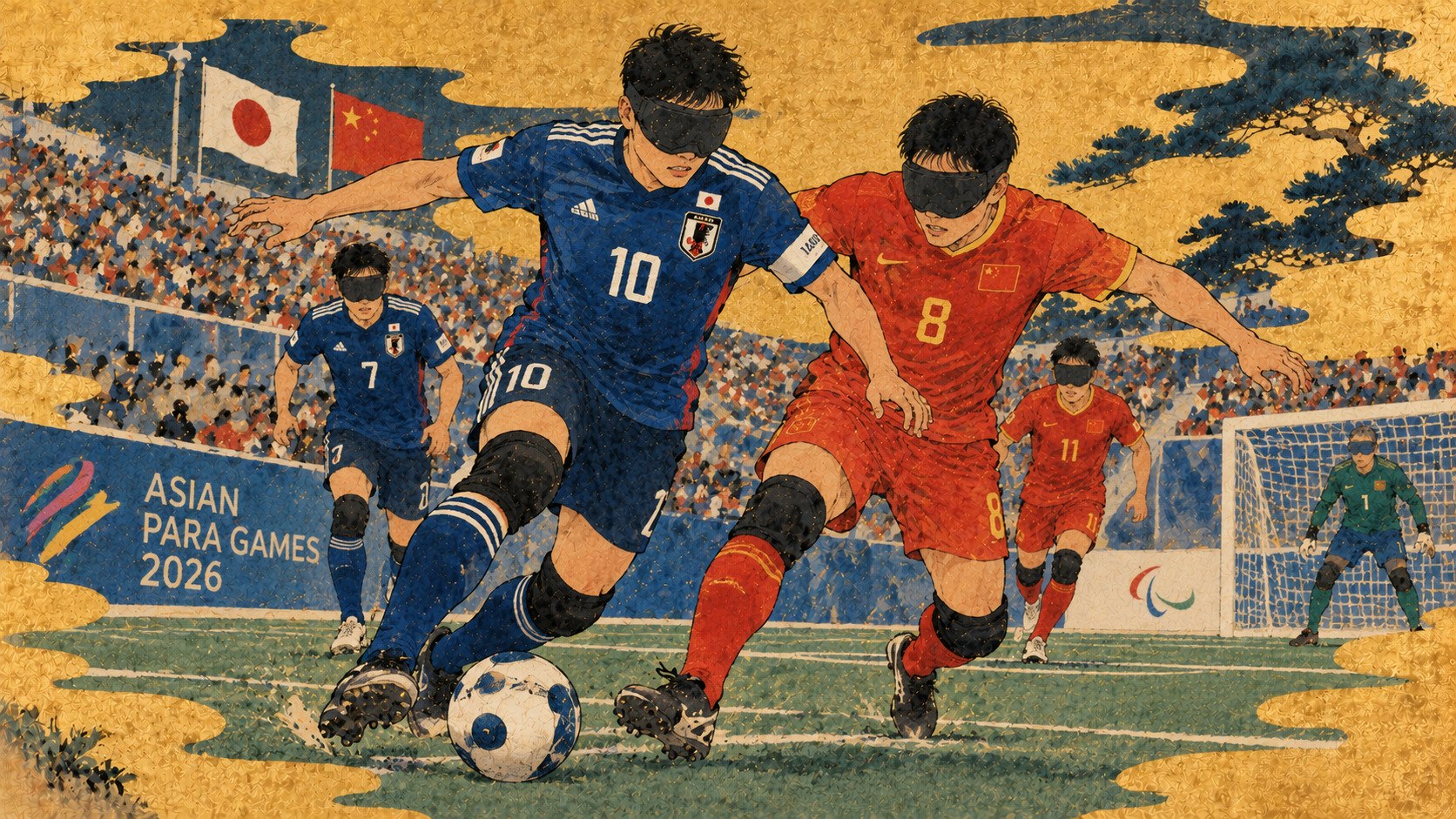
The ball makes a sound. The rest of the game depends on knowing which sounds matter—and on trusting the people around you.
A rematch with the team that beat Japan first
There is a striking paradox at blind football matches: spectators show their support partly by knowing when to fall silent. The ball's internal sound helps players locate it. Teammates call out. A guide communicates from behind the goal. An opponent announces a challenge. Information is being exchanged continuously, often at remarkable speed.
At Nagoya's Tsuruma Park, Japan secured its place in the men's blind-football gold-medal match at the Aichi–Nagoya 2026 Asian Para Games by defeating Iran 2–1 on October 21. Its opponent is China—the same team that defeated Japan 1–0 in the opening match on October 16. The gold-medal match is scheduled for Friday, October 23, at 3:30 p.m. Japan time.
Reporting cutoff: This article is based on official records available through October 22. The October 23 final result was not verifiable at publication preparation time and is not asserted here. This October 24 edition article requires a confirmed final-result update before it is published as a post-match report.
The two Japanese goals that made the final possible
Japan's national blind football association names Masaki Goto as the scorer of its first goal against Iran, in the 19th minute of the first period. Iran equalized through Morteza Karimiamaleh in the seventh minute of the second. Ryo Kawamura scored Japan's winner in the 18th minute of that period. The association's documented final score is 2–1.
That sequence captures the stakes more accurately than a generic story about inspirational perseverance. Japan first established a lead, lost it, and found a late winner under pressure. The win completed a four-victory, one-defeat group campaign, leaving the hosts second in the round-robin table and eligible to face first-place China in the final.
The trajectory matters. Japan's tournament began with a 1–0 defeat by China. It responded with a 6–1 win against India, then successive 1–0 victories over South Korea and Thailand, before the closely contested match against Iran. A substantial victory followed by three narrow wins is evidence of results under different match circumstances—not proof of what strategy will succeed against China.
How blind football works
Blind football is five-a-side, with four outfield players wearing eyeshades to standardize visual conditions. Goalkeepers may be sighted or partially sighted, subject to the sport's rules. An audible ball supplies one vital cue, but the surrounding soundscape matters just as much. Sideboards help prevent the ball from routinely leaving the playing area and create a distinctive rhythm of play.
Defenders must use an audible call when challenging an opponent, reducing collision risk. Guidance comes from defined zones; the people providing it cannot simply direct every movement from anywhere on the pitch. Players still have to control the ball, accelerate, shield possession, anticipate the next pass and make their own tactical decisions. A spectator who pays attention to those choices quickly realizes that this is a highly specialized version of football—not a demonstration staged for sympathy.
Japan's larger campaign and China's challenge
The Japan Football Association entered the Games noting that the national team had finished second at the April 2026 IBSA men's Asian championship. Its stated aspiration was an Asian title at a major tournament staged on home soil. The association's pre-event briefing listed Japan third and China fifth in the world rankings at the time; the first meeting showed why rankings offer no guarantee in a single match.
China beat Japan 1–0 on October 16 and finished at the top of the group. That opening game is the most immediate competitive context for the final. The teams are familiar enough to study one another's vulnerabilities, yet every match begins without a goal on the board. The rematch is a test of sporting execution, not a geopolitical metaphor.
A century of football ideas—and an evolving sport
Blind football belongs to the wider history of adapted sports, developed through athletes, coaches, organizations and communities finding ways to sustain serious competition. Its rules turn hearing and communication into integral elements of a familiar global game. Its modern international structure includes classification requirements, formal officiating and demanding schedules. The men's competition in Nagoya brought together Japan, China, Thailand, Iran, India and South Korea.
One of its most important long-term questions lies far from the final scoreboard: can children and adults with visual disabilities find local clubs, competent coaching, affordable equipment and opportunities to play? International medals can draw attention to the sport, but sustained participation relies on institutions that remain after the closing ceremony. These are questions for policymakers, educators and football organizations as much as for elite athletes.
What the crowd can learn by listening
Calling blind football “amazing” because its players cannot see is easy; explaining the quality of a late run or an organized defense is harder and more respectful. The best coverage identifies the players' decisions and the structure of the contest. It does not treat disability as a substitute for sporting analysis.
That matters for international readers. The Japan–China final offers a compelling point of entry, but the curiosity should lead somewhere substantial: how information is shared, how defenders judge distance, what makes a striker dangerous, and why the audience sometimes falls quiet just as the game becomes most intense.
What remains to be documented
A definitive match story must establish the final score, goalscorers and their times, starting lineups, any disciplinary or officiating incidents, and direct post-match reactions from both sides. None should be invented to satisfy a publication date. Whatever the result, Japan's verified path—from an opening defeat to four straight victories—already makes this a match of genuine sporting consequence.
The lesson of Tsuruma Park is not that blindness is overcome by courage alone. It is that extraordinary football is built with training, communication and skill, and that spectators can learn to appreciate it on those terms.