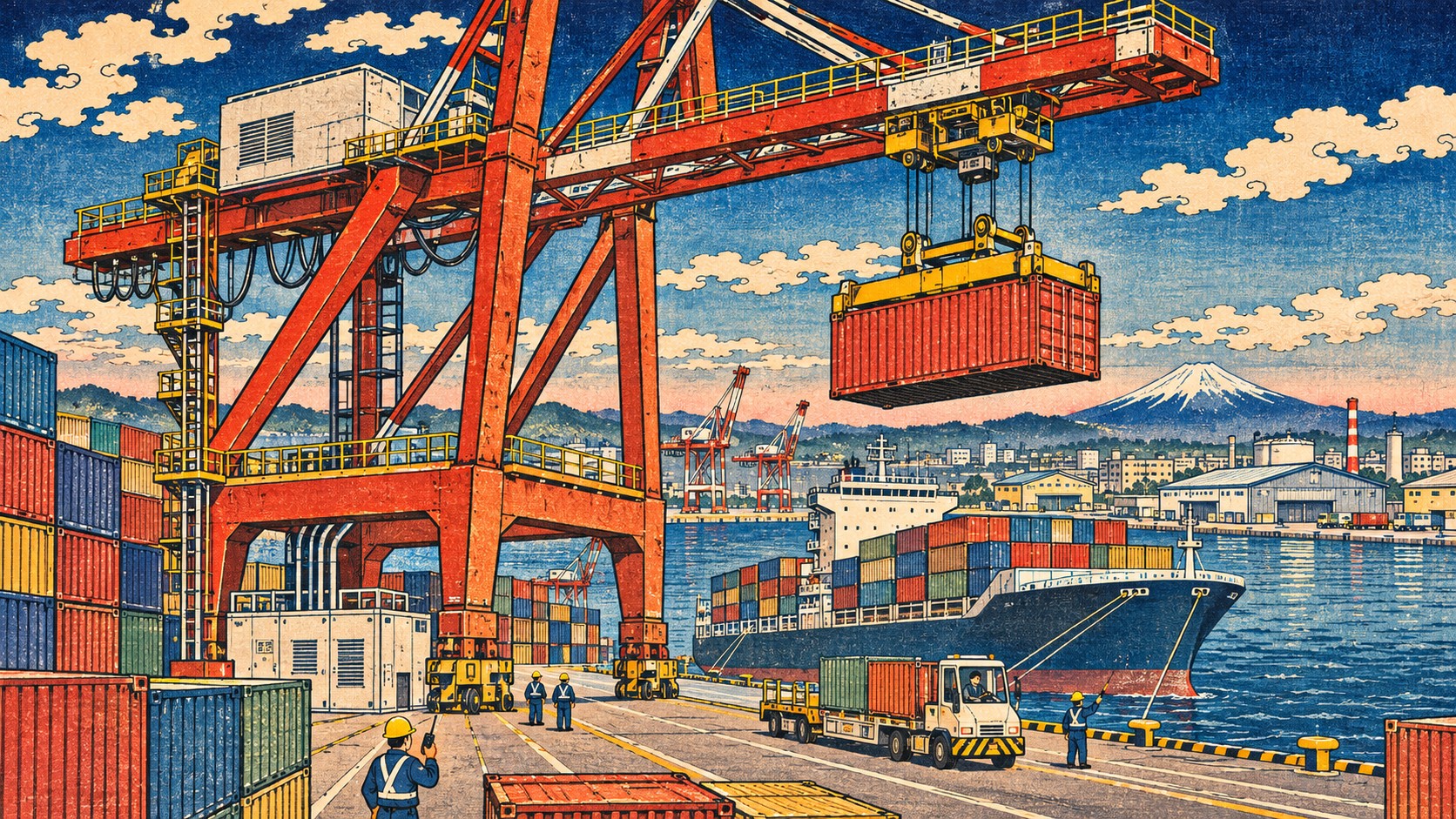
- A cargo crane is now part of Japan’s climate scorecard
- What a CNP rating actually certifies
- Tokyo: 100% LED lighting and a major crane modernization
- Sendai-Shiogama: a regional gateway takes a second step
- The numbers behind the claims: 5.07 and 16.49 kg CO₂ per TEU
- How the policy grew from local experiments to an international ambition
- Will certification make Japanese ports more competitive?
A cargo crane is now part of Japan’s climate scorecard
At a working container terminal, the climate question is not abstract. Shore cranes raise steel boxes, yard machines shuttle them into stacks, trucks queue at the gates and ships wait at berth. Even when the port authority has made an ambitious climate pledge, its environmental performance depends on the electricity, diesel fuel, operating rules and measurement systems used every day.
On November 20, Japan’s Ministry of Land, Infrastructure, Transport and Tourism (MLIT) certified two terminals under its Carbon Neutral Port, or CNP, program. Oi Container Wharf Nos. 1 and 2 at the Port of Tokyo received Level 4++; Takasago Container Terminal at the Port of Sendai-Shiogama received Level 2+. The government had recognized 15 terminals before this announcement, bringing its listed total to 17. The precise terminals and levels appear in the ministry’s November 20 release.
The dates matter. November 20 was the certification date. The Tokyo presentation ceremony is scheduled for November 26, and the Sendai-Shiogama ceremony for December 23. Neither ceremony had occurred as of this November 24 edition.
What a CNP rating actually certifies
Japan established the container-terminal CNP system in March 2025 and began accepting applications on June 30 of that year. Its five-level scale assesses specified steps toward lower-carbon cargo handling, including planning, equipment, lighting and measures affecting vehicles and ships. Additional recommended measures are recognized with plus signs. The scheme is designed to make actions comparable and visible across operators, rather than letting every terminal choose its own marketing language.
Level 4++ is not a claim that an operator has cut emissions by 80%, and Level 2+ does not signify that a port is halfway to net zero. The rating is based on satisfying the criteria at a given level, while the plus marks indicate qualifying extra measures. Crucially, a container terminal is only one part of a harbor’s emissions picture. Ocean voyages, inland freight journeys, fuel supply chains and industrial activities beyond the certified terminal are not automatically included.
That distinction shapes what readers should take away: certification is useful evidence of documented action but not a blanket guarantee of zero emissions, a carbon-neutral shipping route or a fully decarbonized city. Its credibility will ultimately depend on continuing emissions disclosure and the consistency of the underlying accounting.
Tokyo: 100% LED lighting and a major crane modernization
Tokyo’s Oi Nos. 1 and 2 are the first terminals at the Port of Tokyo to obtain the scheme’s certification, according to the metropolitan government. The evaluation cites 100% deployment of inverter-controlled gantry cranes, 92% deployment of low- or decarbonized transfer cranes and 100% LED lighting within the defined assessment. Tokyo also points to early gate opening, steps to relieve yard congestion, and port-entry incentives for ships with better environmental performance. Renewable-sourced electricity contributed to the extra “++” recognition.
The certified facility spans around 26 hectares of yard and 660 meters of quay. Its profile describes hybrid rubber-tyred gantry cranes (RTGs), continuously operated CONPAS gate-management arrangements, renewable electricity and electric vehicles or charging facilities. Tokyo Metropolitan Government, Tokyo Port Terminal Corporation, Daito Corporation and Kawasaki Kisen Kaisha (K Line) are named as cooperating participants. Details and rollout ratios come from Tokyo’s November 20 assessment and the national terminal profile.
These distinctions matter technically. Inverter control can save energy without eliminating upstream power-generation emissions. Hybrid cranes can reduce fuel consumption without becoming fully electric. Nor does the certification cover every terminal throughout the Port of Tokyo. The city’s reported adoption percentages apply to specified equipment at this certified facility.
Sendai-Shiogama: a regional gateway takes a second step
Takasago Container Terminal serves the Sendai port district within the wider Port of Sendai-Shiogama. The regional development bureau says the Level 2+ decision is Tohoku’s first at Level 2, following an earlier Level 1 certification at Hachinohe. The distinction underlines the regional progression without implying that the ports have identical operating models.
According to its official profile, Takasago has approximately 33 hectares of yard, a combined quay length of 830 meters and berths with depths of 12 and 14 meters. The document describes it as handling roughly 60% of the container cargo moving through ports in the Tohoku region. At the time of the profile, it listed five international regular-service routes with eight weekly sailings, including a Philippines service introduced in March 2026, plus seven domestic routes with ten weekly sailings. These are a dated operational snapshot, not a guarantee of future schedules.
Its credited initiatives include inverter-controlled gantry cranes, LED lighting, lower-carbon straddle carriers and port-radio operations aimed at reducing congestion. Miyagi Prefecture, Sanriku Transport and NX Sendai-Shiogama Port Transport are identified among the entities involved. For a regional gateway, better fuel use and equipment efficiency can matter to manufacturing and distribution even when the absolute volume is smaller than at Tokyo’s primary terminals.
The numbers behind the claims: 5.07 and 16.49 kg CO₂ per TEU
The official terminal profiles publish carbon-intensity figures: 5.07 kilograms of CO₂ per TEU for Tokyo’s Oi Nos. 1 and 2 and 16.49 kilograms per TEU for Takasago. A TEU is the conventional equivalent of one twenty-foot shipping container, providing a common cargo-volume unit. Publishing such figures represents a meaningful step beyond saying only that a terminal has bought efficient machinery.
Yet this is not a scientifically defensible league table of whole-port climate performance. A proper comparison would need matching accounting boundaries, time periods, cargo-handling conditions, electricity emission factors, fleet composition and operating practices. The ministry profiles do not by themselves show the causes of the numerical difference or establish that one port’s entire supply chain is cleaner by a given multiple.
A container terminal’s per-TEU figure also should not be mistaken for the emissions from carrying that container across an ocean and onward to its final customer. For the system to become more informative, users will need to see how emissions intensity and total emissions evolve from one reporting period to another, and precisely which activities the calculations cover.
How the policy grew from local experiments to an international ambition
The story has a longer history than this month’s announcement. Japan’s ports grew as hubs for raw materials, industrial exports and ocean trade. Today the same infrastructure must adapt to pressure from global customers, energy policy and new technologies. Tokyo issued a Carbon Neutral Port formation plan in March 2023 and announced renewable-sourced electricity across its container wharves beginning in April 2024. Later that year, a hydrogen-fueled RTG began cargo-handling operations at Oi in a separate project. Those developments illustrate the breadth of Tokyo’s port agenda, but should not be confused with specific equipment certified at Oi Nos. 1 and 2 in 2026.
For Miyagi, the challenge also intersects with its long effort to build resilient logistics and economic infrastructure after the 2011 Tohoku earthquake and tsunami. Its 2026 long-term port vision explicitly highlighted a CNP certification goal for Takasago, showing that the November announcement connects with a regional development strategy rather than arriving out of nowhere.
The policy is also moving beyond Japan. On October 1, 2026, MLIT and the International Cargo Handling Coordination Association issued international CNP guidance to promote use of the assessment approach overseas. That step is significant for a country whose international supply chains depend on ports around the world. The open question is whether overseas adopters will produce genuinely comparable data, not just similar logos.
Will certification make Japanese ports more competitive?
Shippers and carriers still judge terminals primarily on reliability, costs, available routes and the speed at which freight can move through them. Environmental performance is increasingly another consideration, especially when corporate customers track supply-chain emissions. Measures such as more efficient cranes, clean electricity and reduced truck idling may offer both operational and environmental advantages. But the size of those benefits depends on capital spending, local power prices, traffic flows and maintenance.
Nothing in the November 20 release shows that certification has already increased cargo volume, won a shipping contract or reduced emissions by a specific absolute amount. Such claims require independent evidence over time. Nor does a high rating imply that a harbor has solved the harder challenge of supplying zero-carbon fuel to ships on the high seas.
The next questions are concrete: How often are emissions figures updated? Are the methods and boundaries consistent? Which machines are still powered by fossil fuels? What will be the next investments in shore power, low-emissions trucks and fuels? And will operators publish progress once the initial recognition has faded from the headlines? Tokyo and Sendai-Shiogama now have measurable milestones. Whether those milestones translate into durable climate gains is the story to follow.
Primary sources and further reading
This report draws on Japanese government and regional primary sources. Terminal ratings are not presented as proof of zero emissions, and pending certificate ceremonies are identified as scheduled events.
- MLIT certification announcement, November 20
- MLIT CNP certification register
- Tokyo Metropolitan Government: Oi 1–2 measures and ratings
- MLIT: Oi 1–2 terminal profile
- MLIT: Takasago terminal profile
- Tohoku Regional Development Bureau: Sendai-Shiogama notice
- Tokyo: renewable electricity introduction, 2024
- Tokyo: hydrogen-fueled RTG operations, 2024
- MLIT: international CNP guidelines, October 2026
- Miyagi Prefecture: Sendai-Shiogama Port long-term vision 2026