- A diplomatic meeting with a practical outcome
- A relationship built through migration and industrial engineering
- Brazil wants the capacity to build, not merely buy, AI
- Electricity is part of the AI supply chain
- Why language and local knowledge matter
- From farms and factories to disaster response
- Safety and privacy are conditions of commercial trust
- How to judge the next chapter
A diplomatic meeting with a practical outcome
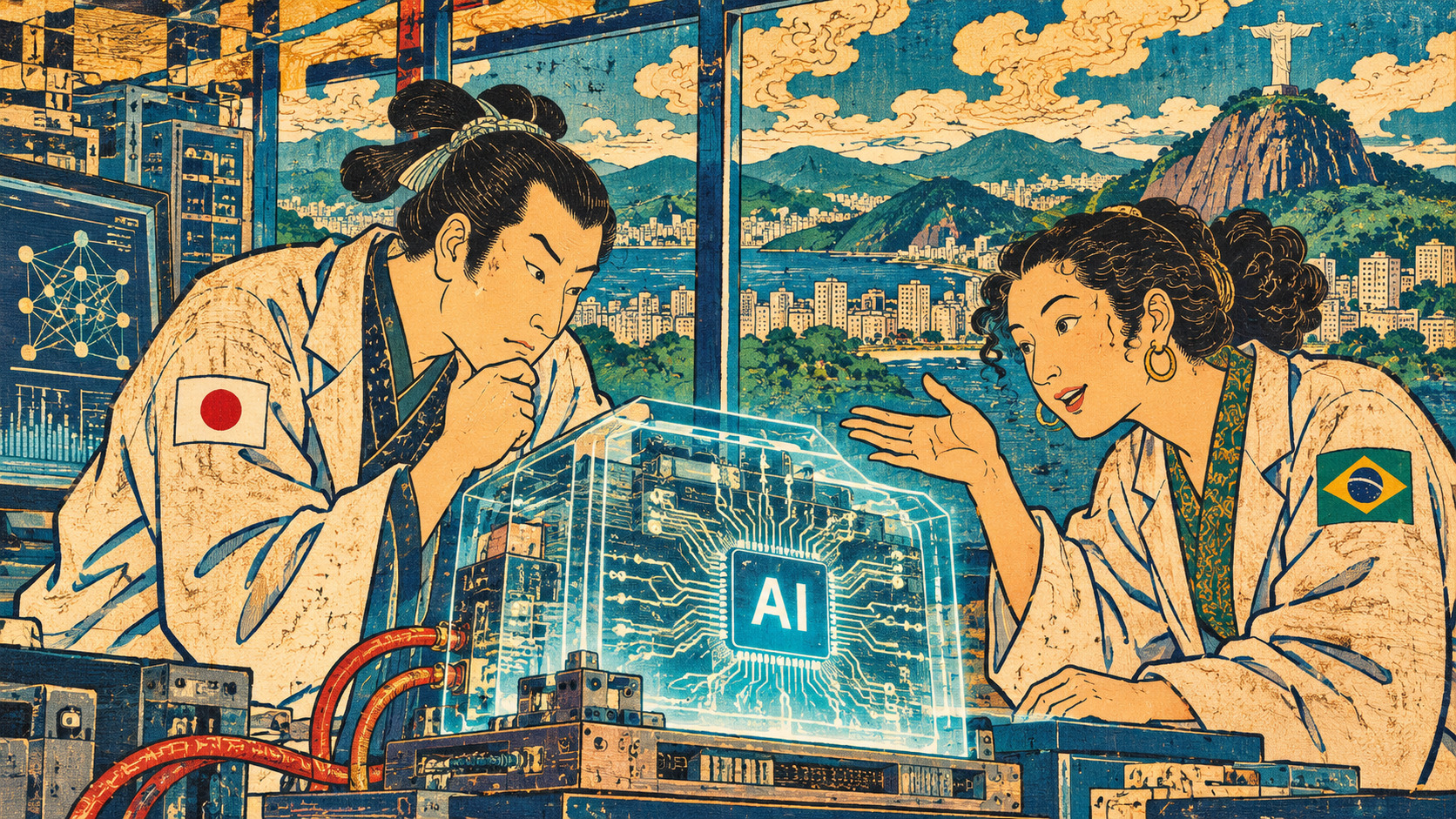
The most tangible result of Japan and Brazil’s inaugural AI dialogue was not a new chatbot or a billion-dollar computing contract. It was a memorandum between Japanese satellite company ArkEdge Space and the University of Brasília. The agreement, reported by Japan’s foreign ministry on November 24, concerns combining space-system information with connected devices and artificial intelligence. It offers a useful illustration of how the two countries might work together: start with a real information problem, then assemble the technology needed to solve it.
The Tokyo meeting followed the June 16 summit in France, where the leaders welcomed the creation of a bilateral AI dialogue. The November session brought together government officials and research organizations, while a separate networking event introduced businesses from both countries. Japan’s Takahiro Hanada and Brazil’s Eugênio Vargas Garcia co-chaired the discussions.
The agenda ranged from computing infrastructure to language models, research training and the risks of advanced AI. Continuing the dialogue was the shared commitment; a funded bilateral AI laboratory, a procurement contract or a specific commercial deployment was not announced in the ministry’s account. The distinction is important for anyone assessing the commercial significance of the meeting.
A relationship built through migration and industrial engineering
Japan’s relationship with Brazil predates the digital age by more than a century. Diplomatic relations began in 1895. In 1908 the Kasato Maru brought Japanese migrants to Brazil, beginning a sustained movement of people that helped shape agricultural communities and eventually a large Japanese-descended population. Japan’s foreign ministry now estimates that community at approximately 2.7 million people.
Relations were interrupted during the Second World War and restored in 1952. Industrial cooperation subsequently became a major part of the relationship. The Usiminas steelworks began operations in 1962, illustrating the importance of engineering knowledge and long-term investment. In the 1970s, agricultural collaboration in the Cerrado brought together research into soils, irrigation and farming techniques. That history also illustrates why development must be evaluated against environmental costs rather than production alone.
A science and technology cooperation agreement signed in 1984 entered into force the following year. The strategic partnership established in 2014 broadened the relationship further. AI is therefore not the beginning of technological cooperation, but a new field in which institutions with decades of experience can explore shared problems.
Brazil wants the capacity to build, not merely buy, AI
Brazil’s national AI plan, launched in 2024, provides the wider context for the November meeting. It envisages roughly 23 billion reais in investment through 2028, using several financing mechanisms. This is a programme of intended investment, not an audited figure for spending already completed. Its ambition extends beyond commercial applications to public services, training and domestic technological capability.
Brazil has research institutions that can participate in such a partnership on their own terms. The University of São Paulo hosts C4AI, a research centre established in 2020 with backing from IBM and the São Paulo Research Foundation. Its work connects fundamental research with practical challenges. The National Laboratory for Scientific Computing, another participant in Tokyo, announced in August 2026 that it was developing plans for a new AI-oriented supercomputer in the northeastern state of Rio Grande do Norte.
For Japanese technology businesses, these institutions offer potential research counterparts rather than simply prospective customers. Local scientists can identify relevant datasets, define meaningful benchmarks and distinguish a promising laboratory result from a system that actually works in Brazil. Building that relationship requires shared research priorities and agreements over access to computing resources and intellectual property.
Electricity is part of the AI supply chain
A language model is a software product, but producing and operating it requires physical infrastructure. Data centres depend on power connections, cooling equipment, networking and skilled maintenance. Brazil has an important starting advantage: JETRO’s November 2026 analysis puts renewables at 86.8 percent of the country’s 2025 electricity mix, including imported electricity.
That national figure is not a guarantee of clean or inexpensive electricity at every site. Hydropower output changes with water availability; wind and solar vary over time. Grid connections, backup power, water use and telecommunications capacity can determine whether a facility is commercially viable. The concentration of existing centres in southeastern Brazil and the renewable resources of the northeast create different opportunities and constraints.
The wider Japanese industrial supply chain could potentially contribute power electronics, cooling systems, monitoring equipment and network components. These are plausible commercial opportunities, not projects awarded at the Tokyo meeting. Any proposed facility would need its own financing, power arrangements and environmental assessment.
Why language and local knowledge matter
Large language models were among the subjects on the bilateral agenda. A model that performs well in English does not automatically understand Brazilian Portuguese or Japanese industrial terminology. Even a fluent translation can conceal a serious mistake: an incorrect measurement, a misunderstood safety instruction or a reference to the wrong local regulation.
Joint teams could build evaluation datasets around the languages and industries they know best. A manufacturer operating in both countries might, for example, test whether a multilingual assistant retrieves the correct maintenance procedure and preserves numerical specifications. The relevant measure would be accuracy and reliability on actual tasks, not whether the answer merely sounds convincing.
Research cooperation also requires decisions about who may use training data, who pays for computing time, and whether the resulting code or models can be shared. An exchange programme that enables engineers to work together repeatedly could have more enduring value than a single demonstration. No specific bilingual model release was announced on November 24.
From farms and factories to disaster response
Satellite data could be particularly relevant to a country with Brazil’s geographical scale. Combining remotely sensed images with ground observations may help researchers investigate vegetation change, crop conditions or flooding. Connected sensors can provide measurements from places beyond conventional communications coverage. AI can help prioritize observations, but it cannot eliminate limitations such as cloud cover, infrequent measurements or inadequate validation.
Manufacturing offers a different type of opportunity. Computer vision can support quality inspection, while sensor analysis may help detect early signs of machinery failure. Japan and Brazil already have a framework for industrial collaboration: the 2024 industrial co-creation initiative covers digital economic development alongside energy transition and other industrial priorities.
These examples are potential applications identified through editorial analysis, not a list of funded projects announced at the dialogue. A credible pilot would specify its baseline, compare performance against existing practice, document errors and measure the full cost of operation. A promising algorithm is not necessarily a viable service.
Safety and privacy are conditions of commercial trust
AI safety was a distinct item on the agenda. Japan established its AI Safety Institute in February 2024 to investigate evaluation methods and foster international coordination. Cooperation on testing could help researchers understand where advanced systems fail, how misuse can be detected and what controls are necessary before deployment.
Brazil also has its own rules for handling personal information. Its data protection authority adopted an international-transfer regulation in 2024, including standard contractual clauses. A service that transfers customer records, employee information or medical data between Brazil and Japan cannot assume that diplomatic cooperation creates an exemption from applicable privacy requirements.
Companies need to establish who controls the data, what purpose processing serves, how access is restricted and who is responsible when a system produces a harmful error. In sensitive applications, human oversight and clear escalation procedures are particularly important. The two countries’ willingness to discuss governance does not mean their regulatory systems have become identical.
How to judge the next chapter
Japan’s foreign ministry records 2025 exports to Brazil of 737.1 billion yen and imports of 1.3551 trillion yen, based on customs trade statistics. The relationship already encompasses industrial goods and agricultural commodities. AI may add new services and research links to that established commercial foundation, rather than replace it.
The November dialogue should ultimately be judged by observable developments: named research teams, funded programmes, transparent data arrangements, tested prototypes and evidence of improvements for users. The satellite memorandum offers a concrete starting point, but its detailed budget, timetable and implementation scope have not been disclosed in the ministry’s announcement.
The opportunity is to connect Japanese engineering capabilities with Brazilian research and local knowledge. In that sense, the challenge resembles earlier industrial partnerships: technology becomes economically useful when people on both sides can adapt it, operate it and improve it over time. The first dialogue opens that possibility; the work of proving its value lies ahead.
Primary sources and references
- 外務省|第1回日・ブラジルAI協力対話の開催(結果)
- MOFA — First Japan-Brazil AI Cooperation Dialogue
- 外務省|日・ブラジル首脳会談(2026年6月16日)
- 外務省|ブラジル基礎データ
- 在ブラジル日本国大使館|交流史(19世紀~1940年代)
- 在ブラジル日本国大使館|交流史(1950年代~1980年代)
- 経済産業省|日伯産業共創イニシアティブ
- JICA|セラード灌漑事業
- MCTI — Brazilian AI plan and governance
- Finep — PBIA financing
- University of São Paulo — C4AI
- LNCC — New AI supercomputer project, August 2026
- JETRO|データセンターハブを目指すブラジル
- 経済産業省|AIセーフティ・インスティテュート設立
- ANPD — International data transfer regulation
- アークエッジ・スペース|非地上系ネットワーク