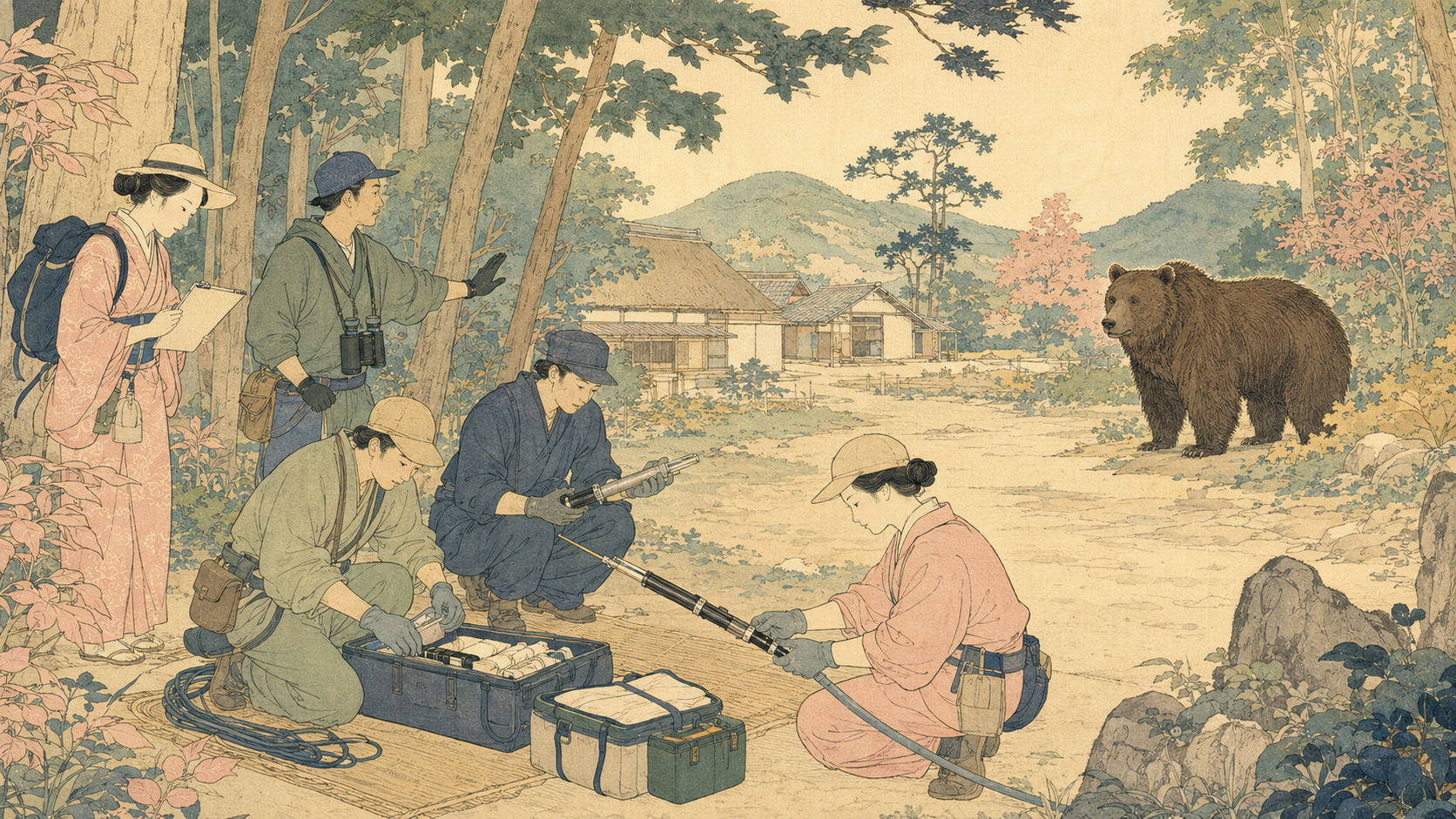
Picture the moment after the dart lands. A bear is trapped in a shed, a box trap or a narrow garden. Police have closed the road. Residents have been ordered indoors. The shooter sees the injection dart strike a muscular part of the animal and must decide whether the drug was delivered. Nothing visible ends. The bear may whirl, charge, climb, pull out the dart or search for an exit. The clock has started, but unconsciousness may still be at least 10 to 15 minutes away.
That interval is the heart of the Environment Ministry’s new 15-page reference document, released on July 24. Its title is bureaucratic—“Building a System for Capturing Bears with Anesthesia”—but its subject is urgent. The handbook tells local governments how to prepare for captures using gas-powered anesthetic dart guns or blowpipes in places where people live. It maps the laws governing drugs, firearms and wildlife; identifies when chemical immobilization may be appropriate; and shows how Akita, Shimane and Nagano have assembled working teams.
The publication follows Japan’s deadliest recorded fiscal year for bear conflict. Provisional ministry data list 216 incidents, 238 victims and 13 deaths in fiscal 2025. Through June 2026 alone, 36 incidents had injured or killed 40 people, including six deaths. Anesthesia is not the answer to that national crisis. It is one tool for a narrow but increasingly common emergency: a large, powerful animal in a place where a conventional bullet may endanger everyone behind it.
What the new document is—and is not
The ministry calls the publication reference material, not a universal order or a complete veterinary protocol. Its intended readers are local-government officials and people already involved in wildlife capture. It does not authorize a member of the public to buy drugs, acquire a dart gun or attempt an immobilization. Nor does checking every box guarantee that anesthesia is the correct choice.
Instead, it gives municipalities a blueprint for capacity that must exist before a bear appears. Who legally owns the gun? Where is it stored? Who holds the drug license? Which police station receives the paperwork? Who closes the road, commands the scene, mixes the drug, fires the dart, watches the bear, protects the shooter, retrieves a missed dart and records every milligram? If those questions are first asked while a bear is moving through a school zone, the response is already late.
The guide also corrects two persistent misunderstandings. Japanese law does not require a veterinarian to administer anesthesia to a wild bear, because wild bears are outside the category of animals covered as veterinary patients under the Veterinarians Act. And a person does not need prior hunting experience merely to receive permission to possess an animal-anesthesia gun. Those statements remove institutional barriers; they do not remove the need for skill. The ministry repeatedly calls for experienced operators, safety equipment and case-by-case judgment.
Anesthesia is not instant sleep
Popular images of wildlife capture compress time: dart, stagger, sleep. Field pharmacology is less obedient. The dose must be estimated before the bear can be weighed. A dart may strike at a poor angle, fail to discharge fully or lodge in thick fat before hibernation. A frightened animal’s physiology can delay or blunt the effect. Even when the full drug load enters muscle, the ministry warns that immobilization takes time.
During that delay, the injection itself may make the bear more agitated. The animal can attack the capture team or escape toward residents, traffic and buildings. Operators must therefore prepare an additional dose, but repeated administration introduces its own medical uncertainty. They must also be able to distinguish a slowing bear from a safely immobilized one and keep the public exclusion zone in place for as long as necessary.
The advantage is ballistic. Dart guns generally operate at shorter effective ranges than hunting firearms; blowpipes are shorter still. Their projectiles carry far less energy, so the danger of a fatal ricochet or a round passing through the animal and into a wall, car or person is lower. The tradeoff is proximity. Akita’s examples put dart-gun shots at roughly 10 to 30 meters and blowpipe work at one to two meters. In Shimane, a dart gun may be used from five to 20 meters against a bear restrained in a snare; a blowpipe may be only 1.5 meters from a bear in a box trap.
A safer projectile is not necessarily a safer operation. It transfers part of the risk from what happens beyond the target to what happens between the bear and the operator.
The ministry’s decision test
The guide offers circumstances that can support an anesthesia decision without turning them into an automatic checklist. Chemical immobilization may make sense when a safe backstop for live ammunition cannot be secured; when dart range is short enough to clear everyone from the danger zone; when the team can retreat inside a building or vehicle if the bear charges; when the animal has no open escape route; or when a property owner will permit a dart but not a conventional shot.
Every condition points to containment. A bear inside a box trap, shed or other confined structure presents a different problem from a free-moving bear on a street. In open terrain, a darted animal may disappear before the drug takes effect. In a neighborhood, the same animal may run from the shooter into a crowd. The new document does not declare that anesthesia is preferable because it appears more humane. It asks whether the entire scene can remain safe if the bear becomes more dangerous after being hit.
| Question before firing | Why it matters |
|---|---|
| Is live ammunition unsafe because there is no reliable backstop? | Anesthetic darts reduce ricochet and penetration hazards but create a delayed immobilization problem. |
| Can all residents and bystanders be cleared beyond the projectile’s maximum reach? | A dart can injure a person, and a missed drug-filled projectile must be recovered. |
| Can the shooter and assistants retreat behind a hard barrier immediately? | A struck bear may charge before the drug works. |
| Is the bear contained, or is every likely escape route controlled? | A mobile, darted bear can carry the emergency into another street or building. |
| Are a backup response and additional drug ready? | The first dart may miss, fail to discharge or produce inadequate immobilization. |
| Is there a lawful plan for what happens after immobilization? | Capture may lead to examination, tagging, transport, release or killing; anesthesia does not decide the management outcome. |
One operation, several bodies of law
Japan’s rules are difficult because an anesthetic dart is simultaneously a wildlife-capture method, a firearm operation and a delivery system for tightly controlled drugs. Different permits attach to different combinations of place, tool, substance and legal authority.
An ordinary authorized capture requires permission under Article 9 of the Wildlife Protection, Control and Hunting Management Act. Firing an anesthetic gun in a residential concentration or other crowded place normally adds a governor’s authorization under Article 38-2. If a toxic or powerful drug makes the method a legally defined “dangerous hunting method,” an Environment Ministry permit under Article 37 may also be required. A blowpipe is not a firearm under the gun-control law, but use of certain drugs through it can still trigger wildlife-law restrictions.
The 2025 emergency-hunting system changes the path. A municipality can authorize firearm use against an adult bear or boar in the sphere of daily human life when statutory safety conditions are met. Under that system, a dart-gun operator does not need the ordinary Article 9 or residential-area permissions, but the operator must satisfy special experience requirements. The new handbook says the person must have used the same type of gun within the previous three years to capture a wild bear, boar or deer. Zoo experience does not count.
| Layer | Typical requirement | Operational consequence |
|---|---|---|
| Wildlife capture | Article 9 capture permission, unless the operation qualifies as emergency hunting | Annual, broad-area permissions can reduce delay, as Akita and Shimane demonstrate. |
| Residential dart-gun use | Governor’s Article 38-2 authorization for ordinary capture | Akita prepares annual permissions where possible but applies case by case for this location-specific approval. |
| Emergency hunting | Municipal decision, statutory scene conditions and a recently experienced operator | It expands options but does not permit an immediate shot merely because a bear is visible. |
| Gun possession | Prefectural Public Safety Commission permission under the firearms law | The owner, supervised users, storage and transport must be arranged in advance. |
| Controlled drugs | Licenses, prescriptions or import confirmations vary by substance | Procurement may take longer than equipment purchase and requires secure storage and records. |
| Dangerous hunting method | Environment minister’s permission can depend on drug and delivery method | A blowpipe may be simpler as a device yet more complicated under wildlife law for some drugs. |
The chemical key has its own lock
The handbook discusses four drugs or drug groups used in bear immobilization. Ketamine hydrochloride is legally a narcotic, a powerful drug and a prescription medicine. Its purchase and possession require a narcotics-researcher license, registration of a research facility, locked robust storage and a narcotics ledger. A worker who is not the licensed researcher may administer it only as an assistant acting under that researcher’s direction.
A tiletamine–zolazepam mixture follows a different route. It is an unapproved veterinary drug in Japan, procured from abroad, and tiletamine is a designated substance. Importation requires confirmations involving agriculture and health authorities, but the mixture is treated differently from ketamine under the dangerous-hunting rules. Medetomidine and xylazine are sedatives that may be combined with an anesthetic; as prescription veterinary drugs, their purchase brings another set of consultations and controls.
This is why “a vet is not legally required to press the trigger” is an incomplete summary. A veterinarian may be the municipality’s most practical narcotics researcher, pharmacology lead and welfare adviser even when the Veterinarians Act does not reserve the injection to that profession. Akita uses both a veterinarian and a wildlife-management specialist as licensed narcotics researchers. Nagano relies on outside experts. The law permits several staffing models, but chemistry still demands competence.
Every loaded dart is also a controlled package. With ketamine, the ministry instructs teams to record the entire quantity as used once fired, even if the dart misses. If a drug remains in a lost dart and could create a public-health hazard, the team must contact the prefectural pharmaceutical office or health center and file a narcotics accident report. Scene safety therefore continues after the bear is gone.
Three prefectures, three ways to build capacity
The strongest part of the national document is its refusal to pretend that every prefecture needs the same organization. Its case studies reveal three distinct models shaped by local geography, staff and purpose.
| Prefecture | Operating model | Typical field team and safety practice |
|---|---|---|
| Akita | Government-owned dart guns at three locations; prefectural specialists prepare drugs and usually fire | At least one prefectural officer, including the shooter, and one municipal officer. A shield-and-bear-spray guard, an open-door escape vehicle or a protected firing gap may shield the operator. |
| Shimane | Prefectural teams respond mainly when bears are accidentally caught in traps and may be released for research | Two or three prefectural staff, one or two municipal staff and two backup hunters. Approach is limited to essential personnel; shots are angled down with a backstop. |
| Nagano | Universities or private specialists own the gun and drugs; municipalities control the scene while the prefecture provides technical support | For a free-moving urban bear, the example minimum includes two prefectural officers, two municipal officers, three hunting-association members and one narcotics researcher, with police and others as needed. |
These are examples, not national minimum staffing ratios. Akita can mobilize a small core because it has invested in trained public specialists and distributed equipment. Shimane’s operation assumes a physically restrained animal and backup hunters. Nagano’s larger urban team compensates for reliance on an outside shooter and a free-moving bear. The lesson is organizational: head count follows hazard, but command, shooter protection, crowd control and a lethal backup cannot be wished away.
The tranquilizer accident Japan should remember
In August 2022, a contractor preparing to capture a macaque in Fuji, Shizuoka Prefecture, accidentally discharged a tranquilizer dart into a nearby woman’s arm. She temporarily lost consciousness, was taken to hospital and recovered. The target was a monkey, not a bear, but the accident illustrates why “less lethal” cannot mean casual.
A dart combines a sharp projectile, compressed-gas equipment and a dose selected for a powerful nonhuman animal. A miss is not empty. Good procedure therefore includes muzzle discipline, a clear firing lane, a controlled perimeter, positive identification of every person near the target, secure handling during equipment adjustment and recovery of every projectile. The public, meanwhile, must not gather for a closer look or turn the cordon into a viewing gallery.
Why Japan needs another tool now
Japan’s bear problem changed faster than its response institutions. The ministry recorded 198 incidents, 219 victims and six deaths in fiscal 2023—a record at the time. Fiscal 2025 then rose to 216 incidents, 238 victims and 13 deaths. Both Asian black bears across much of Honshu and brown bears in Hokkaido set records for authorized captures in fiscal 2025.
Range has expanded as well. Comparing national surveys from 2003 and 2018, bear presence increased in every region except Shikoku. The newest ministry materials show especially large increases in the Kii Peninsula and western Chugoku. Hokkaido estimated its brown-bear population at a median 11,700 in 2020, more than twice its 1990 median estimate of 5,200, though estimates carry substantial uncertainty.
Numbers alone do not explain encounters. Rural depopulation has reduced farming, forestry and daily human movement at the edge of settlements. Abandoned fields, unmanaged orchards and dense vegetation create food and cover. Green corridors along rivers lead into towns. Poor crops of beech nuts, oaks and other hard mast can push animals toward human food in autumn. Once a bear learns that garbage, fruit trees, feed or crops provide easy calories, the geography of risk changes.
Japan responded in stages. In April 2024 it designated brown bears and all Asian black-bear populations except Shikoku as “designated management wildlife,” unlocking national support for population surveys, prevention and capture. A revised law enacted in April 2025 and effective that September created municipal emergency hunting in human living areas. After the record 2025 toll, the government adopted a bear-response package in November and a multi-agency roadmap in March 2026. The anesthesia handbook is one item promised by that roadmap.
From Matagi knowledge to administrative teams
Japan’s relationship with bears is older than any wildlife statute. Mountain hunters known as Matagi developed collective techniques, rules and ritual practices across Tohoku and beyond. Historical research presented by Kitaakita City traces written references to Matagi to 1664. A bear was quarry, food, medicine and a gift of the mountain deity—not merely a pest.
The danger was equally real. In December 1915, a brown bear at Sankebetsu in present-day Tomamae, Hokkaido, killed or injured ten women and children in an episode remembered as Japan’s worst bear disaster. The reconstructed site and local museum preserve it not only as horror, but as a lesson in the relationship between settlement and wild nature.
Twentieth-century policy initially emphasized capture. Asian black-bear harvests rose through the 1960s and reached 2,830 animals in 1970; annual totals stayed near 2,000 during much of that decade. By the late 1980s and 1990s, concern about depleted western populations produced hunting bans and voluntary restraint. The national management framework introduced regional population units and urged harvest limits. Conservation, changing forests and declining hunting pressure helped many populations recover and expand.
That success produced a new problem. The ministry’s 2026 management guideline says the goal is both stable survival of regional populations and lower conflict with people. It now endorses active numerical reduction where populations and distribution have grown beyond coexistence levels, while retaining strict protection where extinction remains possible. The old category “protect bears” and the newer demand “remove dangerous bears” are not opposites. They operate in different places and at different population levels.
One country, two conservation realities
On Honshu and Hokkaido, many local governments face more bears, wider ranges and repeated incursions. On Shikoku, the isolated Asian black-bear population remains close to extinction; its range shrank dramatically between the national surveys. That is why Shikoku was excluded from the 2024 designated-management decision. Other western regional populations also retain hunting restrictions.
Anesthesia does not settle this conservation question. Immobilization describes the method used to gain physical control. What happens next—examination, marking, relocation, release or killing—depends on the animal’s behavior, location, condition and the legally adopted regional management plan. A bear captured alive may still be killed if release is unsafe. A bear accidentally caught in a snare may be anesthetized precisely so it can be released.
Presenting every dart as a rescue would mislead the public. Presenting every capture as extermination would be equally false. The national system must separate three decisions: whether a bear must be physically controlled, how to do so without injuring people, and what population-management outcome is justified after control.
The animal’s safety is part of public safety
The ministry’s handbook is mainly an institutional and legal primer, not a full manual for wildlife anesthesia. A complete local operating procedure still needs to address the bear after it falls: confirmation of depth of immobilization, breathing and circulation, temperature, eye and airway protection, injuries from the dart or trap, safe positioning, transport, recovery and criteria for release. Chemical immobilization can impair thermoregulation; pursuit, struggling and repeated dosing add physiological stress.
Animal welfare is not a luxury separate from human safety. A bear that recovers unexpectedly inside a vehicle threatens everyone nearby. An inadequately monitored animal can die when the operational purpose was relocation or research. A poorly planned release can return the same risk to another community. The capture team therefore needs a written endpoint before firing, not merely a means of making the animal lie down.
The workforce behind the equipment
Japan cannot buy its way out of the problem with dart guns alone. The response requires people who understand bear behavior, firearms, pharmacology, command and local geography. Yet the traditional pool of hunters has shrunk and aged. Official figures cited during the emergency-hunting debate show hunting licenses falling from more than 517,000 in 1975 to about 218,500 in 2020, with roughly 60% of holders then aged 60 or older.
Prefectures are responding with government hunters, wildlife-management specialists and contracts with universities, zoos and private operators. Each model has weaknesses. A centralized specialist may be hours away. An outside expert may not know local roads or command structures. A hunter may understand a charging bear but lack controlled-drug authority. A veterinarian may understand anesthesia but have little field-firearms experience. The team—not a heroic individual—is the unit of competence.
What implementation should look like before autumn
- Pre-authorize what can be pre-authorized: maintain broad, year-round capture and dangerous-method permissions where lawful, with a clear route for case-specific residential approval.
- Distribute people and equipment: map response times, drug storage, dart guns, shields, spray, cages and transport across the prefecture.
- Exercise the whole scene: drill dispatch, command, police coordination, road closure, resident sheltering, firing, dart recovery and medical contingencies.
- Qualify more than one operator: a system that depends on one licensed researcher or shooter is unavailable when that person is sick or distant.
- Write the backup decision: define when another dart, retreat, continued containment or lethal force becomes necessary.
- Plan the animal’s destination: decide who assesses, transports, releases or kills the bear and where each action can lawfully occur.
- Review every deployment: record timing, dose delivery, misses, near misses and public-control failures so the next operation is safer.
Public communication belongs in the plan. Residents should know that a darted bear may remain active, that sirens and roadblocks can last after a successful hit, and that approaching a motionless bear is never safe. During an operation, people should stay indoors when instructed, bring children and pets inside, keep windows and doors closed, avoid the escape corridor and refrain from gathering or flying drones over the scene.
The hardest part begins after the shot
Japan’s new handbook does something valuable by refusing the comfort of a magic dart. It shows a technology bounded by distance, law, physiology and human performance. Its most vivid details are not drug names but arrangements: the shield beside the shooter, the bear-spray guard, the open car door kept as an escape, the backup hunter, the downward firing angle and the official assigned to retrieve a missed projectile.
The long history of Japanese bear management has moved from mountain knowledge to modern conservation, and now from reactive extermination toward planned risk management. None of those eras offers a complete answer. Matagi skill cannot by itself close a city street. A permit cannot read a bear’s movement. An anesthetic cannot restore abandoned orchards or rebuild a depleted rural workforce. A rifle cannot distinguish an abundant population from an endangered one.
But a prepared team can make one dangerous encounter less likely to become another statistic. The measure of the policy will not be how often a dart gun is fired. It will be whether, during the fifteen minutes after impact, every person knows where to stand, what to watch and what must happen next.
Sources and references
This report treats the July 2026 Environment Ministry publication as operational reference material, not a public-use manual or a binding rule. Human-injury and capture totals are provisional and may be revised.
- Environment Ministry: announcement of the bear-anesthesia reference material, July 24, 2026
- Environment Ministry: Building a System for Capturing Bears with Anesthesia (PDF)
- Environment Ministry: provisional bear injury statistics through June 2026 (PDF)
- Environment Ministry: 2026 guideline for regional bear protection and management plans (PDF)
- Environment Ministry: Emergency Hunting Guideline (PDF)
- Environment Ministry: 2016 handling guide for anesthetic guns in residential areas (PDF)
- Environment Ministry: 2021 Bear Appearance Response Manual (PDF)
- Environment Ministry: 2025 emergency-hunting legislation
- Environment Ministry: bear policy, statistics and response resources
- Government of Japan: 2026 Bear Damage Countermeasures Roadmap (PDF)
- e-Gov: Wildlife Protection, Control and Hunting Management Act
- Environment Ministry: ecology, distribution and management history of Japan’s bears (PDF)
- Kitaakita City: historical records and the inheritance of Matagi hunting culture
- Hokkaido Government: Tomamae and the 1915 Sankebetsu bear disaster
- Mainichi Shimbun: 2022 accidental tranquilizer-dart injury in Fuji
- Mammalian Science: field-restraint techniques for carnivores (PDF)