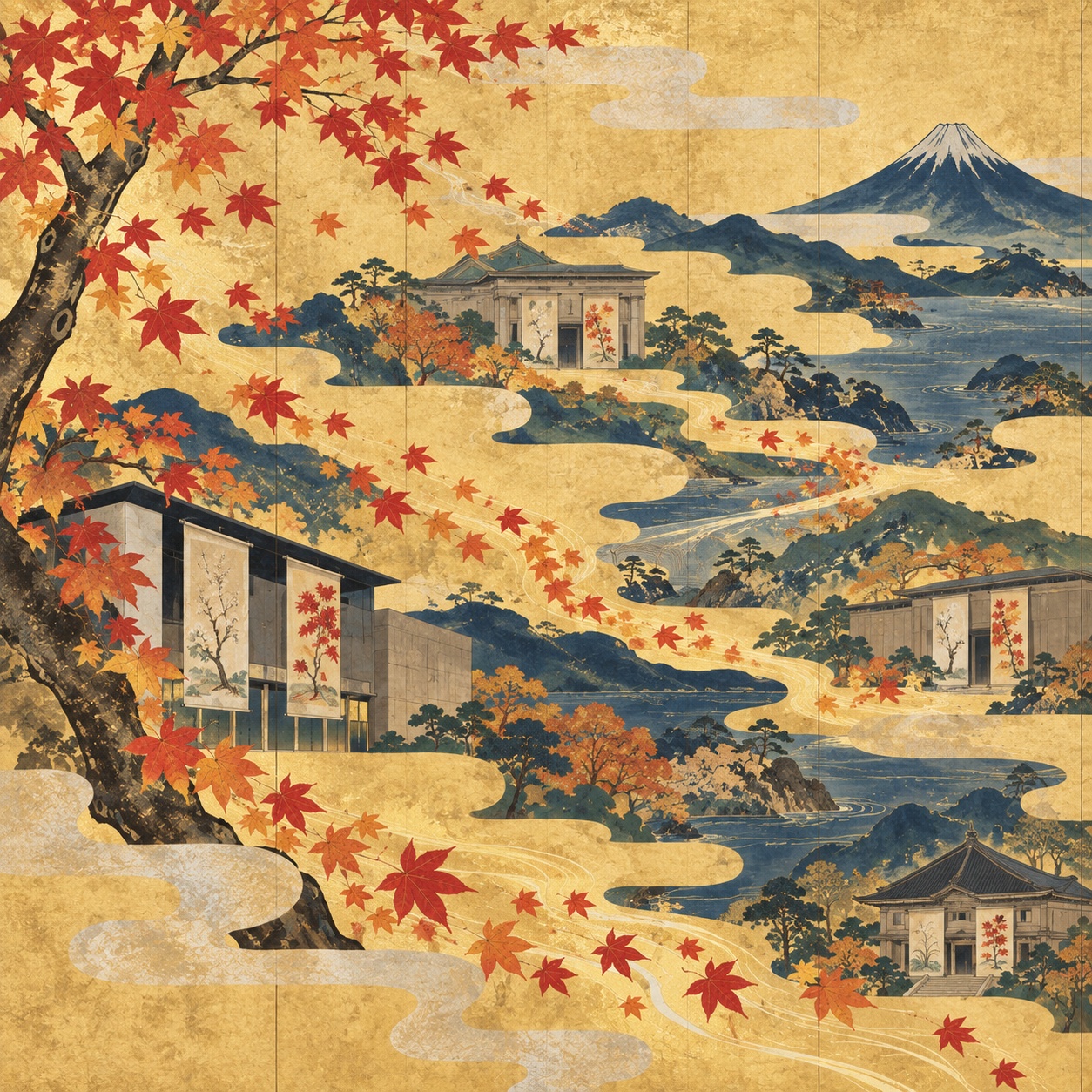
To follow contemporary art in Japan, it used to be natural to begin with the major museums and galleries of Tokyo. In autumn 2026, that map looks increasingly incomplete. The inaugural Maebashi Biennale opened on September 19 not only inside Arts Maebashi but across shopping streets, a hotel, a literary museum, a cinema, a former clock shop, a bank warehouse, vacant buildings and riverside public space. In Gero, Gifu Prefecture, an international art festival is using hot-spring districts, historic streets, forests and a former elementary school. In Niigata’s Echigo-Tsumari region, art programs continue across the satoyama even in a year when the triennale itself is not being held.[1][2][3]
Tokyo has not diminished. The Museum of Contemporary Art Tokyo is running major autumn exhibitions, MEET YOUR ART FESTIVAL returns to Tennoz in October, and the new citywide ARTE TOKYO begins October 10. The capital remains Japan’s deepest concentration of museums, galleries, collectors, publishers and art-market infrastructure. What has changed is that regional festivals are no longer simply trying to reproduce a Tokyo exhibition elsewhere. Their strongest proposition is something Tokyo cannot supply: artworks embedded in landscapes, vacant buildings, hot-spring towns, islands, former schools and shopping streets that cannot be moved without changing the work itself.[4][5]
In Maebashi, the city comes before the museum
Maebashi Biennale 2026 runs from September 19 through December 20 under the theme “Mebuku—Where Good Things Grow.” The festival is explicitly linked to a city-development vision formulated in 2016, a decade of public-private redevelopment, and a series of architecture-led projects including Shiroiya Hotel and Maebashi Galleria.[1][6]
Yet the biennale does not present redevelopment only as finished success. Its venues include renovated architecture but also old warehouses, shopping streets, a former clock store and partially empty buildings awaiting further redevelopment. One official program uses a long-vacant building on Ginza Street for electronic music and immersive art, describing the ruin-like space not as an end point but as a launch point for new activity.[7]
The result changes the act of viewing. Visitors do not simply move from one gallery room to another. They walk past empty storefronts, hotels, restaurants, the Hirose River and both old and new architecture. Art viewing and urban observation become the same trip.
Martin Margiela moves from Tokyo and Kyoto to Maebashi
One of the autumn’s most telling examples is Martin Margiela. An exhibition that traveled through Kudan House in Tokyo and Taka Ishii Gallery in Kyoto earlier in 2026 has been reconfigured for Maebashi, where it is spread across Arts Maebashi, rin art association MAEBASHI in Maebashi Galleria and Shop rin art association.[8]
Calling that merely a regional stop on a touring exhibition misses what Maebashi changes. Margiela’s work now sits within a citywide program alongside local artists, citizen projects, music, cinema, bookstores, commercial streets and architecture associated with the city’s redevelopment. The objects may travel; the surrounding meaning does not.
Gero turns hot springs and a former school into exhibition space
Gero Art Discovery 2026 runs from September 11 through November 8. Fifty-nine artists and artist groups from 14 countries and regions are creating site-specific projects across the Gero Onsen district, historic Hida-Hagiwara, forests, the Minami-Hida Health Promotion Center and the former Yuya Elementary School. The festival describes itself as an international art festival “woven from forests and hot springs, historic roads and abandoned schools.”[2]
The former school is particularly revealing. A project called “School for All” uses the closed building as a place for artworks, classes, play, food and workshops. The organizers set the project against a national demographic backdrop: 8,850 public elementary and junior-high schools closed between fiscal 2004 and 2023, while the number of pupils fell from 17.53 million in 1982 to about 8.92 million in 2025.[9]
The site therefore matters as much as the artworks. Population decline, school closure, mountain culture and tourism become part of the encounter. The visitor guide recommends staying one night and two days to experience the full program, linking art explicitly with food, transport and Gero’s hot springs.[10]
Echigo-Tsumari created a model: use art as a guide through a region
The history of today’s regional-art landscape leads back strongly to the Echigo-Tsumari Art Triennale. The first edition opened in 2000 across Tokamachi and Tsunan in Niigata Prefecture, a vast 760-square-kilometer area shaped by heavy snow, agriculture, aging and depopulation. The official history traces the project to a 1994 prefectural revitalization plan intended to increase exchange population by revealing regional assets through art.[11]
The first triennale featured 138 artists and groups from 32 countries and regions, 153 works and 162,000 visitors. By 2024, the event had grown to 278 groups and individuals from 42 countries and regions, 312 works and 545,931 visitors. Attendance is not a complete measure of regional impact, but the festival’s 25-year continuity has helped establish a durable Japanese model in which abandoned houses, rice fields, forests, villages and schools function as art infrastructure.[11]
2026 is not a triennale year. Even so, “Echigo-Tsumari in 2026” continues through November 8 with exhibitions, food, music, outdoor works and guided programs. Autumn tours encourage visitors to walk the satoyama, and some routes are designed so visitors without cars can still see multiple works. The festival has evolved from a once-every-three-years event toward a year-round regional art field.[3][12]
Setouchi proved that islands themselves could become the venue
The Setouchi Triennale, launched in 2010, extended that logic into an island geography. Its first edition ran for 105 days across nine areas including Naoshima, Teshima and Shodoshima, with 75 participating groups from 18 countries and regions and about 938,000 visitors. By 2013 it had expanded to 14 areas, 200 groups and about 1.07 million visitors.[13]
The innovation was not simply more museum construction. Ferries, ports, village lanes, empty houses and the Inland Sea itself became part of the art itinerary. Travel time and local contact could not be separated from viewing.
Official post-festival reporting also records the costs of popularity: cars entering residential roads, requests for better multilingual guidance, pressure on food provision and the need for continued dialogue with residents. Regional festivals do not become successful merely by attracting visitors. They have to coexist with ordinary life.[14]
Okayama and Fukuoka broaden the model beyond contemporary-art biennales
The autumn decentralization is not confined to international contemporary-art festivals. Okayama Arts Festival 2026 runs from September 1 to December 13 across Okayama City, using Okayama Performing Arts Theatre Harenowa, Okayama Castle, Omotecho shopping streets and community venues for music, visual art, theater, dance, literature and traditional performing arts. The city created the festival in 2023 by restructuring its international music festival and municipal arts festival.[15]
Fukuoka Prefecture is similarly running its prefectural arts and culture festival from October through December across multiple locations, while Fukuoka City has a separate citizen arts festival and a Fukuoka Art Biennale scheduled in November.[16][17]
These are structurally different from Maebashi or Gero, but they share one change: culture is distributed through a city or prefecture rather than concentrated in a single auditorium or museum.
Tokyo remains the center. It is simply no longer the whole map
Regional growth should not be reduced to a Tokyo-versus-the-rest narrative. Tokyo still contains Japan’s largest concentration of major museums, galleries, market infrastructure, schools, critics and collectors. In autumn 2026, the Museum of Contemporary Art Tokyo is staging major exhibitions, and MEET YOUR ART FESTIVAL in Tennoz brings together more than 150 artists.[4][5]
Regional festivals gain strength not by recreating a Tokyo white cube, but by using things that cannot be imported into one: mountains, islands, empty schools, hot springs, local memory, shopping streets and old industrial or financial buildings.
Seeing Margiela in Tokyo and seeing a reconfigured presentation in a Maebashi city center caught between vacancy and architectural renewal are not identical experiences. A work made for a former school in Gero cannot be detached from that school without losing part of its meaning.
From an “art trip” to reading a place
Movement is part of the format. In Echigo-Tsumari, visitors travel between artworks through rice terraces and snow-country settlements. In Gero, they combine JR, shuttle buses, bicycles and walking between hot springs and former schools. In Maebashi, they move on foot through the central city.
Putting every artwork under one museum roof would be more efficient. The inefficiency is partly the point. Twenty minutes between works exposes the visitor to a river, an empty storefront, farmland, houses, a festival preparation or someone’s daily routine. That time alters the artwork.
- Maebashi: A walkable urban biennale connecting museums, hotels, shopping streets, warehouses and vacant buildings.
- Gero: Site-specific art across hot springs, forests, an old highway town and a closed school.
- Echigo-Tsumari: A pioneering satoyama model using villages, farmland, empty houses and landscape as an art field.
- Okayama: A citywide multidisciplinary arts festival distributed across theaters, castle grounds, shopping streets and community spaces.
- Fukuoka: Prefectural and city-level autumn programs combining professional and citizen cultural activity across multiple venues.
Can an art festival “save” a region?
This is where the rhetoric of art-led revitalization needs care. Maebashi explicitly links its biennale to urban regeneration. Echigo-Tsumari began inside a regional revitalization plan. Gero encourages visitors to stay overnight and links its passport to tourism benefits.[6][11][10]
But it is too early to conclude that the 2026 Maebashi or Gero festivals have reversed population decline, revived shopping streets or permanently changed regional economies. Those claims require long-term evidence: attendance, overnight spending, business activity, vacancy rates, migration, resident opinion and repeated visitation.
Echigo-Tsumari’s 25-year history shows that regional art can create enduring institutions and repeated flows of visitors. Setouchi’s own reports show the other side: traffic, pressure on local services, pricing concerns and friction with daily life. Art festivals are not miracle cures. They are one tool in regional management.
Not “art shown in the regions,” but art that requires the region
A useful test of maturity is whether the location is interchangeable. If an exhibition created in Tokyo can simply be moved to another gallery without losing anything, its regional setting may be incidental. If the work depends on the memory of a closed school, the geography of a hot-spring town, the vacancy of a shopping street, the labor of a farming village or the route of an island ferry, the place has become part of the artwork.
Gero explicitly says its 59 participating artists and groups are making site-specific work through engagement with local nature, history and everyday life. Maebashi includes projects made with local students and performances built inside long-vacant commercial structures.[2][18]
At that point, the region is no longer a secondary destination receiving culture from the center. It becomes one of the conditions from which the work is made.
Japan’s autumn art map is becoming a network
Tokyo’s importance to Japanese art is unlikely to disappear. The concentration of institutions, media, education, capital and international access remains formidable. But the map of where serious contemporary art is encountered is becoming plural.
Echigo-Tsumari established a model in 2000 in which artworks guide people through satoyama. Setouchi made islands and sea routes part of the exhibition in 2010. In autumn 2026, Maebashi is linking an international festival to the physical transformation of its city center, Gero is turning a former school and hot-spring district into art infrastructure, and Echigo-Tsumari is sustaining visitation even between triennales.
This is no longer just a story that “there is art in regional Japan too.” It changes what the viewer sees around the artwork: depopulation, vacancy, transportation, memory, tourism, industry and landscape become visible alongside it.
To follow Japanese contemporary art this autumn, a Tokyo exhibition calendar is not enough. The viewer increasingly needs a wider map, a train timetable, sometimes a shuttle bus—and perhaps a room for the night. Changing where art is seen is also changing what part of Japan the art allows us to see.
Sources
- Maebashi Biennale 2026 official site: dates, theme and urban context
- Gero Art Discovery 2026: 59 artists/groups from 14 countries and regions
- Echigo-Tsumari Art Field: 2026 autumn programs and tours
- Museum of Contemporary Art Tokyo: autumn 2026 exhibition schedule
- Tokyo Metropolitan Government: MEET YOUR ART FESTIVAL 2026
- Maebashi City: Maebashi Biennale and central-city regeneration
- Maebashi Biennale: Algorave project in a long-vacant building
- Maebashi Biennale: Martin Margiela exhibition reconfigured after Tokyo and Kyoto
- Gero Art Discovery: School for All in the former Yuya Elementary School
- Gero Art Discovery: visitor guide and overnight itinerary
- Echigo-Tsumari Art Triennale: history since 2000 and attendance data
- Echigo-Tsumari Art Field: autumn 2026 guided visits
- Setouchi Triennale: 2010 and 2013 official summary data
- Setouchi Triennale 2016 report: resident, traffic and visitor-management issues
- Okayama City: Okayama Arts Festival 2026
- Fukuoka Prefecture Arts and Culture Festival 2026
- Fukuoka Citizen Arts Festival 2026
- Maebashi Biennale: artists and local collaboration projects
