- Eleven runs before the first out
- The anatomy of a first-inning avalanche
- Three home runs, three different contributions
- What the pitchers accomplished behind the offense
- A tournament designed to reveal the next generation
- From the first championship in 2017 to a regional fixture
- Australia’s difficult afternoon should not erase its other results
- Three games, three different kinds of victories
- The meaning of sixteen runs is what comes next
Eleven runs before the first out
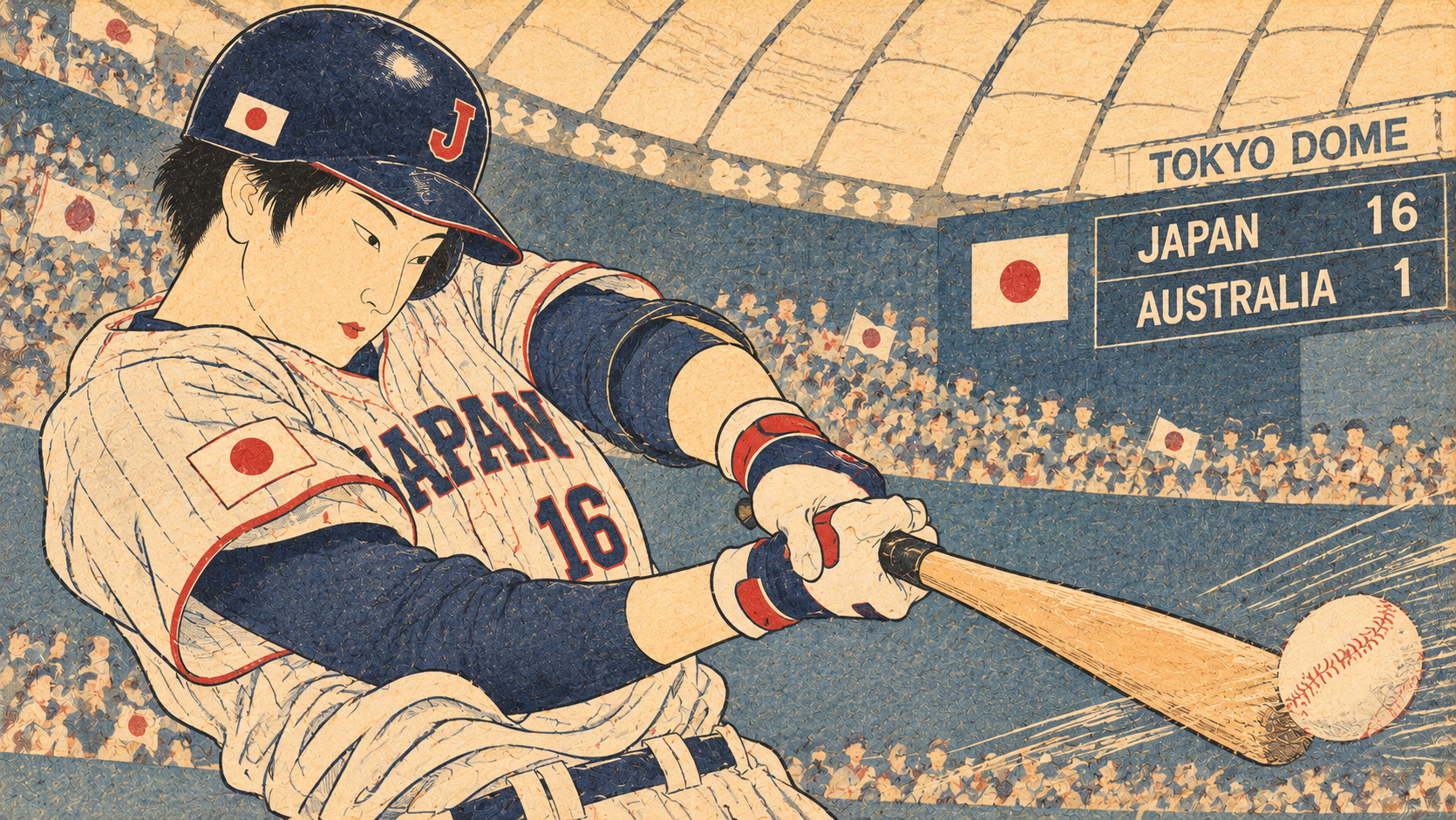
The afternoon began with a walk and a single. Before Australia could record an out, Japan had sent its lineup around and put eleven runs on the Tokyo Dome scoreboard. By the time the mercy rule ended Saturday's Asia Professional Baseball Championship game after seven innings, Samurai Japan had won 16–1 and completed the round-robin stage with three victories in three games.
The scale of the opening inning was extraordinary, but its construction was more revealing than the score alone. Japan did not simply hit four home runs and coast. There were patient plate appearances, mistakes punished, consecutive run-scoring hits, bases-loaded walks and then Rui Muneyama's grand slam. A promising young lineup transformed a sequence of small advantages into a blowout before Australia's first defensive out.
Official Nippon Professional Baseball records put the crowd at 33,711. The game began at 12:02 p.m. local time and ended at 2:39 p.m., lasting two hours and 37 minutes. Japan finished with eleven hits and no errors; Australia managed two hits and committed one error. Understanding that lopsided result requires examining the inning in which the contest effectively changed.
The anatomy of a first-inning avalanche
Tomoya Masaki drew the leadoff walk, and shortstop Rui Muneyama singled to right, putting runners on the corners with nobody out. A ground ball from Misho Nishikawa produced an Australian error and Japan's first run. RBI hits by Koki Yamaguchi and Seiya Watanabe followed. Australia replaced starting pitcher Doran early, but the relief move did not stop the damage.
Japan kept the bases occupied. Tai Sasaki contributed an infield hit; Shunsuke Sasaki and Yudai Shoji drew run-scoring walks, as did Masaki when the order came around again. With the bases still full, Muneyama drove a grand slam toward right-center. The inning reached eleven runs with not a single out yet recorded. This was an attack built partly on Japanese execution and partly on Australia's inability to regain command of the strike zone.
Japan manager Tadahito Iguchi had explained that Muneyama's placement in the number-two spot reflected his ability to use the opposite field after the leadoff hitter reached base. On this day the strategy worked almost immediately. It was a reminder that a devastating inning can begin with a series of disciplined decisions rather than one spectacular swing.
Three home runs, three different contributions
Muneyama's grand slam was only the first Japanese homer of the afternoon. Masaki followed with a two-run shot in the second inning. In the third, after Yamaguchi's double, Watanabe hit a two-run homer that pushed the margin to 15–0. Japan added one more run in the fifth to reach sixteen.
The official NPB box score credits Japan's home runs to Muneyama, Masaki and Watanabe. The last identification matters: some secondary summaries have attributed the third-inning blast to a different player, but the Japanese governing body's game record explicitly names Seiya Watanabe. That primary-source record is the basis for this report.
Samurai Japan's own account noted that Muneyama and Masaki had each reached four home runs in three tournament games. Their production was spectacular, but international development is more than accumulated home-run totals. The first inning also offered evidence of plate discipline, runners advancing on contact and the ability to sustain pressure after the opponent changed pitchers.
What the pitchers accomplished behind the offense
Japan's pitching performance was easy to overlook amid the scoring. Natsuki Takeuchi started, followed by pitchers identified in the official record as Taka, Kutani and Ken Matsumoto. Catching duties were shared by Kojima and Shindo. Australia's only run came when Aydel hit a solo home run in the fourth inning. Otherwise, Japan's pitchers limited Australia to one other hit.
NPB lists Taka as the winning pitcher and Doran as the losing pitcher. That should not be read as a conventional nine-inning starting-pitcher win. With a seven-inning mercy-rule finish and multiple pitchers used, the line is a record of who received the official pitching decisions, not a ranking of every contributor.
In a tournament lasting only four days, distributing innings can also protect the pitching staff for the championship game. A heavily one-sided score offered flexibility to use several arms without putting the outcome at significant risk. The short outing and limited opposition sample are insufficient, however, to establish how those pitchers would fare against a deeper lineup over nine innings.
A tournament designed to reveal the next generation
The Asia Professional Baseball Championship is not the World Baseball Classic. It is a shorter international competition organized around emerging professional talent, giving players a chance to face pitching, defensive systems and pressure that differ from their domestic leagues. Its 2026 edition brings Japan, South Korea, Chinese Taipei and Australia to Tokyo Dome from November 12 through November 15.
The event is backed by Japan's professional baseball organization and counterpart governing bodies from the participating leagues. Its rules have historically emphasized younger professionals while also providing for eligibility exceptions and over-age slots. Describing every participant as strictly under 24 would obscure those provisions; the current tournament's formal eligibility rules should be consulted for any roster-wide demographic claim.
Such events can have long echoes. Players learn to adjust to unfamiliar pitching repertoires and international strike zones; coaches can observe how prospects respond when national expectations replace club routines. A win as emphatic as Japan's against Australia is evidence of what happened on one afternoon, not proof that the development system has already solved every challenge.
From the first championship in 2017 to a regional fixture
The competition began in 2017 with Japan, South Korea and Chinese Taipei. Japan won that inaugural event. Australia later joined to create a four-team tournament, and Japan won again in 2023. The 2026 edition is the third staging, offering Japan an opportunity to pursue three consecutive titles.
Its institutional history reflects a broader story: professional baseball in East Asia and Australia maintains its own league cultures yet increasingly meets in international events. Domestic success remains central to a player's career, but cross-border competition can expose abilities and weaknesses that familiar opponents do not test.
History should also caution against reading the region as a permanent two-country rivalry. Chinese Taipei has an established professional league and its own national sporting identity; Australia draws from a mix of domestic and overseas development pathways. The championship is a platform for all four, regardless of the day-to-day imbalance in individual results.
Australia’s difficult afternoon should not erase its other results
Australia entered the Japan game with a win over South Korea, 8–7, and a 4–6 defeat to Chinese Taipei. That opening victory itself showed the team was capable of winning against strong regional opposition. Its loss to Japan was severe, but one disastrous inning in a short competition is not a complete assessment of a national program.
Samurai Japan's tournament preview described an Australian roster with some players who had experience of major international competition and North American professional development. Their backgrounds made them credible opponents, even though the defensive miscues and loss of command in Tokyo doomed this particular contest.
The useful lesson is precise: Japan capitalized on a weak first inning and continued adding runs, while Australia's lineup produced only two hits. It is tempting to turn a 15-run margin into an argument about the permanent hierarchy of Asian and Pacific baseball. The available evidence does not justify that larger claim.
Three games, three different kinds of victories
The Japanese campaign began with a 5–0 win over Chinese Taipei on November 12. The next evening, Japan beat South Korea 9–5. Saturday's 16–1 victory took the group-stage total to thirty runs scored and six conceded. Each contest tested different abilities: a shutout in the opener, a more competitive win against Korea, and an overwhelming early offensive burst against Australia.
Masaki homered twice in the opening match while pitcher Yumeto Kanemaru impressed. Muneyama homered twice in the Korean game, then added his grand slam against Australia. Japan's performance therefore cannot be reduced to a single star or a single offensive pattern. Multiple players supplied big swings, while the team collected three wins under new manager Tadahito Iguchi.
At the time of this article's reporting cutoff, Japan had secured a rematch with South Korea in the November 15 final. The announced starters were Hiroto Takahashi for Japan and Kim Geon-woo for Korea. Because the championship game remained in the future at the cutoff, this account does not invent its result. The November 17 publication should be refreshed against the official final scoreboard.
The meaning of sixteen runs is what comes next
One inning can dominate a highlight reel and conceal the wider purpose of a tournament. The image most viewers will remember is Muneyama circling the bases after his grand slam, with an eleven-run first inning already guaranteed. Yet the more durable question is whether the skills that produced this avalanche—patience, situational hitting, adaptable pitching—translate into closely contested international games.
Good teams can win routs. More demanding tests come when the opposing pitcher throws strikes, runners are scarce, and the next run may decide the night. Japan's group-stage sweep offered encouraging evidence of offensive depth and pitching management, but it did not remove the need to win those tighter confrontations.
The Tokyo Dome scoreboard will forever record Australia 1, Japan 16 on November 14, 2026. For these players, the number is a milestone rather than a conclusion. The championship and the years of international baseball ahead will determine what that explosive afternoon ultimately represents.
Official records, historical sources and reporting limitations
Compiled from official NPB records, Samurai Japan’s match account and tournament histories. No original interviews or on-site reporting. The November 15 final was not available at the research cutoff.