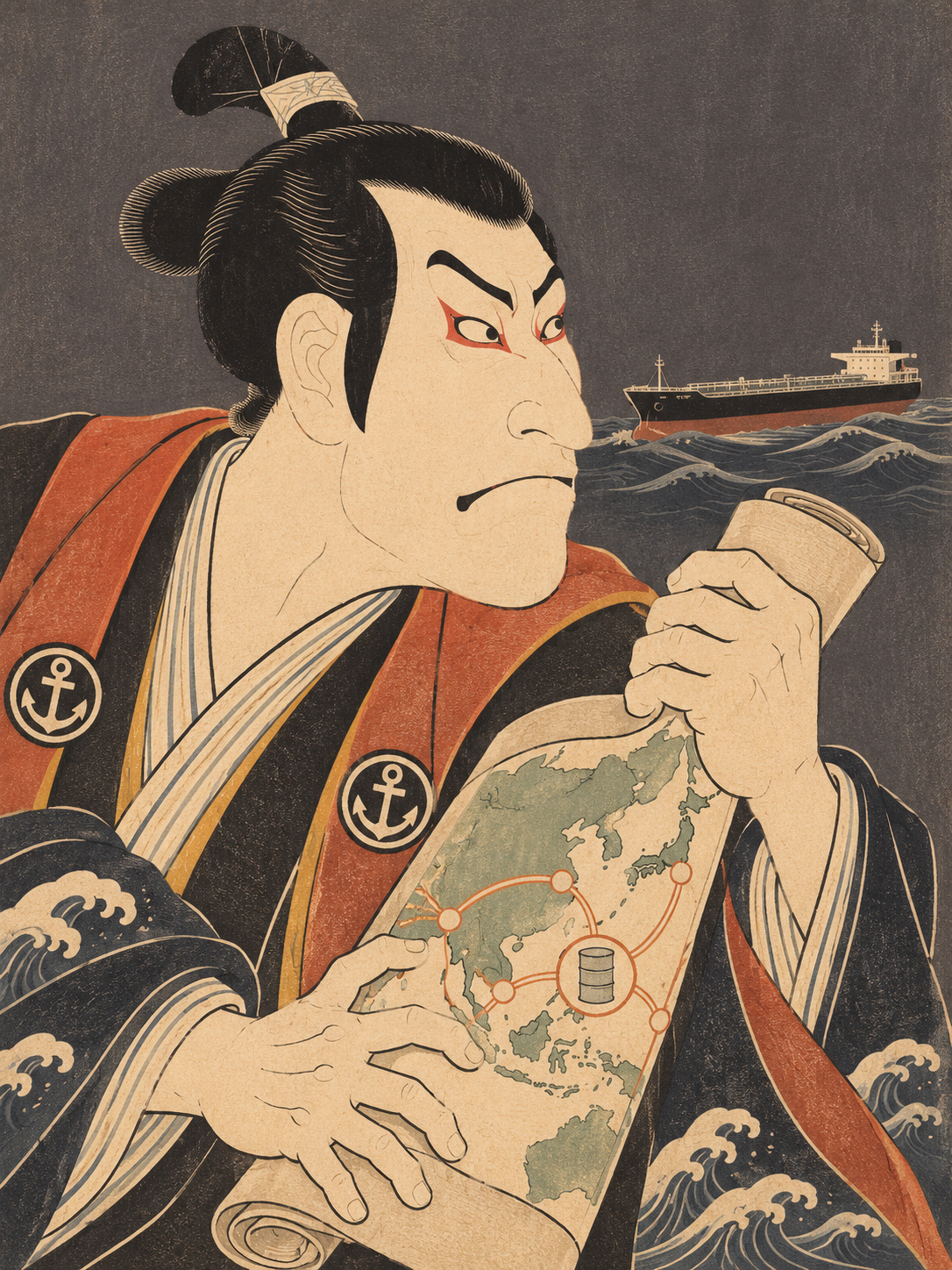
- An Asian oil-security system is taking shape—but is not yet operational
- Why the Strait of Hormuz has renewed an old vulnerability
- Japan learned the importance of reserves the hard way
- Three kinds of stockpiles—and different rules for each
- What the task force, the Tokyo hub and regional storage would each do
- An “Asian IEA” is a metaphor, not a new treaty
- Can idle Japanese tanks serve Southeast Asia?
- Why an emissions-focused partnership is talking about oil
- The potential gains—and the incentives that could divide participants
- How to tell whether the Manila proposal succeeds
An Asian oil-security system is taking shape—but is not yet operational
When an oil tanker cannot reach its destination, a stockpile hundreds of miles away is useful only if someone knows who owns it, who can release it and how quickly it can reach a refinery or fuel distributor. Japan wants Asian governments to answer those questions together. At the fourth Asia Zero Emission Community (AZEC) leaders’ meeting in Manila on November 17, 2026, Tokyo advanced a plan for regional cooperation on emergency oil reserves, market intelligence and coordinated responses to supply disruptions.
Prime Minister Sanae Takaichi co-chaired the meeting with Philippine President Ferdinand Romualdez Marcos Jr. Japan’s proposal centers on an Asia Oil Security Task Force, established at the meeting according to a joint Japan–International Energy Agency statement. Working with the IEA and the Economic Research Institute for ASEAN and East Asia (ERIA), experts are expected to examine stronger inventories and emergency-response arrangements.
A related but separate proposal would create an IEA–Japan Oil Security Hub for Asia in Tokyo. Japan and the IEA expressed their intention to work toward the hub’s establishment; they did not announce that a fully functioning reserve-sharing authority, with guaranteed release volumes, had already begun operations. The distinction matters. The diplomatic architecture has been announced. The operational architecture still has to be built.
Why the Strait of Hormuz has renewed an old vulnerability
Asia’s industrial economy relies on energy that moves through long and exposed shipping routes. The Strait of Hormuz connects the Persian Gulf to the wider ocean, making it a critical passage for supplies flowing from Gulf producers toward Asian buyers. Disruption in or around the strait raises concerns not just about the immediate availability of crude, but also about freight, insurance, refining schedules and the prices paid by households and businesses.
The November 17 Japan–IEA statement specifically identifies instability around Hormuz and Asia’s dependence on imported Gulf oil and gas as reasons for stronger coordination. Not every Asian economy has the same exposure, and not every disruption produces the same shortage. Yet even a country that buys from diverse suppliers can be affected by global pricing and shipping-market stress.
That is why the proposed cooperation goes beyond the simple idea of accumulating barrels. Authorities need reliable data about stocks, clear release rules, rapid communication and ways to deliver the right petroleum products to the places that need them. Without these, an apparently large reserve can be difficult to use during a fast-moving crisis.
Japan learned the importance of reserves the hard way
The first oil shock in 1973 changed Japan’s understanding of economic security. An economy dependent on imported petroleum faced soaring prices and fears of physical shortages. Tokyo responded by creating legal and institutional tools for managing supply, expanding private-sector reserves and ultimately building state-owned inventories. Japan enacted its petroleum stockpiling legislation in 1975 and launched national government reserves in 1978.
The process had begun even before the crisis: Japan started strengthening private stocks in 1972. But the shock turned emergency inventories from a largely commercial safeguard into an enduring public-policy priority. The IEA itself was created in 1974 in the aftermath of the oil crisis, to help importing countries manage major disruptions collectively.
The lesson was not that governments could eliminate dependence on foreign oil. Reserves buy time. They create room to reroute cargoes, adjust demand and prevent temporary supply breaks from cascading into deeper economic damage. The challenge now is to extend some of that resilience across Asia without assuming that every country has Japan’s storage infrastructure or fiscal resources.
Three kinds of stockpiles—and different rules for each
Japan’s petroleum stockholding system comprises government-controlled national reserves, inventories held by private refiners and other firms, and joint stockpiling arrangements under which oil-producing countries’ national oil companies hold crude in Japanese storage facilities. The Agency for Natural Resources and Energy describes these as distinct categories; the owner, legal basis and conditions for use differ.
An agency overview published in 2026 reported 72.89 million kilolitres of oil in storage as of the end of January 2026, equivalent to 70.06 million kilolitres on a product-converted basis and 248 days under the Japanese measure used in the publication. Those are historical January figures, not a verified November inventory, and they do not indicate how much oil could be made available to other Asian countries.
Neither should Japan’s reported “days” be casually equated with the IEA’s requirement for member countries to hold at least 90 days of net oil imports. Different reporting conventions and denominators matter. An accurate discussion of readiness must identify which inventory is being measured, when it was measured and who has authority to release it.
What the task force, the Tokyo hub and regional storage would each do
The package unveiled in Manila has three complementary parts. The Asia Oil Security Task Force is an expert coordination mechanism intended to gather and analyze information, improve stockholding systems and consider emergency-release and sharing rules. It is designed to work with the IEA and ERIA.
Separately, the proposed IEA–Japan Oil Security Hub for Asia would supply technical knowledge and market analysis. The November 17 joint statement says the hub is to be hosted by the Japan Organization for Metals and Energy Security (JOGMEC) in Tokyo, drawing on the IEA’s headquarters in Paris and its Regional Cooperation Centre in Singapore. The initial focus is capacity-building, improved information-sharing and examination of emergency cooperation frameworks.
The third element is physical stockpiling. Japan has proposed exploring whether unused tanks inside the country, potentially including facilities at closed refineries, could store oil for Asian partners in coordination with a Philippines-led ASEAN regional joint-stockpiling initiative. This is a potential project, not a signed commitment identifying particular tanks, volumes or delivery schedules.
An “Asian IEA” is a metaphor, not a new treaty
The label “Asian version of the IEA” helps convey the ambition, but it can obscure the legal reality. IEA member countries are bound by a long-established emergency-response framework and an obligation to maintain oil stocks equivalent to at least 90 days of net imports. The Asian initiative announced in Manila does not automatically impose those same commitments on AZEC or ASEAN participants.
For a regional system to function, governments must agree not only on a headline ambition but also on the trigger for releasing supplies, the legal status of stocks held outside a country’s borders, data confidentiality, cost sharing and dispute resolution. Countries differ in refining capacity, import patterns and domestic energy-pricing systems. A one-size-fits-all agreement may be unrealistic.
The Japan–IEA statement accordingly describes technical assistance, analysis and examination of frameworks as the early priorities. The work is institution-building: developing the conditions under which shared storage and coordinated action might become practical rather than declaring a ready-made emergency authority.
Can idle Japanese tanks serve Southeast Asia?
The infrastructure idea is appealing. Repurposing an idle tank could be less expensive than building a new strategic petroleum reserve from scratch. Japan already has a long history of managing crude oil storage, safety procedures and international stockholding partnerships. For countries with limited land, capital or established reserve systems, access to existing facilities could lower some barriers.
But location cuts both ways. Crude stored in Japan is not immediately usable as gasoline or diesel in another country. A successful emergency response requires appropriate refining capability, compatible product standards, a ship or pipeline route and a port able to receive the cargo. A closed refinery’s tanks may need inspection, repair or new operating arrangements. Storage capacity and rapidly deployable fuel are not interchangeable.
Ownership is equally complicated. If several governments finance a stockpile, do they receive proportional rights to withdraw it? Could Japan restrict shipments during a domestic emergency? Who bears the costs of renewing inventories and insuring cargoes? The November 17 documents do not provide definitive answers, and those questions will help determine whether the project ultimately becomes meaningful.
Why an emissions-focused partnership is talking about oil
AZEC was conceived as an avenue for cooperation on decarbonization and economic growth. Emergency petroleum stocks may seem out of place in a “zero-emission community.” The apparent contradiction becomes easier to understand when short-term resilience and long-term energy transition are considered on different timescales.
Much of the region still depends on petroleum products for transport, agriculture, industrial production and essential services. Maintaining the ability to withstand a sudden disruption does not, by itself, determine long-term demand for oil. Japan’s wider POWERR Asia initiative, introduced in April 2026, also addresses structural resilience, energy-source diversification and cooperation between producers and consumers. Takaichi described a related POWERR Gulf proposal to deepen ties between Gulf suppliers and Asian markets.
The difficult policy test is whether governments can protect essential supply during a crisis while continuing investment in efficiency, clean electricity, alternative fuels and resilient infrastructure. More storage may reduce one kind of vulnerability, but it cannot substitute for diversification of energy systems over time.
The potential gains—and the incentives that could divide participants
For energy-importing countries, shared reserve expertise promises greater predictability and a buffer against disruption. For Japan, technical leadership in a region of vital trading partners may strengthen both diplomatic and commercial relationships. Oil producers could benefit if their customers can receive supplies more reliably or if some oil is stored closer to end markets.
Yet incentives are not perfectly aligned. A government paying to maintain reserves may be reluctant to release them during a domestic shortage. A country facing a sudden crisis may want immediate access even if the oil is located abroad. Emergency shipments could be constrained by maritime insecurity, port congestion or the absence of suitable refining capacity.
Nor can reserves permanently suppress global oil prices. Stocks are finite. In a prolonged disruption, coordinated releases would need to be combined with alternative sourcing, temporary demand measures and perhaps longer-term changes in energy infrastructure. A sound system must acknowledge those limits instead of offering regional storage as a universal solution.
How to tell whether the Manila proposal succeeds
The next milestones will be concrete rather than ceremonial. Which countries formally participate in the task force? What information will they share? Will a timetable and staffing plan be announced for the Tokyo hub? Which Japanese storage facilities pass technical and regulatory scrutiny? Can partners agree on who owns the oil, who pays for it and who orders a release?
The case for cooperation is strong precisely because the remaining obstacles are substantial. Before a crisis, countries need to decide on financing, customs procedures, safety standards, transport contracts, inventory accounting and priority rules. After those decisions, exercises and operational tests would show whether the system can actually deliver fuel when it is most needed.
In 1973, an oil shock pushed Japan toward an architecture of lasting national resilience. The 2026 initiative raises a larger question: can countries whose energy futures are deeply connected create a credible shared safety net while retaining control over their own reserves? The answer will be measured not by the name of a task force, but by agreements and shipments that work under pressure.
Primary sources and reporting scope
This independently written report draws on official materials available through November 18, 2026 (JST). No interviews with officials or participating institutions were conducted. Budget, committed volumes, tank locations, contracts, legal release powers and operational timetables remain unpublished or unverified here. Prepared for the November 20 edition; developments after the research cutoff are not incorporated.
- Japan Ministry of Foreign Affairs: Fourth AZEC Leaders Meeting
- MOFA: Upgrading POWERR Asia (official overview in Japanese)
- Japan–IEA joint statement (Japanese provisional translation)
- Joint Statement by the Government of Japan and IEA (English)
- Fourth AZEC Leaders Meeting: Upgrading POWERR Asia (English)
- IEA: Oil Security and Emergency Response
- Agency for Natural Resources and Energy: Oil shocks and Japan’s response
- Agency for Natural Resources and Energy: Japan’s oil stockpiles (2026 overview)
- Agency for Natural Resources and Energy: Petroleum stockholding statistics methodology
- MOFA: Fourth AZEC Leaders Meeting (English)