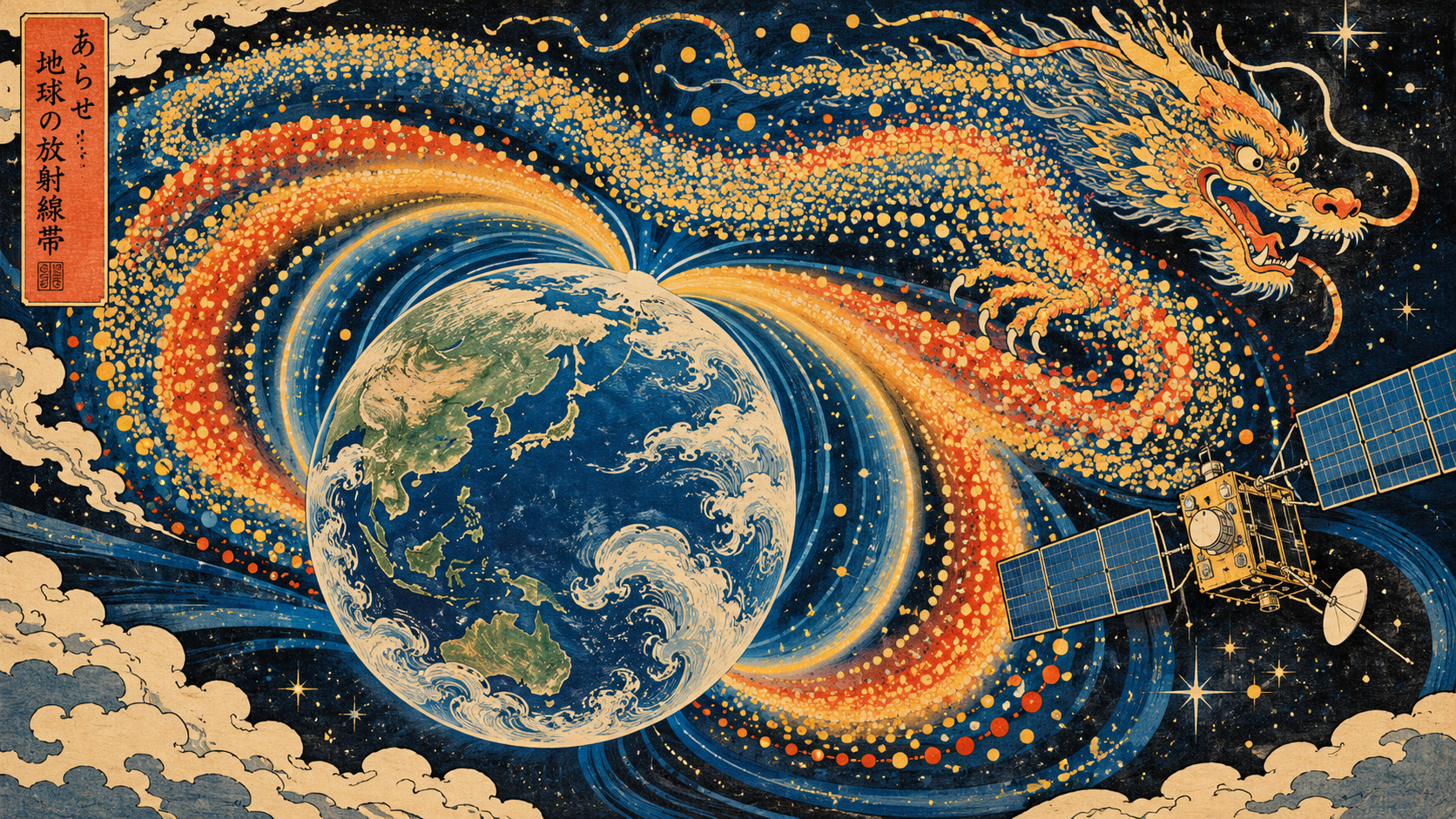
The story is not simply that electrons crossed a boundary. They appear to have gained energy inside it.
The surprise was not a hole in a physical shield
A spacecraft did not photograph a broken wall around Earth. Instead, Japanese satellite measurements revealed something stranger: electrons with energies of several million electron volts apparently gained energy inside a zone long regarded as an effective barrier to their inward movement. A new study links that unusual local acceleration to intense electromagnetic chorus waves and exceptionally depleted plasma during the geomagnetic superstorm of May 2024. The distinction between particles crossing a boundary and particles being energized on the other side is central to the discovery.
A discovery announced in 2026, rooted in a storm in 2024
The timing matters. Kyoto University announced the results on October 27, 2026, following publication in Geophysical Research Letters at 10 p.m. Japan time on October 26. The analyzed storm occurred more than two years earlier. In May 2024, an extraordinary disturbance of Earth’s magnetic environment accompanied auroras visible across unusually broad regions. Arase, a Japanese geospace research satellite, was already collecting measurements. The latest paper turns that rare record into a new account of what happened inside the inner boundary of the energetic-electron population.
What is a radiation belt?
Earth’s magnetic field can confine electrically charged particles, producing radiation belts extending thousands of kilometers into space. The belts are dynamic populations rather than solid rings. Their particle energies, locations and intensities change with space weather. The apparent barrier examined in this study concerns very energetic electrons near a magnetic-coordinate boundary commonly described around L-star of three; Kyoto University describes the affected region as approximately below 12,000 kilometers in altitude. It is not an atmospheric shield and it does not mean Earth’s entire magnetic field suddenly ceased to function.
From the first American satellite to a new mystery
In January 1958, Explorer 1 entered orbit carrying instruments designed by James Van Allen and his team. Data from it and subsequent missions revealed trapped radiation encircling Earth, an early scientific breakthrough of the Space Age. The finding quickly became practical as well as academic. Spacecraft electronics and astronauts encounter environments governed by energetic particles. The challenge has never been simply to map two belts: researchers must explain how electrons are created, accelerated, transported and removed as the Sun disturbs Earth’s magnetic surroundings.
The “impenetrable barrier” emerged in 2014
NASA’s twin Van Allen Probes exposed remarkable fine structure in the belts. A 2014 Nature paper reported a remarkably sharp inner limit for ultrarelativistic electrons—an effective barrier to inward radial transport under observed conditions. The dramatic phrase was useful, but it did not describe an indestructible shell. It was a scientific inference about how a particular population behaved. More extreme storms, different energies and changing plasma environments always remained important tests of that inference. The 2024 event supplied an unusually severe one.
Why a Japanese spacecraft was in the right place
Arase, also known by its mission acronym ERG, launched aboard Japan’s Epsilon rocket from Uchinoura on December 20, 2016. JAXA named the craft after turbulent rapids and the Arase River near the launch location. Its instrumentation was intended to study energetic electrons, magnetic fields and plasma waves together. That combination matters: a measurement showing electron intensities alone would reveal an anomaly, but concurrent measurements of the surrounding wave and plasma environment allow scientists to investigate a plausible physical cause.
The space “birdsongs” that can energize electrons
Chorus waves are electromagnetic plasma waves in the magnetosphere, not audible bird calls traveling through vacuum. When converted to sound they can resemble chirping birds. Under suitable conditions, these waves exchange energy with charged particles and accelerate electrons. In the new study, the electron increase occurred close in space and time to strong chorus-wave activity. Rather than treating the electron enhancement as an isolated curiosity, the researchers investigated whether the waves supplied energy locally in a region once expected to resist such a population.
The missing ingredient: an unusually empty plasma environment
The superstorm severely eroded the plasmasphere, a region of relatively cool plasma surrounding Earth. Kyoto University’s account says recovery remained delayed amid an unusual ionospheric response, leaving plasma densities far lower than typical in the affected area. That changed how chorus waves interacted with electrons. The researchers argue that this environment allowed efficient acceleration to multi-MeV energies deep within the previous boundary. It is a proposed physical explanation grounded in coordinated observations, not a claim that a photographic camera watched electrons being manufactured.
Why this is not the first report that the boundary was crossed
Accuracy requires a look at the recent scientific record. A paper first published in December 2025 combined Macau Science Satellite-1 and Arase measurements and found energetic electrons penetrating unusually deep during the same May 2024 event. It discussed possible transport, diffusion, local acceleration and scattering mechanisms. The October 2026 study should therefore not be described as the first-ever detection of barrier penetration. Its sharper contribution is evidence supporting local acceleration by chorus waves in a drastically depleted plasma region inside the boundary.
Why satellite engineers should care, without exaggeration
Energetic electrons are a recognized concern for satellite charging, electronics and mission reliability. Models of where particles can emerge help engineers assess unusual exposure conditions and help space-weather researchers develop warnings. But this particular study does not document the failure of any named spacecraft or establish a new probability of satellite damage. It also does not show an equal risk for all orbital altitudes. Its engineering relevance is to broaden the physical scenarios that planners and models may need to consider during exceptional disturbances.
A magnetosphere that can both empty and refill
The May 2024 superstorm has generated studies showing sharply different changes in electron populations. Some observations found enormous losses of relativistic electrons from the outer radiation belt during the main phase; others tracked penetration and acceleration deeper inside. These are not necessarily contradictory. Distinct energies, locations and stages of a storm can produce loss in one region while energizing particles in another. Turning a complicated space-weather event into a single claim that all radiation increased would misrepresent the physics.
The international experiment behind a Japanese lead
The new paper lists an international team led by Yoshizumi Miyoshi of Nagoya University with Satoshi Kurita of Kyoto University and collaborators including Ayako Matsuoka. It reflects decades of work across Japanese, American and other research institutions. Japan’s advantage here is less a dramatic one-off instrument than the persistence of a mission capable of observing rare conditions years after launch. Even in an era of sophisticated simulations, exceptionally long-lived sensors can challenge assumptions set by earlier spacecraft.
A better question for the next extreme storm
Scientists now have a more specific puzzle: under which plasma densities and wave conditions does acceleration begin inside what once seemed a robust boundary, how frequently can those conditions recur, and how well can they be predicted? The answer will require more storm comparisons, quantitative modeling and continued observations. For now the enduring revelation is not that Earth has lost a protective wall. It is that the boundary was part of a changing system—and the most consequential activity may have been occurring on the side scientists least expected.
Sources and verification
Verified against Japanese institutional announcements and peer-reviewed publications. No original interviews or independent spacecraft-failure analysis were conducted. Observations and physical interpretation are distinguished.
- 京都大学/Kyoto University:2026年10月27日研究発表
- Miyoshi et al., Geophysical Research Letters (2026), DOI:10.1029/2026GL125879
- NASA: A Short History of Earth’s Radiation Belts
- Baker et al., Nature (2014), impenetrable barrier
- JAXA:ジオスペース探査衛星「あらせ」の名称と由来
- JAXA:あらせ衛星機器・ミッション
- Sun et al., Journal of Geophysical Research: Space Physics (2025)
- JAXA:2024年巨大磁気嵐を捉えたあらせの観測
- NASA: Van Allen Probes mission results