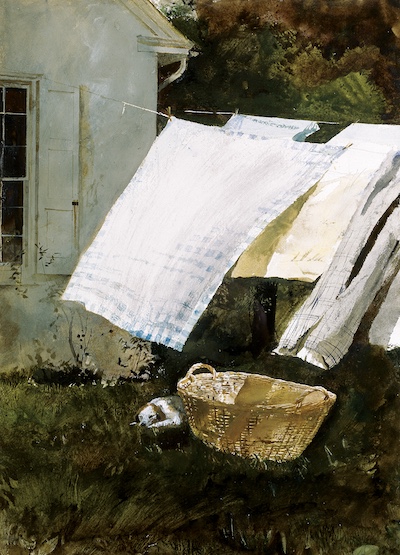
A house, a washing line, a basket: the ingredients of Andrew Wyeth’s Light Wash could hardly be more ordinary. Yet the white fabric opens across the picture with a force that exceeds its domestic subject. Below it, shadows gather. Looking moves between the recognition of familiar things and the arrangement of light and dark that makes them unexpectedly strange.[12]
That movement offers a way into Toyota Municipal Museum of Art’s Andrew Wyeth exhibition, which closes on September 23. Its organising idea is the boundary: the window, doorway or other division that both separates spaces and connects them. For visitors during the final holiday stretch, it is an invitation to look beyond the artist’s reputation for painstaking realism. The museum is scheduled to open on Monday, September 21.[1]
A small geography, revisited for a lifetime
Born in Chadds Ford, Pennsylvania, in 1917, Wyeth learned from his father, the illustrator N.C. Wyeth. His first solo exhibition in 1937 sold out. He developed his career around Pennsylvania and Maine, returning to nearby people and places rather than building an artistic identity around distant travel. He died in 2009.[3]
The scale of that commitment becomes clearer in the Brandywine Museum of Art’s account of Kuerner Farm. Over more than six decades, the property inspired nearly 1,000 works. Access also involved a human relationship: the artist gradually earned the family’s trust and moved from observing the farm towards exploring its interior.[8]
Such persistence complicates the idea of landscape as a view collected in passing. A building can remain recognisable while its meaning changes. Its inhabitants grow older; the light shifts; a room acquires associations that a stranger cannot immediately see. Wyeth’s close observation involved both the visible surface and the accumulation of familiarity. The question is not simply how accurately he painted a place, but what repeated encounters allowed him to notice.
What a window lets us see
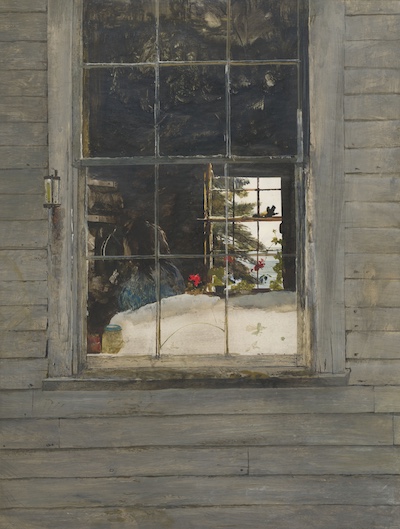
In Geraniums, a weathered window dominates the composition. Its grid divides areas of darkness and reflected or transmitted light; small red flowers appear within that complicated space. The surrounding boards occupy a large part of the picture. Instead of offering an uncomplicated view through glass, the image makes looking itself feel partial.[13]
There is room to read loneliness into such a scene, but doing so immediately risks missing its construction. The red matters because of the colours around it. The window matters as a pattern of lines before it becomes a metaphor. A useful first response is to trace where the eye travels, and only then ask what emotional significance the scene might carry.
The exhibition’s curatorial account connects boundaries with the relationship between inner and outer worlds, and between life and death. That is an interpretive framework, not a code that supplies a single correct meaning for every window. A visitor can use it to sharpen attention without allowing it to replace the experience of the painting.[4]
Preparatory work is part of the story
The Toyota checklist includes several studies for Wind from the Sea. The distinction matters: these are preparatory works, not a promise that the famous finished painting is on view. Looking at a study asks a different question from admiring a completed image. What received the artist’s attention? Which shapes were developed, and which could remain unresolved?[2]
Materials offer another route into that process. The checklist identifies Light Wash as watercolour and Geraniums as drybrush and watercolour. Other works use egg tempera on panel. These labels encourage visitors to compare different kinds of edges, densities and marks, rather than treating every Wyeth as an exercise in photographic precision.[3]
Japan’s Marunuma Art Park has made drawings and watercolours central to its presentation of the artist. Its collection commentary emphasises the passage from observation through memory and selection. That is a useful corrective to the assumption that realism means recording everything equally. A preparatory sheet can reveal an act of thought: deciding what the eventual picture needs, and what it can leave out.[7]
Beyond Christina’s World
For many viewers, Wyeth’s name first evokes a woman in a field looking towards distant buildings. Christina’s World, painted in 1948, belongs to New York’s Museum of Modern Art.[10] Its finished version does not appear on the Toyota checklist. The exhibition’s Christina Olson, dated 1947, is a separate work.[2]
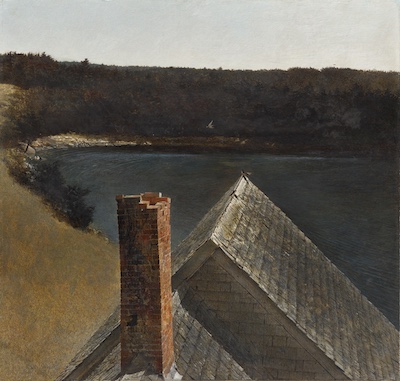
Remembering the famous image can open a door into Wyeth, but expecting every exhibition to revolve around it can narrow the visit. In End of Olsons, the foreground roof and chimney are set against water and a dark, distant shore. The roof’s diagonals press towards the horizontal landscape beyond. The scene can be approached through those relationships before its title supplies a sense of ending.[14]
Try looking once with the title in mind and once while concentrating on the picture’s geometry. Does the distance seem different? Does the empty space feel more emphatic? These are questions for the viewer, not claims to recover the artist’s private thoughts. They show how an apparently straightforward landscape can sustain more than one kind of attention.
Japan’s relationship with Wyeth has a history
The Tokyo Metropolitan Art Museum’s account of Wyeth’s Japanese reception records 330,000 visitors to the 1974 exhibition in Tokyo and Kyoto, followed by major exhibitions in 1995 and 2008–09.[4] At Toyota, the museum announced director’s talks to mark attendance reaching 30,000. That announcement is a milestone, not a final attendance total.[5]
These are firmer foundations for discussing his appeal than a sweeping claim that Japanese audiences share one response to solitude or impermanence. Attendance demonstrates interest; it does not explain every visitor’s motivation. Some may come for landscape, others for portraits, others for the pleasure of seeing how a brush describes a surface. An exhibition can accommodate those different encounters.
Collecting also matters. Marunuma Art Park, in Asaka, Saitama Prefecture, was established in 1985 to provide studios for young artists. Its collection supports artistic study alongside that continuing production.[6] Wyeth’s presence in Japan therefore extends beyond occasional large exhibitions: work held here can become material through which other artists consider their own practice.
The preparatory works are particularly important to that relationship. They shift attention from the completed masterpiece as an object of reverence to the choices that made it possible. For a contemporary painter—or any visitor willing to slow down—that process may be as engaging as the finished illusion of a place.
Realism need not exclude abstraction
It is equally limiting to cast Wyeth as an artist sealed off from modern abstraction. The Brandywine exhibition Abstract Flash, which opened in 2023, presented previously unexhibited abstract watercolours and examined his engagement with contemporary artistic developments. Those works should not be assumed to be in Toyota; the relevance is the broader understanding of the artist that the research makes possible.[9]
A recognisable subject and an abstract organisation of shapes can coexist. In Light Wash, try seeing the fabric first as an expanse of white, then as laundry. Neither reading cancels the other. The tension between them helps explain why an ordinary domestic scene can hold attention long after its objects have been identified.
That is the most productive promise of the Toyota exhibition’s theme. Boundaries need not be treated only as symbols of inaccessible lives. They are also visible decisions: the edge of a roof, the divisions of a window, the transition from a lit surface to darkness. Following them allows a familiar artist to become less predictable.
Planning a final-days visit
The venue is Toyota Municipal Museum of Art in Aichi Prefecture. The museum gives a walking time of about 15 minutes from either Meitetsu Toyotashi Station or Aichi Loop Railway’s Shin-Toyota Station. Check its latest notices before travelling, including any change to opening arrangements.[11]
| Run | July 18–September 23, 2026 |
|---|---|
| Monday, September 21 | Open |
| Hours | 10:00–17:30; last entry 17:00 |
| Adult admission | ¥1,900 at the door; ¥1,700 online |
| Junior-high age and younger | Free |
Dates and prices follow the exhibition’s official information. Some works rotate during the run, so the full checklist is not a guarantee that every listed work is displayed on a particular day.[1][2] Even on a short visit, choose one picture and return to it after seeing the others. Wyeth spent years returning to familiar places. A second look is a modest way to begin understanding what that practice can reveal.