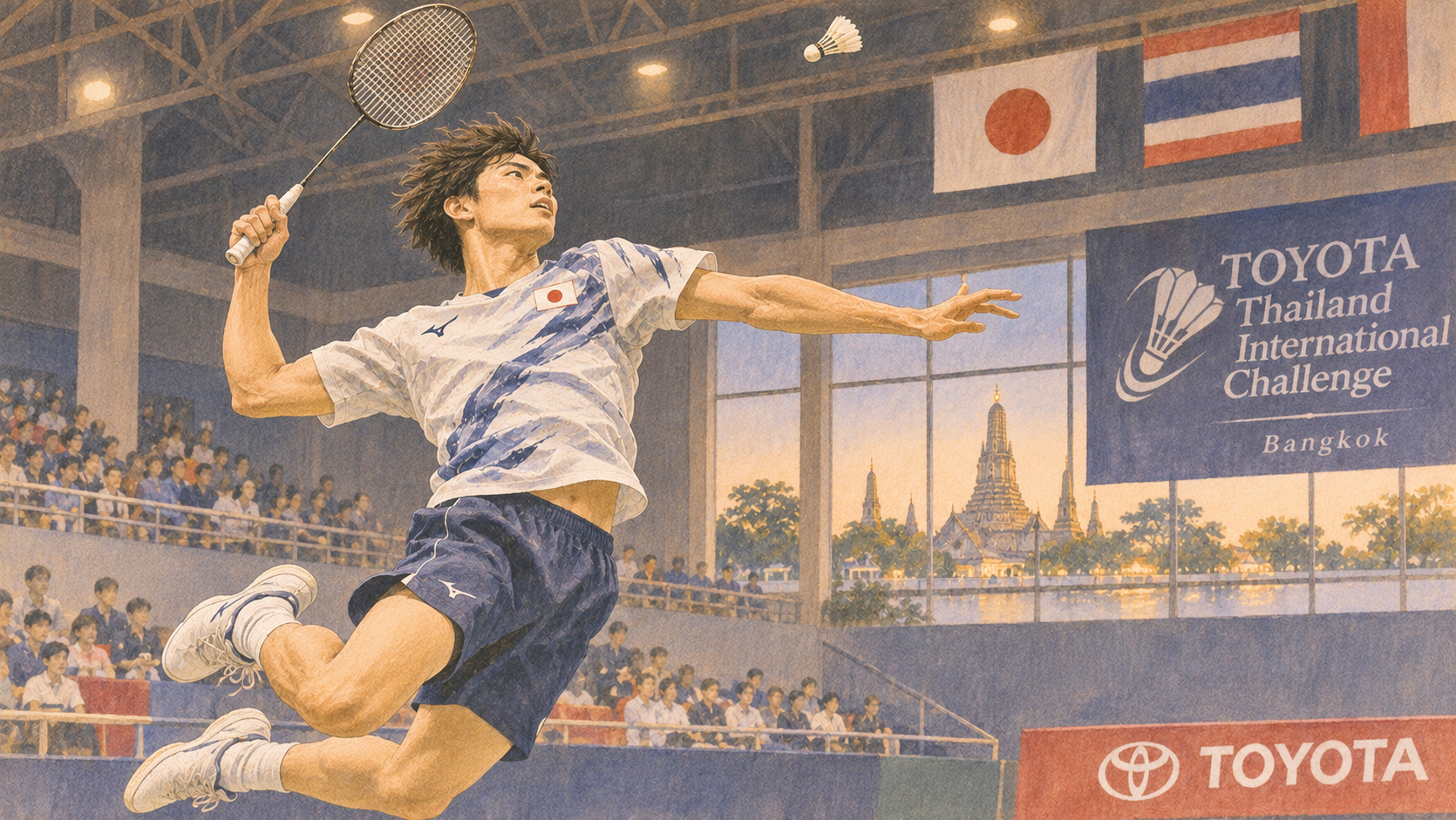
A tournament far from the television spotlight
The route to elite badminton runs through arenas that rarely command the attention of the Olympic Games. At Bangkok’s PAT Arena, the Toyota International Challenge is scheduled from November 24 to 29. Japan's national association lists Akira Hanada of Tonami Transportation among its men's singles entrants. The Thai association confirms the venue and tournament category.
A Japanese results service reports that Hanada defeated Singapore’s Chua Min Han 21–18, 21–11 on November 25, following a 21–4, 21–5 win over Malaysia’s Wei Jie Tiew the previous day. It lists Hanada as the 26th seed and places him in the fourth round, against seventh seed Huan Kai Hern of Malaysia. This is the last 32, not the last 16. The individual scores are attributed to the results service; the official draw was unavailable for independent inspection at the reporting cutoff.
The progression from a three-point margin in the first game against Chua to a ten-point margin in the second is notable, but the score alone cannot establish what tactical adjustments Hanada made. Without a match recording or interview, it would be premature to credit a particular stroke or change of strategy.
A player shaped by Japan’s domestic system
Hanada was born on September 11, 2002, in Fukuoka Prefecture, according to the J SPORTS player directory. Now 24, the right-handed player progressed through Yanaginishi Junior High School, Yatsushiro Higashi High School and Nihon University before appearing on the roster of Tonami Transportation in Toyama. The national association's Bangkok entry list also records his teammate Kusanose in singles and two men's doubles pairs from the same company.
Bangkok is not Hanada’s first international challenge. The Japanese association’s March 28 results from São Paulo record a straight-games victory over Israel’s Misha Zilberman, 21–19 and 23–21. Competing in South America and Southeast Asia exposes players to different opponents, venues and schedules. A career develops through these repeated opportunities, rather than a single dramatic victory.
What an International Challenge actually means
The Badminton World Federation (BWF) organizes a hierarchy of sanctioned events. The World Tour includes the familiar Super 1000, 750, 500 and 300 categories, while International Challenge, International Series and Future Series competitions belong to Grade 3. These are senior international competitions, not necessarily youth events or qualifying rounds of a World Tour tournament.
The BWF’s published 2018 ranking rules illustrate the underlying mechanism: points increase with tournament level and finishing position, and the ranking generally considers a rolling 52-week period with up to ten best results. The historical points schedule awarded 4,000 points to an International Challenge winner. That figure is an illustration of the system, not a verified 2026 award for Bangkok. Entry requirements, seeding and rankings are related but not identical. A seed number is not a world ranking.
An athlete can use results at this level to build a record for future entries, but no individual result guarantees admission to a higher tournament or selection for an Olympic team. Travel costs, recovery time and the strength of available draws all influence which competitions make sense.
From YMCA gyms to Olympic medals
Japan's badminton association traces the spread of organized play to YMCA instruction in cities including Nagoya, Osaka, Kobe and Yokohama from 1919 into the 1930s. The association was established in 1946 and joined the international federation in 1952. This history predates badminton's inclusion as a full Olympic medal sport at Barcelona in 1992 by decades.
Japan’s Olympic breakthrough came in London in 2012, when Mizuki Fujii and Reika Kakiiwa won women's doubles silver. Four years later, Ayaka Takahashi and Misaki Matsutomo captured the country's first badminton Olympic gold in Rio. Japan's achievements in women's singles and mixed doubles have since broadened public recognition of the sport.
Those milestones are the visible results of an ecosystem that includes school competitions, university teams, corporate clubs and international events. The less prominent competitions matter because they provide the encounters through which future contenders learn to compete beyond familiar domestic settings.
The company team as a bridge to the world
Japan’s domestic team league dates to 1979. Its official history chronicles successive eras of competition among major company teams. Tonami became one of the leading men's teams, alongside NTT East and the former Nihon Unisys team. The modern S/J League continues this tradition of institutional competition.
Company teams can give athletes a stable training environment, coaching partners and access to organized competition. Their contribution is not limited to marquee national-team players. International trips can also develop the experience of athletes who are still establishing themselves in the senior field. The precise financial and employment arrangements for Hanada have not been disclosed in the sources reviewed.
The Bangkok delegation illustrates the shared infrastructure behind individual results: the entry list includes both singles and doubles players and names a team staff member. For a sport in which much of the international competition takes place away from home, coordinated preparation can be as consequential as domestic visibility.
What comes next
At the November 26 morning Japan-time reporting cutoff, the fourth-round match against Huan was scheduled but had not been completed. The tournament runs through November 29, so the November 25 victory should be understood as an intermediate result, not a title or a final placing.
The broader test for Hanada and other players at this level is sustained performance against a changing field: adapting to opponents, maintaining consistency through multiple rounds and accumulating competitive experience without compromising recovery. Results from Bangkok will be one part of that longer process.
For readers following Japanese sport, the value of this tournament is precisely that it reveals the work that precedes the major championships. The next generation of international contenders is not produced exclusively on the biggest stage; it develops in many smaller arenas along the way.
Sources and further reading
- Japan Badminton Association – November tournament calendar
- Japan Badminton Association – official Bangkok entry list
- Badminton Association of Thailand – event calendar and results
- Guguspo – secondary match results and draw tracker
- J SPORTS – Akira Hanada player profile
- Japan Badminton Association – Tonami S/J League roster
- Japan Badminton Association – São Paulo results, March 28
- Japan Badminton Association – history
- Japanese Olympic Committee – badminton history
- Japan Badminton Association – S/J League history
- BWF – historical world ranking regulations (2018 edition)
- BWF – official Bangkok event page (access restricted during research)