- The journey that cannot be booked with confidence
- Two clinics, two transport networks
- Universal coverage is not the same as universal access
- Why a mobility problem is becoming a demographic problem
- What the earlier Tokushima experiment actually found
- The metrics that should matter to patients
- Medical information is not ordinary routing data
- A transport network built around destinations
The journey that cannot be booked with confidence
Imagine arranging a ride to a clinic at nine in the morning. Booking that journey is straightforward. Booking the return is not: the patient might finish at ten, or still be waiting for a test or payment at noon. For someone who cannot drive, the uncertainty can shape the entire decision to seek care. A relative may need to reserve half a day for a short appointment.
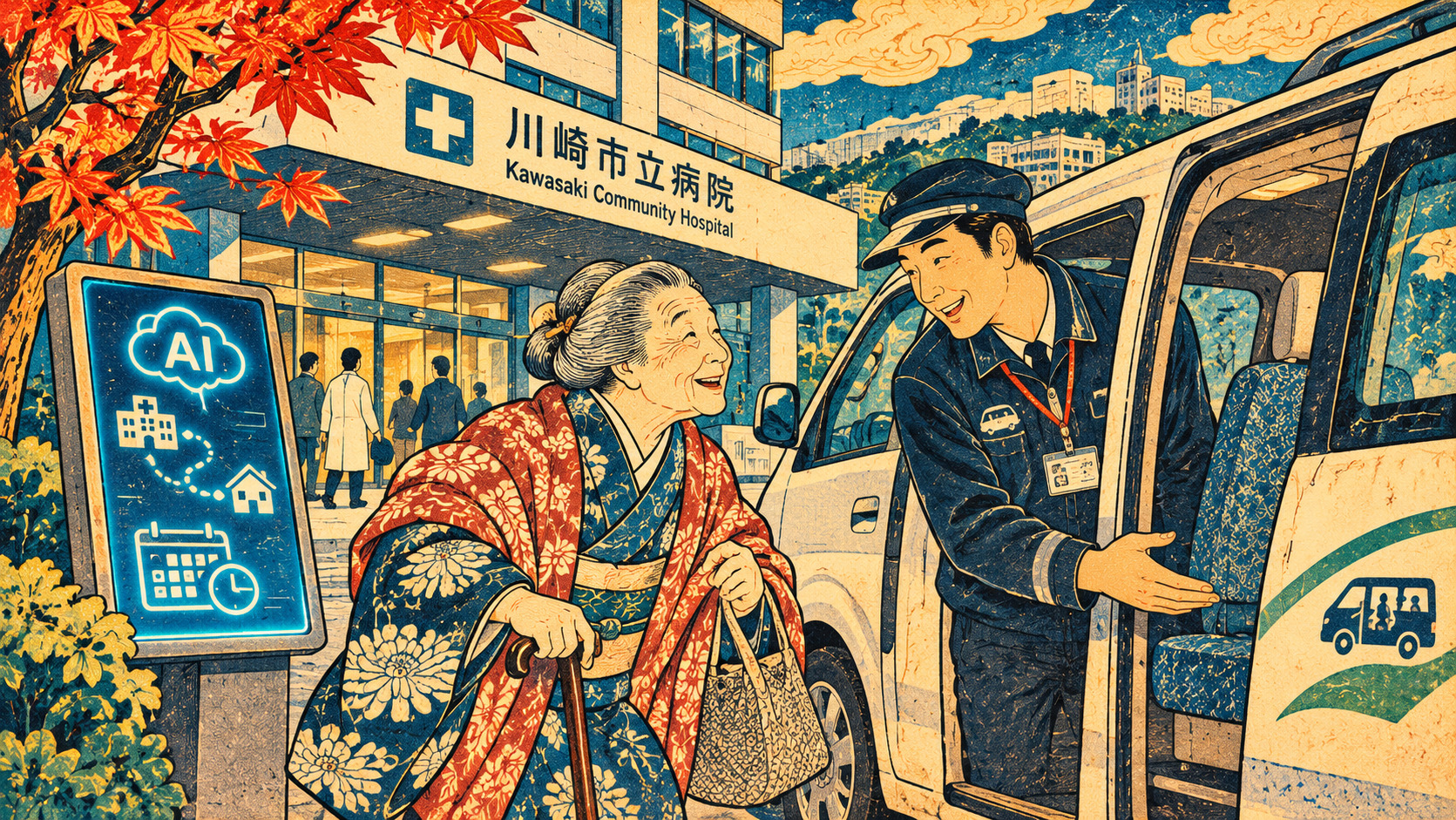
On November 24, Fujitsu and Kawasaki City announced a pilot that addresses this overlooked scheduling problem. Beginning December 1, the project will use machine learning to estimate when a patient is ready to leave and coordinate a reservation with local shared transport. It is part of the Japanese transport ministry’s COMmmmONS digital transformation programme. The experiment is about access to healthcare, not AI diagnosis, and no results from Kawasaki are available at the time of publication.
Two clinics, two transport networks
The trial is deliberately limited. At Kawasaki Municipal Kawasaki Hospital it involves consenting prenatal checkup patients through January 29, 2027. At Nakahara Kosugi Motosumiyoshi Hoshioka Internal Medicine, Gastroenterology and Endoscopy Clinic, consenting patients scheduled for gastroscopy or colonoscopy may participate through January 30. The respective transport services are NORU-TO KAWASAKI (のるーとKAWASAKI) and Choisoko Kawasaki (チョイソコかわさき).
Fujitsu is responsible for connecting the systems; Fujitsu Japan develops the prediction model. Patients will use the relevant medical visit application to manage reservations and notifications. This is an interoperability experiment as much as a forecasting experiment: the new system must work across organizational boundaries rather than assume every service uses the same software. Older people may eventually benefit, but the actual recruitment criteria are based on appointment types and consent, not age.
Universal coverage is not the same as universal access
Japan’s experience offers an important historical lesson. Public insurance for some employees began in 1927; universal health insurance coverage was achieved in 1961. A 1973 policy aimed to establish medical schools in prefectures that lacked them. These steps addressed financial and geographic barriers to medical care. The more recent community-based integrated care approach brings medical services, long-term care and everyday living support together.
Yet a healthcare system can be geographically extensive and still leave individual patients stranded. Distance on a map is not the same as an accessible journey. A steep walk to a bus stop, a difficult transfer or an uncertain pickup can be decisive for people with limited mobility. Transportation should therefore be considered alongside insurance and clinical capacity when evaluating whether medical services are genuinely reachable.
Why a mobility problem is becoming a demographic problem
Japan’s 2026 aging society white paper puts the number of residents aged 65 and over at 36.22 million as of October 2025, or 29.4 percent of the population. Of these, 21.27 million were at least 75. Age alone does not determine a person’s ability to travel, but the aggregate figures show why a transport network designed around independent driving cannot meet every need.
The Ministry of Land, Infrastructure, Transport and Tourism describes a simultaneous contraction in local bus provision and shortage of drivers. Conventional scheduled buses remain indispensable where demand is concentrated, while demand-responsive services can fill gaps where journeys are more dispersed. A shared vehicle, however, still has finite seats and a driver with finite working hours. Booking software is valuable only if it helps make that real capacity available at the right place and time.
What the earlier Tokushima experiment actually found
The Kawasaki work follows a field trial at Tokushima Prefectural Central Hospital from November 4 to December 26, 2025. The earlier system used predefined rules informed by records of consultations, examinations and payment processes. In its project report, the transport ministry says more than 70 percent of observations met the target of a difference of less than 30 minutes between predicted and actual departure. The report also describes requests for vehicles that are easier to enter and exit.
That is a useful benchmark, not a guarantee of a successful return journey. A prediction twenty minutes too early can lead to a missed vehicle; one twenty minutes too late may produce a long wait. Machine learning can capture patterns in data, but performance may change between hospitals, appointment types and operating conditions. Kawasaki is testing a different model and connections to other providers; its accuracy has not yet been established.
The metrics that should matter to patients
The central question is whether a better prediction translates into a better journey. A dispatcher may allow a buffer between an estimated departure and pickup. Too little buffer risks missed bookings; too much leaves patients waiting. Because vehicles are shared, a rescheduled trip can affect other passengers. The coordination system must handle these trade-offs rather than simply output a time.
An evaluation should report actual waiting times, missed pickups, successful rescheduling, completed appointments, caregiver time and vehicle utilization, with attention to people experiencing unusually long delays. These are proposed editorial evaluation criteria, not announced trial endpoints. Accessible vehicles, assisted booking, language support and alternatives for people without smartphones also matter. Where a medical procedure requires an escort or special travel arrangements, clinical instructions take precedence over the convenience of shared transport.
Medical information is not ordinary routing data
A transport operator needs enough information to provide the appropriate ride, but it does not necessarily need the underlying medical record. Japan’s Personal Information Protection Commission and health ministry classify many kinds of medical information as requiring special care. Consent is generally required for acquisition and third-party disclosure, subject to legal exceptions and the applicable arrangements for processing data.
For a healthcare transport platform, sensible design questions include which fields are necessary, who can access them, how long records are retained and whether declining the service affects ordinary care. A prediction could be transmitted as a booking window without disclosing the diagnosis, if the architecture and operational needs permit. The public announcement does not provide a complete data-flow specification, so this is a design principle rather than a claim about the deployed system.
A transport network built around destinations
COMmmmONS began in fiscal 2025 with an emphasis on making fragmented transport systems work together. A separate initiative explores sharing vehicles used by community facilities. The logic is that a town may have several fleets serving different purposes, while residents still struggle to reach essential destinations. Coordinating existing resources may be more realistic than procuring an entirely new fleet.
Fujitsu envisages connections beyond hospitals, including care facilities, shops and public services. The potential is substantial, but the economics remain unresolved: who pays for the software, who absorbs the cost of a cancelled ride, and who provides capacity at peak times? A rural district may have too few drivers even with perfect predictions, while a dense city may face a different problem of coordination. Kawasaki’s forthcoming results should be judged against these operational realities. The ultimate measure of success is not a sophisticated algorithm, but whether people can confidently make the journey home.
Primary sources and references
- Fujitsu: Japanese pilot announcement, November 24
- Kawasaki City: healthcare MaaS announcement
- Cabinet Office: 2026 aging society white paper
- MLIT: Tokushima pilot results and limitations
- MLIT: COMmmmONS programme
- MHLW: Japan’s history of universal health coverage
- MHLW: community-based integrated care
- PPC and MHLW: medical and care privacy guidance
- MLIT: shared facility transport management
- Fujitsu: English pilot announcement