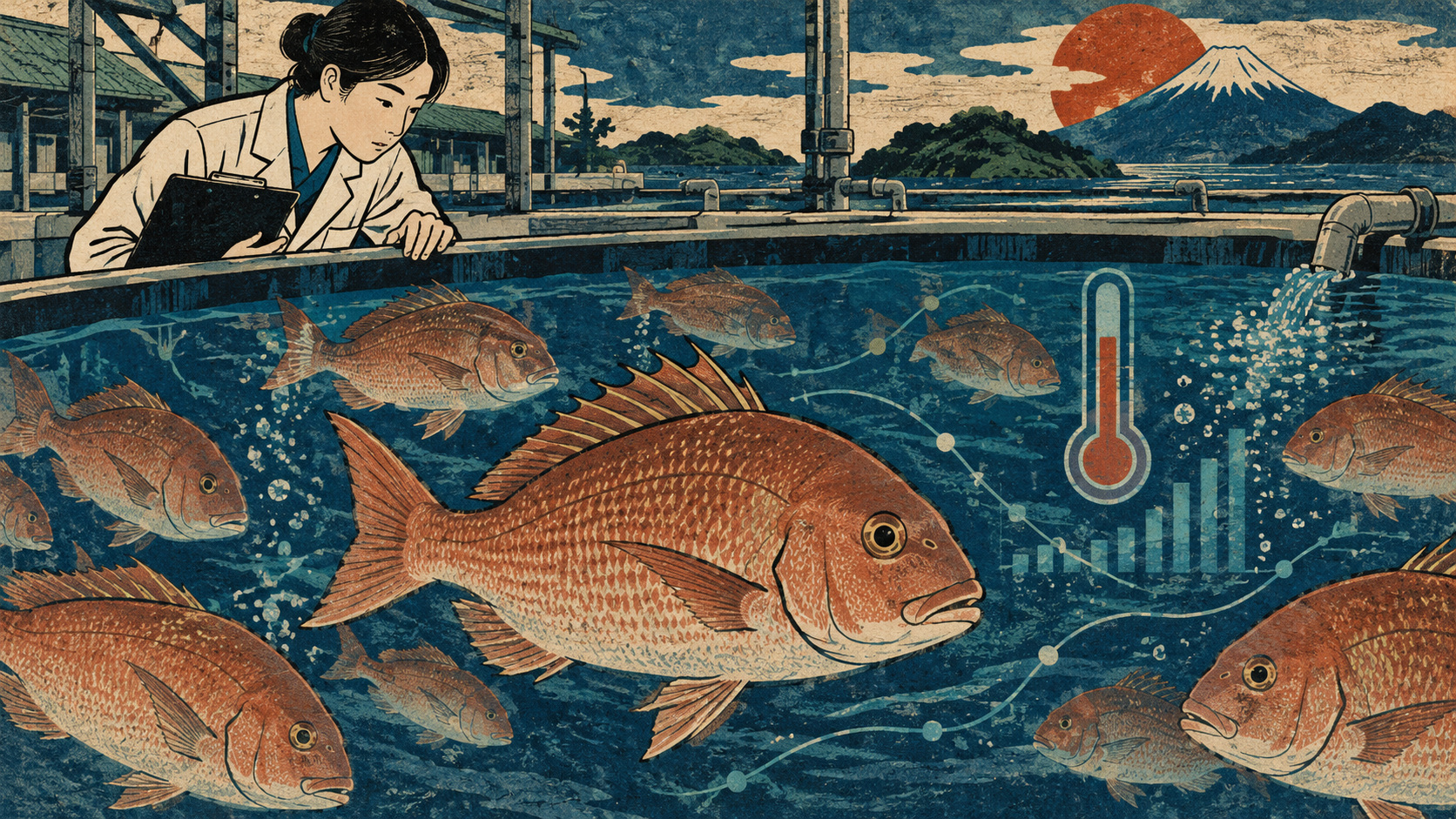
The aquaculture question behind a small laboratory fish
In Ehime’s coastal fish farms, an overheated summer is a business threat. Temperature affects feeding, disease pressure, survival and the calendar for bringing fish to market. The industry needs reliable information about how animals respond to extreme conditions—yet those answers are difficult to obtain and even harder to compare across different stocks.
A recently published Japanese AI technique may improve one part of that scientific process. It automatically identifies the moment a fish loses its balance under temperature stress. That does not make fish heat-resistant, cool a sea cage or establish a ready-to-buy aquaculture service. Its possible significance is more fundamental: making a research measurement less dependent on the judgment of the person watching a video.
Why this is a follow-up, not a newly discovered result
Nagoya University, the University of Fukui and the Japan Science and Technology Agency announced the study on September 10, 2026, when it appeared in Scientific Reports. Japan.co.jp covered the original medaka finding on September 14. This article revisits the science from a different angle: what would it take to connect an experimental technique to the operational problems documented by Ehime’s fisheries researchers?
The distinction matters because the experiments involved medaka strains and related Oryzias species, not commercial trials in Ehime’s sea bream, yellowtail or mackerel pens. The researchers have not reported a measured financial benefit for regional aquaculture companies.
What loss of equilibrium can tell researchers
Fish are ectothermic: changes in surrounding water affect their physiological condition. One experimental way to compare tolerance is to change water temperature under controlled conditions and observe when an individual can no longer maintain an upright posture. Researchers call this endpoint loss of equilibrium, or LOE. It is not the same as observing death.
Traditionally scientists replay video and decide when LOE occurred. Observers may differ slightly, and scoring large batches takes time. A consistent automated endpoint can make comparisons between strains and species more practical without claiming that one measurement captures every dimension of animal health.
How the Japanese team built the detector
The team filmed individual fish in separate compartments. DeepLabCut, a machine-learning approach for tracking animal posture, identified seven body landmarks including the nose, fins, body and tail. A subsequent image-classification system—identified by the university as using ResNet34—judged when the animal entered the LOE state.
In an evaluation involving 50 fish, the automated judgments were comparable with the variation between experienced human observers. Repeated analysis of the same video also yielded consistent decisions. Those are meaningful tests of reproducibility, but they are not field trials under the turbid, crowded or changing lighting conditions of commercial fish farms.
A revealing exception among medaka relatives
Comparisons among medaka strains and allied species indicated substantial differences in temperature tolerance. In general, relatives from higher latitudes tended to tolerate colder conditions, and Japanese medaka showed particularly strong cold tolerance. Yet a Taiwanese relative described as a new species in 2025 was more cold-tolerant than its latitude alone would have suggested.
That exception underscores a practical point: a species’ location is not a substitute for measuring its biology. Genetic background, developmental history and other mechanisms may help explain why some fish withstand temperature stress better than others. The research creates a means to explore such questions; it does not identify a universal thermal threshold for all fish.
Ehime’s own warning from the water
A prefectural fisheries research report describes a practical trial in which hatchery-produced chub mackerel were supplied to operators around Yawatahama, Uwajima and Ainan in 2024. At one participating operation, survival fell during temperatures exceeding 30°C. At two other sites, parasitic skin-fluke problems were associated with poor survival.
The authors concluded that culturing chub mackerel in temperatures at or above roughly 30°C was difficult under the trial conditions and emphasized parasite prevention. This was a finding about a particular species and study—not a rule that every farmed fish fails above that temperature. Its value here is to show how water temperature and disease can create overlapping operational risks.
A region with an established research infrastructure
Ehime’s fisheries research is not waiting for artificial intelligence to begin investigating these problems. The prefectural Fisheries Research Center documents work on fish disease prevention, alternative feed ingredients, farmed sea bream and strains of pearl oyster better suited to stressful conditions. This experience offers a potential foundation for deciding which new laboratory tools would be worth evaluating.
But relevance should not be confused with adoption. Nothing in the published medaka research demonstrates that the Ehime center has deployed the LOE detector, partnered with its inventors or selected new commercial stocks using this system.
The long road from proof of concept to commercial use
A credible aquaculture application would first need species-specific validation. The marker points and posture patterns that work for small medaka may require new training or interpretation for larger sea bream or active yellowtail. Researchers would also need to understand how body size, maturity, water clarity and handling conditions affect results.
Second, a useful thermal measure would have to correlate with outcomes that operators care about: survival, feeding performance, growth, welfare or disease. Third, equipment, staffing and analysis costs would have to justify themselves. Finally, repeated testing in independent facilities would be needed before anyone could claim reliable commercial performance.
AI cannot replace temperature management
An automated scoring algorithm makes measurements; it does not physically lower seawater temperatures. Farm operators still face decisions about where to site pens, how to manage stocking density and feeding, what to do during heat events, and how to reduce disease exposure. The research might eventually help evaluate breeding lines or biological responses, but it is only one piece of that management system.
LOE is also an acute-stress endpoint. It cannot by itself establish an ideal routine farming temperature or reveal every chronic effect of warm water. Any expanded testing needs appropriately reviewed animal-welfare and experimental safeguards.
What investors and fish farmers should ask
Commercial discussions about AI tend to leap from laboratory accuracy to projections of productivity gains. Here the published evidence supports a narrower claim: the method can automate a specific measurement in the fish groups studied. It does not yet support sales forecasts or cost savings for Ehime operators.
Before endorsing a new system, businesses and government laboratories would need transparent data on cross-species performance, independent replication, false classifications, equipment cost and direct links to production outcomes. A technology can be scientifically valuable without being commercially mature.
The real gain may be a better scientific yardstick
The strongest implication of the research is the possibility of comparing many individuals with a more consistent endpoint. That could support future work on physiology, molecular mechanisms and the ecological risks associated with climate change. The surprising differences between medaka relatives make the need for careful measurement evident.
Ehime’s aquaculture sector provides a compelling real-world reason to pursue such work. But the promising part of this story is not an AI machine that rescues a fish farm tomorrow. It is a better experimental tool that could help scientists ask more precise questions about what fish can survive—and why.
Sources and reporting methodology
- Nagoya University, University of Fukui and JST: fish thermal tolerance study, September 10
- Nagoya University Japanese research announcement
- Nagoya University ITbM: detailed explanation of the method
- Scientific Reports peer-reviewed paper
- Ehime prefectural research newsletter: chub mackerel aquaculture trials
- Ehime Fisheries Research Center: Research information
- Ehime Fisheries Research Center: Research findings
- Japan.co.jp original September 14 report on this research
Editorial note: this is an Ehime-oriented follow-up to research announced September 10, 2026, not a new October discovery. Commercial validation and collaboration with Ehime operators have not been documented.