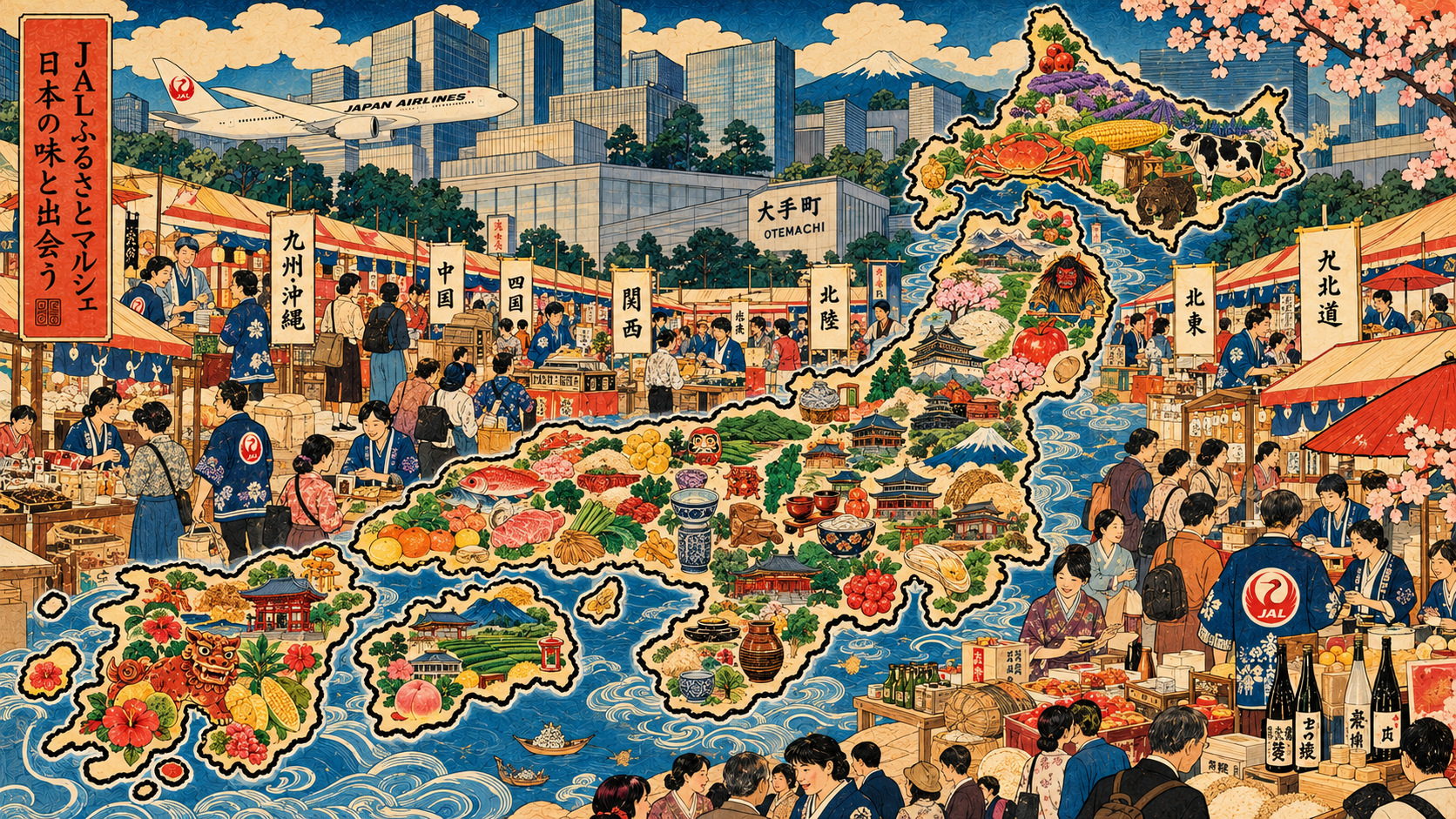
A sale lasts a moment. A relationship between a city buyer and a regional producer has to last much longer.
A regional market in Tokyo’s financial heart
On two October days, commuters passing through the underground concourse of Otemachi Tower can encounter goods usually associated with places far from the capital: specialties from Hokkaido and Okinawa, among other prefectures. JAL Furusato Marche, organized by Japan Airlines and property developer Tokyo Tatemono, is a small event with a much larger ambition. Its organizers want a purchase in an office district to become the beginning of a longer relationship with a distant community. Whether that happens is a testable question, not an established result.
Where and when the market takes place
The official event is scheduled for Wednesday and Thursday, October 28–29, 2026, 11 a.m. to 7 p.m. each day. The venue is Mori no Plaza on basement level two of Otemachi Tower, 1-5-5 Otemachi, Chiyoda-ku, Tokyo, linked directly to Otemachi subway station. Admission is free, while merchandise and food are sold. The organizers warn that products and availability can change. This reporting was prepared in advance of the event; it is not a firsthand account of crowds or transactions.
Why an airline is opening a marketplace in an office tower
The two partners bring different assets. JAL works with communities throughout Japan and operates passenger, cargo and commercial networks. Tokyo Tatemono controls busy urban real estate. In September 2026 they announced cooperation spanning resource circulation, environmental education and regional revitalization. The October market is their first stated initiative for connecting urban customers with regional suppliers. A landlord supplies proximity to buyers; an airline provides relationships to sellers and places. That combination is the business model being tested.
Not a pop-up at the airport
Otemachi matters because the audience includes office workers who might not be looking for a holiday or boarding a plane. The building combines offices, retail and a hotel, but this market is specifically in its underground Mori no Plaza. Tokyo Tatemono separately describes the Otemachi forest occupying part of the complex’s land. The forest and the underground event site should not be confused. The commercial experiment is about putting regional products into the daily route of a metropolitan customer.
What the stalls promise
The organizers identify regional producers and groups from Hokkaido and Okinawa and other prefectures, as well as JAL-related products. Contemporary event coverage also names Yamagata, Saitama, Chiba, Shizuoka, Nagano, Mie and Nara, with categories including fruit, tea, confections, wine and dried noodles. A separate reported offering includes products upcycled from aircraft components. These descriptions should not be mistaken for a final stock inventory: exhibitors and specific merchandise may change, and suppliers’ commercial claims require their own evidence.
The roots of JAL’s hometown strategy
JAL did not invent its regional-development program this autumn. It began a JAPAN PROJECT initiative in May 2011, expanded the New JAPAN PROJECT in 2015, and introduced the JAL Furusato Project in April 2021. The corporate history traces a shift from promoting destinations toward supporting regional industries, product development and commercial distribution. The Otemachi event therefore represents a new partnership and setting, not the beginning of JAL’s interest in rural economic life.
From flight attendants to community ambassadors
A striking element of JAL’s regional strategy is the use of people, not only airplanes. Since 2020 it has deployed Furusato Ambassadors—cabin crew who relocate to regions with local connections—and a wider internal support network to work with tourism organizations, producers and municipalities. JAL describes support ranging from new products to visitor experiences. This does not establish that any particular ambassador will appear at Mori no Plaza; the staffing and on-site program need separate confirmation.
Japan has a name for relationships beyond tourism
The Japanese policy term kankei jinko, loosely “relationship population,” describes people who maintain varied, continuing ties to a community outside their everyday residential or commuting area without necessarily moving there. A 2025 Ministry of Land, Infrastructure, Transport and Tourism survey estimated around 22.63 million adults in Japan had such relationships, slightly more than one-fifth of the adult population. Buying a sweet once in Tokyo is not the same as becoming a durable supporter of its hometown. The gap between those two acts is exactly where this market’s claims should be judged.
The economic challenge behind regional charm
Regional sellers often need access to customers beyond their immediate communities as populations age and demand shifts. Japan’s agriculture ministry estimated the fiscal-2025 food self-sufficiency rate at 37% by calories and 66% by production value, two different metrics. These national statistics are important context for food supply but do not measure the impact of this market. A pop-up may help brand discovery, but it cannot be credited with changing Japan’s self-sufficiency or solving rural demographic decline.
The hard part begins when the stalls close
For a small supplier, a busy opening is only part of the equation. Delivery charges, spoilage, margins, labeling, payment terms, staffing and the cost of future fulfillment determine whether a new channel is worth keeping. Organizers have not published independently audited figures for exhibitor profits, repeat purchases or subsequent orders from this event. A meaningful follow-up would ask producers how much they spent to participate, whether buyers reordered, and whether they reached customers they could not otherwise access.
What an airline can gain without selling a ticket
JAL presents regional commerce and overseas sales as extensions of its network. Its sustainability materials discuss tourism promotion, producer support, distribution and cross-border e-commerce. Building affection for destinations could also indirectly encourage travel, although no causal link has been demonstrated for this market. Nor should readers assume every item on sale arrived by air; the shipping mode and environmental footprint of individual products have not been established.
The difference between visibility and development
A two-day fair can give an unfamiliar craft or food product publicity, but economic development requires repeatable value for producers and communities. Follow-up measures would include repeat orders, new wholesale relationships, consumer retention and whether more revenue stays in the originating region. The organizers say they hope to create continuing relationships. At the moment that is an objective, not evidence that it has already happened.
A useful question for October 29
The market is scheduled to continue through October 29. This article establishes what organizers announced ahead of opening and why the event matters; it makes no claim to have inspected the stalls, interviewed participants or counted sales. For visitors, the market offers a rare chance to speak with regional sellers in the middle of Tokyo’s business district. For researchers of Japan’s local economies, it suggests a more exacting question: what happens after someone discovers a distant place through a purchase?
Sources and verification
Checked against Tokyo Tatemono’s October 15 announcement, the companies’ September partnership, JAL’s corporate history and Japanese government statistics. This is pre-event source-based reporting, not an onsite visit, sales audit or vendor interview.