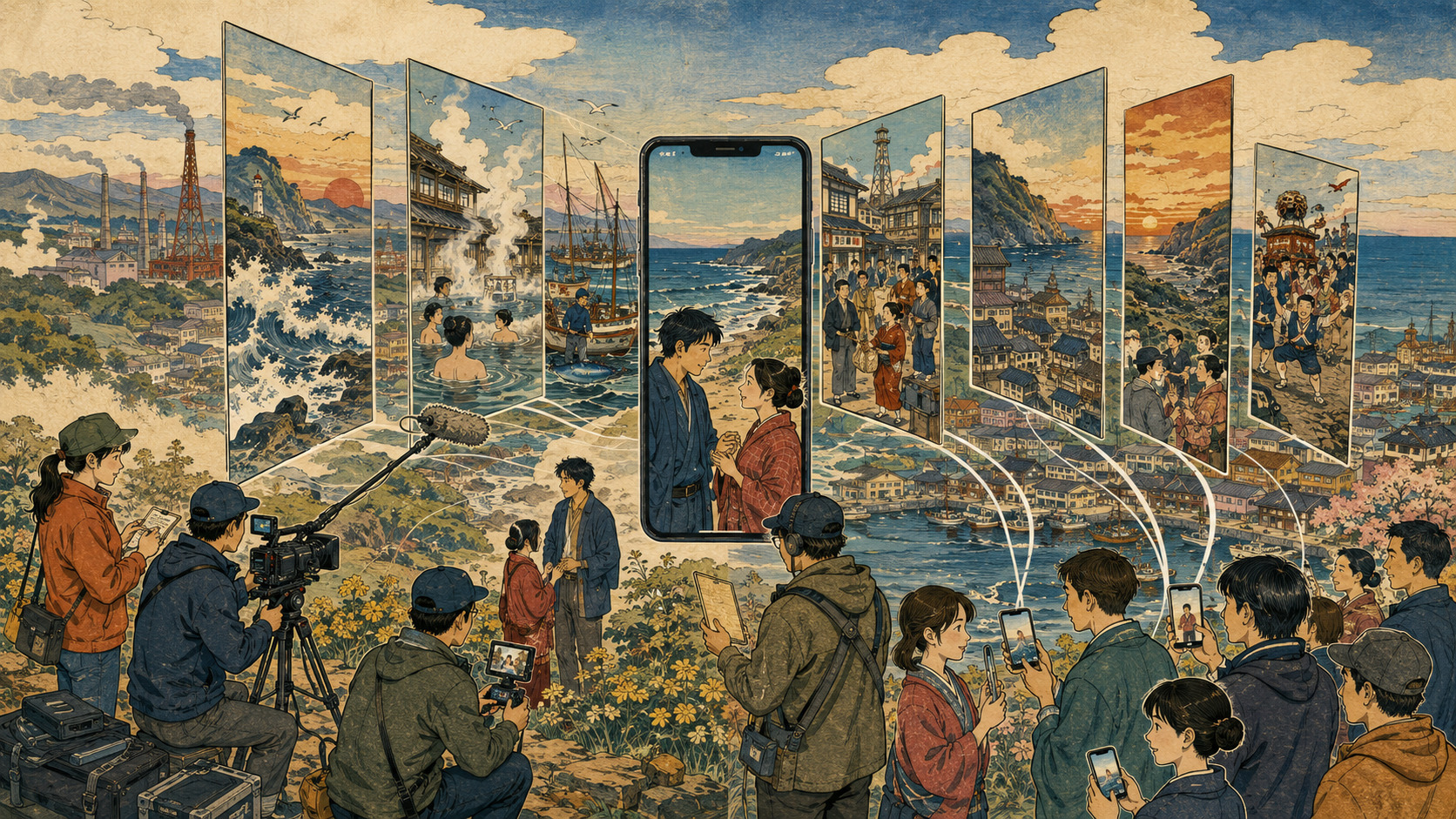
Episode one appeared March 9, 2026, and episode two the next day. GOKKO Club's Yui Ouchi wrote and directed; Kurando Hachijoin, Shiori Yamamoto and Iwaki-born Kai Hayasaka were among the cast. The Iwaki Joint Tourism Campaign Executive Committee planned the project, with GOKKO producing and supervising it for TikTok, Instagram, X, YouTube and LINE VOOM.
What the story shows
A couple facing relationship fatigue rides the Hitachi limited express and visits JR Yumoto Station, Onsen Shrine, Spa Resort Hawaiians and Aquamarine Fukushima. With JR East cooperation, scenes were filmed on an actual platform and train, embedding “direct from greater Tokyo” in movement rather than a voice-over claim.
Attractions do not sit in a catalogue. A hot spring creates space to speak, an aquarium gives the couple something to look at together, and the train separates ordinary life from travel. The emotion may remain longer than a facility name. That is narrative advertising's wager.
This is the second installment
Iwaki and GOKKO Club released another two-part drama, The Island Where Happy Winds Blow, in January 2025. It was the city's first use of vertical short drama for tourism promotion, weaving places and products into a young relationship. A local newspaper reported one million views within roughly a week.
Commissioning a sequel suggests movement from a one-off format experiment toward repeated learning. But the creator group's headline claim of 12 billion total social views describes its whole output, not this Iwaki production. The subject of every number matters.
Why vertical?
| Phone behavior | Vertical-drama response | Tourism effect |
|---|---|---|
| One hand, full screen | Faces fill a 9:16 frame | Emotion reaches viewers before scenery |
| Infinite scroll | Conflict or question in seconds | Story begins before viewers reject an ad |
| Muted playback | Captions and visual acting | Works on trains and commutes |
| Short attention | Compressed scenes and an ending hook | Moves viewers to part two or a travel page |
Cropping a horizontal commercial does not create vertical storytelling. A portrait frame layers people in depth and privileges faces, hands, phones and food. It is weaker at vast coastlines, but stronger at showing a person's response to one.
The grammar of a minute
Short drama is not a summary of a feature film. It poses a question immediately, cuts exposition, loads glances and objects with relationship information, and ends with a reversal or incomplete beat. Location facts must enter through signs, captions, dialogue and travel rather than stopping the story.
The danger is that algorithm-friendly arguments and tears outlive the place. If the romance could occur in any city after swapping landmarks, views may rise while Iwaki disappears. The deeper script uses local causality: hot springs born from mining, an economy rebuilt around tourism, the sea and aquarium, and a 60-kilometer coast.
Iwaki has long reinvented itself through story
Spa Resort Hawaiians grew from water flowing into the Joban coal mine. As coal declined, the company opened Joban Hawaiian Center in 1966, recasting an industrial liability as a hot-spring tropical dream. “Take ¥1,000 and go to Hawaii” sold an attainable narrative, not merely a pool.
The dance academy, hula shows and film Hula Girls turned that facility into a regional transformation story. The smartphone format is new; remembering a destination through changing characters rather than a factual list is not.
Post-2011 imagery carries responsibility
The 2011 tsunami severely damaged Aquamarine Fukushima and killed many animals. Staff and a national aquarium network helped it reopen 126 days later, on July 15. It still teaches disaster history. Filming Iwaki's sea only as beautiful scenery can erase reconstruction, preparedness, fisheries and reputational harm after the nuclear accident.
No one-minute romance can bear every layer. A campaign can connect the emotional entry to location articles, disaster-learning material and later films. Municipal communication should use feeling as a door into facts, not their replacement.
From municipal commercial to branded entertainment
Conventional tourism video safely assembles drone shots, cuisine, landmarks, smiling visitors and narration. It is informative and instantly recognizable as an ad—therefore easy to skip. Drama borrows attention by asking viewers to follow a character's goal before foregrounding the city.
Sponsorship should still be clear. Public agencies and production relationships need disclosure, and paid distribution or actor posts should identify the tie-up. Narrative subtlety and transparency about public spending are compatible.
A view is not a visitor
| Stage | Measure | Question |
|---|---|---|
| Attention | Reach, 3-second views, completion | Did people stop and finish? |
| Emotion | Saves, shares, comment meaning | Did story and place remain? |
| Consideration | Site clicks, searches, itinerary saves | Did they research travel? |
| Booking | Rail, hotels, tickets, codes | Did intent become paid action? |
| Local impact | Nights, dwell, circulation, spend | Did benefits extend across the city? |
Autoplay, brief exits and repeats mean views are an awareness signal. Dedicated URLs, booking codes, geographic comparisons, search lift and unexposed control regions can help. Weather, holidays, the destination campaign and other advertising still complicate attribution.
The last meter from viewer to traveler
Emotion disappears with the next swipe unless the viewer immediately finds place names, maps, transport, hours, prices, reservations and a two-day itinerary. Iwaki's location page exists to bridge that gap.
Circulation matters. A visitor should move beyond Hawaiians or the aquarium toward Yumoto, the shrine, coast, food and lodging. Iwaki is geographically large; places close together in an edit may be far apart. Honest travel times protect satisfaction.
Letting an algorithm choose a city's face
Platforms do not fully reveal who received a video or why it spread. If intense romance and young attractive faces dominate, children, older adults, solo travelers, disabled people, international visitors and ordinary local life disappear. Repeating the viral formula narrows the city.
A municipality should archive films on its own site and provide captions, audio description, translations, horizontal versions or still alternatives. Public campaign records should not vanish after a platform changes its rules.
Can production capacity remain local?
An outside creator brings actors, scripting, editing, distribution skill and an existing audience. Reach can arrive quickly, while money and skills may leave when the shoot ends.
Local casting, film-office work, student workshops, short-video training for businesses and shared footage can turn advertising into capability. Casting Iwaki-born Kai Hayasaka is one step toward a story connected to place rather than merely located there.
Do not sell the city; dramatize a reason to go
A minute cannot explain a city. It can create one emotion, one face and a desire to continue the experience there. Brochures organize information and search compares options; drama moves the imagination before selection.
Iwaki's result will not be decided by the digits beneath a video. Did viewers remember the name, investigate transport, stay overnight, move among districts and encounter the city's history of industrial change and disaster recovery? The vertical screen is small. With a carefully engineered exit, it can open onto a much larger real place.
Reporting and sources
- Iwaki tourism: official page for When Love Changes
- GOKKO: 2026 production announcement
- Iwaki tourism: the 2025 first installment
- Spa Resort Hawaiians: from coal mine to resort
- Reconstruction Agency: Aquamarine Fukushima's damage and reopening
- Iwaki Minpo: first installment reaches one million views
View counts and creator totals are figures published by their respective sources. This article does not treat video plays as evidence of arrivals or overnight stays and separates the measurement stages.