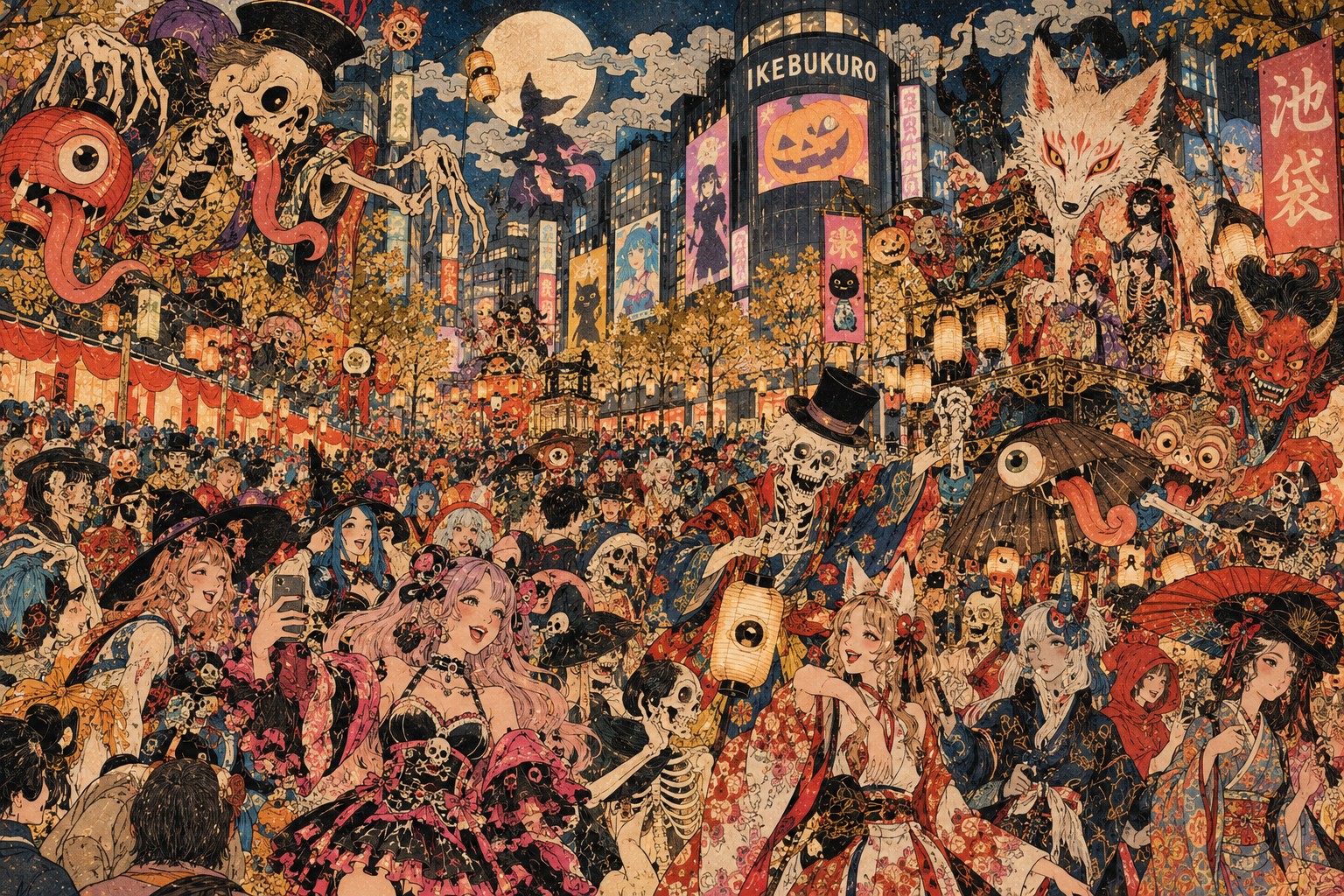
The costume may be handmade. The stage is built by an entire neighborhood.
The city becomes the costume
On Halloween Saturday, Tokyo’s Ikebukuro district is preparing to become something more than a backdrop for photographs. The Ikebukuro Halloween Cosplay Festival returns October 31–November 1, with a separate Friday-night event on October 30 at Sunshine City. The proposition is striking: ordinary streets, public spaces, shopping corridors and performance venues become a stage for people who invest extraordinary skill in becoming characters. The festival has been announced, but 2026 attendance totals and spending have not been observed yet. This is an advance feature, not a post-event report.
The parade has a route—and a purpose
Organizers schedule the October 31 cosplay parade to begin at 2:20 p.m. along Sunshine 60 Street toward Tokyo Tatemono Brillia Hall. Roughly 400 cosplayers are planned, accompanied by the wind ensemble of Tokyo Metropolitan Toshima High School. The program includes music associated with Sound! Euphonium, the animated series set in Uji, Kyoto Prefecture. Parade applications have already closed. That distinction is important for visiting fans: buying a festival ticket does not automatically place a person in the marching group. The route and timing can still change for operational or weather reasons.
The celebrities are not the whole show
The main stage at Naka-Ikebukuro Park is scheduled to host a cosplay runway, family activities and even cosplay arm wrestling. A special ceremony at 1:20 p.m. on October 31 features Toshiya Miyata of Kis-My-Ft2 and well-known cosplayer Enako, according to the festival program. The guest names have reach well beyond the district. But the deeper fascination is the range of participants: accomplished costume makers, photographers, children, first-time visitors and people simply curious about a culture they have encountered online.
A remarkable debut in 2014
Ikebukuro’s festival did not begin as a massive ticketed attraction. Its first edition was held October 25–26, 2014. Dwango’s contemporary report says general entry and viewing were free, with cosplay registration costing ¥500. The organizer reported around 52,000 on-site visitors, including approximately 10,000 cosplayers, with participants from 22 countries. It also reported more than 256,000 online viewers through the niconico platform. These organizer-reported figures describe the inaugural event, not a comparable measurement of 2026. They show how physical participation and online circulation were linked from the beginning.
Why this happened in Ikebukuro, not just anywhere
The local history predates the Halloween festival. Toshima Ward’s cultural strategy documents describe the rise of Otome Road on Ikebukuro’s east side, where specialist shops increasingly catered to women interested in manga, anime and related fandom from around 2000. The district’s identity became more visible under the Otome Road name around 2005. A 2014 municipal guide mapped the area’s shops, cafés and cultural stops. This was already a neighborhood where fandom had a physical geography. The festival added a public, participatory layer to that accumulated commercial and cultural network.
An unusual coalition of businesses and city hall
The 2026 organizing committee includes Dwango, Animate, Hacosta, Sunshine City and Toshima Ward. Each contributes a different part of the ecosystem: digital communities, retail, cosplay infrastructure, physical facilities or public administration. That makes the festival interesting to urban planners and entertainment businesses as well as fans. Organized changing rooms, controlled photography areas, pedestrian management and programming make the experience possible. Yet the event schedule alone cannot establish how much money it generates for hotels, food outlets or shops. A proper economic analysis would require independently checked spending and business data.
How to attend without buying the wrong ticket
The official English site distinguishes cosplayer registration, photographer registration and general visitors. Registered cosplay and photography participation requires the appropriate ticket. For October 31 and November 1, the standard pass is ¥2,980 in advance or ¥3,480 on the day; premium admission is ¥3,980 in advance or ¥4,480 on the day, with different check-in times and benefits. These prices are per day, and service fees may apply. They are not a universal admission charge on every passerby entering Ikebukuro. Watching a public parade or stage event is different from entering designated participant and photography areas. Tickets are limited, and sold-out categories have no door sales.
Friday night is for adults; daytime includes families
Ikehalo Night is listed for October 30 from 4:30 to 10:30 p.m. inside Sunshine City, and entry is for adults aged 18 or older; high school students are excluded even if they are 18. The main daytime festival runs 10 a.m. to 6 p.m. Saturday and Sunday. For registered child cosplayers in elementary school, the special ticket costs ¥500; elementary pupils living in Toshima Ward may qualify for free registration with identification, and preschool children are free. Families should check the relevant changing-room, guardian and reception instructions rather than assuming every category has the same rules.
Photography is a culture of consent
The crowd produces striking images, but a camera registration is not a blanket waiver of personal rights. Successful cosplay involves sewing, makeup, props, posing and trust between subject and photographer. The official rules control where registered photography is permitted and how the event operates. Asking before taking a portrait, discussing where images will be posted and respecting refusal are essential practices. For journalists, the distinction between documentary photographs and imaginative editorial illustrations also matters. A yōkai-filled visual inspired by historical Japanese art can capture the mood, but it must never be passed off as a literal photograph of the festival.
The practical map behind the spectacle
The main event spreads across the Ikebukuro area rather than one enclosed arena. Sunshine City serves an important registration and changing-room role, with activities around Naka-Ikebukuro Park, Sunshine 60 Street and Hareza Ikebukuro. Premium and standard ticket holders have different reception windows; for example, general registered cosplayers check in from 11 a.m. while premium registration begins earlier. Visitors should consult the latest official event map rather than guessing where to change or meet collaborators. Outdoor elements may change in adverse weather, and stages can restrict entry when areas fill.
What the world can learn from a neighborhood festival
Halloween reached Japan as an imported seasonal occasion. In Ikebukuro, it has evolved into a collaboration between fans, shops, venues, online communities and the ward government. That evolution is not necessarily evidence of record economic growth, nor is cosplay simply a marketing stunt. The striking insight is that an audience for Japanese cultural products has become a community that makes new objects, performances and relationships. For overseas visitors, the best way to understand the festival is not merely to photograph the biggest costume. It is to notice the people and the neighborhood that make the spectacle possible.
Sources and verification
Advance report based on information published by October 28, 2026. Organizer projections and historical figures are attributed. No on-site attendance or actual 2026 economic impact is asserted.
- Official 2026 event overview
- 2026 ticket categories and prices
- 2026 parade route and time
- 2026 stage schedule and guests
- Organizer announcement and committee members
- Dwango 2014 original event announcement
- Dwango 2014 results and audience figures
- Toshima Ward cultural strategy and Otome Road history
- Toshima Ward 2014 Otome Road guide
- Sunshine City venue announcement