Turning the carts hospitals already own into robots
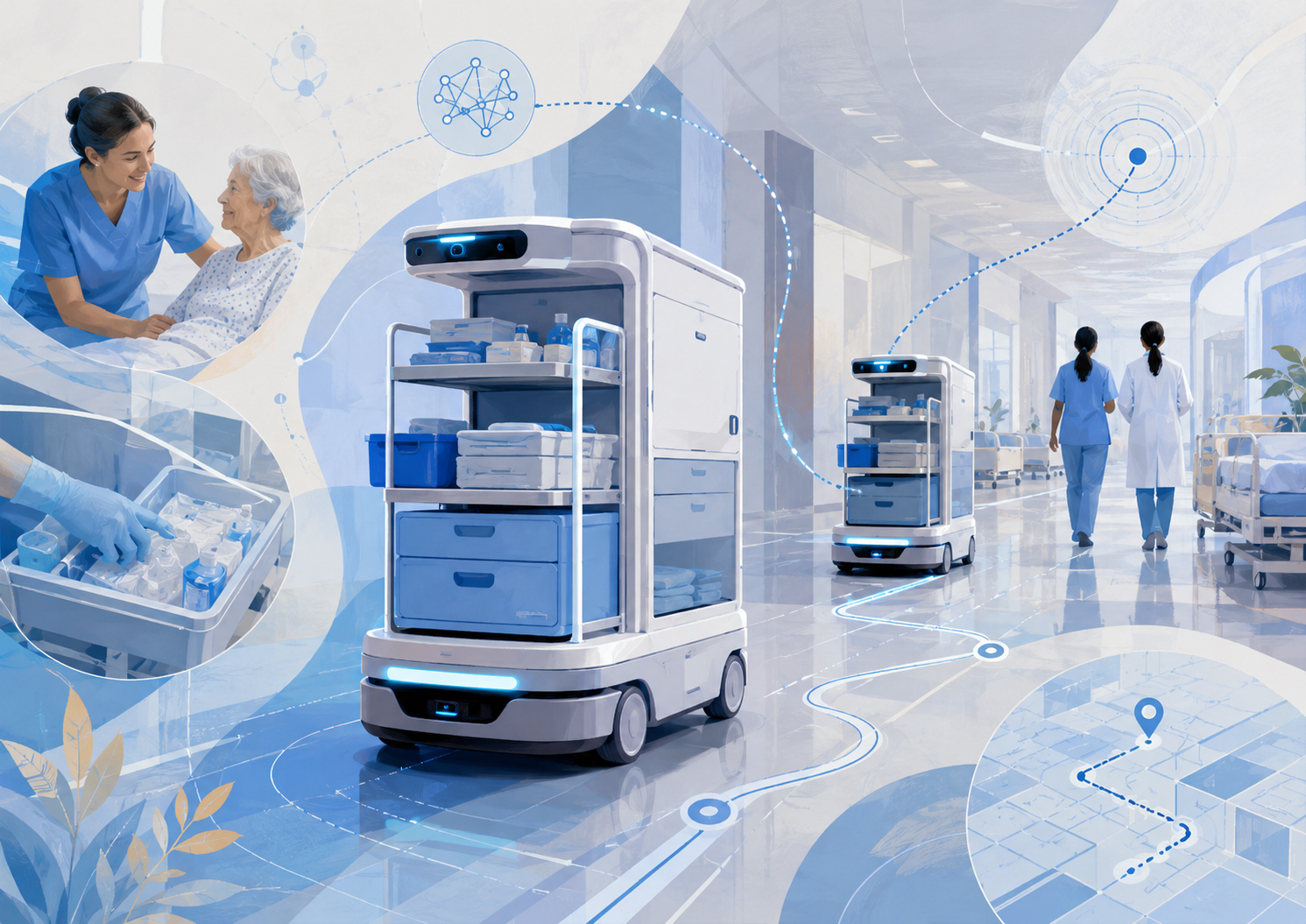
Hospital automation often suggests buying dedicated robotic cabinets and replacing every existing cart. TransCar reverses the logic. A low-profile robot moves beneath modified medication, linen and meal carts, lifts them and transports them autonomously.
Developed by Singapore robotics company OTSAW and introduced in Japan by Moraine Corporation, it is designed to move loads of up to 500 kilograms and work with slopes, elevators and automatic doors using laser scanners, ultrasonic sensors and contact bumpers.
The deeper value is organizational. Hospitals can preserve familiar carts, loading routines, storage points and staff practices while automating only the movement.
Hospital transport is a hidden giant workflow
Hospitals continuously move medication, specimens, linen, meals, waste, supplies, surgical instruments, documents, wheelchairs and oxygen cylinders.
Nurses, pharmacists, assistants and logistics staff accumulate hours walking corridors and waiting for elevators.
The objective is not simply labor removal. It is returning professional time to observation, medication safety, judgment and patient care.
Hospital logistics has a long pre-robot history
Large hospitals automated movement long before mobile robots. Pneumatic tubes carried specimens and documents. Dumbwaiters and dedicated lifts moved meals and supplies. Automated guided vehicles followed wires, magnetic tape or reflectors.
Those systems are effective for regular bulk movement but expensive to retrofit and difficult to reroute.
Autonomous mobile robots map buildings, avoid people and change paths, shifting logistics from fixed infrastructure toward software.
From AGV to AMR
Traditional AGVs follow defined routes and stop when blocked. AMRs use lidar, cameras, inertial sensors and simultaneous localization and mapping to navigate dynamically.
Hospitals are harder than warehouses. Patients, beds, IV poles, wet floors, emergency transfers and visitors constantly change the environment.
Predictable, courteous movement matters more than the shortest route. Robots must slow, yield and avoid surprising people.
The economics of reusing carts
Replacing every cart changes storage, shelves, locks, cleaning and loading systems across pharmacy, kitchens, wards and sterile supply.
Reusing carts reduces asset disposal and training. One robot can serve several cart types rather than dedicating one machine to each payload.
Not every cart is suitable. Center of gravity, wheels, brakes, dimensions, clearance and load rating must be assessed and modified.
What a 500-kilogram capacity means
A 500-kilogram capacity places TransCar in a different category from small delivery robots. Meal, linen and waste carts can be heavy and high-volume.
Bulk movement can remove many human trips, but weight increases braking distance, floor and elevator requirements and collision consequences.
Safety must include speed control, emergency stopping, load retention, communication-loss behavior and manual recovery.
Elevators are the real bottleneck
Flat-corridor navigation is only part of hospital transport. Multi-floor movement is harder.
A robot must call an elevator, enter, select a floor, share space safely and exit. During congestion it may wait for long periods.
A 2026 feasibility study of autonomous medication delivery found that elevator congestion can determine operational capacity. More robots do not improve throughput if the elevators are saturated.
Automatic doors and building systems
Robots need interfaces with elevators, automatic doors and secure zones through wireless signals, APIs, gateways or relays.
Older hospitals contain equipment from different eras and manufacturers. Fire doors and infection-control zones cannot simply open for every machine.
Deployment is therefore a building-integration project involving facilities, IT, nursing, pharmacy, infection control and security.
Infection-control potential and risk
Robots can reduce human entry into isolation areas and support contactless delivery.
They can also become moving surfaces for contamination. Wheels, bumpers, sensors and handles need defined cleaning responsibility and frequency.
Clean and contaminated loads may require separate carts, routes, schedules and documented disinfection.
Medication delivery needs custody and locks
Medication must be tracked: who loaded it, who received it, when it arrived and whether it was opened.
Controlled drugs, refrigerated products, chemotherapy and emergency medicines have different requirements.
Robots can strengthen audit trails, but procedures are still needed for authentication or network failure.
Patients and robots share the corridor
Hospitals include people with impaired vision, hearing or cognition, children, walkers and wheelchairs.
Robots should indicate direction with lights, sound or displays, travel slowly and stop with generous distance. Excessive warning noise can itself become harmful.
Design must anticipate touching, blocking and objects placed on the robot.
Measuring nursing time
Impact should not be measured only in robot kilometers. Hospitals should measure walking time removed and patient-care time restored.
Toyota reports that 24 Potaro transport robots at Toyota Memorial Hospital have traveled 27,000 kilometers since 2023 with a 99% delivery success rate as of January 2026.
That scale shows robots can become infrastructure, while also requiring fleet management, charging and maintenance.
Japan’s healthcare labor shortage
Japan’s aging population increases medical demand while hospitals struggle to recruit nurses and support staff.
In February 2026, SINFONIA group delivered its first AmuA hospital transport robot to Akaiwa Hospital, citing transport burden and task shifting.
The market includes cabinet robots, towing systems, under-ride carriers and fixed AGVs. Hospitals need different tools for different workflows.
Dedicated robots versus under-ride systems
- Dedicated cabinet: Strong security for medicine and specimens, but limited payload and use.
- Towing robot: Moves large carts, but creates a long vehicle in narrow corridors.
- Under-ride carrier: Lifts and releases carts and can serve several workflows.
- Fixed AGV: Efficient for regular bulk routes but costly to install and change.
A hospital may combine small secure robots for specimens with under-ride systems for meals and linen.
Scheduling determines value
Medication may be scheduled, specimens urgent, meals time-critical and waste separated from clean loads.
Fleet software must consider priority, time windows, battery, elevator congestion and cleaning status.
Research on stochastic hospital scheduling shows that uncertain travel and service times strongly affect cost and utilization.
A hospital cannot stop when a robot fails
Hospital logistics operates continuously. Medication and food still move during failure.
Hospitals need manual fallback, spare units, remote support, parts, night coverage and local operation during cloud outages.
Automation should create resilience, not remove every human backup.
Cybersecurity and patient information
Connections to hospital systems, elevators, doors and medication management create cyber risk.
Destination and route data may reveal patient location or treatment. Encryption, access control, logs, updates and vulnerability response are essential.
Foreign cloud services raise questions about data location, remote access and continuity if the vendor exits.
ROI is more than wages
Return on investment includes transport time, delay reduction, medication traceability, fatigue, injury, night-shift burden, turnover, infection exposure and restored bedside time.
Costs include building integration, cart modification, maintenance, connectivity, cleaning, charging space and software.
A narrow labor-saving calculation can understate benefits or hide implementation cost.
Environmental value of existing assets
Reusing carts avoids replacing durable stainless-steel and plastic equipment.
A robot shared across many carts can raise asset utilization and reduce material demand.
Reuse should not preserve unsafe or difficult-to-clean carts. Hospitals must distinguish viable assets from equipment that should be retired.
Hospital transport robots by the numbers
What hospitals should verify before purchase
- Workload: What moves, how heavy, how often and when.
- Building: Corridor width, slopes, floors, doors, elevators and charging.
- Infection control: Clean/dirty separation, cleaning method and records.
- Safety: Patients, beds, emergency routes, stops and manual recovery.
- Information: Authentication, delivery logs, medication systems and cyber controls.
- Continuity: Maintenance, spares, fallback staff and long-term vendor support.
Japan.co.jp view: the best hospital robot may be invisible
The popular image of a hospital robot is humanoid and patient-facing. The first truly large-scale hospital robots may instead be quiet machines close to the floor moving carts.
TransCar’s strength is modesty. It preserves existing carts and workflows while automating repetitive movement.
Success is not how futuristic the robot looks. It is whether medication arrives on time, nurses regain bedside time, night shifts become easier and the hospital continues through failure.
The ideal hospital robot eventually attracts no attention at all. Staff trust it as they trust elevators, lights and other infrastructure.
Sources and further reading
- Moraine Corporation, July 8, 2026: TransCar, reuse of existing carts, 500 kg capacity, sensors and elevator integration.
- LOGISTICS TODAY, July 8, 2026: Japanese introduction and infection-control uses.
- Toyota, March 5, 2026: 24 Potaro robots, 27,000 km and a 99% transport success rate.
- SINFONIA, February 16, 2026: First delivery of the AmuA hospital transport robot.
- Lee et al., 2026: Medication delivery feasibility under elevator congestion.
- Cheng et al.: Stochastic scheduling of hospital AMRs.
- Aethon: Retrofitting existing hospital carts for robotic transport.