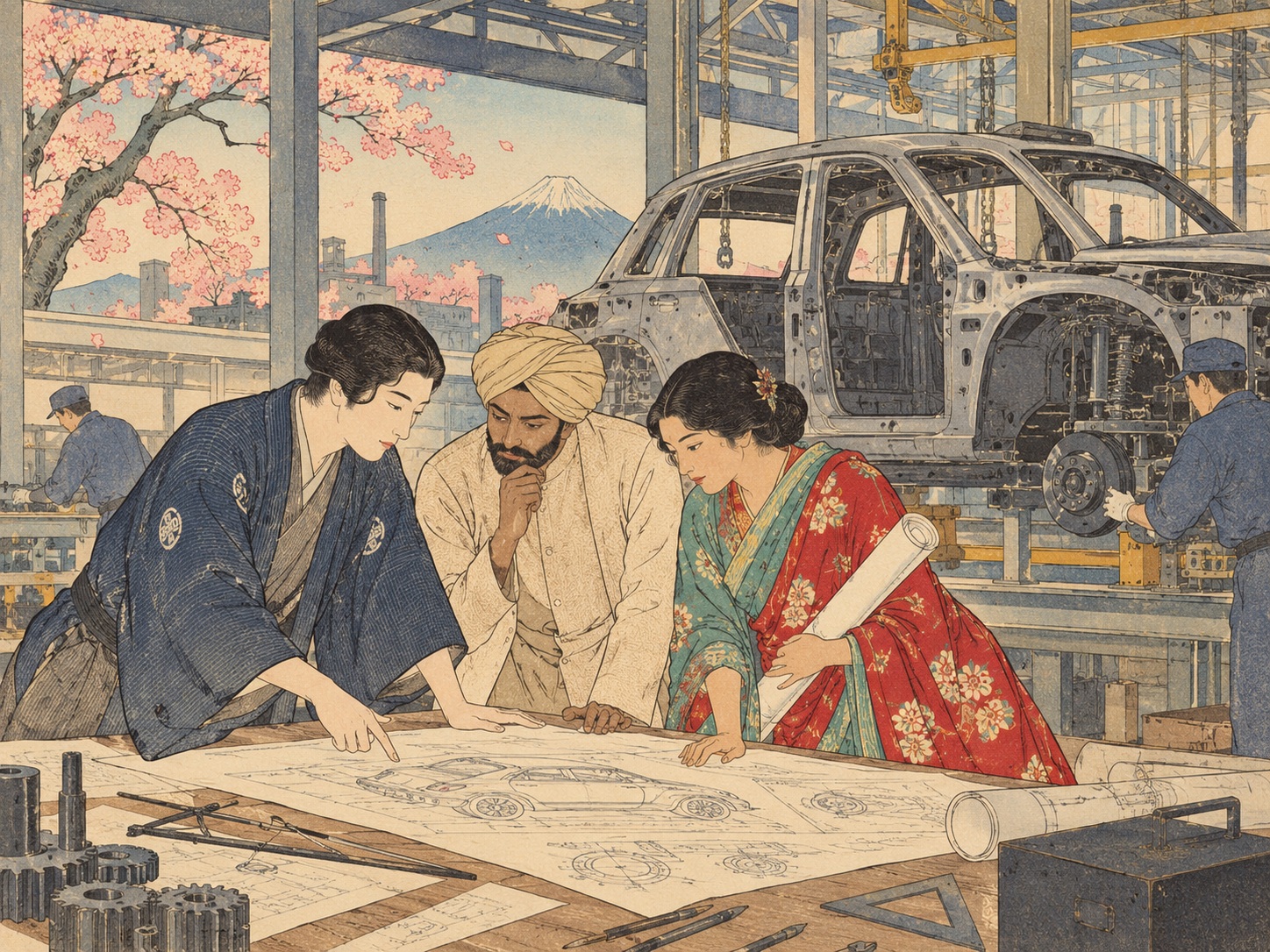
Honda’s problem in India is no longer simply that it needs more models. The deeper issue is who decides what those models should be, where the parts come from, how quickly engineers can move from concept to showroom, and how much of that process must remain entirely inside Honda.
Reuters reported on October 5, citing people familiar with the matter, that Honda Motor is using Tata Technologies in India with the aim of cutting vehicle-development costs by as much as 20% and roughly halving a process that can take around five years. According to the report, Honda would retain control of core technology and quality while drawing on Tata Technologies’ engineering capacity and local supplier network.
Honda has already said it must change how it develops cars
The India move fits squarely inside a broader restructuring. At Honda’s May 14, 2026 business update, President and CEO Toshihiro Mibe laid out a three-year push to rebuild the automobile business around cost discipline, higher development efficiency and concentration of resources in priority regions.
Honda’s three stated pillars are resource reallocation, strategic use of external resources and a stronger manufacturing structure. North America, Japan and India were identified as markets where the company intends to expand its lineup, while China requires more fundamental competitive reform. Honda also plans to introduce a new generation of hybrids beginning in 2027 and spread them across 15 global models by fiscal 2029.
That makes the reported Tata Technologies arrangement more than a one-off outsourcing exercise. It looks like an operating test of a strategy Honda has already presented to investors.
Why India, and why now?
Honda has been building its automobile business in India for more than three decades. Honda Cars India Ltd. was established in December 1995. The City sedan arrived in 1998 and became one of the company’s defining products in the country; in 2022, Honda said cumulative City sales in India and export markets had exceeded 900,000 units.
But the market moved. SUVs and compact utility vehicles became central to Indian passenger-car demand, while domestic manufacturers and Korean rivals filled price points and body styles more aggressively. Reuters reported that Honda’s passenger-vehicle share has fallen from above 7% at an earlier peak to roughly 1% today.
The deeper problem is product cadence. When a development cycle stretches toward five years, a model conceived for one market environment can arrive after customer preferences, tax incentives, feature expectations or rival pricing have already shifted.
From local factories to local decisions
Honda has already localized manufacturing extensively. Its Tapukara complex in Rajasthan began finished-vehicle production in 2014 and was designed as an integrated plant with forging, pressing, powertrain, welding, paint, plastics, engine assembly and vehicle assembly.
In 2020, Honda reorganized Indian production and concentrated finished-vehicle manufacturing at Tapukara, while Greater Noida retained functions including headquarters, R&D and parts operations. Honda’s current manufacturing directory lists Tapukara with annual capacity of 180,000 vehicles.
So the next localization challenge is not simply building cars in India. It is moving product planning, design choices, supplier selection and cost engineering closer to the market.
What Tata Technologies brings
Tata Technologies is not Tata Motors. It is a product-engineering and digital-services company serving manufacturers across automotive, aerospace and industrial sectors. Its offerings include full-vehicle development, EV engineering, embedded software, product-lifecycle management and smart manufacturing.
The company has built its pitch around compressed product cycles. In a 2023 interview published by Tata Technologies, an executive said automotive development cycles that once ran 48 to 52 months had moved toward 36 months and were increasingly being pushed toward roughly 22 to 25 months. Volvo Cars selected Tata Technologies as a strategic engineering supplier in 2025 for work including product engineering, vehicle systems and components, embedded software and lifecycle management.
For Honda, the value is not simply lower-cost engineering labor. A local engineering partner can potentially bring supplier knowledge, Indian cost structures, regulations and customer preferences into the product much earlier.
The four-meter line matters
India’s market has long treated 4,000 millimeters of vehicle length as an important planning boundary, shaped in part by the country’s tax structure. Indian GST rules use the 4,000 mm threshold in vehicle classifications, including elements of the definition applied to certain SUVs.
Reuters reported that one model planned for 2028 is a sub-four-meter SUV. Honda had not publicly confirmed that model sequence in the primary sources reviewed here, so the timing remains reported rather than official.
The strategic logic is clear nonetheless. A successful compact SUV in India is not just a smaller global SUV. It is a package tuned around urban maneuverability, tax treatment, pricing, equipment, fuel economy, rear-seat space and visual presence. Designing those trade-offs locally from the beginning can be very different from adapting a global model late in the process.
Honda is already sending India-built cars back to Japan
India is no longer merely a domestic production base for Honda. The WR-V sold in Japan is sourced from India, demonstrating that an India-built vehicle can flow back into Honda’s home market. That reverses the older assumption that finished concepts and engineering logic move mostly outward from Japan.
Honda Cars India also opened pre-launch bookings for an updated Elevate on October 1 and positioned India as the lead market. The significance is larger than a model refresh: Honda is increasingly willing to let India lead, not simply receive.

The EV reset made development efficiency more urgent
Honda’s India rethink also belongs to a broader industry reset. EV adoption has developed more unevenly than many manufacturers once expected, yet investment must continue across hybrids, EVs, batteries, software and advanced safety systems. Automakers are funding more technical domains at the same time that competitive product cycles are shortening.
That turns engineering capacity into a strategic resource. For a company such as Honda, which has long taken pride in its internal engineering culture, using outside resources more aggressively is not a declaration that engineering matters less. It is a decision about where proprietary engineering matters most.
The risk is equally clear. Faster development only helps if Honda preserves the characteristics customers associate with the brand: durability, safety, steering and ride behavior, powertrain calibration and manufacturing quality. The more responsibility is distributed, the more disciplined the interfaces must become.
The first real test could arrive in 2028
If Reuters’ reported timeline holds, the planned sub-four-meter SUV in 2028 will be the first major test of the new system. The questions are measurable. Did development time actually fall? Did local sourcing lower cost without increasing warranty risk? Is the price competitive? Did Honda finally fill an under-served high-volume segment? Can the architecture support exports or derivatives?
Honda’s own 2026 plan gives the experiment global significance. The company is trying to restore the profitability of its automobile business while preserving investment in hybrid technology, software and safety. A development model that works in India could become a template for other fast-moving markets where local knowledge matters as much as global scale.
Thirty years after entry, a new kind of localization
Honda’s Indian automobile history can be read as a sequence of localization steps. It established the company in 1995, built a brand around the City from 1998, invested in India-specific diesel engineering in the 2010s, built out Tapukara, concentrated production there and then turned India into an export source for Japan.
The next step is more intangible: localizing judgment. Which dimensions matter? Which features can be removed? Which ones cannot? Which supplier can meet Honda standards at Indian cost? How much engineering can happen in parallel rather than sequentially?
There is no guarantee the model will work. External engineering can accelerate execution, but it cannot fix indecision at the top. Local suppliers can lower costs, but not if specifications keep changing. Faster development can miss the market just as easily as slow development if the original product brief is wrong.
That is why the India effort is more consequential than a conventional outsourcing story. Honda is testing whether a Japanese automaker can move from bringing global cars to India toward developing in India for India—and potentially for the world.
Sources and references
- Reuters, “Cost pressures and deadlock force Honda to rework India strategy, sources say,” October 5, 2026.
- 本田技研工業株式会社「2026 ビジネスアップデート 説明概要」2026年5月14日。
- Honda Stories「四輪事業再構築に向けた『3本の柱』」。
- Honda「生産拠点」Honda Cars India Ltd.
- Honda「インドにおける四輪車生産体制を再編」2020年12月23日。
- Honda「インド、ラジャスタン州タプカラの四輪完成車工場で生産を開始」2014年2月24日。
- Honda「インドでの四輪事業強化について」2013年4月2日。
- Honda Cars India, “Honda City celebrates its 25 glorious years in India.”
- Honda Cars India, New Honda Elevate pre-launch booking announcement, October 1, 2026.
- Tata Technologies, Engineering R&D and full-vehicle development solutions.
- Tata Technologies, strategic engineering supplier to Volvo Cars, 2025.
- Government of India, Central Board of Indirect Taxes and Customs, GST goods and services rates.
Reporting cutoff: October 6, 2026, 1:23 a.m. JST. The specific Tata Technologies contract terms, reported 20% cost target, development-time target and 2028 product sequence were not established in the Honda primary materials reviewed for this report and are attributed to Reuters’ October 5 reporting.
What changed
Honda is testing a more locally networked development model in a market it has named a strategic priority.
What is confirmed
Honda itself has identified “strategic use of external resources” as a pillar of its automobile restructuring.
Reporting cutoff
Public information checked through October 6, 2026 at 1:23 a.m. JST.