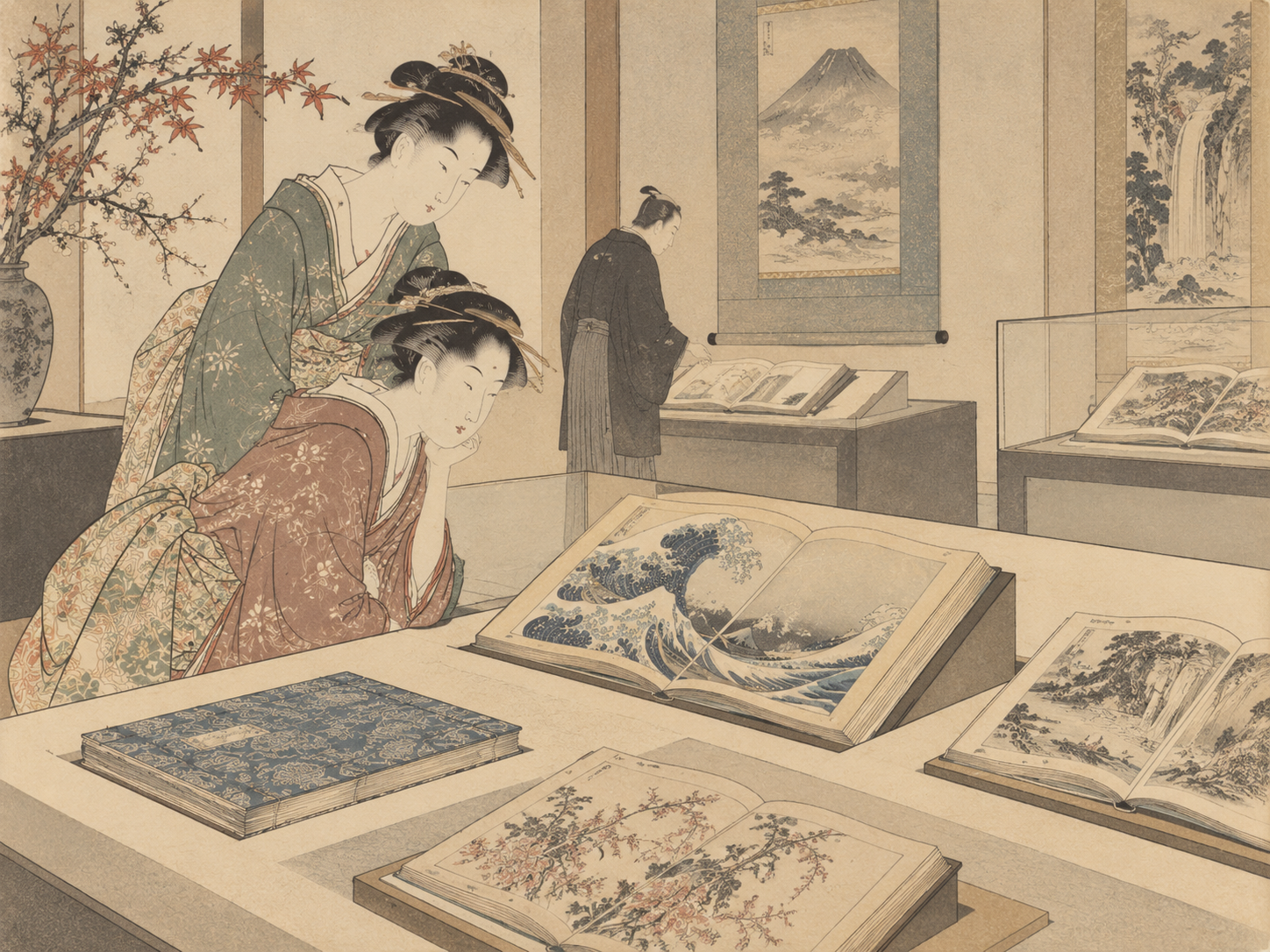
Hokusai’s books did not “stay” in Shimane because Hokusai made them there. He was an Edo artist. They stayed because one of the great scholars of his work—Seiji Nagata, born in the castle town of Tsuwano—spent roughly half a century collecting Hokusai, built a museum around that collection in his hometown, and finally donated 2,398 works and documents to Shimane with a condition that the Nagata Collection not be exhibited outside the prefecture. [4][6]
That condition gives the exhibition opening September 19 at Iwami Art Museum an unusual geography. To see these particular books, prints, woodblocks and documents, the object does not travel to the visitor. The visitor travels to Shimane.
The Iwami edition of Nagata Collection: The Full Picture, Chapter Two concentrates on Hokusai at roughly ages 46 to 60: the “Katsushika Hokusai” and “Taito” periods. This is Hokusai before the great Fuji-print fame that dominates his modern image. In his forties, he became a leading illustrator of yomihon, long prose narratives. In his fifties, he increasingly produced edehon, drawing manuals and picture books for students, admirers and craftspeople. Hokusai Manga began in this period. [1][8]
The exhibition’s deeper subject is therefore publishing. It shows books as images, but also as manufactured things that were carved, printed, reprinted, simplified, wrapped, bought and used. A first-edition woodblock and an original wrapper from Hokusai Manga survive beside first and later printings. The famous artist becomes, for a moment, an artist inside a publishing system.
Shimane Art Museum’s broader Hokusai holdings exceed 2,500 items, including more than 1,600 works by Hokusai himself. The out-of-prefecture restriction applies specifically to the 2,398-item Nagata Collection at the core of those holdings. Shimane’s governor has explained that Nagata’s donation condition was that the material not be exhibited outside the prefecture; in practice it is shown at Shimane Art Museum in Matsue and Iwami Art Museum in Masuda. [6][7][14]
Hokusai built his middle-aged reputation inside books
Around 1805, in his mid-forties, the artist began using the name Katsushika Hokusai and turned intensely toward illustration for yomihon. These were text-led, long-form novels rather than image-first popular books. Hokusai worked with leading writers including Kyokutei Bakin and Ryūtei Tanehiko. [8][10]
Among the major titles were Shinpen Suikogaden and Bakin’s Chinsetsu Yumiharizuki. The latter reimagines the warrior Minamoto no Tametomo in an expansive adventure extending toward the Ryukyus and has been described by Sumida Hokusai Museum as an Edo-period bestseller. [1][11]
The pictures were not decorative afterthoughts. Sumida Hokusai Museum characterizes this phase by Hokusai’s use of ink gradation, deep spatial construction and unconventional composition to raise the artistic level of novel illustration. [10] A reader encountered the narrative in prose and then opened a spread in which darkness, architecture, weapons and bodies could suddenly organize the story as an image.
The Nagata Collection is powerful here because it does not reduce the period to one famous sheet. It preserves sequences of books and states of books, allowing Hokusai’s rise as a book illustrator to be reconstructed through publication rather than retrospective celebrity.
A printed book can change while keeping the same title
Woodblock books were reproducible, but not identical in the modern digital sense. Blocks were carved, inked and printed by hand. Successful books could be printed again. Color or gray blocks might be omitted to reduce work. Blocks could wear, be altered or be recut. Two copies with the same title can therefore preserve different production decisions. [11]
Iwami highlights this with two states of Raigo Ajari Kaishoden. In the first printing, supernatural mice appear in gray because a pale-gray block is used. In a later printing, that block is omitted and the mice become white. [1]
That difference is not aging. It is printing history. Put the two copies beside one another and a curator can ask what Hokusai’s image initially looked like and what happened when the book entered a longer commercial life.
This is one reason first printings mattered to Nagata. A collector interested only in “owning Hokusai” might prefer a clean, famous image. A researcher collects versions, wrappers, blocks and anomalies because comparison produces knowledge.
In his fifties, Hokusai began teaching at a distance
Around 1810 Hokusai began using the art name Taito and gradually shifted from novel illustration toward edehon. In the narrow sense these were manuals for people learning to draw, but their use was broader: people bought them for enjoyment, students copied them, and craftspeople could use images as design references. [8][11]
The shift answered a problem of scale. Hokusai had more pupils, and admirers who could not study with him directly were spread across Japan. Drawing manuals published not only in Edo but also by publishers in Nagoya and western Japan allowed a “Hokusai style” to circulate without Hokusai himself moving from studio to studio. [8]
Ryakuga Hayaoshie, for example, teaches the construction of forms from circles and lines. Other books collect models to copy rather than giving step-by-step instruction. A woodblock book becomes a portable studio lesson.
Hokusai Manga is not “manga” in the modern comic-book sense
Hokusai Manga began with its first volume in 1814. It ultimately ran to 15 volumes and contains roughly 3,900 images. People, occupations, animals, plants, deities, monsters, buildings, tools, weather and landscapes appear across the series. [12]
Volume two groups familiar fish—goldfish, medaka, gobies, loaches, anglerfish, flounder—among other marine life, animals and plants, suggesting editorial organization rather than random doodling. [20] Volume three shows dancers in slightly changing poses, allowing the eye to reconstruct movement in sequence. [19]
The name can mislead modern readers into imagining panel comics. It is better understood as a drawing manual, picture compendium and visual reservoir. Different users could extract different value: an aspiring painter copied it, a craftsperson adapted motifs, a general reader browsed it for pleasure.
That multiplicity also helps explain its later global reach. Sumida Hokusai Museum notes that Hokusai’s drawing manuals circulated internationally and became a source for Western artists and designers. [8][13]
An 1814 printing block survived
One of Iwami’s most extraordinary objects is not a finished book. It is a woodblock from the first edition of Hokusai Manga. The museum explains that the first volume was completely recut in 1828. The block displayed at Iwami belongs to the original 1814 edition, and no other surviving example of that original block is known. [1]
That changes the way the book is understood. A printed page can feel like Hokusai’s direct image. The block restores the hidden production chain: design, transfer, carving, inking, printing, folding, binding and sale.
An original wrapper that enclosed an early printing of Hokusai Manga is also displayed. It might look peripheral beside a great image, but it records the book as merchandise. It is closer to a publisher’s cover or commercial package than to a painting. Nagata preserved it because the life of a book begins before the museum removes the packaging. [1]
Nagata collected celebrated works, but also first and later printings, wrappers, blocks, works by Hokusai’s pupils and research documents. The result can support questions about publishing, distribution and reception—not only questions of connoisseurship. [4]
Nagata’s own Hokusai story began with a book
There is a satisfying symmetry here. According to Shimane Art Museum, Nagata became fascinated with Hokusai in the third grade of elementary school after encountering the drawing manual Ehon Hayabiki. By his mid-teens he was collecting Hokusai seriously. [5]
He studied under the intellectual influence of ukiyo-e scholar Muneshige Narazaki, attended Rissho University and from 1972 became involved in publishing, editing and writing for the specialist journal Hokusai Kenkyu. He joined the Ota Memorial Museum of Art in 1977 and eventually served as deputy director and head curator. [5]
In 1990 he opened the Katsushika Hokusai Museum in his hometown of Tsuwano, centered on his own collection. It closed in 2015. Nagata received the French Order of Arts and Letters, Officer, in 2016. In 2017 he donated 2,398 works and documents to Shimane Prefecture; he died the following February at 66. [4][5]
The collection therefore did not “return” to a place where Hokusai had made it. It returned to the home prefecture of the person who spent a lifetime constructing a scholarly Hokusai archive.
“Not to leave the prefecture” was a donation condition, not a slogan
The phrase “ken-gai fushutsu”—not to leave the prefecture—can sound like museum marketing. Shimane has described it more concretely. In a 2025 press conference, the governor said Nagata’s donation was accepted on the condition that the material not be placed on exhibition outside Shimane. The two prefectural institutions capable of meeting the arrangement are Shimane Art Museum in Matsue and Iwami Art Museum in Masuda. [6]
The restriction does not apply to every Hokusai work owned by Shimane. The prefecture’s holdings include other collections, such as the Shinjo Collection, that do not carry the same condition. [6] The distinction is crucial: it is the Nagata Collection that stays.
A condition like this can be read in two ways at once. It limits lending to major exhibitions elsewhere. It also leaves a permanent reason for scholars, collectors and visitors to travel to Shimane. When the donation was announced in 2017, the prefecture explicitly discussed both educational benefit for local residents and children and the potential to attract visitors from outside Shimane. [15]
Tsuwano, Matsue, Masuda: a modern geography for an Edo artist
Hokusai’s historical geography is centered on Edo. The Nagata Collection’s modern geography is western Japan. Nagata was born in Tsuwano. His private Hokusai museum operated there for 25 years. The donated collection is now interpreted by prefectural museums in Matsue and Masuda.
That modern route matters because collections are not natural facts. Someone chooses what to buy, what to preserve, what to call rare, what to keep together and where the whole group should eventually live.
The Nagata Collection is therefore also a portrait of a researcher. Why preserve a paper wrapper? Why seek a first printing beside a later one? Why keep blocks and pupils’ works? The answers reveal Nagata’s belief that Hokusai should be studied through production and transmission, not only through masterpieces.
The 2026 Iwami show should not be described as “all 500+ books”
There is a useful editorial distinction between the Matsue and Iwami versions of Chapter Two. The 2025 Shimane Art Museum presentation explicitly advertised more than 500 volumes of yomihon, drawing manuals and other printed books shown comprehensively. [9]
The official 2026 Iwami page uses different language. It says the exhibition allows visitors to survey the major yomihon and drawing-manual works, drawn from roughly 450 Katsushika Hokusai-period items and 200 Taito-period items in the Nagata Collection. [1]
Japan.co.jp therefore does not carry the “all 500+ volumes” claim automatically into the Iwami edition. The museum does confirm a broad display of prints, surimono, printed books and paintings, with all nishiki-e and surimono replaced between the first and second halves, pages of books changed, and about 90% of displayed material changing overall. [1]
| Work | Type | Period | Display note |
|---|---|---|---|
| Shinpen Suikogaden, first part | Yomihon illustrated novel | Katsushika Hokusai period | Shown through the exhibition; published image from first half |
| Chinsetsu Yumiharizuki, first part | Yomihon illustrated novel | Katsushika Hokusai period | Shown through the exhibition; published image from second half |
| Raigo Ajari Kaishoden, first part | Yomihon illustrated novel | Katsushika Hokusai period | First/later printing comparison |
| Hokusai Manga | Drawing manual | Taito period | Shown throughout, with displayed pages changed |
| Onogabakamura Mujina no Tsuwamono | Printed book / drawing-manual context | Taito period | Shown throughout |
| Santai Gafu | Drawing manual | Taito period | Shown throughout |
| Ryakuga Hayaoshie, first part | Drawing manual | Taito period | Shown throughout |
Displaying a book is an act of selection
A print can be hung and seen almost all at once. A book cannot. A bound volume may contain dozens or hundreds of pages, while a museum case reveals one opening at a time. Light exposure and conservation needs also matter.
Iwami’s notice that displayed book pages will change is therefore not merely an exhibition trick. It acknowledges the form. Different openings can reveal different aspects of the same volume, while limiting how long one page remains exposed. [1]
Book exhibitions ask visitors to imagine what is closed. The visible spread belongs to a sequence; an illustration has text before and after it; a drawing manual contains systems of comparison that cannot be understood from a single plate.
This is one reason the exhibition’s “book world” language is apt. The art is not only on the page. It is in turning, sequencing, repeating and learning.
A book could be art, merchandise and instruction at the same time
Edo-period categories overlap in ways modern museum labels can obscure. Chinsetsu Yumiharizuki is literature and an illustration project. Hokusai Manga is a drawing manual, a picture album and entertainment. Ryakuga Hayaoshie is instruction and an expression of how Hokusai thought forms could be constructed.
Sumida Hokusai Museum notes that drawing manuals were not restricted to formal art students. They could be purchased for viewing and used by craftspeople as design sources. [11]
That versatility helps explain how Hokusai’s influence became larger than his personal circle. A book travels where the teacher does not. Someone in another city can copy the style without entering the studio. A craft worker can lift a motif into another material. When the books travel abroad, the same mechanism operates across languages.
The Wave can obscure the artist who thought in pages
Iwami’s related programming deliberately links Hokusai Manga with the famous Great Wave: the Kyoto publisher Unsodo will demonstrate printing reproductions of both. [1] The pairing is useful because modern Hokusai is often reduced to a single-sheet image, while Chapter Two concentrates on the decades when books were central.
His forties were shaped by narrative illustration. His fifties by manuals and picture books. Later came other peaks—surimono, landscape series and the mature painted work for which different periods are remembered.
Calling Hokusai “the artist of the Wave” is not wrong. It is simply incomplete. Hokusai Manga, the tonal plates in yomihon, the geometric instruction of Ryakuga Hayaoshie and the material evidence of printing blocks reveal an artist who spent years solving visual problems inside books.
The Iwami edition opens September 19
The exhibition runs September 19 through November 9 in Gallery D at Iwami Art Museum inside Grand Toit in Masuda. The first half runs through October 12; the second begins October 15. The Hokusai exhibition closes October 13–14 for the changeover. Admission to the special exhibition is ¥1,000 for adults, ¥600 for university students and free for high-school students and younger; combination tickets with the collection galleries are also available. [1]
For the prefecture’s Silver Week, people who turn 65 or older during 2026 can view the exhibition free from September 19 through 25 with proof of age. [18]
On September 20, Unsodo will demonstrate woodblock printing using reproductions of Hokusai Manga and the Great Wave. On September 26, dealer and noted Hokusai Manga collector Mitsuru Uragami will lecture on the work. A miniature printing workshop using reproduction blocks is scheduled for November 3. [1]
The museum says roughly 90% of displayed works change between the two halves. In that sense, one visit cannot easily stand in for the whole chapter. A collection assembled across decades is being disclosed across years, chapters and rotations rather than compressed into one blockbuster display.
Why Shimane matters to the history of these objects now
Hokusai did not need Shimane to make these books. Their later history did.
A child in Tsuwano encountered a Hokusai drawing manual. The child became a collector, then a scholar, then a museum curator and founder. He built a museum in his hometown. When that museum closed, the collection did not scatter. He gave it to his prefecture and attached a condition that kept it there. [4][5][6]
There are legitimate tensions in such a choice. Objects that cannot travel cannot join as many exhibitions elsewhere. But a place-bound collection can also build local expertise, create continuity and force the global Hokusai audience to recognize a place outside Tokyo as part of the artist’s modern history.
In autumn 2026, anyone who wants to see the original 1814 Hokusai Manga block, the wrapper from an early copy, or first and later impressions side by side has to move toward the collection rather than wait for the collection to move toward them.
The books were made in Edo. Nagata found and studied them. Shimane became their second geography. That geography is now part of their story.
Sources and references
- Iwami Art Museum: Nagata Collection, Chapter Two — Hokusai’s Katsushika Hokusai and Taito periods
- Shimane Prefecture: Iwami edition of Nagata Collection Chapter Two, press release (Sept. 11, 2026)
- Shimane Prefecture / PR TIMES: Iwami Hokusai exhibition announcement (Sept. 15, 2026)
- Shimane Art Museum: Development of the Hokusai collection — Seiji Nagata and the 2,398-item donation
- Shimane Art Museum: Nagata Collection — Seiji Nagata’s life and collecting
- Shimane Prefecture governor’s press conference: donation condition restricting the Nagata Collection to exhibitions inside Shimane
- Shimane Art Museum: Hokusai Collection overview — 2,500+ total items, 1,600+ by Hokusai
- Shimane Art Museum: Chapter Two overview — from yomihon illustrations to drawing manuals
- Shimane Art Museum: Nagata Collection full-series project — Hokusai’s six periods and Nagata biography
- Sumida Hokusai Museum: Hokusai’s life — the yomihon and drawing-manual periods
- Sumida Hokusai Museum: Hokusai Book World — the world of woodblock-printed books
- Sumida Hokusai Museum: Hokusai Manga, first volume — 1814, 15 volumes and about 3,900 images
- Sumida Hokusai Museum: Open the Drawing Manual! Hokusai Manga Etc.
- Shimane Art Museum Hokusai Project — Nagata Collection restricted to Shimane
- Shimane Prefecture: 2017 governor’s remarks on the Nagata donation
- Shimane Art Museum English: The Hokusai Collection
- Grand Toit: Iwami Chapter Two exhibition notice (Sept. 11, 2026)
- Grand Toit: 2026 Silver Week free-admission notice
- Sumida Hokusai Museum: Hokusai Manga, volume three — sequential movement
- Sumida Hokusai Museum: Hokusai Manga, volume two — fish, animals and plants
Evidence reviewed September 16, 2026, Japan time. The 2026 Iwami Art Museum page controls the current exhibition dates, works, first/later-printing comparison, 1814 block, wrapper and rotation details. Shimane Art Museum and Shimane Prefecture primary sources support Nagata’s biography, the 2,398-item donation and the restriction on exhibition outside Shimane. The 2025 Matsue presentation’s “500+ volumes shown comprehensively” language is not carried over to Iwami, whose official 2026 wording instead says major yomihon and drawing-manual works can be surveyed. General context on Hokusai’s book periods and Hokusai Manga comes from Sumida Hokusai Museum. Analysis is Japan.co.jp’s unless otherwise attributed.