- A tiny canvas with an evolutionary history
- A century of asking flies about inheritance
- From a landmark to a pigment pattern
- Making an unfamiliar species experimentally tractable
- Dpp: the information behind the wing veins
- Notch changes the outcome as development proceeds
- What the pattern can—and cannot—tell us about evolution
A tiny canvas with an evolutionary history
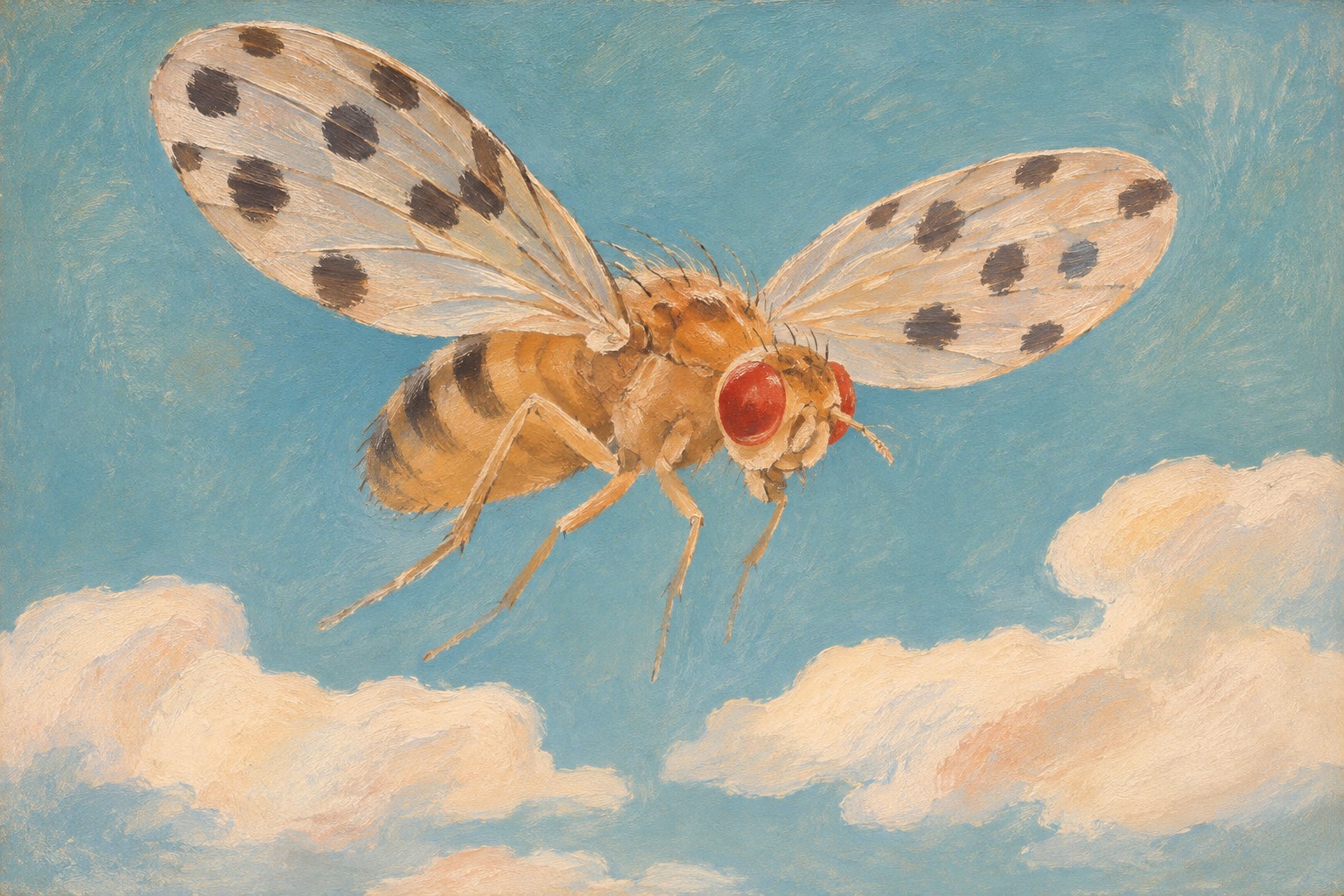
Look closely at the wings of the polka-dot fruit fly, Drosophila guttifera, and a transparent flight surface becomes a remarkably elaborate pattern. The dark markings are associated with anatomical landmarks rather than scattered indiscriminately. How does a developing insect know where to put each mark?
Hokkaido University announced on November 26 that Masato Koseki, a doctoral student during the research, and Professor Shigeyuki Koshikawa had investigated the regulatory machinery behind those patterns. Their peer-reviewed paper appeared in BMC Biology on November 17.
The answer emerging from their experiments concerns the reuse of biological machinery. The signals that organize a wing can also participate in decorating it, while the same signaling system can have different consequences as development proceeds.
A century of asking flies about inheritance
Fruit flies helped turn genetics into an experimental science. In the early twentieth century, Thomas Hunt Morgan and his colleagues used mutations in Drosophila melanogaster to establish the relationship between genes and chromosomes. Rapid breeding and manageable laboratory populations made the insects unusually useful.
Later generations of researchers shifted attention toward how genes construct an animal during development. Their experiments revealed that much of the machinery for building bodies is conserved across surprisingly different animals. Genes are not instructions that run in isolation: they are components of interacting systems.
The next challenge was to explain diversity. A laboratory fruit fly tells us much about how a wing develops, but comparing it with a patterned relative can reveal how evolution changes the use of that machinery. The polka-dot species offers an especially visible experimental endpoint: a change in development can be assessed in the adult wing.
From a landmark to a pigment pattern
In 2010, a Nature study involving Koshikawa connected the markings of D. guttifera with the signaling protein Wingless. A developmental signal used to organize tissues was also associated with pigment production at specific positions. This established a bridge between anatomy and coloration.
A 2015 study followed the evolutionary trail into regulatory DNA. Enhancers are sequences that help determine where and when a gene is transcribed. The team found several additional regulatory activities associated with the patterned fly, including one for vein tips that appeared to have developed within an older regulatory sequence.
Consider a building with existing electrical wiring. A new connection can put a familiar component to work in another room without requiring an entirely different component. The analogy captures the distinction between acquiring a new gene and changing the regulation of an existing one, although actual biological networks are much more complex.
Making an unfamiliar species experimentally tractable
A gene with several developmental jobs poses a practical difficulty. Disrupt it throughout development and the resulting animal may lack the very structure a scientist wants to study. A more informative experiment reduces its activity in selected tissues or during a defined developmental interval.
Koseki and Koshikawa established an RNA interference approach using the GAL4/UAS system in the patterned species. The approach enabled them to investigate developing wing-vein regions in the middle of the pupal stage and pigmentation regions later. RNA interference reduces expression rather than necessarily eliminating a gene from the genome.
Their comparisons connected changes in adult markings to molecular events in the developing wing. Reducing wingless narrowed the pigmentation domain; reducing the pigment-associated gene yellow instead weakened the dark coloration. The distinction matters: deciding where to pigment is a different problem from producing the pigment itself.
Dpp: the information behind the wing veins
Decapentaplegic, usually abbreviated Dpp, is a developmental signaling molecule involved in wing organization. When the researchers reduced dpp expression during the middle pupal period, they observed defects in some veins alongside smaller spots.
The experiment also connected Dpp signaling with the regulation of wingless. Activity of the downstream factor Mad and of a regulatory element associated with wingless declined. The evidence supports a model in which information originally involved in constructing the wing is also used to place its coloration.
This does not establish every molecular step. In particular, the researchers identify the question of whether the regulatory connection is direct as a subject for further work. A signaling pathway can influence a gene through intermediaries; determining that sequence is essential to a complete mechanistic account.
Notch changes the outcome as development proceeds
One of the most revealing findings concerns Notch, a signaling system through which nearby cells influence one another. In the middle of pupal development, reducing Notch activity produced wider veins and enlarged markings at their tips. At a later stage, interfering with Notch or its associated ligand Delta reduced the area of pigmentation without comparably disrupting wing shape.
The two observations should not be mistaken for a contradiction. Developing tissues change over time. A signal received by a cell that is establishing structural identity can produce a different response from the same signal received later by a cell preparing to acquire pigment.
The result adds a temporal dimension to evolutionary innovation: changing when an existing pathway acts, or how cells respond to it, may change the final appearance. The molecular explanation for the late-stage expansion of the spots remains an open research question.
What the pattern can—and cannot—tell us about evolution
A separate study published online in late 2025 and in a 2026 journal issue examined the pigmentation genes yellow and tan using CRISPR/Cas9. Mutations weakened pigmentation but did not erase the underlying pattern. Together, these lines of work help distinguish the machinery that establishes a spatial design from the machinery that realizes it in color.
Evolutionary developmental biology investigates how inherited changes in development generate diversity. Natural selection can subsequently favor or disfavor particular variants, but a developmental mechanism alone does not establish the ecological advantage of a marking. The November study does not demonstrate why these particular spots evolved, nor that all insect patterns use the same mechanism.
The new experimental system provides a way to compare related species and test which changes are shared or distinctive. Future work can ask how regulatory elements acquired new inputs and how the late Notch response is produced. Those questions connect the appearance of a tiny fly to a much larger scientific problem: how remarkably diverse animals emerge from a comparatively familiar collection of developmental components.
Primary sources and references
- Hokkaido University announcement, November 26
- Hokkaido University detailed release
- Hokkaido University Department of Biological Sciences
- Koseki and Koshikawa, BMC Biology (2026)
- Werner et al., Nature (2010)
- Koshikawa et al., PNAS (2015)
- Review: Evolution of wing pigmentation in Drosophila
- Matsumoto et al., Insect Molecular Biology (2026)
- Koshikawa, Enhancer modularity and the evolution of new traits