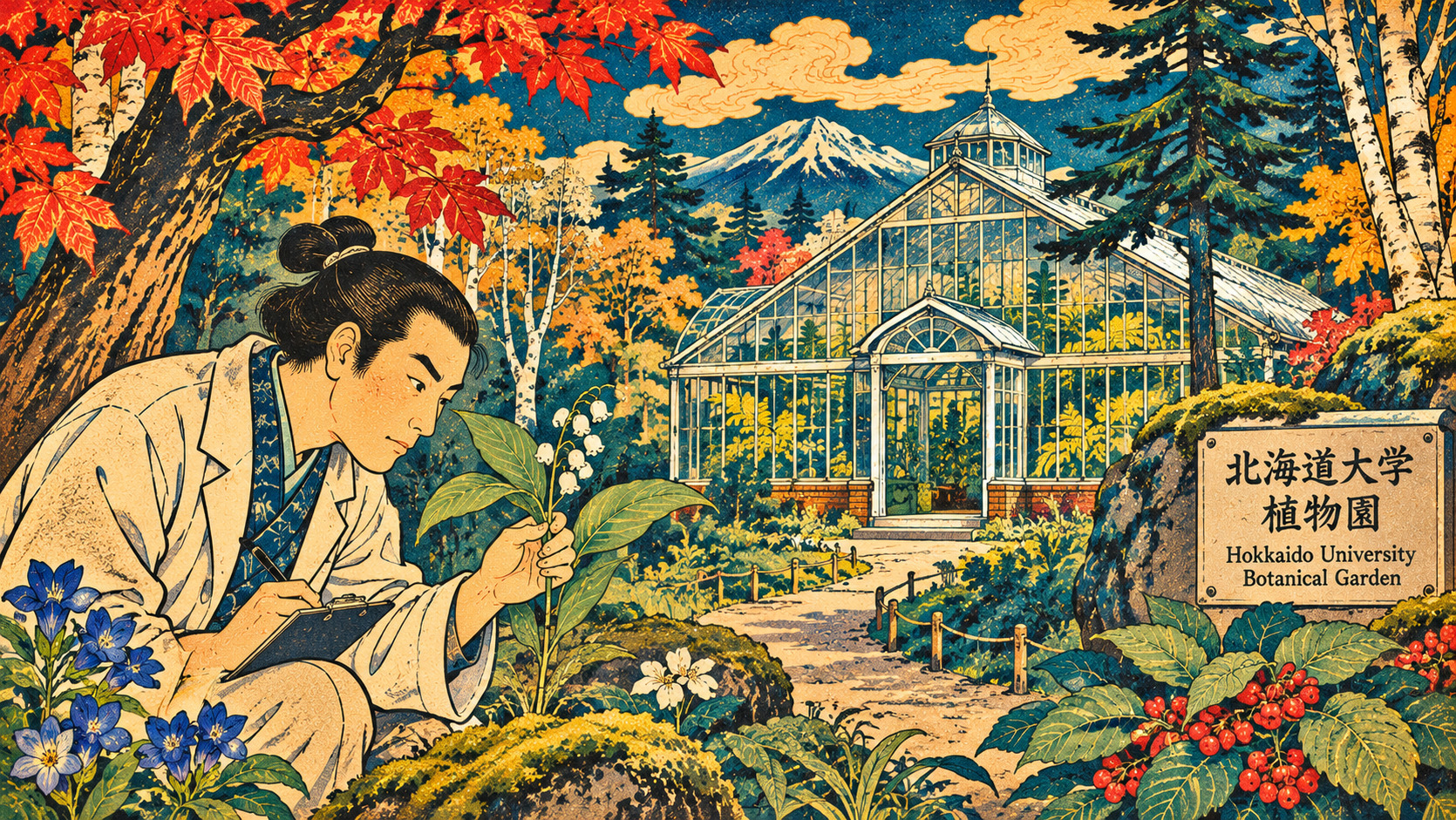
- A forest in the middle of a city
- From an agricultural college to a living archive
- What a botanical garden preserves
- Why living collections and records matter
- A second laboratory, on the scale of a watershed
- Japan’s route from protected parks to broader conservation
- How to judge whether recognition makes a difference
- A responsibility extending beyond the classroom
A forest in the middle of a city
A short walk from Sapporo Station brings visitors to a landscape that predates much of the modern city. Mature trees rise above the paths of Hokkaido University’s Botanic Garden, a research institution whose living collections and surviving woodland offer a different perspective on the development of Japan’s northern island.
On October 30, 2026, the garden received certification under Japan’s regional biodiversity enhancement law. The university’s sustainability office announced the recognition on November 18, and its central news index carried the item on November 24. The Uryu Research Forest, recognized under the preceding system in 2023, moved into the statutory framework on the same October date. The garden is the university’s third recognized site, after the forest and Sapporo campus.
Both newly certified activities are classified as maintenance of existing biodiversity. The announcement therefore concerns the enduring value of habitats and their management, not the sudden creation of new woodland or a measured increase in species. It illustrates how a university can make conservation part of its responsibilities as a land manager.
From an agricultural college to a living archive
The garden’s origins lie in the nineteenth-century transformation of Hokkaido. William Smith Clark, vice-principal of Sapporo Agricultural College, proposed a botanical garden for teaching in 1877. The college acquired the present site and museum in 1884. The garden opened in 1886, making 2026 its 140th anniversary. Hokkaido University describes it as Japan’s first modern botanical garden.
Kingo Miyabe (1860–1951), a graduate of the college, helped design the garden and undertook a botanical collecting expedition through Hokkaido and the Kuril Islands in 1884. His subsequent studies at Harvard and research on northern flora helped establish an enduring scientific tradition. He became the garden’s first formally appointed director in 1900 and received Japan’s Order of Culture in 1946.
The early institution served practical economic purposes as well. Researchers evaluated introduced trees for suitability to northern climates and distributed seedlings. Yet the design also retained elements of the existing landscape. The result was not simply a collection of imported plants but a place in which research, education and the history of the land could coexist.
What a botanical garden preserves
The garden covers 13.3 hectares and maintains around 4,000 kinds of plants, with a particular emphasis on Hokkaido flora and alpine species. That figure describes its collections; it should not be interpreted as a count of native species within an undisturbed ecosystem. Japanese elm, painted maple and Mongolian oak are among the trees associated with the surviving broadleaf woodland.
Sapporo developed on the alluvial fan of the Toyohira River. Springs once flowed across the garden’s site, known in Ainu as mem. Today, the garden uses pumped groundwater to maintain its watercourses. The distinction matters: conserving urban nature often requires deliberate intervention to sustain environmental conditions altered by a surrounding city.
The garden’s alpine collection, established in 1938, provides opportunities to study plants adapted to mountain conditions. A plant’s ability to survive in cultivation, however, does not automatically guarantee that its wild populations are secure. Conservation must address the soil, water, pollinators and other organisms on which those populations depend.
Why living collections and records matter
Botanical gardens can complement habitat conservation by maintaining plants outside their original environments. This is known as ex situ conservation, in contrast to in situ protection of populations in the wild. The two approaches address different risks. A carefully documented collection can preserve research material, while a healthy wild habitat sustains ecological interactions and ongoing evolution.
Herbarium specimens provide another form of evidence. Preserved material can help later researchers verify a plant’s identity and investigate changes in distribution. Combined with repeated observations of living plants, such records can support research into flowering seasons, climate responses and relationships between plants and insects. These are examples of the scientific value of long-term collections, not results attributed to the October certification.
The garden also holds material relating to northern Indigenous cultures. Hokkaido’s environmental history cannot be understood solely through the institutions established during the Meiji era. Ainu knowledge and relationships with plants deserve attention in their own right, with respect for the communities and provenance of cultural material.
A second laboratory, on the scale of a watershed
Far from downtown Sapporo, the Uryu Research Forest offers a complementary model. Established in 1901 as a property forest of Sapporo Agricultural College, it is the oldest of Hokkaido University’s research forests. The university’s forest station reports a managed area of 24,913 hectares. That facility figure is not necessarily identical to the boundary of its conservation certification.
The forest lies near Lake Shumarinai in northern Hokkaido. Mixed conifer and broadleaf forests, river margins, wetlands and stands of Sakhalin spruce form a landscape shaped by snow, geology and water. Different substrates and terrain support different vegetation, giving researchers opportunities to compare ecological processes across a large area.
Uryu is a working research landscape rather than a place where all intervention is prohibited. Research into forest regeneration and watershed-scale water and nutrient cycles can involve managed plots and long-term observations. Experimental forestry can inform better stewardship, provided the effects of interventions are monitored and the conservation objectives remain explicit.
Japan’s route from protected parks to broader conservation
The international Kunming–Montreal Global Biodiversity Framework, adopted in December 2022, established a target of effectively conserving at least 30 percent of land and sea by 2030. Japan incorporated that ambition into its national biodiversity strategy in March 2023. The broader aim, commonly called nature positive, is to halt and reverse biodiversity loss.
Japan’s law promoting regional biodiversity enhancement activities came into effect on April 1, 2025. It provides a statutory mechanism for recognizing activities that maintain, restore or create biodiversity. Land managed by universities, companies and other organizations can therefore contribute alongside conventional protected areas. Certification of an activity plan does not turn a botanical garden into a national park.
An important international concept is the other effective area-based conservation measure, or OECM. These areas deliver conservation outside designated protected areas. Hokkaido University says its campus and Uryu forest already have international OECM registrations, whereas registration of the newly certified garden is planned. Domestic recognition and international registration are separate milestones.
How to judge whether recognition makes a difference
Japan’s 2026 environmental white paper reported that designated protected areas covered about 20.8 percent of land and 13.3 percent of marine territory as of August 2025. Those are protected-area figures, not the latest combined totals including OECMs. Expanding coverage is important, but the quality and durability of management matter just as much.
For a botanical garden, meaningful indicators might include the survival and regeneration of native trees, the condition of habitats, control of invasive plants and the persistence of associated insects. For a research forest, monitoring might examine forest structure, water systems and the ecological effects of management. These are illustrative evaluation criteria, not an assertion that the university has adopted every one of them in its certified plans.
The October designation does not itself provide evidence of a subsequent increase in biodiversity. Nor does it resolve the competing demands of public access, research and maintenance. Establishing transparent baselines and making long-term results available would help readers understand how the value of the sites is being sustained.
A responsibility extending beyond the classroom
Hokkaido University says its campuses and affiliated field facilities cover around 70,000 hectares. In June 2022 it became the first Japanese national university corporation to join the domestic 30by30 alliance. Its scale gives it a role beyond publishing research: decisions about the land it manages can affect the habitats it studies.
Universities are unusually well placed to sustain records across generations, train specialists and connect conservation with public education. The challenge is to maintain those capacities when budgets, staffing and competing land uses change. A recognized site needs continuing care rather than a one-time announcement.
JAPAN.co.jp’s forthcoming November 29 Hokkaido edition will explore the island’s history, economy and communities. The garden and Uryu forest offer a useful starting point for that wider picture: Hokkaido’s natural systems are not merely scenery for visitors but a foundation for research, forestry, agriculture and everyday life. Preserving that foundation requires a commitment measured in decades, not just in hectares.
Primary sources and references
- Hokkaido University sustainability office — certification announcement
- Hokkaido University — November 2026 news index
- Botanic Garden — overview and history (Japanese)
- Botanic Garden — detailed institutional history (Japanese)
- Hokkaido University Museum — Kingo Miyabe biography
- Hokkaido University — public facilities
- Forest Research Station — Uryu Research Forest
- Field Science Center — Uryu Research Forest
- Ministry of the Environment — biodiversity law commencement
- Ministry of the Environment — 30by30
- Ministry of the Environment — National Biodiversity Strategy 2023–2030
- Hokkaido University — nature-positive initiatives
- Ministry of the Environment — 2026 environmental white paper
- Ministry of the Environment — certified site register
- Hokkaido University SDGs — Sapporo campus certification