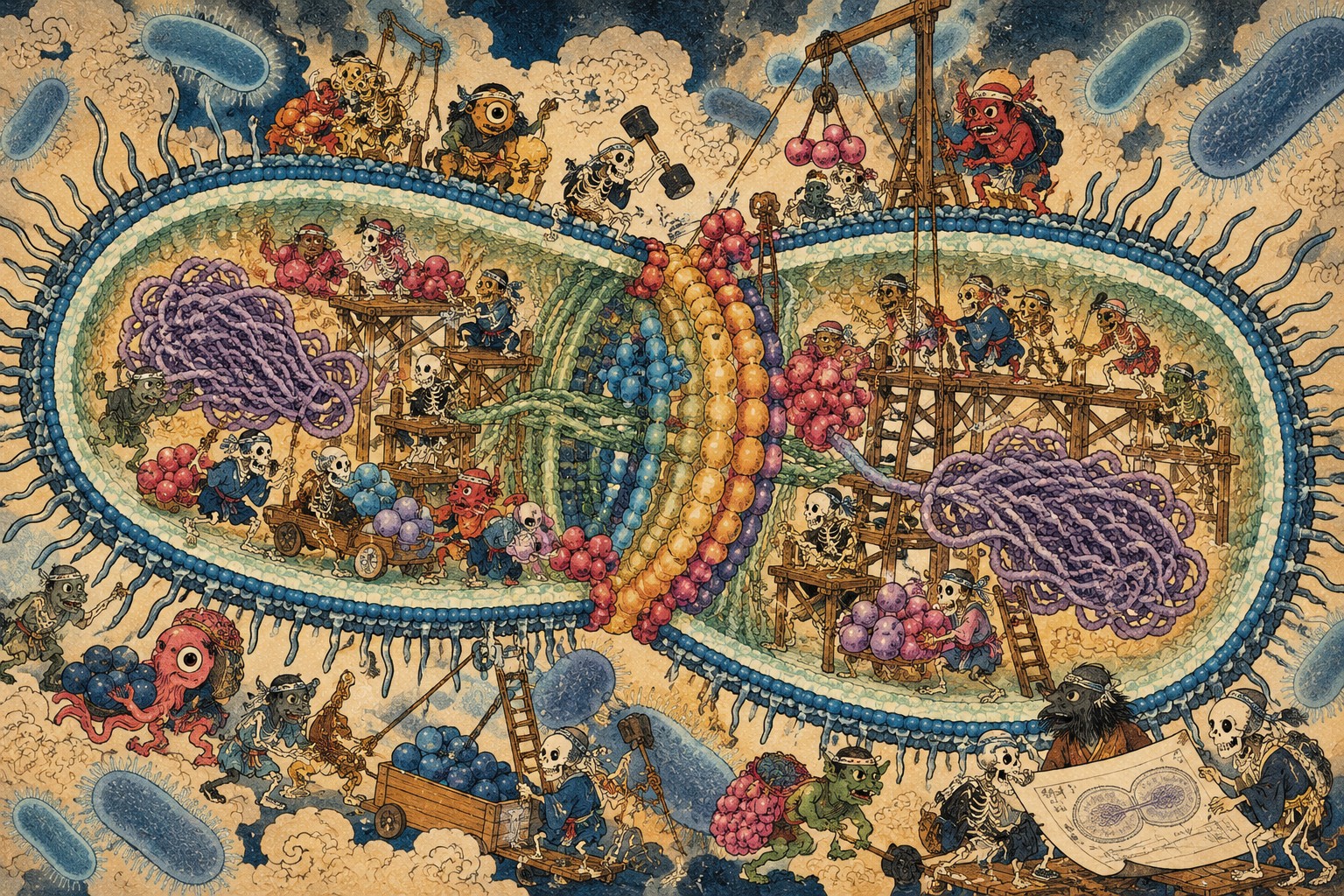
This is not a new antibiotic. It is a clearer view of the machinery a future antibiotic might stop.
A construction site inside a dividing bacterium
There is a moment in bacterial life when a wall must be built without allowing the cell to fall apart. The organism must partition itself into two daughters, synthesizing a new barrier at precisely the place where division occurs. This is a molecular engineering problem: the wall must be extended, strengthened, and coordinated with the machinery that divides the cell. A new study involving Hokkaido University and Duke University offers unusually detailed insight into how two of the workers on that construction site act together.
The breakthrough, and its boundaries
Published in Nature Communications on October 22, 2026, and announced by Hokkaido University on October 28, the study examined the FtsWIQLB division complex from Vibrio cholerae, the bacterium associated with cholera. The researchers did not test a treatment in people. They characterized an essential bacterial protein assembly using structural, biochemical, and chemical approaches. This distinction matters: understanding a potential drug target is a crucial research step, not the same as discovering a working antibiotic.
Why bacteria need a different kind of wall
Most bacteria support their cells with peptidoglycan, a mesh of sugar chains linked together by short peptide bridges. It has to be strong enough to withstand mechanical forces but adaptable enough for growth and division. During the creation of a new division septum, an enzyme called FtsW helps polymerize the glycan strands while its partner FtsI, also known as penicillin-binding protein 3, forms peptide cross-links. One process supplies length; the other supplies strength. Neither can be understood in isolation.
Two conformations and a turning point
The investigators combined cryo-electron microscopy, AlphaFold structure predictions, biochemical assays using native substrates, chemical probes, and mass spectrometry. They identified a down conformation of FtsI and an up conformation proposed to be active. In the working model, engagement with a lipid-linked cell-wall building block called lipid II helps initiate FtsW polymerization. A portion of FtsI rotates by approximately 90 degrees, exposing its active site so that cross-linking can proceed. The paper is evidence for a mechanistic model, not a real-time film of every step inside living bacteria.
The helix that connects two jobs
A structural element of FtsI called the coupling helix emerged as especially important. The experiments indicate that it directly influences FtsW processivity—roughly speaking, its ability to keep extending glycan chains. The two enzymes therefore appear to be connected through more than their physical proximity. Their interactions help couple the chemical tasks in space and time. This is the kind of microscopic detail that gives researchers new ideas about where a small molecule might disrupt an essential reaction.
An unexpected length requirement
The study also found that peptide cross-linking requires a sufficiently long glycan chain. The university describes a threshold around 11 repeating units, and its mechanism illustration uses n greater than 11. That figure should not be mistaken for a universal rule for every bacterium. It is a length condition established in the experimental system and helps explain how the catalytic site of FtsI becomes accessible to the growing strand. The discovery connects molecular geometry with the order of reactions.
A century of antibiotic history
The larger stakes come into focus through history. Alexander Fleming observed penicillin’s antibacterial activity in 1928. Scientists including Howard Florey and Ernst Chain subsequently made its medical development possible. Antibiotics that interrupt bacterial cell-wall synthesis helped transform infectious disease treatment in the twentieth century. But bacteria have continually evolved defenses, and antimicrobial resistance has eroded the effectiveness of some established therapies. A more exact picture of the bacterial wall machinery may open new directions for researchers searching for inhibitors.
A promising inhibitory clue, not a medicine
One experiment supplied a particularly interesting result. Modified lipid II molecules with shortened lipid tails inhibited enzyme activity. That points to the tail’s importance in FtsW processivity and suggests a chemical starting point for future investigation. It does not demonstrate that these analogues can enter bacteria efficiently, selectively kill pathogens, avoid harming patients, or succeed in animal or human trials. A useful laboratory inhibitor can be a very long way from a medicine.
The global cost of resistance
The World Health Organization’s 2026 policy documents estimate that bacterial antimicrobial resistance directly caused approximately 1.14 million deaths worldwide in 2021 and was associated with roughly 4.7 million deaths. These are global modeled estimates, not fatalities attributable to a particular protein or preventable by the newly studied compounds. They underscore why even basic mechanistic work matters. New medicines, responsible prescribing, infection prevention, diagnostics, and stronger health systems are complementary responses—not substitutes for one another.
What scientists knew already
Scientists have known for years that FtsW and FtsI participate in division. Earlier work, including research on E. coli published more than two decades ago, found that FtsW is needed to recruit FtsI to the division site. Other investigations have illuminated the FtsZ ring and additional divisome components. The new advance is not the discovery of these proteins; it is the integrated proposal for how structural switching, substrate engagement, glycan extension, and cross-linking are coordinated in the V. cholerae assembly.
What remains to be tested
Researchers will need to determine how broadly the proposed coupling mechanism applies to other bacterial species, whether the conformational transitions occur in exactly the same way in living cells, and whether compounds designed to disturb the machinery can reach clinically useful concentrations. The apparent active state is a structural interpretation supported by experiments, not a guarantee of how all related machines behave. Independent replication and further experiments will sharpen the model.
What this discovery really changes
The value of this research lies in converting a mysterious molecular sequence into a testable engineering diagram. In one view, a membrane-bound enzyme extends the wall material, a partner changes position, and the growing chain can finally be cross-linked. It is intricate, ordinary biology carried out innumerable times—and a process that researchers may someday learn to interrupt more effectively. Hokkaido University has not announced a cure. It has helped reveal where a future one might begin.
Sources and verification
Based on the university’s primary Japanese release, published study abstract, historical literature and WHO documents. Researchers were not independently interviewed.
- Hokkaido University official research announcement
- Original paper DOI, Nature Communications (2026)
- Journal article landing page
- Earlier FtsW–FtsI research (PubMed Central)
- Hokkaido University on FtsZ
- Nobel Prize archive: Fleming and penicillin
- WHO antimicrobial resistance fact sheet
- WHO 2026 global action plan document