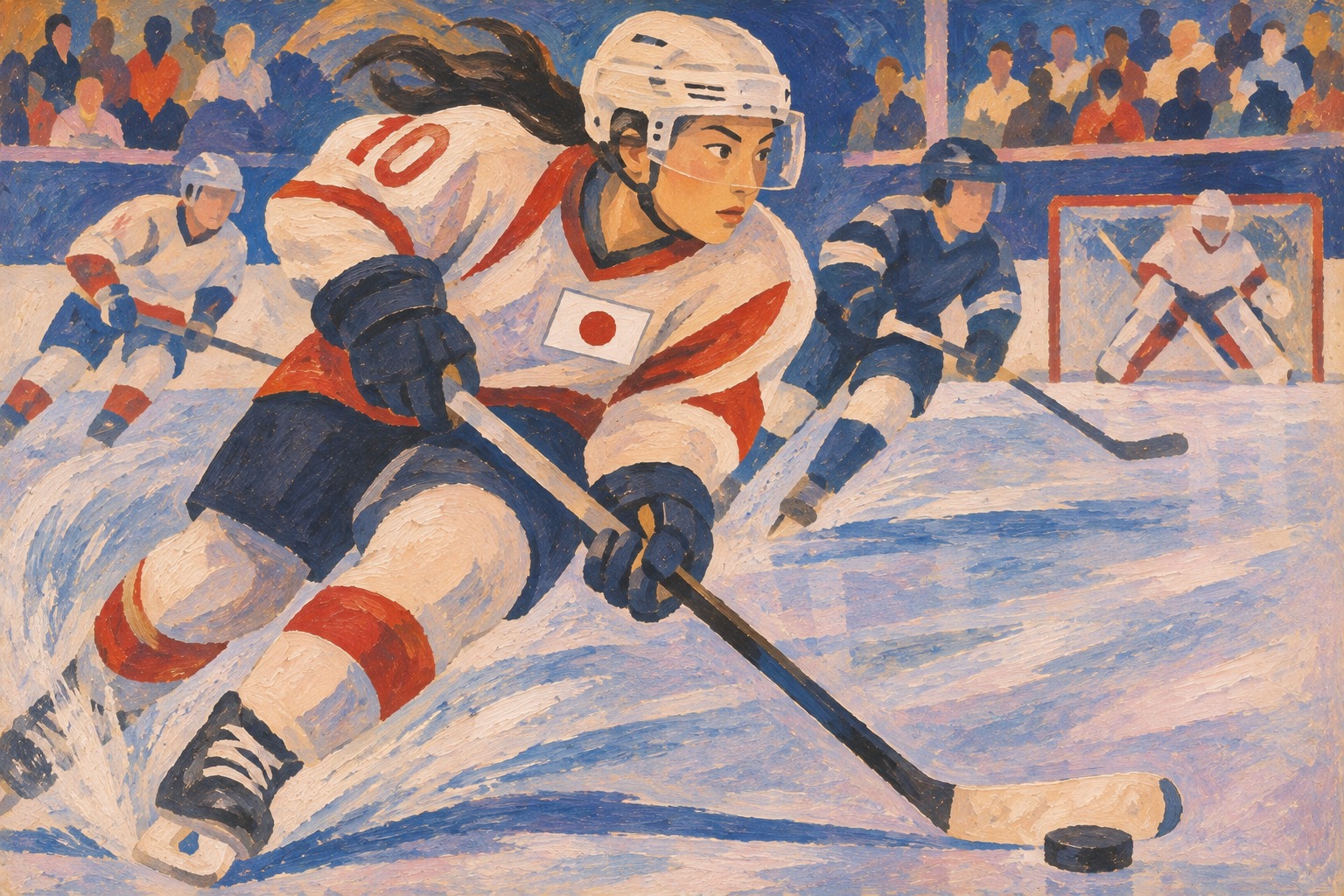
- A comeback in the city that lives on ice
- How a paper-making town acquired a hockey identity
- Women built their own sporting institutions
- From Olympic breakthrough to a difficult rebuilding year
- The unusual opportunity for teenage players
- The economics of keeping the ice available
- What to watch as the season moves toward Obihiro
A comeback in the city that lives on ice
Tomakomai’s November hockey weekend began with a reminder that a two-goal lead is not necessarily enough. Douken Peregrine trailed Mikage Gretz after the first period on November 27, scored once in the second and three times in the third, winning 4–2. Elsewhere, Daishin beat Toyota Cygnus 7–4. These were among six completed games in the second stage of the 15th Women’s Japan Ice Hockey League, officially branded the 2026–27 SMILE JAPAN LEAGUE.
The competition is not a national-team tournament: it is a domestic development and competition platform. Twelve entries meet across two venues, nepia Ice Arena and Dynax Numanohata Ice Arena, in three groups of four. The season began in Kushiro in September and concludes with a final stage in Obihiro on February 20–22, 2027. The opening-day results below are confirmed by the federation; later matches are not treated as completed in this report.
| Winner | Score | Opponent |
|---|---|---|
| TOKACHI Obihiro Ladies | 4–2 | VORTEX SAPPORO |
| Kushiro Bears | 10–0 | Junior High School Select |
| Douken Peregrine | 4–2 | Mikage Gretz |
| Hokkaido Barbarians H.C. Infinity | 2–1 | National U18 Select |
| Daishin | 7–4 | Toyota Cygnus |
| SEIBU Princess Rabbits | 3–0 | Showa Medical University Blue Winds |
How a paper-making town acquired a hockey identity
A century ago, winter skating in Tomakomai was intertwined with its industrial workforce. The city’s historical bulletin traces organized enthusiasm to the 1920s and records the creation of Oji Paper’s hockey club in 1931. It won the national championship on its first appearance the following year. Such teams gave workers and residents a focal point for winter recreation and competition.
Investment in municipal and artificial ice facilities made practice less dependent on natural freezing conditions. The city’s rink network expanded over decades, including the opening of Shiratori Arena in 1996 and Numanohata in 2000. Today’s competition rests on that accumulated infrastructure. A hockey community needs more than cold weather: it needs reliable ice, coaching, equipment, time and organizations willing to keep them available.
Women built their own sporting institutions
Tomakomai’s Peregrine women’s team dates to 1977 and won the second national women’s championship in 1979, according to the city’s chronology. That predates the Olympic debut of women’s ice hockey by almost two decades. The history matters because it shows that local sporting institutions were already making room for women before the Olympic spotlight arrived.
Today the league brings together different institutional models, including regional clubs, university-affiliated teams, company-associated teams and age-group selections. This should not be mistaken for a fully salaried professional league. For athletes balancing work or education with training, access to affordable ice and a durable club structure can be as consequential as international selection. The league gives those organizations a common competitive calendar.
From Olympic breakthrough to a difficult rebuilding year
Japan entered the first Olympic women’s hockey competition as host in Nagano in 1998, then missed three successive Games. Qualification for Sochi marked a return; the nickname Smile Japan was announced in March 2013. Japan subsequently reached PyeongChang and Beijing, making its first Olympic quarterfinal in 2022.
Tomakomai itself hosted a defining moment on February 8, 2025, when a 6–0 victory over Poland secured qualification for Milan Cortina 2026. But Japan finished ninth in Italy after one win and three losses. The November world championship in Denmark brought another setback: Japan placed tenth and was relegated to Division I A, losing the relegation game 2–1 in overtime to Austria. Neither result negates decades of progress, but both underscore why the domestic competition is more than an annual showcase.
The unusual opportunity for teenage players
One of the league’s most interesting entries is the national U18 selection. The federation announced in September that it would draw players from teams not otherwise participating, giving them competitive experience. In the opening stage the selection defeated Kushiro Bears 4–3; in Tomakomai it lost narrowly to Hokkaido Barbarians H.C. Infinity. A junior-high selection also participates.
For young players, facing older opponents can expose weaknesses that are harder to identify against peers. The puck moves quickly, decisions must be made before receiving a pass, and defensive positioning becomes crucial when an opponent has greater experience. Those learning opportunities are not captured fully by the scoreboard. Coaches must balance challenging competition with appropriate preparation, recovery and player safety.
The economics of keeping the ice available
The city advertises introductory ice-sport experiences, and Shin Tokiwa Skating Center offers opportunities for different ages. This provides a route into the sport outside elite selection. For a child who has never played hockey, access to instruction and equipment may determine whether an interest turns into a lasting commitment.
Indoor ice is an engineered environment, requiring refrigeration, resurfacing, maintenance and trained staff. Travel between Japanese hockey centers also imposes costs. Club sponsorship, municipal facilities and federation support are therefore part of the sport’s competitive infrastructure. Better scheduling, efficient equipment and wider access to coaching may help sustain it, although the financial impact of any particular measure requires local data.
What to watch as the season moves toward Obihiro
The November 29 schedule includes Daishin against Douken Peregrine at 13:50 at nepia Ice Arena. The federation lists paid live coverage from that arena and planned paid recordings of games at the Numanohata venue from the following day onward. Readers should consult the official competition page for current results and schedule changes.
Japan’s challenge after its difficult international season is to improve the everyday environment from which national-team players emerge. The February finals in Obihiro will offer another measure of domestic performance. Over a longer horizon, the meaningful test is whether talented players can develop, remain in the game and compete internationally. Tomakomai’s history shows how much of that work begins far from an Olympic arena, in the routines of a local rink.
Primary sources and references
- JIHF — second-stage official results
- JIHF — league announcement
- JIHF — first-stage results
- JIHF — national U18 selection
- Tomakomai municipal bulletin, February 2013
- JIHF digital museum — Olympic history
- JIHF — national team nickname
- JOC — Olympic qualification in Tomakomai
- Kokushikan University — 2026 Olympic results
- JIHF — 2026 world championship results
- Tomakomai — ice sports experiences
- Shin Tokiwa Skating Center — classes
- JIHF — development priorities