- A record price at the beginning of winter
- Why northern Japan built a heating economy around kerosene
- From the global oil market to a doorstep in Hokkaido
- What a winter fuel bill means for households and employers
- The building is the first heating technology
- Can a heat pump compete with ¥160 kerosene?
- Energy security begins with useful heat, not just electricity
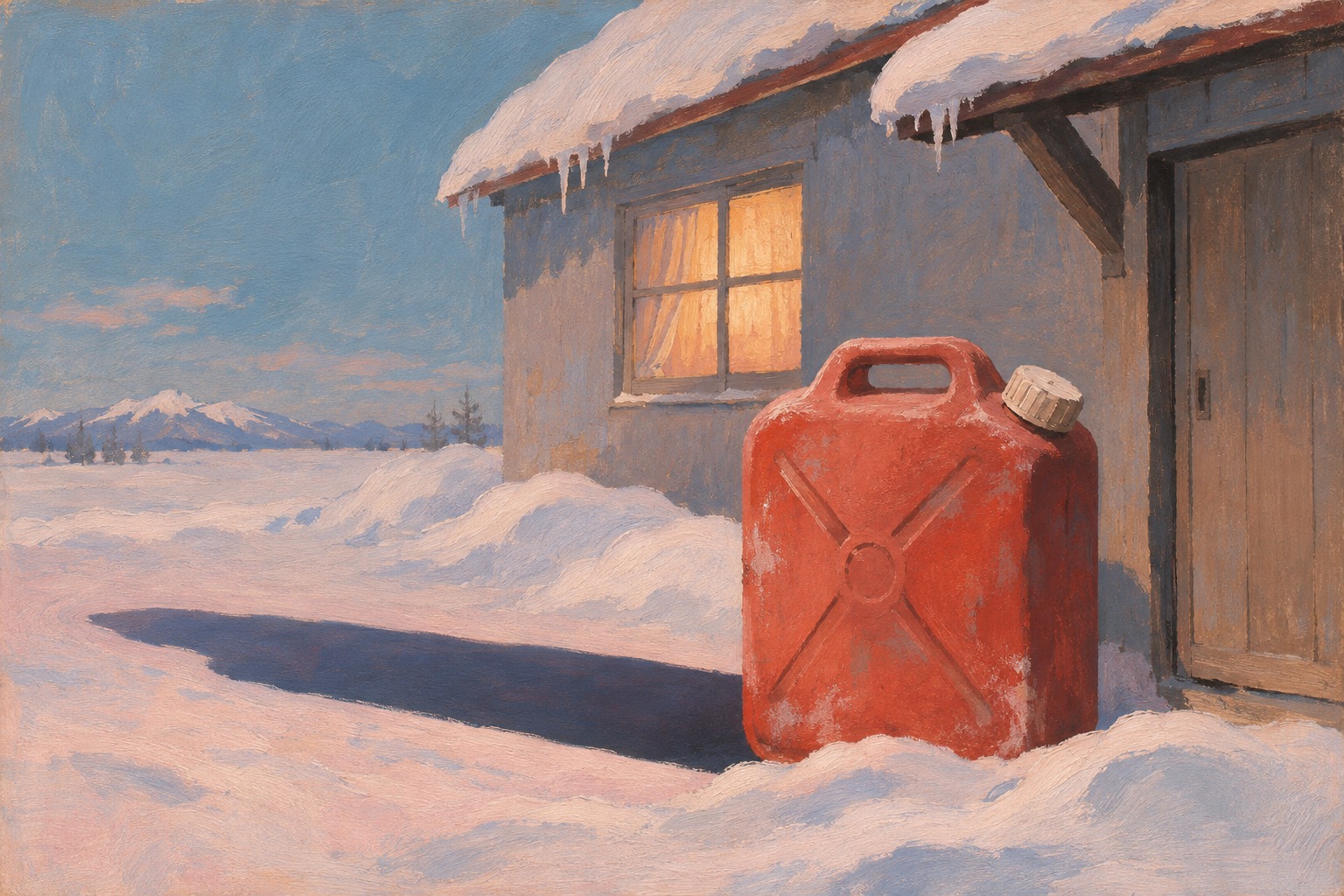
A record price at the beginning of winter
In Hokkaido, the cost of energy is measured not only in household bills but in the ability to keep an entire home comfortably warm. On November 26, broadcaster HTB reported that the government's November 24 survey put the island's delivered kerosene price at ¥160.2 a liter. The rounded figure matched the record reported earlier in November, after a brief decline to ¥160.1.
The underlying 18-liter figures tell a slightly more precise story: a secondary compilation of the government series gives ¥2,883 for delivery on November 24, against ¥2,884 on November 9. The latest in-store price was ¥2,819. The difference is important when describing a record: the rounded per-liter figure ties the high, while the container price falls one yen short. The national delivered average was ¥2,793 per 18 liters.
The immediate concern is the next adjustment to national fuel support, scheduled for December 3 according to HTB. A reduction in support could put upward pressure on retail prices, but it is not a guarantee that every supplier will raise prices by the same amount. Sapporo's separate monthly survey also illustrates why consumers should compare prices for their own delivery quantities and locations.
Why northern Japan built a heating economy around kerosene
For visitors from warmer parts of Japan, Hokkaido's houses can seem strikingly different: substantial windows, enclosed entrances and heating equipment designed for prolonged operation. The region's housing traditions reflect decades of adapting buildings to cold and snow rather than simply purchasing larger heaters.
Research from Sapporo City University describes the evolution from coal stoves in postwar block houses to widespread use of sealed, forced-flue kerosene heaters in the 1980s. The oil shocks of the 1970s also accelerated attention to insulation and airtight construction. In 1988 the prefecture began developing its Northern Housing initiative with researchers and industry, building a regional approach to thermal performance.
Kerosene had a practical advantage over fuels requiring a continuous pipeline: a household tank could be replenished by truck. That remains useful in dispersed settlements. Yet the infrastructure that made heating accessible also ties rural communities to deliveries, international petroleum markets and the cost of maintaining a distribution network across large distances.
From the global oil market to a doorstep in Hokkaido
The heating fuel sold in a northern Japanese town is the end product of a long supply chain. Crude oil must be acquired, shipped, refined and distributed, while finished kerosene can also be imported. Japan sources more than 90 percent of its crude oil from the Middle East, according to the national energy agency. Exposure to external supply shocks therefore remains significant.
Currency movements add another layer. A weaker yen raises the local-currency cost of a dollar-priced shipment even when its dollar price does not change. But neither exchange rates nor crude benchmarks alone determine the price a resident pays. Refining margins, product availability, inventories, logistics and government support all intervene. There is insufficient evidence to allocate the latest weekly price movement among these factors.
Hokkaido's October 16 request to the national government specifically addressed the delivery network as well as affordability. Maintaining deliveries to depopulating areas becomes harder as drivers retire and replacement workers are difficult to recruit. A functioning fuel market requires both a supply of kerosene and the people and infrastructure to get it to the customer.
What a winter fuel bill means for households and employers
At ¥160.2 per liter, a household purchasing 500 liters spends ¥80,100. A thousand liters costs ¥160,200. An increase of ¥30 per liter would add ¥30,000 to that second budget. These are illustrative quantities rather than a claim about typical consumption. Housing size, hot-water systems, insulation and weather all influence annual purchases.
On November 13, Governor Naomichi Suzuki announced that Hokkaido would double the standard contribution used to support municipalities operating welfare heating-fuel programs. The measure is intended to help vulnerable residents, including low-income elderly households. It does not automatically entitle every Hokkaido resident to a payment; municipal rules determine eligibility and application procedures.
Businesses face related pressures. A small inn, a shop or a greenhouse must maintain usable temperatures while controlling operating costs. Some can pass higher costs to customers; others cannot. Fuel dealers themselves face labor and vehicle expenses. The challenge is economic as much as technological: protecting vulnerable customers while maintaining a commercially viable distribution service.
The building is the first heating technology
Before comparing fuels, it is worth asking how much heat a building actually needs. A poorly insulated window or roof makes every heating technology more expensive. A better thermal envelope can reduce the size of the heating system required, moderate temperature swings and extend the period a house stays warm when its equipment stops.
Japan's UA-value describes average thermal transmittance through a building envelope. A lower value indicates less heat transfer per unit area under comparable conditions. It does not by itself predict a utility bill: ventilation, air leakage, solar gains and occupancy matter as well. Retrofit decisions should address moisture control and safe ventilation alongside insulation.
Hokkaido's Northern Housing ZERO initiative builds on the region's experience by incorporating locally appropriate measures such as renewable energy and local timber. The prefecture also supports municipalities offering programs for efficient new homes, retrofits, solar panels and batteries. Eligibility and available funding differ by municipality, so a homeowner needs to check local conditions rather than assume a subsidy is assured.
Can a heat pump compete with ¥160 kerosene?
Heat pumps move heat rather than relying solely on electrical resistance to generate it. Hokkaido Electric Power describes equipment capable of operation at outdoor temperatures of minus 25°C. That is a meaningful engineering development, although operation at a given temperature does not establish that the unit can meet a particular home's peak heat demand there.
A transparent comparison starts with useful heat. Assume a liter of kerosene contains approximately 10 kWh of energy and the heating equipment delivers 85 percent of that energy as useful heat. At the reported price, useful heat costs approximately ¥18.85 per kWh. With electricity assumed to cost ¥35 per additional kWh, a heat pump operating at a coefficient of performance (COP) of 2 delivers heat at ¥17.50 per kWh; at COP 3, the figure is ¥11.67. The operating-cost crossover is around COP 1.86.
These assumptions are illustrative, not measured household tariffs or equipment performance. Installation, maintenance, fixed charges and financing may change the economic outcome. Frost removal, low-temperature capacity and snow clearance are particularly relevant for air-source equipment. Ground-source systems and hybrid arrangements may also merit assessment, and both electric and many oil-fired systems require a plan for power outages.
| Heating method | Illustrative cost per kWh of useful heat |
|---|---|
| Kerosene (85% efficiency) | ¥18.85 |
| Heat pump COP 2 | ¥17.50 |
| Heat pump COP 3 | ¥11.67 |
Energy security begins with useful heat, not just electricity
The Environment Ministry's fiscal 2023 survey attributed 1.73 tonnes of annual CO2 emissions per Hokkaido household to kerosene, within a total of 4.14 tonnes from household energy. The figures are not heating-only estimates, but they demonstrate why oil use deserves attention in regional energy planning.
Hokkaido's wind, geothermal and solar resources present opportunities to diversify energy supply. Their practical value for heating depends on timing, grid capacity and storage. Solar output may be limited by snow or short winter days, while wind output varies. Heat storage, efficient buildings and well-designed equipment can help manage the mismatch, but electrification does not automatically eliminate emissions or guarantee lower bills.
A sensible winter strategy has two horizons. The immediate objective is to keep residents safely warm and fuel deliveries reliable. The longer-term objective is to reduce the amount of purchased energy required for a comfortable home. Hokkaido's experience offers a lesson to other cold regions: energy security is not merely the availability of fuel or electricity, but the ability to deliver affordable, dependable warmth.
Primary sources and references
- HTB Hokkaido, November 26
- HTB Hokkaido, November 11
- Secondary compilation of government retail prices, November 24
- Hokkaido government: winter kerosene supply measures
- Governor’s press conference, November 13
- Environment Ministry: heating equipment survey
- Environment Ministry: regional household CO2 statistics
- Sapporo City University: research on northern housing and thermal comfort
- Agency for Natural Resources and Energy: energy security
- Hokkaido Electric Power: heat pump systems
- Hokkaido government: Northern Housing ZERO
- Hokkaido government: housing decarbonization support
- Sapporo municipal petroleum retail survey
- National fuel-price support program
- HTB Hokkaido, November 18