A championship measured in strength, not just speed
On Sunday evening in Obihiro, a field of three-year-old fillies is scheduled to contest the 51st Banei Oaks. The National Association of Racing lists the event for 7:35 p.m. Japan time on November 29, with a first prize of ¥5 million. It is classified BG1, the highest grade in banei. Ten horses appear on the published entry list. No result was available at the reporting cutoff.
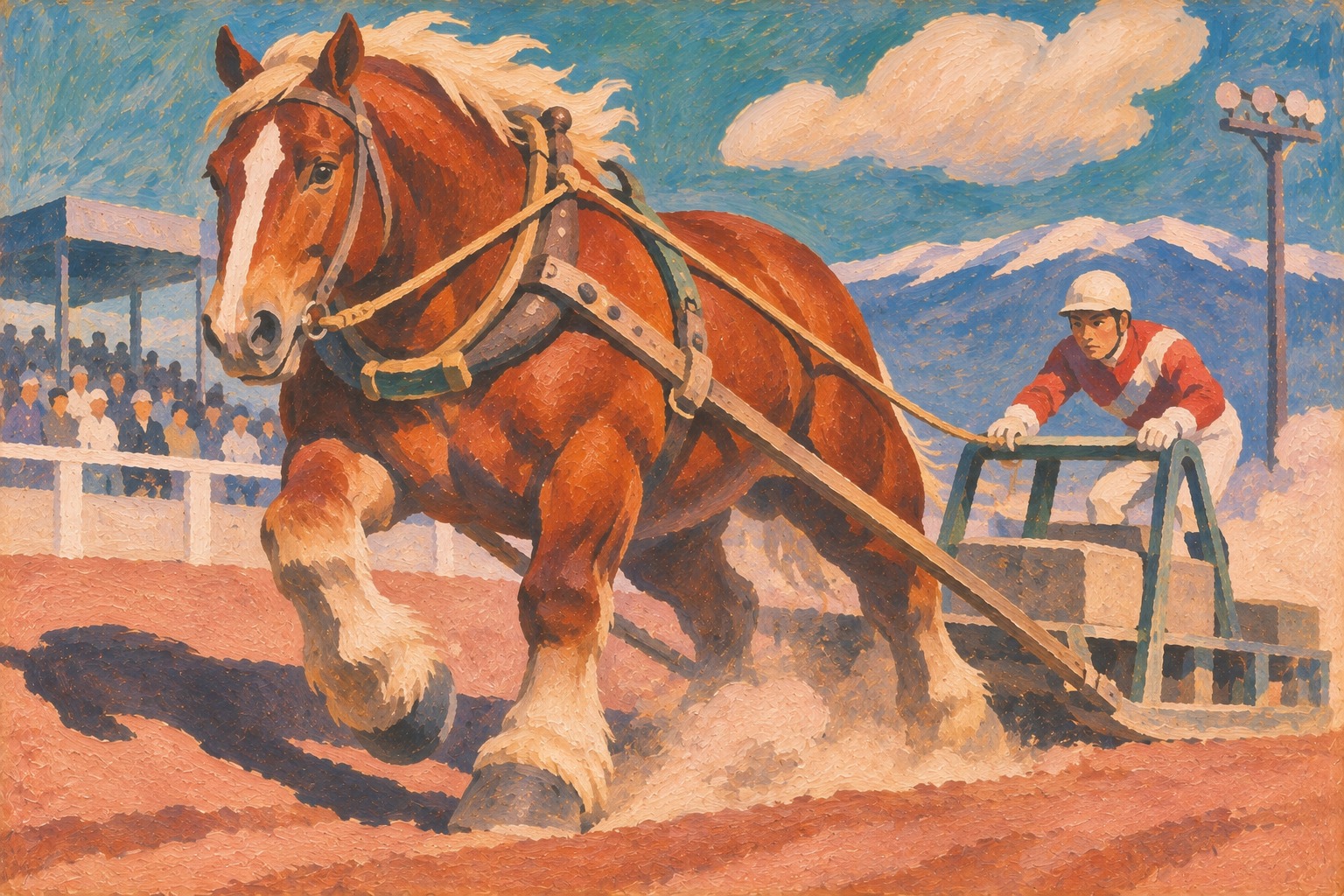
What makes this championship unusual is the relationship between the horse and its load. Rather than carrying a jockey on its back, the animal pulls a weighted sled with the rider aboard. The finish is determined by the rear of that sled, not the nose of the horse. That difference changes the character of the entire contest: movement, endurance and the ability to negotiate changes in gradient matter alongside speed.
The agricultural world behind the race
For much of modern Hokkaido’s agricultural history, heavy horses supplied the power that machinery would later provide. They moved timber and supplies and worked the broad fields of the Tokachi plain. Festivals in farming communities included contests of pulling strength, the predecessors of the modern sport. This history belongs within the wider history of Hokkaido, including the Indigenous Ainu peoples and the consequences of modern settlement; it is not a story of an empty island awaiting development.
Obihiro’s municipal account dates prefectural public racing to 1949 and the establishment of municipal racing in four cities to 1953. The cities were Obihiro, Asahikawa, Kitami and Iwamizawa. As tractors and motor vehicles displaced working horses, the competition acquired a new economic function: it helped sustain demand for the breeding and care of large horses.
A horse built for a different job
The animals derive from heavy draft stock, including Percheron and Breton horses from France and Belgian draft horses. Selective breeding produced Japanese draft types, including the Nihon Bankei breed. Some competitors weigh more than a metric ton, a physical scale rarely associated with conventional racehorses. The characteristics required of a pulling horse differ from those selected for galloping speed.
Breeding is only one component of the system. Stable staff must monitor condition, movement and recovery, maintain harness and hoof health, and provide appropriate nutrition and veterinary care. In the organizer’s November 27 interviews, trainer Ayumi Tani and jockey Chihiro Imai discussed the development of Princess Mimi, including her improved ability to continue through the latter portion of a race. Their comments offer a window into the gradual development of young horses, rather than evidence that any particular horse is certain to win.
The engineering of a 200-meter course
Obihiro’s straight track includes two hills, approximately one meter and 1.6 meters high. The course has separate lanes. A winter heating system helps prevent freezing; the additional sand obstacle near the finish used in warmer months is removed during that period. This is a sporting facility adapted to the climate of northern Japan, not simply a preserved agricultural track.
The weight of a sled is not the same thing as the force required to move it. Friction, surface moisture and the slope all affect resistance. This explains why the visual pace can differ sharply between races. A horse may stop during a contest, and officials and handlers must distinguish ordinary pauses from signs of distress or incapacity. The mechanics make welfare assessment particularly important.
How Obihiro kept the tradition alive
The four municipalities pooled their operations in 1989. Falling receipts after Japan’s asset-price bubble and worsening finances eventually brought the joint enterprise to an end after fiscal 2006. Obihiro chose to continue alone in fiscal 2007, supported by proposals from private enterprise and the racing community. It remains the sole host municipality.
Keeping a racecourse open also preserves an ecosystem of breeders, stable employees, veterinary workers and skilled suppliers. Yet their economic interests do not by themselves settle questions about the treatment of horses. The city has sought connections beyond racing, including the Tokachimura tourism and agricultural-products facility, which opened in 2010. Visitors encounter the region’s food and farming heritage alongside the sporting tradition.
A ¥54.9 billion business, not a ¥54.9 billion profit
The fiscal year that ended on March 22, 2026, recorded ¥54,876,047,100 in gross ticket sales over 149 racing days and 374,970 racecourse admissions, according to the season-closing report reproduced by Rakuten Keiba. Sales were 94.90 percent of the prior year. The organizer identified equine influenza and heavy snowfall among the reasons for cancellations. In fiscal 2007, the first year of Obihiro-only operations, sales were about ¥12.9 billion.
Gross wagering turnover is not municipal income or net profit: payouts, operating expenses, staff, facilities and horse-related expenditures must be accounted for. Admissions are visits, not unique individuals. Although tourism and local employment are important economic channels, a reliable estimate of their net effect would require separate evidence on local spending and public accounts. The financial recovery illustrates the scale of the enterprise, not a blanket justification for it.
The responsibility that comes with preservation
In April 2021, the organizer confirmed two separate incidents during qualification tests in which a jockey and a stable employee kicked horses that were unable to proceed. It announced disciplinary action and measures intended to prevent recurrence. Such incidents are material to any fair account of a sport that depends on animals performing demanding physical work.
Contemporary welfare questions include how loads are assessed, how fatigue and injuries are recorded, when a horse is withdrawn, how supervision works, and what happens after retirement. The sources reviewed for this feature do not establish comprehensive current injury rates or retirement outcomes. Greater transparency would allow the public to evaluate progress rather than simply accept assurances. The Banei Oaks offers a view into Hokkaido’s agricultural inheritance, but the future of that inheritance must be measured in the wellbeing of the horses as well as in the survival of the competition.
Primary sources and references
- National Association of Racing: 51st Banei Oaks official entries
- Banei Tokachi: November 27 trainer and jockey interviews
- Obihiro City: banei racing and municipal operating vision
- Banei Tokachi: historical project
- National Association of Racing: course guide
- FY2025 closing report reproduced by Rakuten Keiba
- Banei Tokachi: FY2025 closing statement
- Banei Tokachi: April 2021 improper conduct report
- Banei Tokachi: racing guide
- Banei Tokachi: graded races