- The AI boom is becoming a heat-management problem
- Two laboratories inside one research effort
- Why air and liquid cooling must coexist
- A one-degree test of predictive control
- The neglected electricity bill: moving the coolant
- The October cold-plate prototype—and the meaning of 30%
- A long lineage of industrial controls at Omika
- From a research testbed to HMAX and the planned Chowa no Oka center
- Electricity demand makes incremental efficiency consequential
- PUE is useful, but it is not the whole environmental scorecard
- What evidence would make this a breakthrough?
The AI boom is becoming a heat-management problem
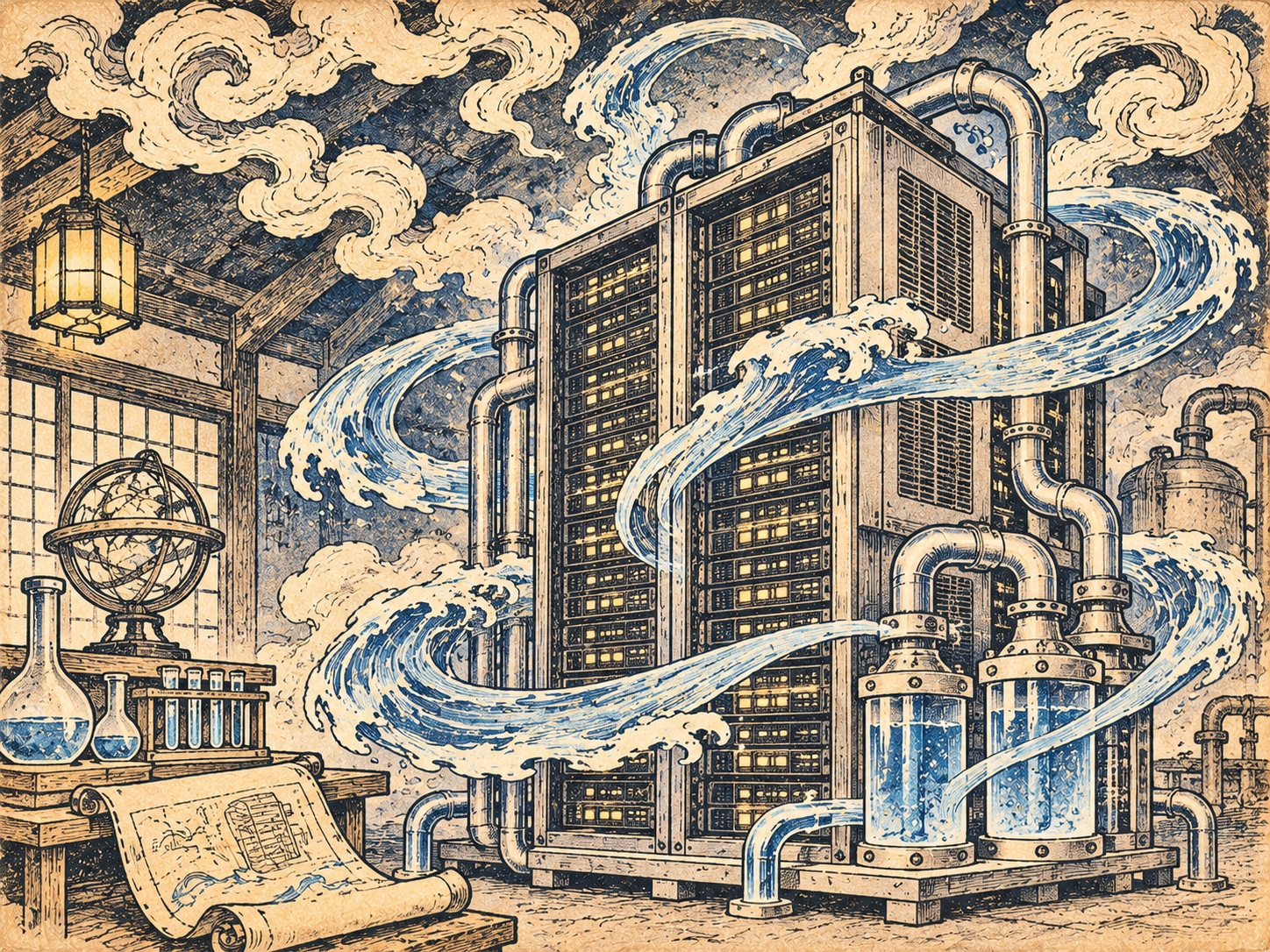
When an AI model runs, the electrical energy fed to its processors ultimately appears largely as heat. Extracting that heat is a system-wide engineering problem, not merely a matter of fitting a more effective fan to a server. On November 16, 2026, Hitachi announced that it had constructed the Omika Data Center Lab at its Ibaraki research site in the Omika district. The facility is intended to test how an AI data center can remain thermally stable while reducing the electricity consumed by its supporting cooling infrastructure.
The announcement is about a verification environment, not a newly opened commercial hyperscale data center. Hitachi has outlined equipment and performance objectives but has not published a measured, facility-wide electricity reduction achieved there. Its emphasis is significant: high-density computing will increasingly be constrained by the coordination of chips, water loops, fans, pumps, chillers and the people who operate them.
Two laboratories inside one research effort
Hitachi describes an AI Data Center Area containing liquid-cooled GPU servers alongside air-cooled servers, temperature and power sensors, and workloads that combine actual AI processing with simulated loads. In a separate Liquid Cooling System Evaluation Area, multiple simulated liquid-cooled servers reproduce next-generation GPU heat conditions. Coolant distribution units, pumps and cold plates let engineers study how liquid flows when the heat load changes.
The distinction is central to the research. One area examines the interaction between the server room and its cooling equipment; the other looks closely at the hydraulic and thermal conditions of the liquid-cooling loop. Data generated in these environments could eventually inform Hitachi’s commercial offerings, but moving from controlled trials to a customer installation will require different reliability and integration tests.
Why air and liquid cooling must coexist
Dense GPU packages can produce heat loads that make direct liquid cooling attractive. A cold plate, in contact with the hot device, carries away energy through circulating coolant. Yet many elements of a facility—including some CPU systems, power electronics and ancillary equipment—may still rely on moving air. Existing data centers are rarely rebuilt around a single cooling technology overnight.
Air and liquid systems have different response times, temperature requirements and controls. A server load spike might prompt both systems to react excessively if operated independently. But an aggressive energy-saving adjustment can be worse: if a device exceeds its allowable temperature, performance or availability may suffer. The question is not whether liquid cooling simply wins over air. It is how the mixture can be managed safely with the least unnecessary power.
A one-degree test of predictive control
Hitachi says it will verify high-speed analysis capable of predicting room temperature distributions on a seconds-scale, with differences from measured temperatures of less than 1°C. The prediction would be combined with operational-technology knowledge to coordinate liquid and air cooling in real time, rather than reacting separately and overcooling equipment under changing computing loads.
That figure is a validation target; it is not an independently established operating record of the lab. Practical evaluation must examine sensor placement, workload transitions, response to failure, changing server densities and repeatability across sites. A successful forecast is only one input to a control system that also needs a safe fallback when a sensor, pump, valve or controller behaves unexpectedly.
The neglected electricity bill: moving the coolant
Liquid carries heat efficiently, but it does not move without cost. Narrow passages and long pipes create pressure drop; pumps must supply the energy needed to circulate coolant. Hitachi’s test equipment includes a coolant distribution unit (CDU), which exchanges heat between a facility water circuit and a server coolant circuit. The engineers intend to vary liquid flow and its distribution in response to simulated GPU heat.
Cooling equipment extends well beyond the cold plate. Depending on a site’s design, heat may pass through heat exchangers, water circuits and chillers before it is finally rejected outdoors. A local improvement that demands substantially higher pump power may not translate into better system performance. That is why measuring combined fan, pump and chiller electricity matters as much as reporting a single chip temperature.
The October cold-plate prototype—and the meaning of 30%
Hitachi’s latest lab follows an October 21 announcement of a U-Tunnel cold-plate prototype. Thousands of short channels direct incoming coolant toward a GPU’s hot region before guiding warmed fluid back out, an arrangement intended to preserve cooling performance while limiting pressure loss. The company reported thermal resistance of 0.011 K/W and pressure drop of 27.6 kPa with coolant flowing at four liters per minute in prototype testing. Those are component-level observations, not measurements of a completed data center.
In the same release Hitachi estimated that the design could reduce the electricity needed to reject captured GPU heat to the outside air by 30% under modeled conditions that include regional outdoor temperatures. Crucially, that is not a claim of a 30% reduction in all electricity consumed by servers and facilities. The outcome would depend on how often warmer coolant can avoid mechanically intensive cooling, the climate, plumbing and operating profile.
A long lineage of industrial controls at Omika
The Omika setting is more than convenient geography. Hitachi traces its founding to 1910 and its large-scale industrial-control history through the modernization of power grids, railways and factories. It established a specialized control-systems works at Omika in 1969. Operational technology, or OT, is the discipline of monitoring and controlling physical equipment with the reliability expected in industrial environments.
Integrating IT—the systems that process and exchange information—with OT—the systems that operate physical infrastructure—is a familiar Hitachi proposition. In an AI data center, however, the workload itself fluctuates rapidly. Cooling, electrical distribution and fault response must adapt while computing services continue. The laboratory puts decades of control-systems experience beside modern AI processors.
From a research testbed to HMAX and the planned Chowa no Oka center
Hitachi places the Omika lab within its longer plan for Chowa no Oka, a next-generation social infrastructure research hub scheduled for 2030. The newly constructed testbed allows it to investigate integrated design, operation and control ahead of that larger project. It will also act as a Customer Zero environment: Hitachi intends to operate computing workloads internally, collect data and use its own facilities as an early customer of its research.
The company says lessons may expand HMAX Data Center, a solution within its HMAX by Hitachi family. But a research facility does not establish that every capability is already available as a supported commercial product. Prospective customers will want evidence of interoperability with mixed-vendor servers, maintenance procedures, fail-safe behavior and performance under a full annual range of temperatures.
Electricity demand makes incremental efficiency consequential
The International Energy Agency estimated that the world’s data centers used roughly 415 terawatt-hours of electricity in 2024. Its April 2025 base-case analysis projected consumption rising to approximately 945 TWh by 2030. The IEA’s 2026 update similarly describes a trajectory of approximately 950 TWh in 2030 from 485 TWh in 2025, while highlighting bottlenecks in electrical equipment, grid connections and financing. These are global estimates and scenarios—not a forecast of Hitachi’s revenue or a result achieved by the Omika lab.
For grid planners, a lower cooling overhead can ease a costly infrastructure problem. For customers, it can create room for useful computing without proportionately increasing facility power. But efficiency does not necessarily reduce total demand: if lower computing costs accelerate AI use, absolute energy consumption may keep climbing. The most useful assessment is therefore both local and system-wide.
PUE is useful, but it is not the whole environmental scorecard
Power Usage Effectiveness, or PUE, compares the total electricity entering a data center with electricity used by its IT equipment. A value closer to one indicates a smaller non-IT overhead. It can help quantify the contribution of cooling, but it does not measure computational output or directly capture water use and all environmental impacts.
Liquid cooling introduces additional operational concerns: leak detection, water chemistry, fouling, redundancy and the practical difficulty of servicing high-density systems. Even lower chiller electricity may be offset by other energy or water requirements. Clear testing would include the facility’s complete cooling power, temperature compliance, operating hours and relevant water metrics rather than one laboratory headline figure.
What evidence would make this a breakthrough?
The next valuable disclosure would be a controlled comparison: total cooling electricity across fans, pumps and chillers at specified workloads, cooling-water temperatures, outdoor conditions and hardware densities. Engineers would also need evidence of how the system handles abrupt transitions, component failures and remote interventions. Results from simulated thermal loads should be distinguished from continuous real-world GPU operation and customer deployments.
As of the November 16 announcement, Hitachi had not disclosed an achieved whole-lab electricity-saving percentage, construction cost, named customer deployment or long-term availability figures for the system. The research is nonetheless worth following because it confronts a stubborn physical constraint in the AI industry. The servers may make the headlines; the plumbing and controls determine how much it costs to keep them working.
Sources and reporting limitations
This independent analysis draws on corporate and public-agency disclosures available by November 16, 2026. No laboratory site visit or independent thermal or electricity measurement was conducted. Construction cost, commercial customers, long-term reliability and achieved total-system energy savings remain unverified.