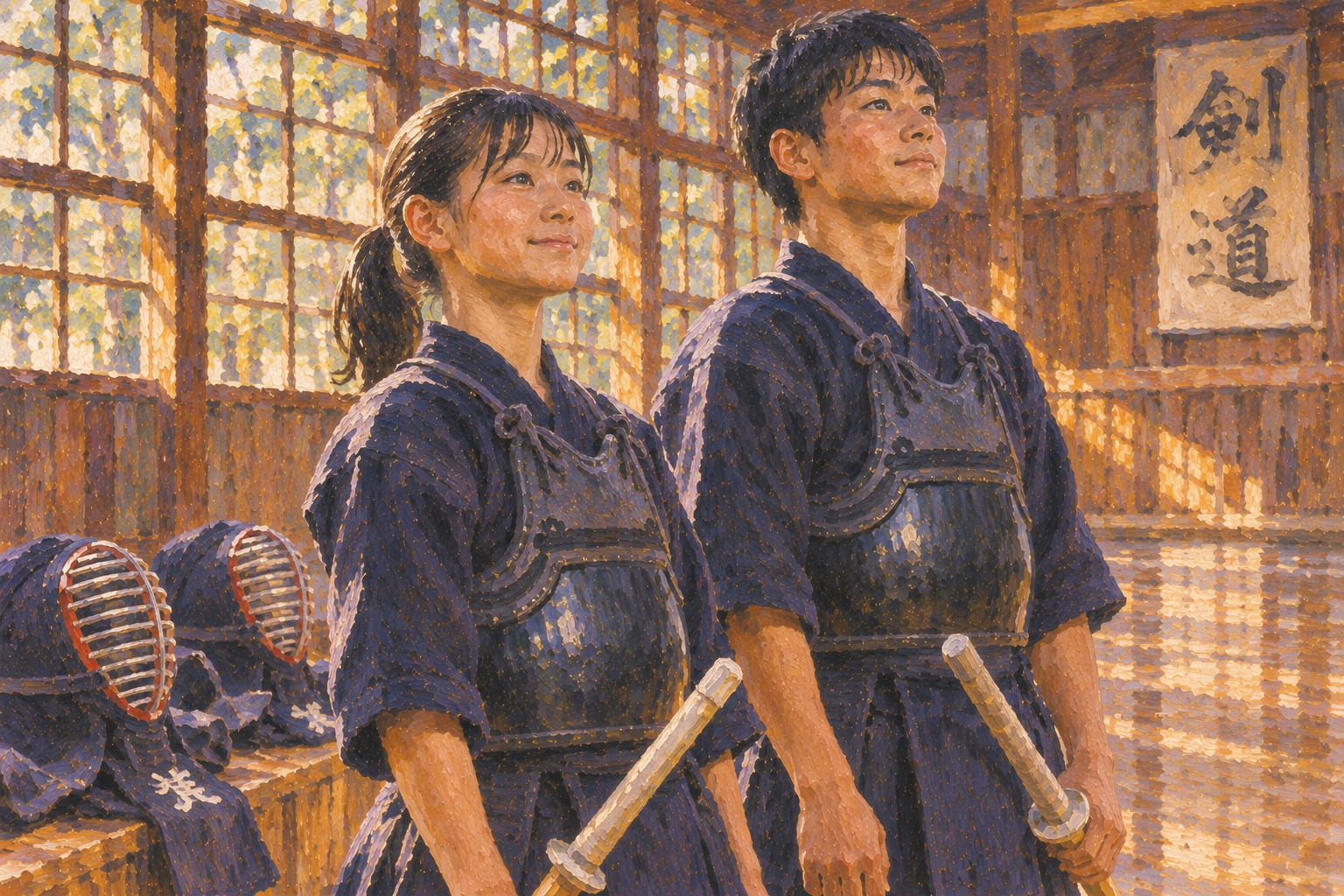
- Two gold medals, two young athletes, one prefecture
- The precise location of a national triumph
- Kaio Masuda: the work behind the medal
- Keita Ariba: a champion with another destination in mind
- The qualifying road from Hiroshima
- What makes an ippon in kendo?
- A living tradition, not an unchanged relic
- Two dojos and the wider community
- Why the word “first” needs care
- What comes after a national title?
Two gold medals, two young athletes, one prefecture
On November 18, two young kendo competitors arrived at the Hiroshima Prefectural Government offices to meet Governor Mika Yokota. Ninth-grader Kaio Masuda and sixth-grader Keita Ariba had each brought home a national individual title. The celebration marked a rare double achievement for Hiroshima, but the more interesting story begins in the training halls where both young athletes learned their craft.
Masuda won the junior-high boys’ division of the National Dojo Youth Kendo Championship; Ariba won the elementary boys’ division. These were separate individual tournaments, not a single team event or a sweep of all age categories. Hiroshima broadcaster TSS described the same-year pair of victories as a first for the prefecture in the competition’s long history.
The precise location of a national triumph
The championships were held on October 25, 2026, at Hanamaki City General Gymnasium in Iwate Prefecture. The All Japan Kendo Dojo Federation, the event organizer, lists the elementary and junior-high boys’ contests as their 50th editions; the corresponding girls’ divisions were in their 43rd year. A separate inter-dojo team championship shared the event date.
A November 18 television report mistakenly placed the competition in Ishikawa. The organizer’s official documentation names Hanamaki, Iwate, and that is the location used here. Correcting a detail that might otherwise look incidental matters when a regional achievement is being preserved in the public record.
Kaio Masuda: the work behind the medal
Masuda, a third-year junior-high student, represented Shinseikan Momiji Dojo (心成館もみじ道場). The organizer’s published results identify Yuta Furusawa of Shiseikan in Saitama as the runner-up in his division. During the governor’s visit, Masuda credited sustained practice without taking days off or relaxing his concentration for the breakthrough, according to TSS.
His dojo’s October 29 account adds a human dimension: he had previously been deeply disappointed by missing qualification for a national junior-high individual event. The dojo describes that setback as part of his return to training and eventual championship. These are the dojo’s recollections, not interviews independently conducted by JAPAN.co.jp.
Keita Ariba: a champion with another destination in mind
Ariba, a sixth-grade student from Higashihiroshima Kendo Club (東広島剣道クラブ), won the elementary boys’ title. The federation’s results list Keishiro Agata from Takada Shonen Kendo Club in Kumamoto as runner-up. The names and divisions matter: two different Hiroshima dojos succeeded against national fields in two different age groups.
When the boys met the governor, Ariba said he was happy and wanted to qualify for nationals again—and win—in junior high school. It is the straightforward ambition of a young competitor looking ahead, rather than evidence of a future title already assured.
The qualifying road from Hiroshima
The national stage is the visible end of a longer competition calendar. The 2026 Hiroshima prefectural dojo-youth results list Ariba as winner of the elementary boys’ individual division and Masuda as winner of the junior-high boys’ division at the May 6 competition in Higashihiroshima. They arrived at the national event as athletes who had already won against peers at home.
The available documents do not provide a reliable point-by-point description of their national finals. We cannot reconstruct which strikes scored, the timing of decisive exchanges or tactical instructions spoken by coaches. Doing so would replace sporting reporting with invented drama.
What makes an ippon in kendo?
A kendo match is not decided merely by touching an opponent with a bamboo sword. Under the All Japan Kendo Federation’s standard for yuko-datotsu, a valid strike requires purposeful spirit, correct posture, proper use of the striking part of the shinai and a fitting follow-through called zanshin. The judging standard reflects the martial art’s distinctive fusion of technical precision and mental composure.
For readers outside Japan, this helps explain why hours of seemingly repetitive dojo practice matter. Footwork, distance, timing and the ability to maintain attention after a strike all become part of a competition result. Winning young requires far more than an aggressive swing.
A living tradition, not an unchanged relic
Kendo grew from Japanese swordsmanship traditions, evolving through the use of bamboo practice swords and protective equipment in early-modern training. In the modern era, educational institutions, police organizations and governing bodies helped shape a standardized discipline that now has an international following. Its present rules should not be confused with an unchanging code passed directly from medieval warriors.
Youth clubs and dojos bring those historical forms into contemporary communities. Children learn through practice with peers and mentors as well as through individual competition. The tradition remains meaningful because people continue to adapt, teach and participate in it.
Two dojos and the wider community
The two champions trained with different clubs. The achievement therefore illuminates more than a single successful local program. Masuda’s dojo wrote publicly about his contribution as a team captain figure in competition; Ariba’s club produced the other national individual winner. Both results invite attention to Hiroshima’s network of youth kendo instructors and volunteer support.
Exact weekly practice schedules, each coach’s training methods and family circumstances were not independently established. This story deliberately avoids invented conversations with the boys, detailed psychological claims or imagined scenes in the dojo. Their verified achievements are compelling without embellishment.
Why the word “first” needs care
TSS called the two male age-division titles a first for Hiroshima in the championship’s approximately half-century history. The organizer’s current-year records independently confirm both wins, while a full historical audit of every preceding championship was beyond the scope of this report. The “first” designation is therefore attributed to the broadcaster rather than presented as a separately audited statistic.
It is equally important to recognize that other prefectures won the girls’ individual championships, while a separate club took the inter-dojo team crown. Hiroshima did not win every competition at the event. What the prefecture achieved was narrower, clearly verifiable and still remarkable.
What comes after a national title?
Both athletes now face transitions. Masuda is nearing the end of junior high school; Ariba will move into a higher age category. Opponents, physical development and the demands of training will change. No result this year can guarantee the next.
At the governor’s office, the championships briefly became a moment of public recognition. The following day in a dojo, however, a new practice begins, with familiar footwork and the challenge of finding the next valid strike. That tension between celebration and continued discipline may be the best way to understand Hiroshima’s double victory.
Sources and reporting limits
Independently written from the organizer’s 2026 records, All Japan Kendo Federation guidance, November 18 local reporting and one dojo’s public statement. JAPAN.co.jp did not interview the minors, families or coaches. Romanizations reflect conventional readings but were not independently confirmed by the athletes.