- A mystery hidden in neighboring stretches of shoreline
- Meet the parasite, and the fish it borrows
- A 2021 field study published in 2026
- Eight environmental variables, not one magic number
- The laboratory experiment: five salinities, one sudden change
- Could young fish find a temporary refuge?
- A clue left by Japan’s 2018 floods
- What this does—and does not—mean for fisheries
- Five researchers and a regional scientific network
- The next research question is movement
A mystery hidden in neighboring stretches of shoreline
Two juvenile black sea bream may live only a short distance apart in Hiroshima Bay yet face very different odds of carrying a tiny crustacean parasite. Researchers looking for an explanation collected 4,193 young fish at 16 nearshore sites around Etajima and found that infestation was more common around sheltered shorelines and sites without nearby freshwater inflow. The study, publicized by Hiroshima University on November 19, 2026, offers a window into how small differences in coastal habitat can alter encounters between hosts and parasites.
There is a crucial qualification. The salinity reading taken at an individual site was not itself a significant predictor of infestation in the field analysis. This is not evidence that fish living in generally less salty bays are always healthier. Instead, the team proposes that access to local pockets of low-salinity water—and the tendency of water to remain in enclosed harbors—may help explain why parasite prevalence varies within a relatively small area.
Meet the parasite, and the fish it borrows
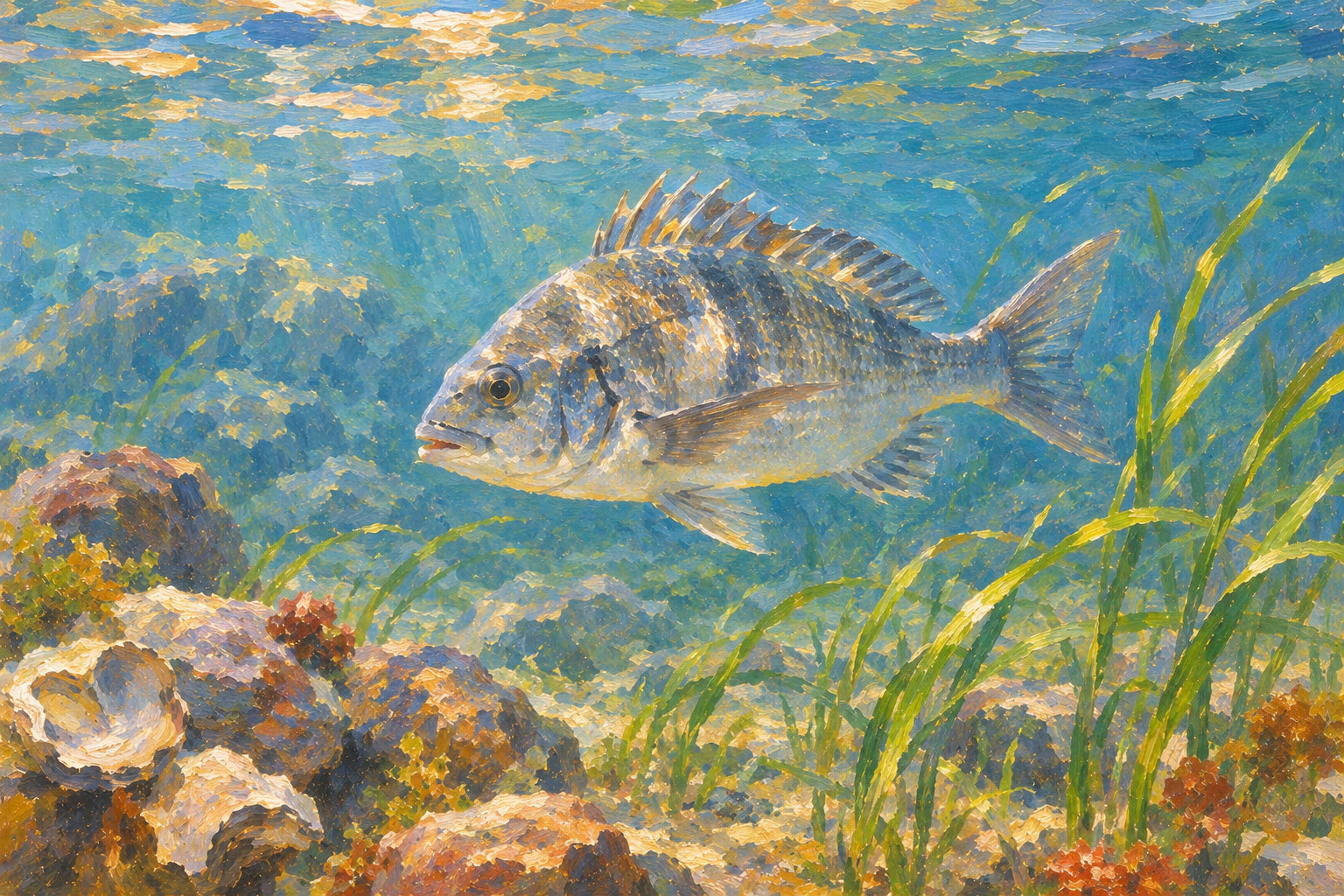
The organism is Mothocya parvostis, a cymothoid isopod: a marine crustacean that attaches to fish, often near the gills. Despite the alarming appearance of such parasites, it is not a microscopic bacterium, a fungus or an insect. Its principal final host is the halfbeak known in Japanese as sayori. Juvenile black sea bream, Acanthopagrus schlegelii, appear to act as intermediate hosts during a stage of the parasite’s life history.
Young free-swimming individuals, called mancae, emerge from the female and search for fish on which to attach. Earlier research suggests that infested young sea bream may grow more slowly, but the university stresses that infestation of black sea bream is largely confined to fish smaller than about four centimeters. The new findings do not constitute a warning that market-sized black sea bream are widely infested or unsafe to eat; Hiroshima University says consumption of fish carrying cymothoid isopods generally does not affect people.
A 2021 field study published in 2026
The fish were collected from mid-June through early August 2021, along the western shore of Nomi Island and the northern shore of Daikoku-Kamishima, both near Etajima in Hiroshima Prefecture. Researchers recorded body length and whether each juvenile carried the parasite, then compared the observations across 16 sites. The study appeared online in Regional Studies in Marine Science on October 21, 2026, before the university’s broader public announcement on November 19.
Fish size matters: parasite prevalence rose as juveniles grew, peaked at an estimated body length of about 36 millimeters, then tended to decline. The authors therefore used statistical models to account for body size. Substantial differences between collection sites persisted even after that adjustment. The distinction matters because a beach with bigger fish could otherwise look like a more dangerous habitat simply because of its fish population structure.
Eight environmental variables, not one magic number
At each site the team evaluated water temperature, salinity, water transparency, sediment temperature, sediment fineness, seabed slope, coastal openness and freshwater inflow. These variables are intertwined: a harbor’s shelter may affect water movement, while proximity to a stream can create gradients that disappear at different times of day. To manage those correlations, the researchers used principal component analysis to reduce the eight measurements into composite environmental axes.
Exploratory modeling associated higher parasite prevalence with lower scores on the second and fourth components, interpreted in the context of sheltered shorelines and limited freshwater inflow. Principal components are statistical summaries, not direct physical quantities such as salinity in parts per thousand. Such an association is a useful hypothesis-generating result, but it cannot alone establish that a particular coastal feature caused infestation.
The laboratory experiment: five salinities, one sudden change
The next step was deliberately different from observing fish in the bay. The researchers obtained free-swimming mancae from three female parasites and placed 30 individuals in each of five salinity conditions: 0, 10, 20, 30 and 40 parts per thousand. The water was held at 21°C. Importantly, larvae were moved directly into the new conditions; the study did not acclimate them gradually.
All the larvae in freshwater, 0 ppt, died within a day. Those in 10 ppt survived significantly less time than larvae in the 20–40 ppt groups. The 20 and 30 ppt groups did not differ significantly in survival. These tests provide mechanistic support for vulnerability to abrupt low-salinity exposure, but they do not show that adding freshwater to a bay is a safe, practical or effective parasite-control measure.
Could young fish find a temporary refuge?
Imagine a small river meeting the tidal sea. Freshwater may form a patch whose salinity differs sharply from adjacent seawater, even if a one-time measurement at the wider site misses that short-lived boundary. The researchers suggest that young sea bream able to move into such water could encounter fewer surviving mancae. At a sheltered fishing port, meanwhile, weak exchange with the open sea might allow drifting larvae and young fish to remain together for longer.
Those scenarios are plausible interpretations, not directly observed fish behavior in this experiment. The team did not track individual sea bream swimming into freshwater plumes to avoid parasites. Nor did it independently quantify all relevant current patterns or larval densities in the field. Those gaps matter if the idea is to move from a statistical association to a physical explanation of how the system works.
A clue left by Japan’s 2018 floods
The project has an unusual historical starting point. In earlier observations, the research group had found a comparatively low prevalence of infestation in 2018, when devastating rains and flooding struck western Japan. This raised the possibility that large freshwater pulses could influence the survival or distribution of the parasite’s free-swimming life stage. The later field survey and salinity experiment were designed partly to investigate that clue.
The 2018 disaster cost lives and caused enormous damage. It would be profoundly misleading to describe the floods as beneficial because of a possible ecological side effect. For marine scientists, however, extreme hydrological events can expose relationships between river discharge, salinity and the life histories of coastal organisms that are difficult to see in an ordinary year.
What this does—and does not—mean for fisheries
Cymothoid isopods can sometimes create significant problems for cultured fish. Mapping the environmental factors associated with their prevalence could eventually inform monitoring, site selection or management research. But this particular study concerns wild juvenile black sea bream and one parasite species. It did not test a treatment, measure survival improvements in aquaculture facilities or show that changing harbor salinity would prevent an outbreak.
The findings also should not be conflated with the separate oyster-mortality crisis affecting Hiroshima growers in 2026. Oysters and juvenile sea bream are different hosts, with different diseases and ecological pressures. A study of Mothocya parvostis provides no evidence for the causes of oyster losses. Scientific credibility depends on resisting convenient but unsupported connections between two stories from the same coast.
Five researchers and a regional scientific network
The article credits Hiroki Fujita, Shota Ohsaki, Takeshi Ohnaka, Kentaro Kawai and Tetsuya Umino. The collaboration spans Hiroshima University’s Graduate School of Integrated Sciences for Life, the Central University of Kerala in India, a Hiroshima Prefecture agricultural and forestry office in Kure, and a fisheries company. Hiroshima University identifies Kawai as an assistant professor and Umino as a professor.
The research combined patient shoreline sampling with laboratory maintenance of a difficult-to-study life stage and careful statistical interpretation. That mixed approach is important: a broad environmental headline may emerge from the work, but its strength rests on many small observations, not an instrument producing a single dramatic number.
The next research question is movement
The clearest next steps are to measure water movement and short-lived salinity gradients while simultaneously observing where juvenile fish and free-swimming parasites congregate. Repeating the survey across seasons and years would test whether the 2021 pattern holds when river flow, temperature and fish abundance change. A trial that tracked individual fish could establish whether the proposed low-salinity refuge is actually used.
For now, the conclusion is measured but valuable: very local habitat conditions appear to matter for the prevalence of a coastal fish parasite, and sudden exposure to fresh water is harmful to the parasite’s mobile stage under laboratory conditions. The study does not furnish a ready-made cure. It gives scientists a sharper map of the questions to ask at the boundary where rivers meet the sea.
Primary sources and reporting limitations
This report independently analyzes Hiroshima University’s November 19 announcement, its earlier paper summary, and the published research abstract. No new field sampling, researcher interview or independent reanalysis of the raw data was undertaken; access to full publisher text may be limited.