- A working life ends, a quieter one begins
- From six-month-old trainee to operational partner
- Twenty minutes that mattered in Saeki Ward
- Finding an older man—and other children
- How scent work depends on two partners
- The long institutional history behind the dog
- The difficult judgment to retire
- Five commendations, and the limits of the record
- The colleagues who came to say goodbye
- A Mihara family, a favorite mat and the sea
A working life ends, a quieter one begins
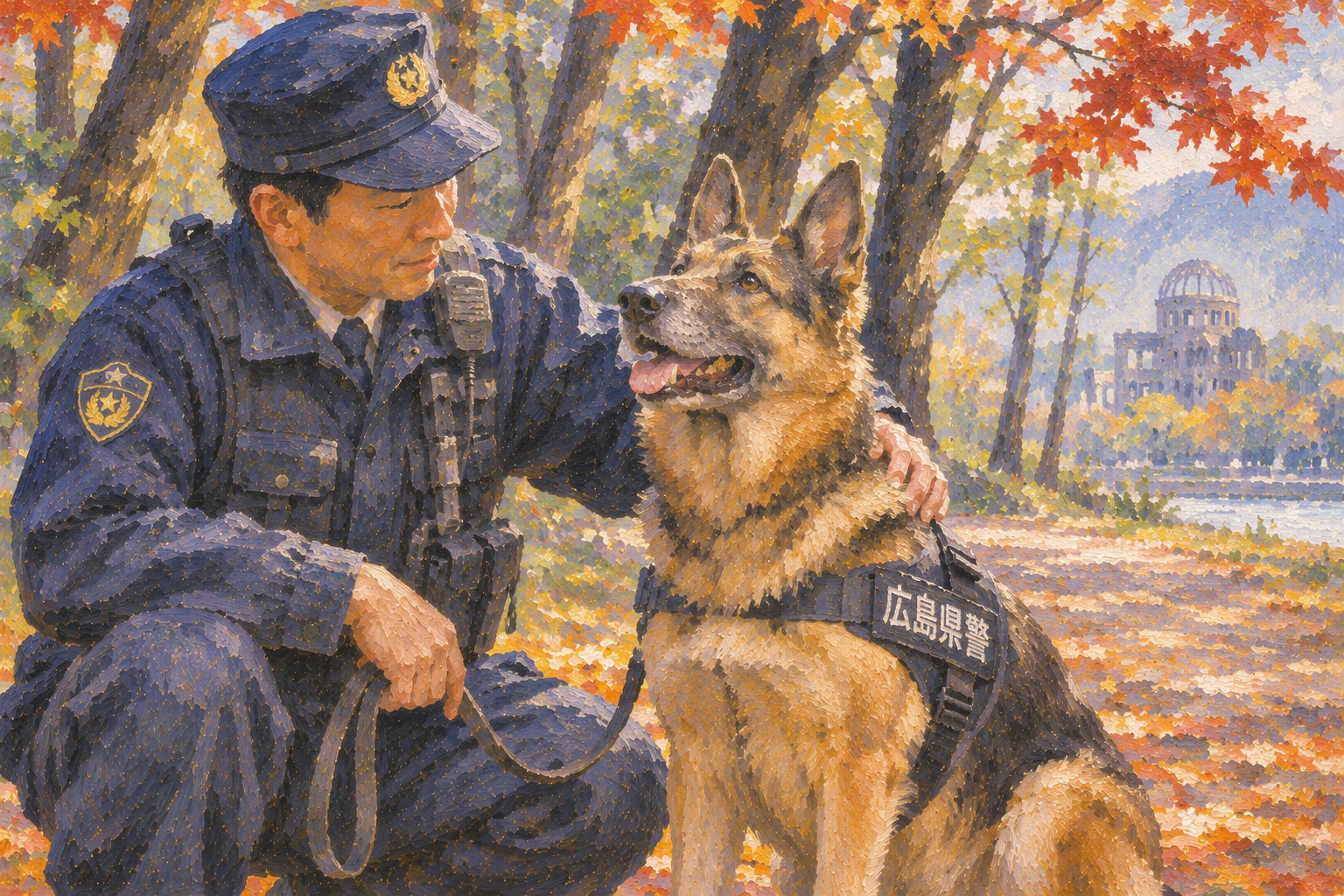
On November 13, 2026, a ten-year-old police dog left Hiroshima Prefectural Police service after a career measured in roughly a thousand deployments. His name was Calif—formally Calif of Smart Child—and he had earned five commendations. The farewell was not a graduation from an abstract training program. For years he had been part of real searches for missing people, including children and an older man who were located within minutes of a scent trail being followed. As television crews documented his retirement, the most striking development was not another assignment. It was a home waiting for him in Mihara, where he would live as a family dog rather than a public-safety worker.
From six-month-old trainee to operational partner
According to Television Shin-Hiroshima, Calif joined the directly managed police-dog unit as a puppy in 2016; RCC dates the start of his police career to October that year. Footage taken when he was six months old shows the unglamorous foundation of a working dog's life: commands, patience and repeated cooperation with a handler. Officer Tomohiko Hatta, who would remain closely involved with Calif, said at the time that missing-person searches would be a priority and that trainers would develop whichever abilities the dog demonstrated. It was a practical training philosophy rather than a promise of celebrity. Calif eventually stood out for his willingness to investigate scent, something colleagues described years later as an unusually strong curiosity.
Twenty minutes that mattered in Saeki Ward
One assignment explains why the retirement attracted attention. In 2021, a schoolboy went missing in Hiroshima City's Saeki Ward. RCC reports that Calif followed scent from clothing belonging to the boy and helped locate him in approximately twenty minutes. The Saeki Police Station chief subsequently commended the dog. Television Shin-Hiroshima's retrospective also describes the search in terms of a garment used as the scent source. Such reports do not provide an independently audited search log, a full minute-by-minute operational record or every officer's contribution. What they establish is a specific successful search that authorities considered significant enough to recognize. When a child is missing, time is not an abstract performance measure.
Finding an older man—and other children
In another documented case, Calif located a missing older man in Hiroshima City's Nishi Ward in around thirty minutes in 2023, earning recognition from the Hiroshima Nishi Police Station chief, RCC reported. TSS recounted a separate 2022 assignment in which two missing junior-high students, one in Hiroshima City's Aki Ward and another in Mihara, were found on the same day. These examples convey the range of missing-person situations that can arise across an urban-rural prefecture. They do not mean the dog worked alone or that every deployment produced a successful find. Call handlers, patrol officers, family members and other responders all form part of the information and safety network within which a police dog operates.
How scent work depends on two partners
A police dog's sense of smell can be useful when witnesses cannot point to the next street or footpath. An item carrying a person's scent may offer a starting point; the animal then works in an environment shaped by vehicle traffic, crowds, weather, surface conditions and time. A handler must read the dog's behavior, make decisions and coordinate with colleagues. Japan's National Police Agency distinguishes dogs directly managed by a prefectural police force from privately kept dogs commissioned to assist police. Its 2024 operating guidance stresses the capacity of directly managed teams to deploy promptly outside ordinary hours while requiring appropriate oversight. The designation describes a system of human and animal teamwork, not a guarantee that scent evidence is infallible.
The long institutional history behind the dog
Police dogs in Japan predate Calif by many decades. The National Police Agency's 1973 White Paper records 31 directly managed dogs and 626 commissioned dogs nationwide at the end of 1972. Its following year's account describes organizational expansion, with the number of directly managed dogs rising to 49 by the end of 1973. Those historic counts are not estimates of present staffing, but they show how the service evolved into a structured part of investigations and missing-person searches. A 2015 White Paper similarly emphasizes trained animals' contribution to finding evidence and people. Technology has transformed policing, yet the use of a living animal's highly developed sensory abilities has continued alongside other investigative methods.
The difficult judgment to retire
Calif's story is not only about capability; it is also about knowing when to stop asking for it. Television Shin-Hiroshima reported that the dog had become less steady on his feet as he aged, while RCC described more frequent stumbling or falling from around July 2026. He was still attending field operations through about April, TSS said, but the last months were deliberately less demanding. The autumn tally was reported as 999 operational deployments before a final public appearance. Broadcaster headlines rounded the total to 1,000; this article uses 'about 1,000' rather than presenting a precise audited count. With potentially hazardous terrain and long searches, aging has consequences for the welfare of the dog and the reliability of the assignment.
Five commendations, and the limits of the record
RCC says Calif received five commendations over his ten-year career. The two identified successes—finding the schoolboy in 2021 and the older man in 2023—help give that number meaning. But an award count is not a controlled measure of scent discrimination, and there is no public performance dataset in the sources reviewed here from which to calculate Calif's rate of successful searches. Nor should every deployment be conflated with a rescue or a crime solved. Search outcomes depend on the circumstances of each report, the initial clues, weather and many other responders. An independent assessment would require police operational records and a clear definition of what constitutes an outing, a search and a success.
The colleagues who came to say goodbye
The November 13 ceremony brought together people who had known Calif as a working partner. TSS reported remarks from Masaharu Kuranishi, head of the prefectural police identification division, thanking the dog for a decade of service. Former handler Kuniharu Sakai also described gratitude and sadness as the assignment ended. Hatta, by then a police inspector, spoke about the physical changes that made retirement appropriate. These details matter because a police dog does not simply belong to a uniformed organization in the abstract. Its performance comes from years of human attention: daily care, repetition, trust and difficult deployments. The officers' quoted remarks in the Japanese reports were not independently obtained by JAPAN.co.jp.
A Mihara family, a favorite mat and the sea
Calif's new owner is Shinichiro Toge, a sergeant assigned to Mihara Police Station, who brought the retired dog into his family. In interviews broadcast by RCC and TSS, Toge expressed the hope that Calif would finally be able to rest and that the pair could walk together along the beach. TSS filmed him settling into his new surroundings, finding a comfortable mat and eating well on his first day. It is an intimate ending to a public story. For ten years, Calif was asked to follow trails leading to people who were missing. His new life will be defined less by duty than by ordinary pleasures—the shore, a home and the people who have made room for him.
Sources, reporting method and remaining questions
This story independently synthesizes reporting by RCC Chugoku Broadcasting (Nov. 15) and Television Shin-Hiroshima (Nov. 17), together with official National Police Agency documentation on police-dog operations and history. JAPAN.co.jp did not independently interview Calif’s handlers or his new family or obtain the official deployment ledger.
- RCC Chugoku Broadcasting: Calif’s retirement, deployments and commendations (Nov. 15)
- Television Shin-Hiroshima: a decade of searches and the family retirement (Nov. 17)
- National Police Agency: guidelines on effective deployment of police dogs (2024)
- National Police Agency: 2015 Police White Paper on working police dogs
- National Police Agency: 1973 White Paper on directly managed and commissioned police dogs
- National Police Agency: 1974 White Paper on institutional expansion