- A pair of tickets, earned in straight sets
- Shintoku avenges the previous final defeat
- Sotoku meets the challenge of Setouchi
- What the official tournament record establishes
- A school rebuilt after the atomic bombing
- Sotoku and the unlikely roots of a dynasty
- Why teamwork defeated two different problems
- Young players, accurate names, responsible reporting
- What a regional representative carries
- January is a beginning, not a conclusion
A pair of tickets, earned in straight sets
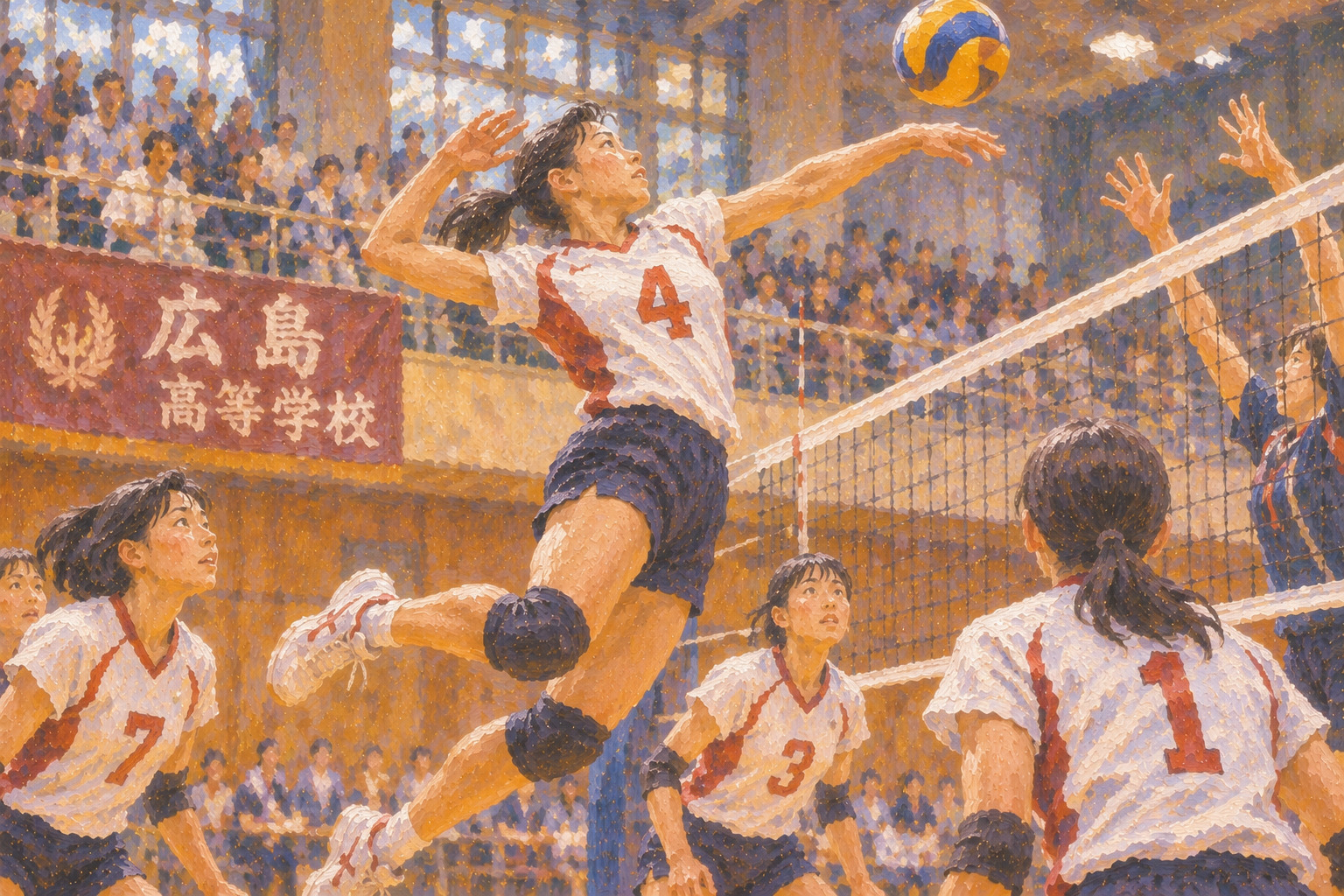
In a Hiroshima gym on November 14, two school teams won the right to carry their prefecture into Japan's best-known high-school volleyball championship. Shintoku Girls' High School defeated Ginga Gakuin 3–0 in the women's final; Sotoku High School swept Hiroshima Setouchi 3–0 in the men's final. Both wins were clear on the scoreboard. Neither was effortless in the story behind it.
For Shintoku, victory settled unfinished business against the opponent that denied it a place a year earlier. For Sotoku, the result reinforced a tradition spanning generations while offering another test of how collective discipline can meet an opponent's exceptional height and power. The national tournament remains ahead, in January 2027.
Shintoku avenges the previous final defeat
The women's final reopened a rivalry with Ginga Gakuin, last year's Hiroshima representative. According to Television Shin-Hiroshima's November 16 account, the Urabe sisters (卜部歩夢 and 卜部夢月) helped Ginga Gakuin establish an early foothold. Shintoku answered by spreading its offense around standout hitter Okamura (岡村心彩) and captain Kadota (門田侑乃), including a five-point run that shifted the opening set.
Okamura's serve became a major weapon in the second set, with the broadcaster describing three consecutive aces. In the third, second-year player Hayashi (林愛月) supplied the final spike. Shintoku won 25–20, 25–11, 25–22, returning to the nationals after a one-year absence. The published accounts do not establish complete player-by-player statistics, and this article does not invent them.
Sotoku meets the challenge of Setouchi
For the sixth consecutive year, the men's Hiroshima final paired Sotoku with Setouchi. This year Setouchi featured a player described by local media as a 203-centimeter student from the Democratic Republic of the Congo, referred to in the reporting as Dieumerci. His attacking height made the opening exchanges competitive.
Sotoku's answer was to keep the ball alive. It built combinations from controlled receptions and the distribution of setter Utena, gradually adapting its defense to Setouchi's leading attacker. Ace Sakoda delivered the final point in the broadcast account. The set scores—25–19, 25–18, 25–14—illustrate how the defending representative imposed increasing control as the match progressed.
What the official tournament record establishes
The Hiroshima qualification campaign began October 31 and continued through November 7–8 before the finals on November 14 at the Hiroshima Prefectural Sports Center's Small Arena. The prefectural high-school volleyball committee publishes separate tournament results for boys and girls. Shintoku advanced past Onomichi and Hiroshima Sakuragaoka in the later rounds, then defeated Ginga Gakuin. Sotoku emerged from the boys' bracket and defeated Setouchi in the deciding match.
Sotoku is headed to its 52nd national appearance, its second straight; Shintoku has qualified for the 14th time, returning after two years between appearances. The national championship is scheduled for January 4–10, 2027. These are qualification victories, not national titles, and neither a January opponent nor a future result should be assumed.
A school rebuilt after the atomic bombing
Founded in 1908 by Nagai Ryujun, Shintoku's history is inseparable from Hiroshima's 20th century. According to the school's own chronology, the August 6, 1945 atomic bombing destroyed its campus and killed 384 students and staff. Classes resumed that November in borrowed accommodation, and the school moved to its present site the following year.
The volleyball program became another expression of continuity. Shintoku's official club history recounts repeated appearances in Japan's national spring tournament and a third-place finish at the 2023 Inter-High tournament. This year's qualification should be understood in its own sporting terms, not reduced to symbolism. Yet the long story of the school helps readers see why its achievements resonate beyond one match.
Sotoku and the unlikely roots of a dynasty
Sotoku's volleyball alumni organization traces the team's beginnings to the devastated postwar city, where enthusiasts reportedly used surviving columns and fishing nets to improvise a court. The volleyball club was formally established in 1946 and won its first national high-school title in 1957.
Its alumni include Katsutoshi Nekoda, the celebrated setter who represented Japan at the Olympics. Sotoku's record in national competitions is part of the institutional memory around the current team. But history does not block a spike or save a difficult reception; those tasks fall to this generation's players.
Why teamwork defeated two different problems
These finals offered two distinct examples of how volleyball is won before the decisive spike. Shintoku's serve placed pressure on the opponent's first contact, limiting how quickly Ginga Gakuin could construct attacks. Sotoku repeatedly converted receptions into coordinated sets, reducing the advantage of a physically imposing opponent.
Serve-receive quality, transitions, blocking and back-court defense interact. An effective rally is rarely the work of one hitter alone. The tactical conclusions here follow match reports and scorelines; JAPAN.co.jp did not conduct an independent rally-by-rally video analysis or produce original advanced statistics.
Young players, accurate names, responsible reporting
A team-supported roster published by Monthly Volleyball for the 2026 Inter-High identifies Shintoku captain Kadota (門田侑乃), attacker Okamura (岡村心彩) and second-year player Hayashi (林愛月). The roster is a summer document, not an exhaustive November lineup or a guarantee of current shirt numbers. Television Shin-Hiroshima independently names their roles in the prefectural final.
The local account refers to Sotoku's setter as Utena (臺) and its final-point scorer as Sakoda (迫田). Full names, precise spellings and match statistics were not reliably established from the material reviewed, so this report avoids supplying unsupported details. No teenagers or coaches were interviewed directly by this newsroom.
What a regional representative carries
A high-school team is built in ordinary school days: classes, training, travel, coaching and the challenge of coordinating players who may have only a few seasons together. Unlike a professional franchise, a school's lineup changes as students graduate. Building continuity requires junior players to absorb both technique and expectations.
Shintoku's return after a painful final defeat and Sotoku's repeated qualification speak to that combination of institutional stability and continual renewal. Neither team's specific training schedule, budget or family stories can be established from these public sources. The verified competition is dramatic enough without invented backstage scenes.
January is a beginning, not a conclusion
At the national championship, Hiroshima's representatives will meet schools with different rhythms, physical strengths and tactical choices. Shintoku will need to sustain serve pressure against new reception systems; Sotoku will have to reproduce its defensive organization against elite attacking teams. Whether those strengths travel successfully remains an open question.
For now, the final scorecards say what happened on November 14. Both teams earned their place. The larger story is about what came before—defeat, tradition, rebuilding and training—and the unpredictable competition still to come.
Sources and reporting limits
Independently reported using prefectural tournament records, Television Shin-Hiroshima’s finals coverage, both schools’ published histories and a team-supplied summer roster. No direct player or coach interviews or independent play-by-play analysis were conducted.