- A promise measured in a hundred years
- Two different kinds of making in one room
- A young woman in Hiroshima on August 6, 1945
- The depot still stands, with a complicated future
- Learning to knit after the war
- From storage boxes to the museum walls
- Hiroko Takayama’s long journey to India
- Thirteen paintings, and the language of light
- The exhibition they promised each other
- Why this quiet exhibition matters beyond Hiroshima
A promise measured in a hundred years
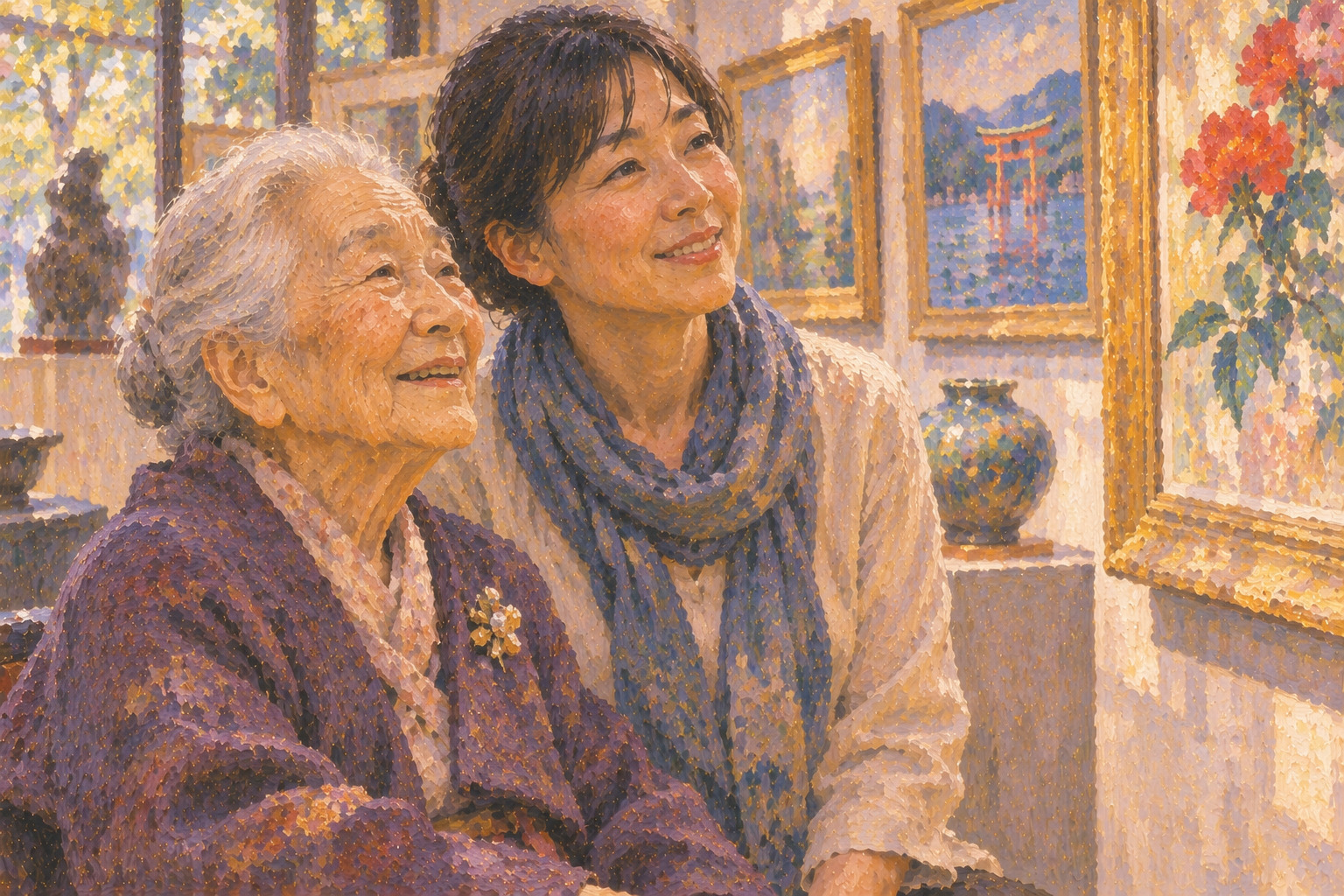
A century of life can be difficult to picture. In a Hiroshima gallery this week, it can be approached through knitted sweaters, dresses and the careful marks of a painter's brush. Akie Monden, who turned 100 on November 11, is exhibiting the needlework she spent decades making and teaching. Beside it hang paintings by her daughter, the artist Hiroko Takayama, now 68. The exhibition opened on November 17 and is scheduled to close on Sunday, November 22.
The name matters: official Japanese listings identify the centenarian as 門田アキエ, and a national newspaper supplies the reading Monden. Earlier English planning materials rendered her surname Momonda, an error this article corrects. The daughter is a painter; the mother is a knitwear artist and teacher. Their relationship is the story, but their accomplishments should not be blurred together for the sake of a convenient headline.
Two different kinds of making in one room
Television Shin-Hiroshima reports that more than a hundred knitted objects by Monden and thirteen paintings by Takayama are on display. The Mainichi Shimbun counts roughly a hundred knitted pieces, including sweaters and dresses. The difference may reflect counting practices; without an exhibition catalogue it would be unwise to declare a perfectly exact total. What is certain is that a substantial body of domestic textile art is being displayed alongside an established painter's canvases.
The exhibition occupies Room 3 of the Hiroshima Prefectural Art Museum's Citizens' Gallery and admission is free. This is not a permanent collection exhibition about Japan's most famous artists. It is a temporary, family-led presentation, but that modest scale makes the intimacy of its premise all the more arresting: work stored away for years is being shared with people who might otherwise never have encountered its maker.
A young woman in Hiroshima on August 6, 1945
Monden was born in Hiroshima on November 11, 1926. At eighteen she was mobilized for work at the Hiroshima Army Clothing Depot when the atomic bomb exploded. Japanese reporting recounts that she heard the blast, sheltered beneath a desk and survived. In the hours that followed, she helped distribute hardtack to injured people brought to the depot. Both of her elder brothers died in the war, including one serving aboard the battleship Yamato.
Those details are drawn from the family's testimony as recorded by Japanese journalists, not from a new interview by JAPAN.co.jp. The stories are painful enough without invented dialogue or embellished scenes. They also remind us that Hiroshima's history was lived by young people working in ordinary institutional spaces, not only by those whose experiences later became internationally familiar.
The depot still stands, with a complicated future
Hiroshima Prefecture records that the surviving Army Clothing Depot warehouses were completed in 1914. They were built to support the military's production and storage of uniforms, shoes and other supplies. Damaged by the atomic bombing, they became an improvised relief facility. Their postwar lives included classrooms and warehouses, and the complex remains one of the city's most important surviving bomb-damaged structures.
The buildings received national Important Cultural Property designation in January 2024. On November 17, 2026, the prefecture updated its information about structural-safety work. Preserving physical evidence of wartime Hiroshima is an engineering, financial and cultural question. Monden's testimony gives that public issue a human dimension, although the museum exhibition is not formally documented as part of the depot preservation project.
Learning to knit after the war
Survival did not produce an easy adulthood. Japanese reporting says Monden struggled with the aftereffects of the bombing. At twenty-seven she began studying knitting seriously, obtained an instructor's qualification, and went on to teach students for nearly six decades. One broadcaster describes more than sixty years of activity as a knitwear maker; these are broadly consistent accounts of a long career, not an independently audited teaching log.
Knitting is sometimes described as hobby work, a label that misses the design decisions and embodied skill involved. The maker has to understand tension, pattern, shape, wearability and texture. The finished garment may be a practical object, but it is also the result of repeated judgments, revisions and patient attention. At Monden's age, the accumulation of that expertise becomes part of the exhibition's artistic force.
From storage boxes to the museum walls
According to Mainichi, Monden carefully kept her knitted garments in clothing storage cases at home. Around a hundred pieces have now been brought out for public display. On opening day she attended in a wheelchair and was reunited with former pupils. Those reunions show something a simple exhibition count cannot: the work mattered not only as objects but through the people she taught.
It is tempting to claim that the garments were all made with an exhibition in mind. No available source establishes that. Their return to public view is powerful precisely without such invention. They speak to an everyday archive of women's work—a record kept not in official ledgers but in clothing, memories, skills and the relationships created through teaching.
Hiroko Takayama’s long journey to India
Takayama's trajectory took a different direction. Her artist profile records graduation from Hiroshima Municipal Motomachi High School in 1977 and Osaka University of Arts in 1981. She began traveling to India in 1982 and reports making twenty-eight research trips. The landscapes and people she encountered there shaped an ongoing interest in vitality, prayer and the dignity of human life.
Her career includes exhibitions at the Nitten and Kōfūkai, individual gallery shows and a Hiroshima cultural encouragement award. The Hiroshima Internet Art Museum's artist profile says she presented a work related to Avalokiteśvara to Indian Prime Minister Narendra Modi during the 2023 G7 summit period. That account comes from the artist's published biography; it has not been separately matched here to an official government record. Such attribution matters when a life story intersects with diplomacy.
Thirteen paintings, and the language of light
The exhibition includes thirteen of Takayama's paintings. Japanese reporting identifies works titled Shōka (昇華), Kōmyō (光明) and Tōmyō (灯明), with dates reported as 2004, 2021 and 2020 respectively. Their titles suggest transcendence, illumination and lamplight. But a title is not enough to certify a painting's religious meaning or how its colors and composition work; close interpretation requires actually seeing the canvases and hearing the artist explain them.
Her published exhibition record contains works with recurring titles across multiple years. This article therefore resists tying every gallery description to a specific Nitten entry without checking the catalogue. What can be said is that Takayama's commitment to painting India and her mother's years of working with yarn represent different materials through which two women have tried to make experience visible.
The exhibition they promised each other
Mainichi reports a remarkable family promise: mother and daughter agreed they would exhibit together when Monden reached 100. In November 2026 the idea became a public event. The younger woman's painting career and the older woman's textile practice were never identical, but the shared show puts them in conversation without asking either artist to surrender her own medium.
Takayama told local television that she hoped people would recognize the value of peace and life. She has described her mother's endurance, including the loss of her two brothers, as a guide to her own artistic journey. The exhibition's emotional strength lies not in an abstract claim that creativity guarantees longevity—there is no evidence for that—but in the concrete fact that teaching and making continued through decades shaped by grief, reconstruction and family life.
Why this quiet exhibition matters beyond Hiroshima
The museum's official calendar sets the show for November 17–22, from 9 a.m. to 5 p.m., in Citizens' Gallery Room 3. Admission to this exhibition is free; that should not be confused with the museum's other ticketed galleries. Mainichi reported a talk on opening day and another planned for Saturday, November 21. Its completion was not verified at the reporting cutoff.
A visitor can leave the room carrying two different images: the bold distance of Takayama's Indian subjects and the intimate nearness of the garments Monden knitted. Hiroshima's past is often recounted through dates, ruins and public monuments. Here it can also be approached through one woman's resolve to learn a craft in the aftermath of war, teach it to others, and keep making things long enough to share them with her daughter in a museum. That is not a lesson manufactured for an anniversary; it is the life the exhibition makes visible.
Sources and reporting limits
This article draws on the museum and Hiroshima cultural foundation schedules, reporting from Hiroshima journalists, the painter’s published biography and prefectural records on the Army Clothing Depot. There was no interview with the family, direct viewing of the gallery or complete exhibition-catalogue audit. Events after the Nov. 19 cutoff are not described as verified outcomes.