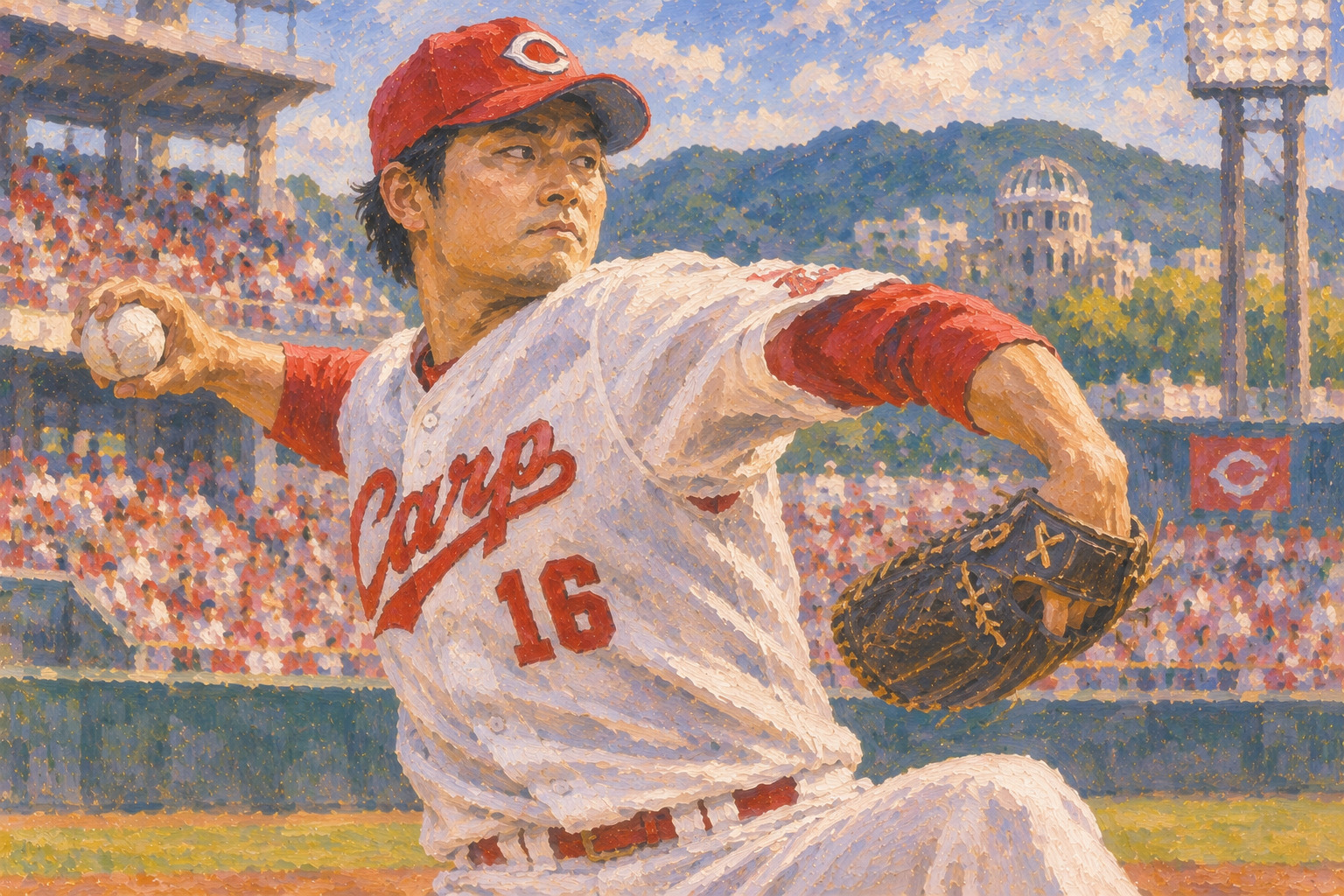
- A second chance in Hiroshima red
- A trade with no transfer compensation
- An Okinawan baseball education
- Sixteen wins—and a rare no-hitter
- What the 2026 numbers can—and cannot—tell us
- Why the Carp need pitching options
- The ambition: one start every seven days
- A veteran who is also a newcomer
- A different league, a different city
- How to judge the comeback
A second chance in Hiroshima red
For 14 seasons, Nao Higashihama wore the uniform of the Fukuoka SoftBank Hawks. On November 19, 2026, the 36-year-old right-hander stood at Mazda Stadium in Hiroshima with a new number—12—and an opportunity that had seemed increasingly remote: a route back to Japan’s top-level starting rotation.
The move is more complicated than a celebrated veteran changing clubs. Higashihama did not pitch in a single first-team game in 2026 amid reported right-shoulder trouble. Hiroshima is not buying a guarantee of past excellence. It is taking a calculated chance on a pitcher whose knowledge and record remain formidable, while his present health and workload remain questions.
A trade with no transfer compensation
The move from SoftBank to the Hiroshima Toyo Carp was announced November 6 as a no-compensation trade, known in Japan as a musho trade. That describes the structure of the transaction, not an assessment that the player has no worth. SoftBank general manager Sugihiko Mikasa explained in a reported briefing that Higashihama wanted a path to more appearances and that the club was also managing its roster registration capacity.
For Hiroshima, acquiring a pitcher with substantial experience without surrendering another player has obvious appeal. The reverse side of the bargain is risk: the performance a team remembers from 2017 or 2022 is not necessarily the performance it will receive in 2027.
An Okinawan baseball education
Born on June 20, 1990, in Okinawa Prefecture, Higashihama learned to compete under the expectations that surround elite high-school baseball. He helped Okinawa Shogaku win Japan’s spring national high-school championship in 2008, then developed at Asia University in Tokyo’s demanding collegiate baseball system.
SoftBank selected him in the first round of the 2012 professional draft, and he began his NPB career in 2013. The path from celebrated prospect to reliable professional starter was gradual. After limited first-team action in his early years, he won nine games in 2016 and finally delivered the defining season that made him a household name among Pacific League followers.
Sixteen wins—and a rare no-hitter
Higashihama went 16–5 with a 2.64 ERA in 2017, earning the Pacific League wins title. He threw 160 innings, striking out 139 batters. Those are the numbers of a starter able to sustain performance over months, rather than one brilliant afternoon.
Then came May 11, 2022: a no-hitter against the Saitama Seibu Lions, completed in just 97 pitches. Two batters walked but both were erased on double plays. The Nippon Professional Baseball record book counts it as the 95th no-hit game in league history, achieved by the 84th pitcher. It was a near-perfect demonstration of command, efficient contact management and defense working together.
What the 2026 numbers can—and cannot—tell us
NPB’s career ledger through the 2025 first-team season shows 180 appearances, 76 victories, 46 losses and a 3.30 ERA. In 2026, however, Higashihama made no top-team appearances. Japanese coverage associates the absence with his right shoulder, although a complete public medical account was unavailable at our research cutoff.
He did work in the farm league: 12 games, a 6–4 record and 2.37 ERA, according to contemporary reporting. That is a credible sign that competitive pitching continued, but the farm league and NPB first teams have different hitter quality. A farm ERA alone does not establish readiness to start every seventh day for an entire NPB season.
Why the Carp need pitching options
Hiroshima enters its 2026–27 offseason facing unusual uncertainty. Starting pitchers Hiroki Tokoda and Masato Morishita, along with catcher Shogo Sakakura, exercised domestic free-agent rights. Their decisions created significant roster-planning questions, but exercising those rights is not the same as leaving the club. The final outcomes should not be anticipated in a story dated November 22.
A healthy Higashihama would give Hiroshima an experienced rotation option and a pitcher familiar with postseason expectations. An unhealthy or limited Higashihama would not solve the problem. That distinction is central to assessing the trade rather than treating it as a completed fix.
The ambition: one start every seven days
At his introductory press conference, Higashihama said he wanted to be ready to pitch through a season on a six-day rest schedule—naka-muika in the Japanese baseball vocabulary. It means six days between outings, the traditional rhythm of many NPB starters. The objective is durability as much as peak velocity.
Such a schedule demands repeatable mechanics, preparation, recovery, sound pitch selection and the ability to work through a lineup multiple times. The club has expressed expectations that he can contend for a starting position, but neither a guaranteed rotation job nor medical clearance for a full workload has been independently established.
A veteran who is also a newcomer
The paradox of the acquisition is that the newcomer may be the most experienced pitcher in the room. At 36, Higashihama can pass along lessons from championship seasons, injuries, scouting reports and the disciplined preparation required for major-league-level pitching in Japan.
At the November 19 introduction he acknowledged that, whatever his age, he is effectively a rookie in Hiroshima. He emphasized the need to perform before he can properly help teammates. Leadership is therefore a possibility, not an outcome that can be credited before the season begins.
A different league, a different city
The move takes Higashihama from the Pacific League to the Central League, where the opponents, scouting routines and rhythms of competition differ. It also moves him from Fukuoka to a city with its own intensely local baseball culture. The Carp occupy a powerful place in Hiroshima’s public identity, forged through decades of devotion and a distinctive baseball history.
Local broadcaster TSS reported that he had sought advice about Hiroshima neighborhoods and restaurants from SoftBank slugger Yuki Yanagita, a Hiroshima native. That ordinary detail captures the human side of professional mobility: a transfer changes a pitcher’s work, home and daily life all at once.
How to judge the comeback
The meaningful measures for 2027 will be straightforward, even if the answer is not. Can the shoulder withstand regular work? Does his command hold against first-team hitters? Can he get deep enough into games to reduce pressure on the bullpen? Wins will matter, but so will innings, consistency, walks and the context of run support.
Higashihama’s past is secure: a wins title, a rare no-hitter and 76 first-team victories. His immediate future is not. That tension is why this no-fee acquisition is more than a routine roster note. Hiroshima has handed a proven pitcher an opening; whether he turns it into a lasting return will be decided on the mound.
Sources and reporting limits
This report draws on NPB and team records and Japanese-language reporting available by November 19, 2026. JAPAN.co.jp did not independently interview Higashihama, the clubs or medical personnel. His recovery, 2027 role and other Carp players’ free-agency outcomes remain uncertain.
- 福岡ソフトバンクホークス:2026年選手名鑑・年度別成績 / SoftBank Hawks profile
- 日本野球機構:東浜巨、年度別投手成績 / NPB career statistics
- 日本野球機構:2022年5月11日の無安打無得点試合 / NPB no-hitter record
- パ・リーグ.com:11月6日の移籍発表 / November 6 trade
- パ・リーグ.com:三笠GMによる移籍理由の説明 / General manager comments
- テレビ新広島:11月19日の入団会見 / TSS press conference
- 中国放送:東浜巨入団会見の一問一答 / RCC interview
- デイリースポーツ:入団会見、通算成績、今季成績 / Career and 2026 farm results
- デイリースポーツ:広島3選手のFA権行使 / Carp free-agent uncertainty
- 日刊スポーツ:契約条件は推定額 / Estimated contract