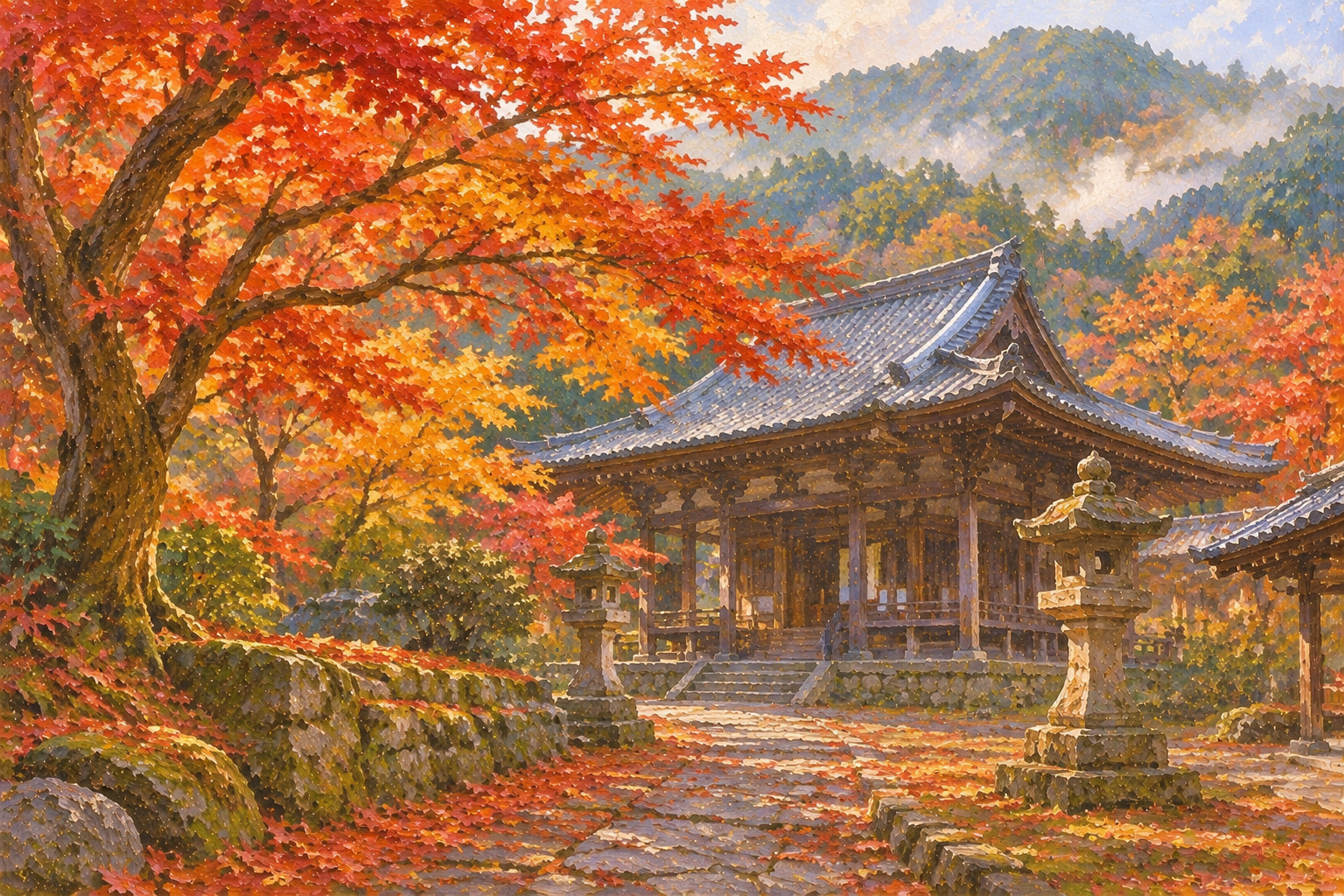
- A valley that turns gold before winter
- What the 2026 foliage reports actually establish
- How a medieval lord established a place for Zen
- A monastery shaped by the Kobayakawa family
- Why 1905 matters as much as 1397
- A surviving building from 1406
- Learning to look beyond the brightest maple
- A Sunday program beyond leaf viewing
- The journey requires planning
- A season that opens a longer history
A valley that turns gold before winter
The road to Buttsūji follows a wooded valley outside Mihara, in eastern Hiroshima Prefecture. By mid-November the maples and other trees framing the Zen temple's approach have shifted into reds and golds. Footage recorded on November 17 and broadcast by HOME Hiroshima on November 18 showed a season running approximately a week ahead of the previous year. Weathernews classified the foliage as near peak, with roughly 70–80 percent color on November 17.
The scenery is reason enough for an autumn journey, but Buttsūji is more than a photogenic landmark. Founded in 1397, it is headquarters of a branch of the Rinzai Zen tradition. Its buildings and centuries of religious history offer a different way to understand Hiroshima, beyond the prefecture's internationally known urban sites.
What the 2026 foliage reports actually establish
Local television's November 18 account describes the leaves as at their best, based on pictures taken the preceding morning, and says the color arrived about a week earlier than in 2025. Weathernews gives a similar near-peak assessment for November 17. Neither report proves that every grove or temple building will be equally photogenic throughout the November 21–23 holiday weekend.
This article is prepared from information available by November 19, not observations made on November 22. Conditions change with rain, wind, elevation and temperature. It would be misleading to treat an autumn forecast as a guarantee. Visitors should check updated local information before leaving.
How a medieval lord established a place for Zen
According to the temple's official history, the story begins in 1397 when Kobayakawa Haruhira, a lord of the Numata Takayama Castle domain, invited the monk Guchū Shūkyū to establish a temple beside the river. Guchū had traveled to Yuan China for Buddhist study and later trained disciples in Japan. The site was chosen for its secluded mountain-and-water setting.
The name Buttsūji refers not directly to its founder but to the posthumous Buddhist title of Guchū's teacher, Sokkū Keiryō. That distinction is easy to lose in a shortened travel description. It reminds visitors that a monastery was part of a living network of teachers, students and religious transmission rather than simply a building sponsored by a warrior.
A monastery shaped by the Kobayakawa family
The temple's own chronology says it flourished under Kobayakawa patronage, at one point encompassing 88 subsidiary compounds within its precincts and approximately 3,000 affiliated temples in western Japan. These are figures in its institutional history, not a count of today's active network. The Ōnin War marked the beginning of a decline, followed by some revival under Kobayakawa Takakage.
The fortunes of religious institutions shifted with the fortunes of military households. Later rulers including the Fukushima and Asano families presided over a changing political landscape in the Hiroshima region. The temple's survival across these changes is a reminder that the attractive calm of a modern heritage site rests on a much less settled past.
Why 1905 matters as much as 1397
Buttsūji today is the head temple of the Buttsūji branch of Rinzai Buddhism. Its official history dates the branch's modern separation from the Tenryūji branch to 1905, under the monk Kanryō Shikyū. The temple's founding and the establishment of its current denominational organization therefore belong to different centuries.
Zen is often reduced in overseas accounts to the image of a person sitting in stillness. Zazen is central, but monastic life also includes ritual, work, study and sustained training. A one-hour public session is an introduction to that tradition, not a compressed version of a resident monk's life.
A surviving building from 1406
Mihara City's cultural-heritage documentation dates the Ganki-in Jizō Hall at Buttsūji to 1406. With its Zen-style architectural details, including characteristic curved window forms, and its accompanying altar, it is designated an Important Cultural Property of Japan. The national designation was made in 1949.
That does not mean that every gate, hall or residence visible today dates from the same period. Heritage sites consist of structures from different phases, maintained and repaired over generations. Preserving wooden architecture is a continuing task of fire protection, upkeep and careful management, not a one-time act of setting history aside.
Learning to look beyond the brightest maple
The path along the river, shaded stones and bridges, the large Buddhist yew mentioned in the city guide, and the temple gate can be as rewarding as a single panoramic photograph. Mihara's visitor materials identify the Kyomō Bridge, subsidiary temples Eitoku-in and Shōbō-in, and principal halls as elements of the landscape.
This is an active religious site. Visitors should give way to worshippers and monastic activities, stay on permitted routes, and exercise care on leaf-covered stone steps after rain. The landscape rewards unhurried observation, especially where brilliant leaves intersect with the subdued textures of wood, moss and water.
A Sunday program beyond leaf viewing
The city and temple have scheduled special autumn admission from November 7 through 29, generally 8 a.m. to 5 p.m., including access to buildings that are not normally open. Admission is ¥500 for adults, with university-age visitors and younger admitted free. A photographic exhibition about the temple's four seasons is also listed.
For Sunday, November 22, zazen sessions are scheduled at 11 a.m. and 2 p.m.; places are generally limited to the first 30 participants per session, with a separate ¥500 participation charge for adults. Temple talks are scheduled at 10 a.m. and 1 p.m. A violin performance by Eiki Ōhara, a Buddhist priest, is scheduled at 10 a.m. and 12:30 p.m. These are announced plans, not events witnessed by this publication.
The journey requires planning
The November 21–23 holiday weekend is expected to be busy. Mihara City has set vehicle restrictions around the temple from November 7–29, typically 9 a.m.–5 p.m. A free shuttle is scheduled for November 22 between Kōsaka Nature Recreation Village Management Center and the temple's second parking area, operating between 9 a.m. and 5 p.m., with the final departure from Buttsūji at 4:30 p.m.
Regular and additional buses from Mihara and Hongō stations are scheduled for November 14–29. The tourism office advertises a direct bus fare of ¥730 for adults from Mihara, but schedules and individual routes should be checked. Drivers are asked to contribute ¥500 per ordinary vehicle toward forest conservation; tour buses require advance parking reservations. Public transport may be the less stressful choice.
A season that opens a longer history
Autumn is the moment when many visitors discover Buttsūji. Yet the most enduring reasons to explore it are not limited to the leaves: a 1397 foundation, a medieval hall dated to 1406 and a modern Zen branch organized in 1905. Those layers make the temple useful not just as a side trip but as a lesson in how religion, architecture and landscape developed together in western Japan.
As the maples fade, the temple remains. The most meaningful visit may be the one in which brilliant foliage leads a traveler to the quieter work of understanding the place and respecting the community that keeps it alive.
Sources and reporting limitations
Based on Mihara City and Buttsūji primary records, city cultural-heritage documentation, local television and dated foliage observations. JAPAN.co.jp did not visit the site or interview monks or visitors. Conditions and event completion on November 22 have not been verified.