Morning at Nihonbashi. A downpour at Shōno. Snow falling through the night at Kanbara. The steep mountains at Hakone. Hiroshige’s landscapes describe locations, yet what survives in memory is often something harder to map: weather, light, bodily effort and the feeling of passing through.
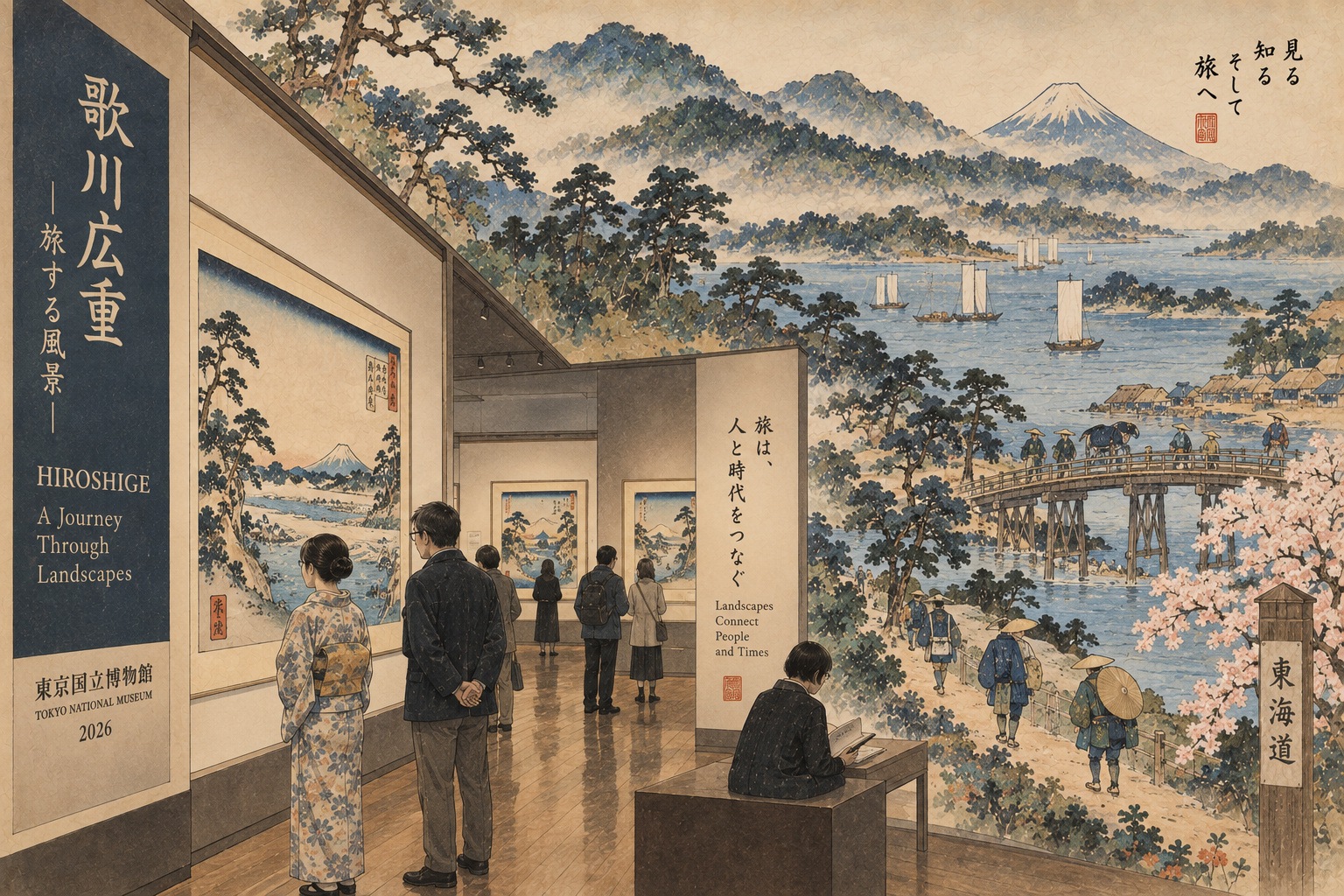
Tokyo National Museum opened Hiroshige: New Perspectives on Edo Japan in Honkan Room A on September 29. Running through December 20, the special exhibition commemorates the museum’s acquisition of 1,025 ukiyo-e prints formerly owned by collector Uchiyama Susumu (1893–1980). Around 300 landscape and bird-and-flower works are shown across three completely different rotations.[1]
What visitors see on October 3 is Part One—the Tōkaidō
The exhibition should not be described as displaying all three major series at the same time. Tokyo National Museum changes every work between the three phases. Part One, September 29–October 25, focuses on The Fifty-Three Stations of the Tōkaidō and Edo views. Part Two, October 27–November 23, turns to The Sixty-Nine Stations of the Kiso Road, provincial landscapes and bird-and-flower prints. Part Three, November 25–December 20, is devoted to One Hundred Famous Views of Edo.[1]
For the October 3 visitor, the central experience is therefore the complete journey of the famous Hoeidō Tōkaidō series: 53 post towns between Edo and Kyoto, plus the departure and arrival points. Together they form not merely a sequence of landmarks but an imagined crossing of Japan by road.
Hiroshige was not simply a recorder of famous places
Tokyo National Museum emphasizes Hiroshige’s ability to signal season, weather and time, integrate people into landscape and use striking compositions to bring familiar places to life.[1]
That helps explain the Japanese exhibition title, Edo no Best Angle. Hiroshige did not behave like a survey camera tasked with documenting one objectively correct viewpoint. He enlarged foreground objects, compressed distance, cut trees or bridges dramatically at the edge of the sheet and used diagonals to control the viewer’s eye.
The British Museum points to Towboats on the Yotsugidōri Canal from One Hundred Famous Views of Edo: a canal that was largely straight is made to curve into depth, while Hiroshige combines a downward view of boats, a long horizontal view along the waterway and an upward view toward distant mountains. Naturalism was a tool, not a rule.[2]
From a fire warden’s household into the floating world
Hiroshige was born Andō Tokutarō into a low-ranking samurai household responsible for fire protection in Edo. The Andō family served as jōbikeshi dōshin, hereditary fire wardens connected to the Tokugawa administration near Edo Castle. As a teenager, Tokutarō entered the studio of Utagawa Toyohiro and moved into the commercial visual culture of ukiyo-e.[3]
That background matters because Hiroshige was never simply an isolated “nature painter.” He stood between two social worlds: a hereditary shogunal service position and the publisher-driven marketplace of Edo.
Ukiyo-e was collaborative media. A publisher commissioned and financed a design; the artist produced the drawing; specialist block-cutters carved it; printers applied multiple colors. The British Museum stresses that famous ukiyo-e designers such as Hiroshige did not personally carve and print every sheet. The final image was a coordinated commercial product.[4]
The Tōkaidō was an enormous content platform before modern tourism
The Tōkaidō connected Nihonbashi in Edo with Kyoto through 53 official stations. Daimyo processions, merchants, pilgrims and ordinary travelers shared the road. By the nineteenth century, domestic travel had become a major subject of books, maps, guide literature and popular imagery.
The Edo-Tokyo Museum describes Hiroshige’s Hoeidō series as transforming post towns frequented by samurai and commoners into beautiful travel imagery—pictures of places many Edo residents dreamed of seeing.[5]
But the series is more than scenery. At Nihonbashi, fish sellers move fresh catch from the market as a daimyo procession begins its journey. At Goyu, inn touts physically pull reluctant travelers toward lodging. Hiroshige’s road is a social ecosystem of work, commerce, humor and movement.[6]
Snow, rain and mist: the landscape is an event
Some of Hiroshige’s most memorable landscapes are remembered through weather rather than geography. In Shōno: Sudden Rain, diagonal rain cuts across travelers scrambling uphill. In the famous Kanbara snow scene, human figures pass through a silence defined by whiteness.
Japan’s Cultural Heritage Online describes Shōno: Sudden Rain as one of the representative designs of the Hoeidō Tōkaidō, capturing people hurrying through a sudden shower with unusual immediacy.[7]
Woodblock printing gives weather special graphic possibilities. Rain can be carved as dense diagonal lines. Snow can be represented by not printing at all: the untouched white of the paper becomes the weather. The Metropolitan Museum notes this effect in Hiroshige’s snow scenes, where unprinted areas carry the whiteness of falling snow.[8]
“Hiroshige blue” was not a pigment he invented
The phrase “Hiroshige blue” is useful shorthand, but it can mislead. The brilliant deep blue associated with nineteenth-century landscape prints depended in part on Prussian blue, a synthetic imported pigment adopted by ukiyo-e artists including Hokusai and Hiroshige.
Hiroshige’s achievement was not inventing the pigment. It was using color gradation, printing technique and composition to turn blue into atmosphere—sky fading toward a horizon, water deepening under bridges, evening settling over Edo.
The British Museum highlights bokashi, subtle gradation achieved in printing, as a key part of the painterly effects Hiroshige developed in close collaboration with publishers, cutters and printers.[3]
The people are tiny—and indispensable
Hiroshige’s human figures are often minuscule beside mountains or rivers. Their scale makes nature monumental, but the people do more than establish distance.
They run from rain, cross rivers on porters’ shoulders, climb slopes, ride boats, carry goods, stop at tea houses. Their bodies translate landscape into sensation. Viewers learn how steep the road is because someone leans into it; how severe the storm is because travelers bend under it.
The Met’s discussion of Hiroshige’s Snowy Gorge notes how tiny figures on a bridge and in boats become almost part of nature, intensifying the scale of the mountains.[8]
Late Hiroshige turned Edo itself into an experiment in seeing
By the 1850s, Hiroshige’s great subject was increasingly not a road across Japan but Edo itself. One Hundred Famous Views of Edo, published from 1856 into 1858, presents the city in vertical sheets organized through seasons and striking viewpoints.
Sudden Shower over Ōhashi and Atake slices the bridge diagonally through driving rain. Plum Garden at Kameido pushes a huge tree trunk into the foreground so that the garden beyond is viewed almost through an aperture.
These are not neutral city views. The famous place becomes a laboratory for cropping, scale and perception.
Van Gogh did not merely admire Hiroshige—he copied him
Hiroshige’s international afterlife is unusually concrete. Vincent van Gogh and his brother Theo collected hundreds of Japanese prints. Van Gogh studied their flat color, outlines, cropping and patterns and carried those visual habits into his own painting.[9]
In 1887 he produced an oil painting after Hiroshige’s Sudden Shower over Ōhashi and Atake. He also copied Hiroshige’s Plum Garden at Kameido in Flowering Plum Orchard (after Hiroshige). The Van Gogh Museum describes the latter as directly copied from a Japanese woodcut in Van Gogh’s collection, though he freely intensified the colors and added decorative borders.[9]
The British Museum likewise identifies the Hiroshige bridge print as the source for Van Gogh’s Bridge in the Rain.[2]
Mass-market prints became symbols of “Japanese art” abroad
Ukiyo-e prints were not created only as unique luxury objects for elite collectors. They belonged to an urban commercial publishing economy. Popular designs could be printed repeatedly as long as the blocks remained usable.
The British Museum notes that some popular Hiroshige designs may have reached around 15,000 impressions before the blocks wore down. Later impressions can differ from early ones as lines weaken, colors change and printing shortcuts accumulate.[2]
After large numbers of prints reached Europe in the nineteenth century, their composition and color influenced artists, designers and photographers. Objects once circulating as relatively affordable Japanese printed culture became internationally valued as major art.
The exhibition is also about Uchiyama Susumu, the collector who chose what to save
The new Tokyo National Museum exhibition is partly a history of collecting. Uchiyama Susumu was born in Shizuoka Prefecture in 1893. While running a trading company, he built a major ukiyo-e collection with a particular focus on Hiroshige. The museum says his first important acquisition was a Hiroshige view of Ejiri and Shimizu harbor, landscapes connected to his home region.[10]
Visits to displays at the Museum of Fine Arts, Boston, and the British Museum helped push him toward systematic collecting. He preferred landscapes and famous-place prints to actor or beauty prints and was especially drawn to Hiroshige’s quiet lyricism.
Uchiyama published his collection privately in 1958, contributed works to major ukiyo-e publications and exhibitions, and helped establish the Japan Ukiyo-e Association, now the International Ukiyo-e Society.[10]
The 1,025-print gift is therefore not random survival. It embodies one twentieth-century collector’s judgment about which impressions and series deserved preservation.
Preservation is why the exhibition keeps changing
Ukiyo-e is light-sensitive. Paper and pigments can fade or deteriorate during long exposure, which is one reason major print exhibitions rotate works rather than leave them on display for months.
Tokyo National Museum emphasizes the strong state of preservation of the Uchiyama collection and has added an ultra-high-definition video area where enlarged details and colors can be examined on large screens.[10]
This is especially important with woodblock prints because two impressions of the same design are not necessarily visually identical. Early and later printings can differ in line, pigment, gradation and wear. A well-preserved impression can bring viewers closer to the intended collaboration between designer and printer.
How to look at Part One: read the Tōkaidō as time, not a map
For an October 3 visitor, the most productive approach may be to stop asking whether each post station looks geographically exact and instead watch time change across 55 sheets.
Nihonbashi is morning. Hakone feels physically oppressive. Shōno is rain. Kanbara is snow. Kuwana requires a sea crossing. Goyu contains the business of travel itself. Distance is measured not only in miles but in changing light, weather, fatigue and human interaction.
Seeing the complete series matters because it reveals the mechanism by which an Edo consumer could travel through printed paper. One famous sheet becomes an icon; all 55 become a journey.
Did Hiroshige personally see every place exactly as he drew it?
A familiar account says Hiroshige joined a shogunal procession carrying horses to Kyoto in 1832 and based the Hoeidō series on sketches from that trip. Major museums have long repeated versions of this story.[8]
Modern scholarship has become more cautious about treating every Tōkaidō view as a direct on-site sketch. Printed guidebooks, older famous-place imagery, publisher planning and Hiroshige’s own travel experience could all feed a design.
That uncertainty makes the series more interesting, not less. The achievement lies less in proving that Hiroshige stood at one exact coordinate than in understanding how he assembled reality, memory and pictorial convention into an image that convinced thousands of buyers they knew the place.
Why Hiroshige matters in an age of perfect maps
In 2026, a smartphone can locate a person within meters. Street View can preview a destination before a traveler leaves home. Geographic information is incomparably more precise than anything available to Edo residents.
Yet travel memory still does not work like GPS. People remember the rain that began without warning, the color of an evening river, the wind on a bridge, a mountain appearing behind buildings.
That is the durable force of Hiroshige. He did not merely preserve the appearance of Edo-period Japan. He found reproducible visual formulas for turning a place into a memory.
The “best angle” in Tokyo National Museum’s title is therefore not simply where to stand for the prettiest view. It is the point from which weather, movement, scale and human life suddenly make a location unforgettable.
Sources
- Tokyo National Museum, Hiroshige: New Perspectives on Edo Japan
- British Museum, Hiroshige large print guide
- British Museum, “Introduction to Hiroshige: artist of the open road”
- British Museum, “How to make a woodblock print like Hiroshige”
- Edo-Tokyo Museum, The Fifty-Three Stations of the Tōkaidō
- Metropolitan Museum of Art, Nihonbashi: Morning Scene
- Cultural Heritage Online, Shōno: Sudden Rain
- Metropolitan Museum of Art, Hiroshige biography and snow landscapes
- Van Gogh Museum, permanent collection text “Dreaming of Japan”
- Tokyo National Museum, Uchiyama Susumu collection history