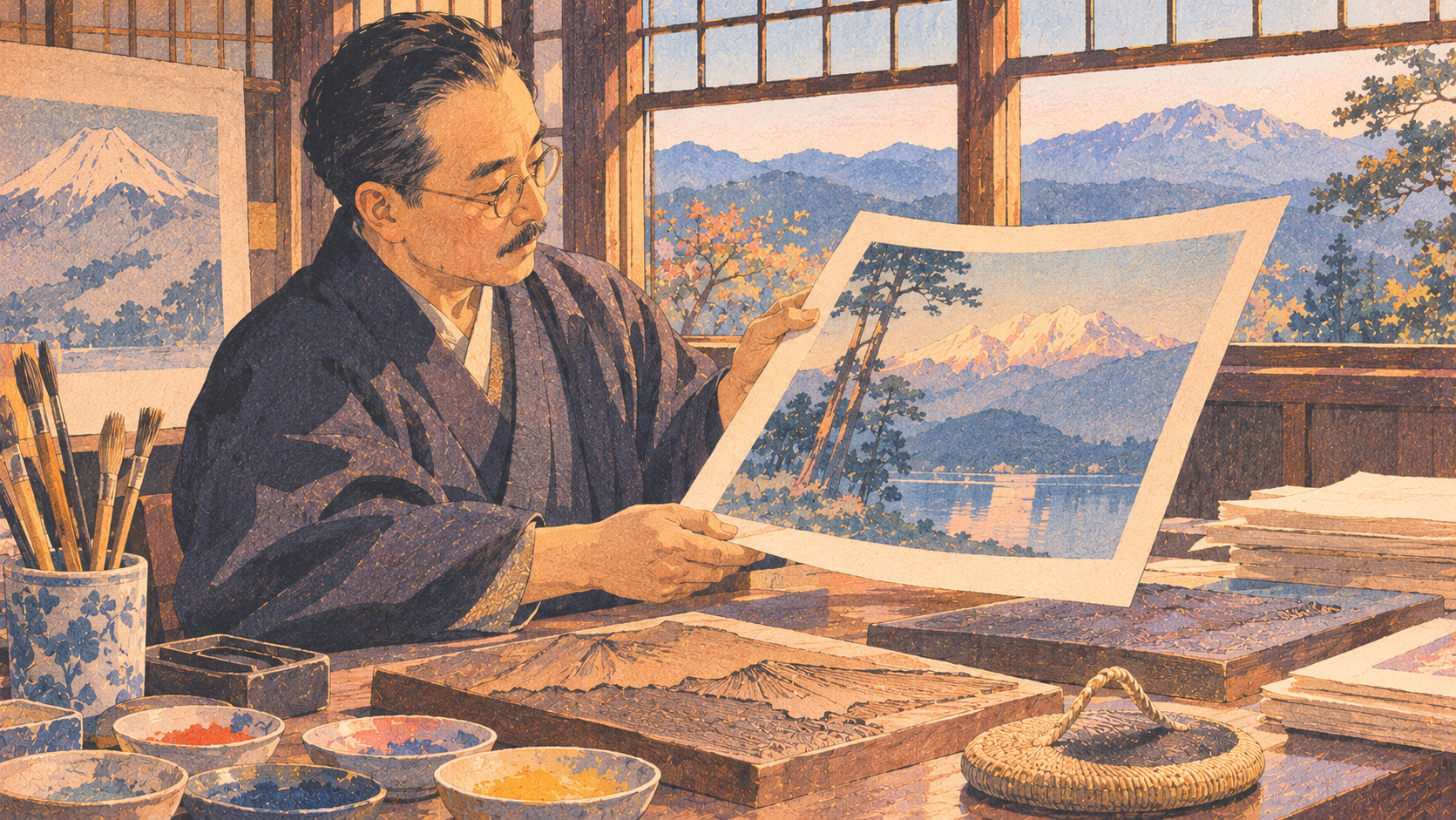
- A centenary hidden inside an anniversary
- A Japanese painter finds an international audience
- The workshop behind the signature
- Three landscapes, one international language
- A city becomes a landscape of reflections
- Three impressions of time: the Seto Inland Sea
- Beyond the Pacific: India and the international print world
- Why Yoshida belongs in a twenty-first-century newspaper
A centenary hidden inside an anniversary
A boat can remain almost perfectly still while the world around it changes. In Yoshida’s sailing prints, dawn warms the sails, mist erases the horizon and night turns the water into a field of blue. These are not merely different palettes: they make the viewer experience passing time through an image that never moves. The year 2026 marks 150 years since Yoshida’s birth and a century since his celebrated 1926 variations.
The MOA Museum of Art marked the anniversary with an exhibition in Atami from September 4 to October 20. In Tokyo, the Museum of Contemporary Art lists the 1929 Kagurazaka print in its collection exhibition running September 19 through January 6, 2027. A separate exhibition at the Maruyama Banka Memorial Museum in Tomi, Nagano, continues through December 6, placing Hiroshi alongside his son Toshi and grandson Tsukasa. These exhibitions offer a useful reminder that his work belongs to an evolving artistic tradition rather than a vanished decorative world.
A Japanese painter finds an international audience
Born Hiroshi Ueda in Kurume, Fukuoka, in 1876, Yoshida took the surname of his adoptive family. He learned Western-style painting with Tamura Soryu in Kyoto and studied at Koyama Shotaro’s Fudosha school in Tokyo. Japan’s Meiji-era modernization created new opportunities for painters trained in oil and watercolor, but Yoshida’s commitment to firsthand observation distinguished the landscapes he would later produce.
In 1899 he traveled to the United States with fellow artist Hachiro Nakagawa, carrying watercolors that found buyers through exhibitions including one in Detroit. Sales helped finance further travel in Europe. He returned overseas in 1903 with Fujio, his future wife and an artist in her own right. His involvement in the Taiheiyo Painting Society, founded in 1902, and recognition at government-sponsored exhibitions made him an established painter before his mature career as a printmaker. The international audience was not an afterthought: it had helped shape his career from its beginning.
The workshop behind the signature
Yoshida began publishing woodblock prints in 1920 in collaboration with Watanabe Shozaburo, a publisher central to the new-print movement known as shin-hanga. Following the 1923 Great Kanto Earthquake, an American fundraising journey for affected artists reinforced his awareness of the appetite for Japanese prints. In 1925 he issued independently supervised series depicting the United States and Europe. He continued painting in oils as well as producing prints.
The traditional workshop divided work among designer, block carver and printer. Yoshida retained these specialist skills but took unusually close control of the result. His jizuri seal indicates prints produced under his supervision; it is not evidence that he personally carved and printed every impression. Registration marks align the paper with successive blocks, and a baren transfers pigments to the sheet. Gradated application of color and repeated impressions allow the printed surface to suggest changing illumination rather than simply outline objects. This is where his watercolor experience met the craft knowledge of Japanese printmakers.
Three landscapes, one international language
The American and European prints of 1925 mark a turning point. Their subjects are geographically distant from Japan, yet the way Yoshida organizes foreground, middle distance and horizon is recognizably his own. A canyon is a study in geological scale, an Alpine summit in reflected light, and a Greek ruin in the relationship between architecture and atmosphere. The following three works invite close looking rather than a quick tour of famous destinations.
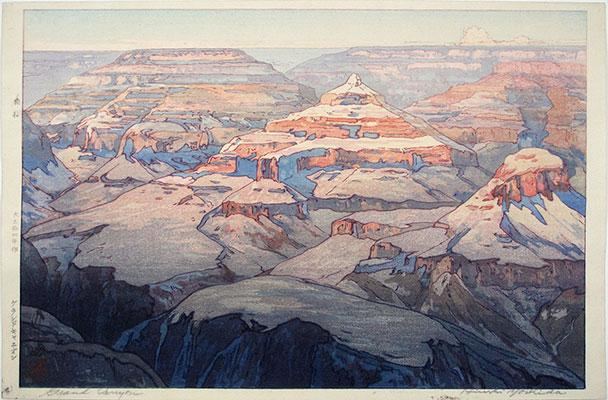
From the United States series, this Arizona landscape uses pale rock terraces and cool foreground shadows to suggest the canyon’s immense depth. The eye travels through geological layers rather than following a single landmark. The Saint Louis Art Museum records a 1925 impression as public domain.
Museum catalogue / reference impression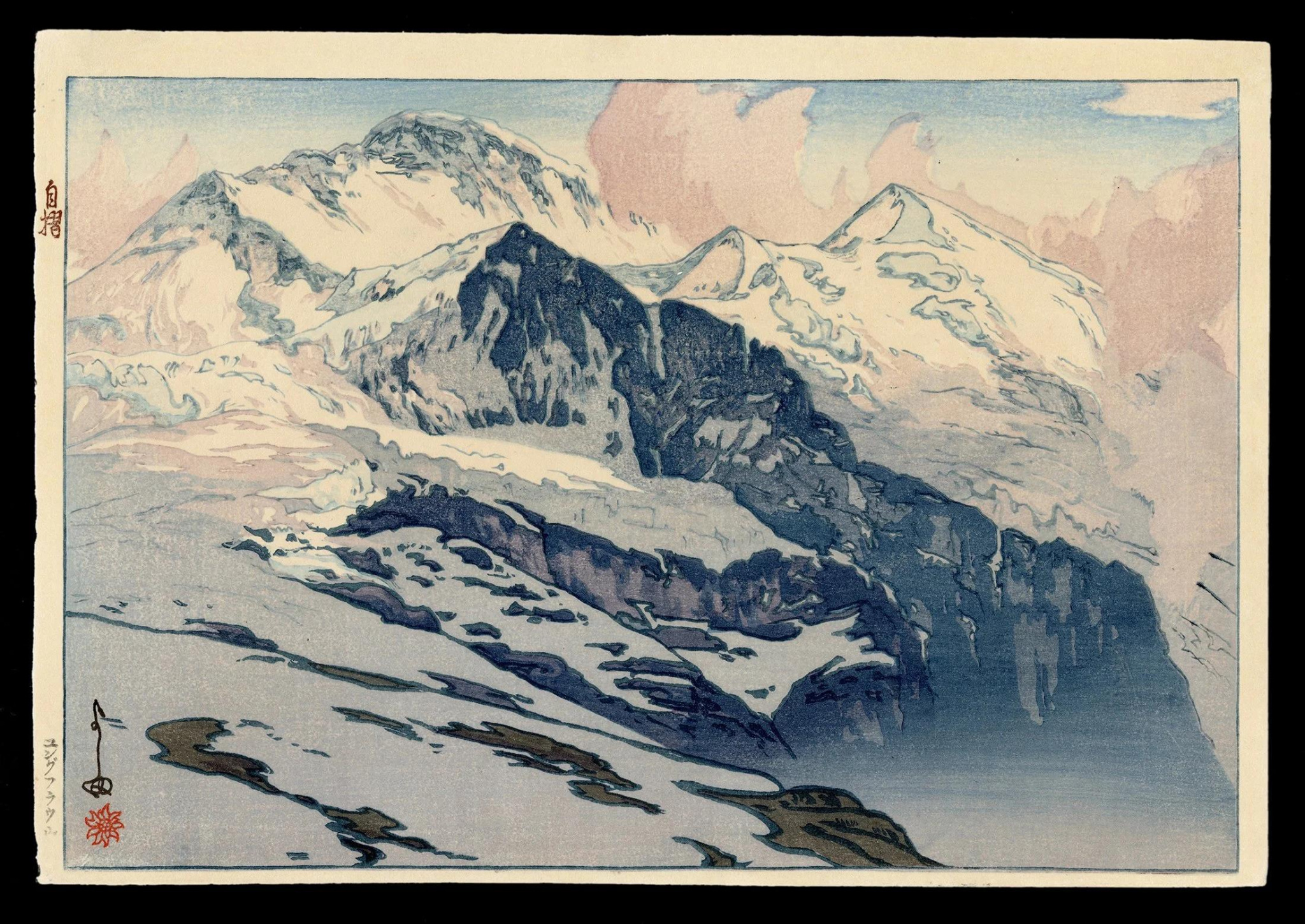
In this Swiss Alpine scene, pale snow and blue-black rock create an alternating rhythm of light and shade. Yoshida’s mountain experience is apparent in the attention given to slopes and ridges. Snow becomes a colored surface reflecting the atmosphere rather than a blank area of paper.
Museum catalogue / reference impression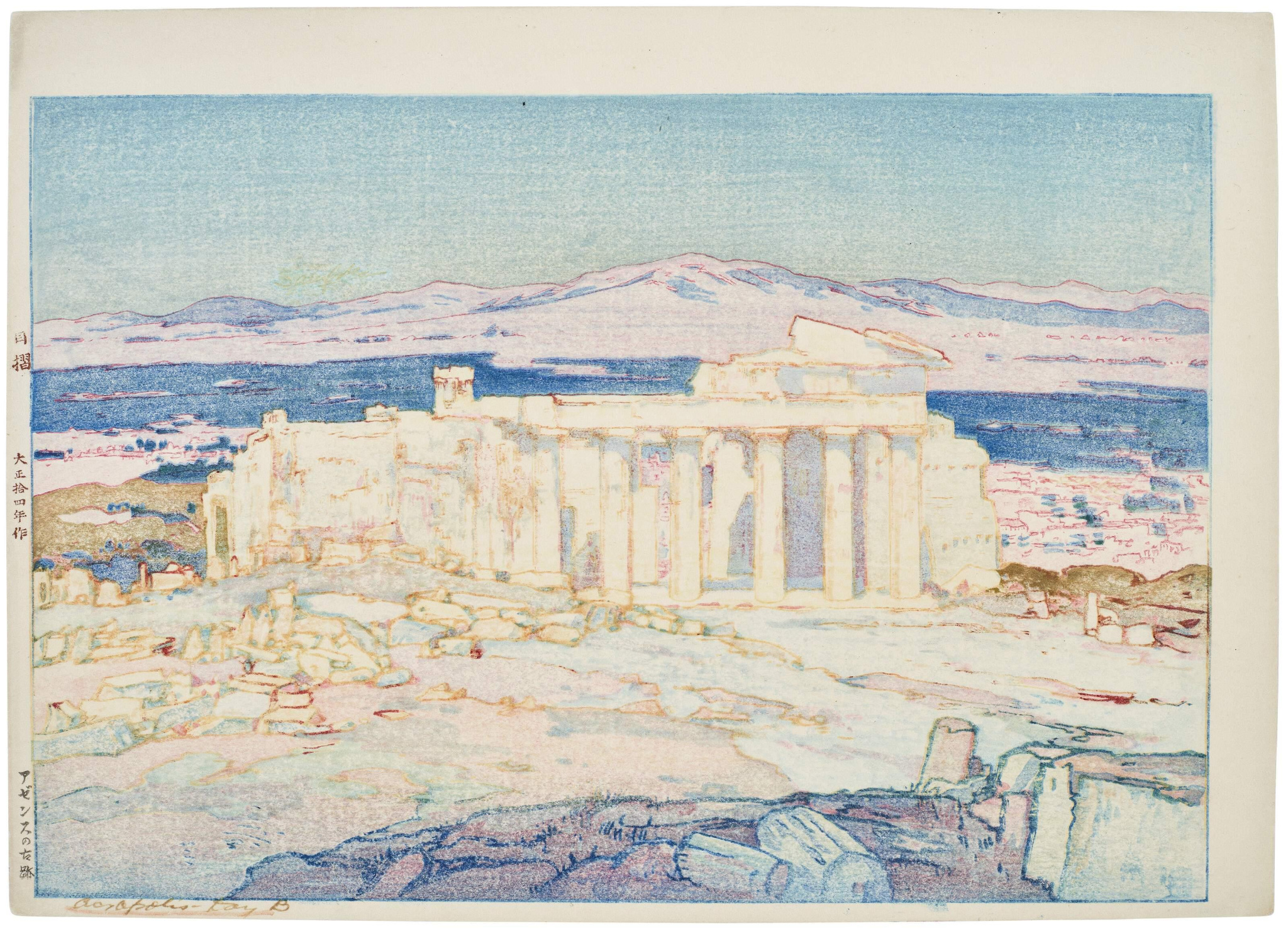
The Greek ruins appear almost weightless in the sun, with pale stone set against blue distance. Rather than emphasizing the monument through dramatic outlines, Yoshida makes the Mediterranean atmosphere part of the subject. The museum distinguishes this 1925 work from a separate night version.
Museum catalogue / reference impressionA city becomes a landscape of reflections
Yoshida’s travel prints might suggest an artist who preferred untouched scenery, but his Tokyo views reveal a different strength. Kagurazaka developed from a district of samurai residences into a lively neighborhood; the relocation of Zenkokuji temple in 1792 helped draw visitors, according to the Tokyo Fuji Art Museum. In this 1929 print, a commercial street becomes a study of artificial light, water and human presence. The visual drama is not a monumental building but the ordinary pavement beneath people’s feet.
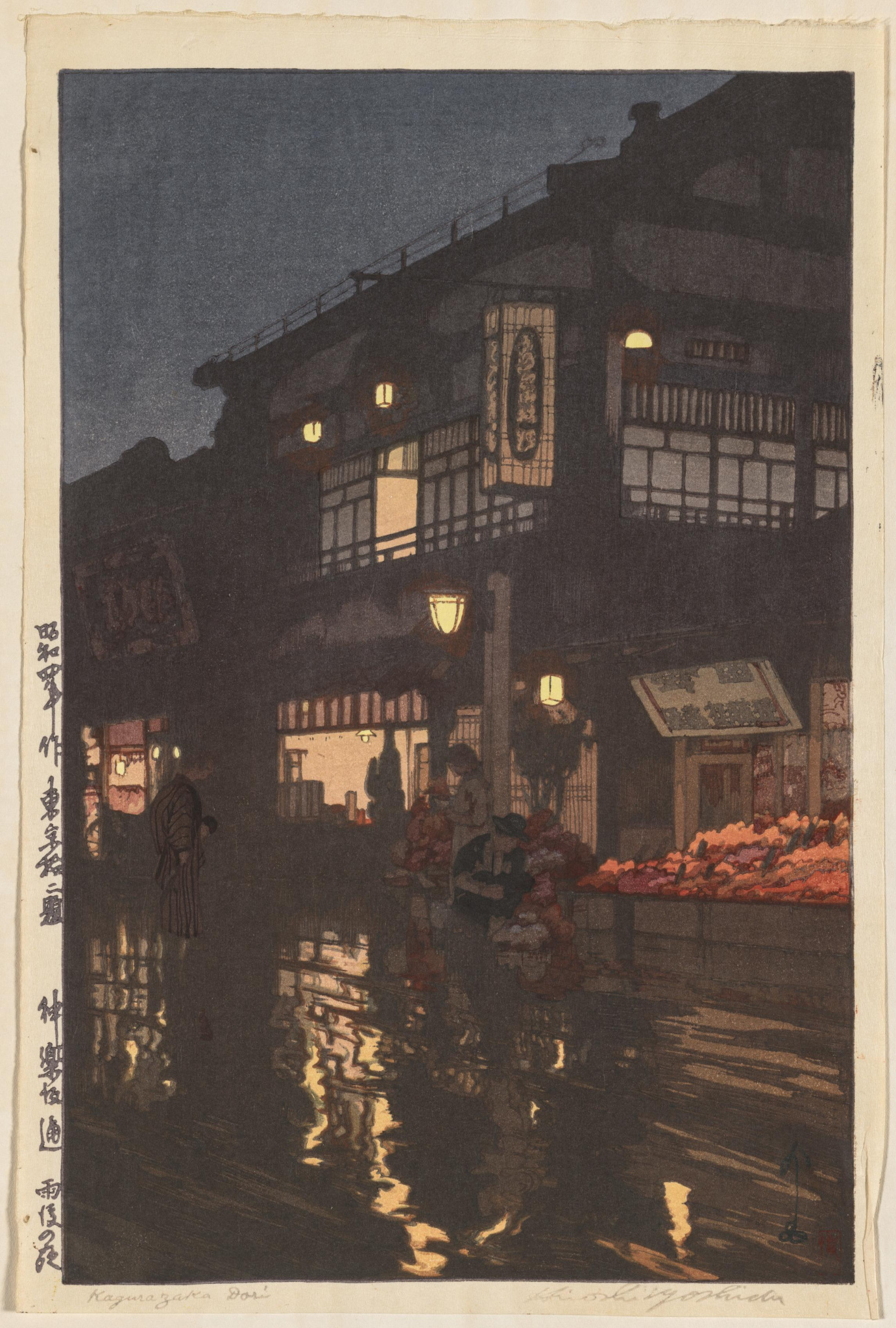
A print from Twelve Scenes of Tokyo. The storefront windows glow against nearly dark architecture, and their broken reflections animate the pavement. The Museum of Contemporary Art Tokyo records woodcut and anastatic printing among the techniques used in its impression.
Museum catalogue / reference impressionThree impressions of time: the Seto Inland Sea
The 1926 Sailing Boats sequence is an especially effective demonstration of betsuzuri, or alternative color printings using shared blocks. Six versions depict morning, forenoon, afternoon, evening, mist and night. Shizuoka City Museum of Art explains how the series uses different pigment combinations to create different weather and lighting conditions. The same hull and rigging become a visual control against which the viewer can measure changes in color. Our selection juxtaposes three of the six versions. They are best understood as separate prints, not as digital recolorings.
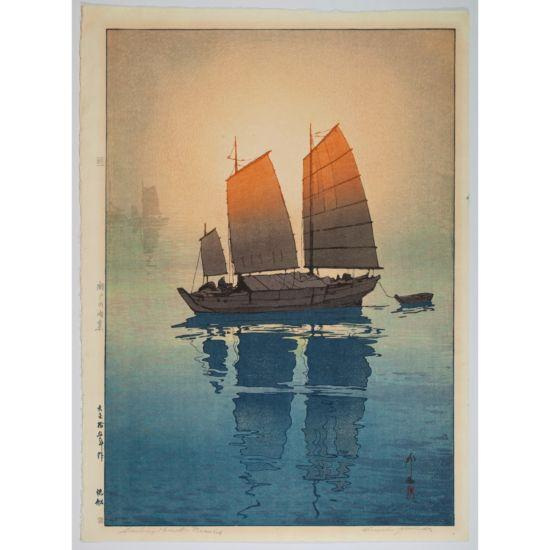
Warm light touches the upper sails while their shadows deepen toward the hull. The reflections below extend the composition vertically, giving the sea an almost equal role to the vessel itself.
Museum catalogue / reference impression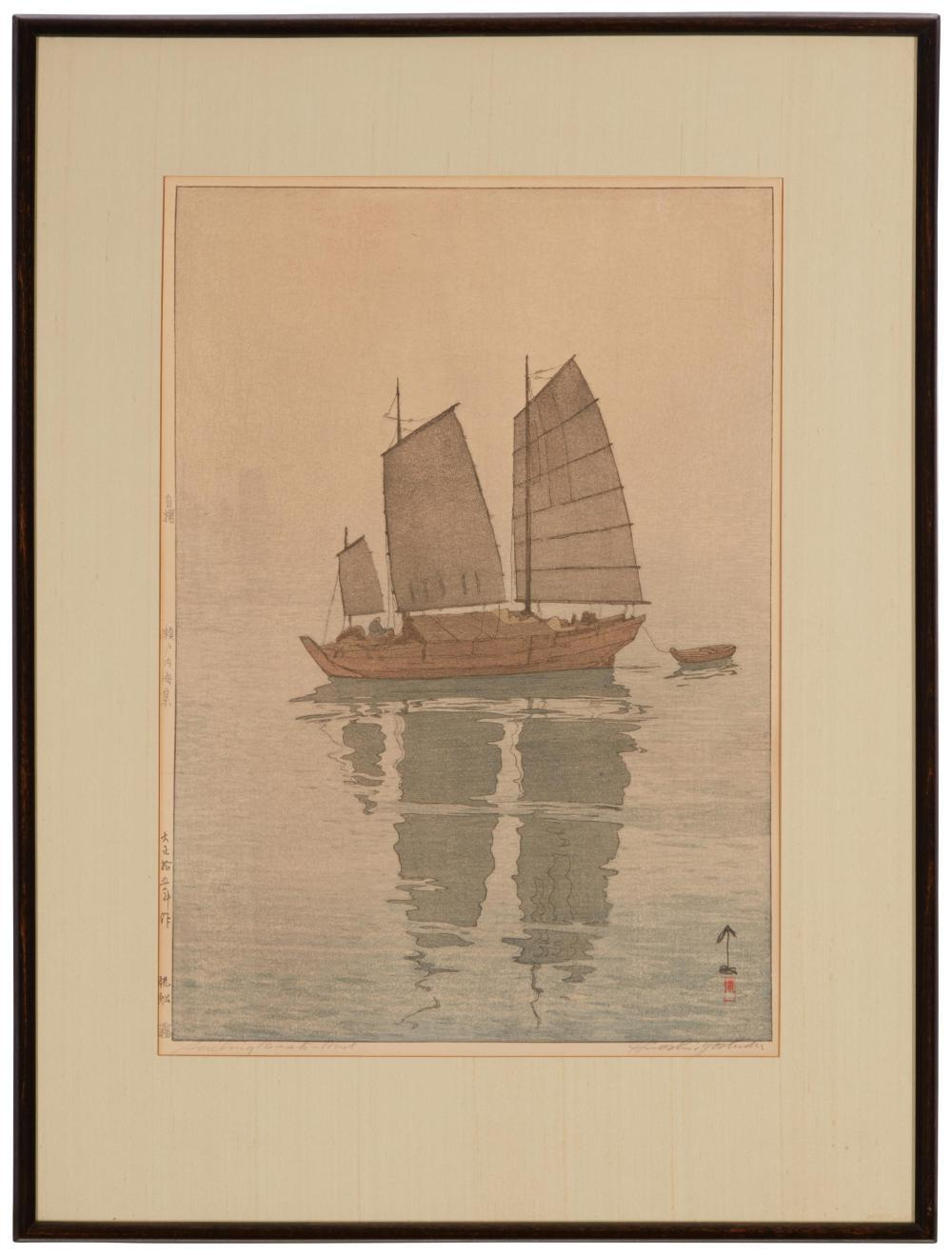
Muted gray and brown tones soften the boundaries of the boat and suppress the distant horizon. The result is not simply a less saturated morning: the space feels compressed by the mist. The supplied image includes a frame; photographic conditions may also influence its appearance.
Museum catalogue / reference impression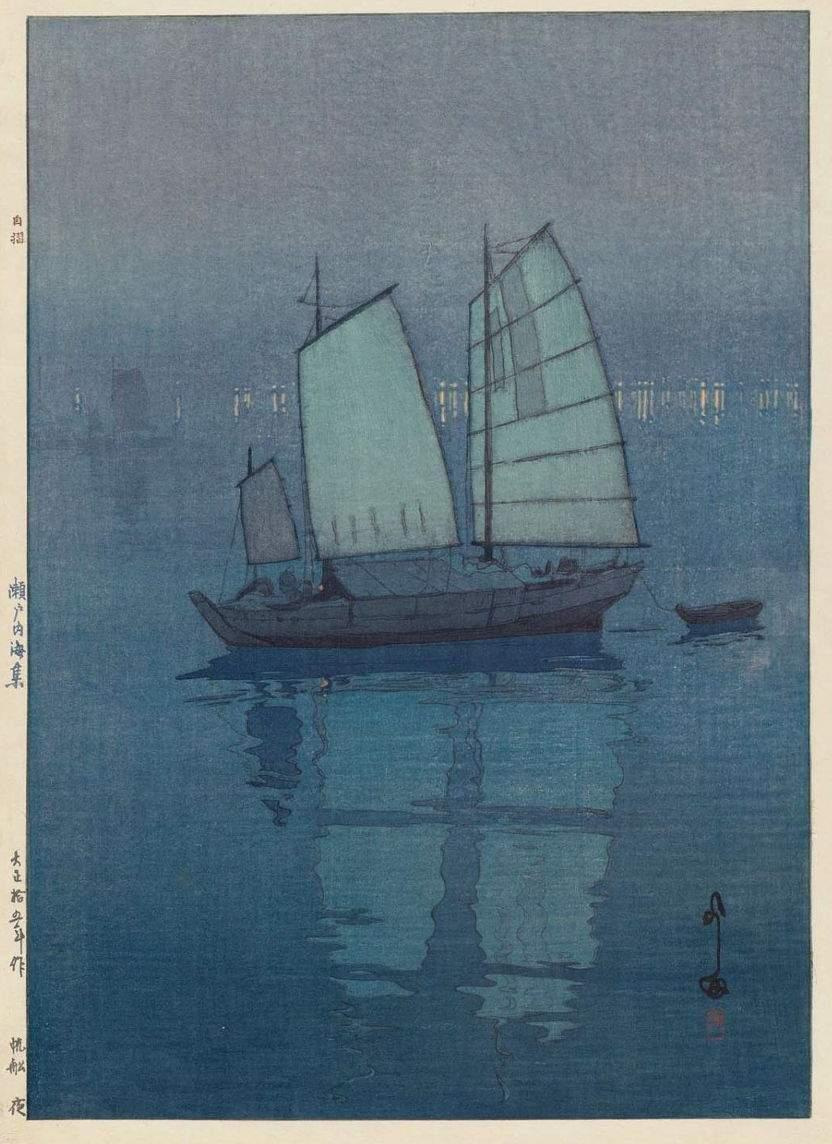
Blue dominates the water and sky, but the pale sails remain legible. Small lights in the distance suggest a shore beyond the darkness. Compare the reflections with Morning to see how the same basic geometry conveys a completely different hour.
Museum catalogue / reference impressionBeyond the Pacific: India and the international print world
From November 1930 into February 1931 Yoshida traveled through India and Southeast Asia. The Ashmolean Museum identifies 32 prints produced from that journey. The Taj Mahal became another opportunity to study a single subject under distinct atmospheric conditions, including mist and nighttime versions made in 1932. Other prints look toward the Himalayas and the architecture of Southeast Asia. These later works are discussed here without reproducing them.
His influence traveled through exhibitions as well as prints. The Toledo Museum of Art credits him with helping organize its 1930 exhibition of modern Japanese prints, an important encounter between American collectors and contemporary Japanese printmaking. His English titles and signatures helped make his art approachable abroad. The family tradition continued through Toshi Yoshida and later generations, who developed their own subjects and methods rather than simply replicating Hiroshi’s landscapes.
Why Yoshida belongs in a twenty-first-century newspaper
For this November 25 edition, JAPAN.co.jp commissioned original AI-generated editorial illustrations informed by the visual vocabulary of his early prints. The Mercury exploration story uses raking light over a vast cratered landscape; the lighthouse report employs the layering of distant islands and reflections; the Miyajima story uses amber firelight against cool evening blues. Even laboratory stories can use reflected light as an organizing visual idea.
These are contemporary interpretations, not historical Yoshida prints, scientific diagrams or photographs of the events described. The seven works reproduced in this gallery are presented separately as historical compositions. Their lesson is not that a single visual style can explain every event, but that attentive composition can help readers notice the relationship between a subject and its surroundings. Yoshida’s achievement was to make a reproducible medium sensitive to the fleeting character of the world. Explore the JAPAN.co.jp Art Gallery.
Primary sources and references
Catalogue records identify reference impressions of the compositions; they do not establish the provenance of the particular image files supplied for this gallery.
- MOA Museum of Art: 150th anniversary exhibition
- MOA Museum of Art: biography and printmaking
- Tokyo Fuji Art Museum: collection and biography
- Shizuoka City Museum of Art: mountain landscapes and color variants
- Shizuoka City Museum of Art: workshop practice
- Shizuoka City Museum of Art: Taj Mahal variants
- Ashmolean Museum: Yoshida in India
- Toledo Museum of Art: artist biography
- Maruyama Banka Memorial Museum: three generations exhibition
- Tokyo Fuji Art Museum: Kagurazaka historical context
- Grand Canyon (1925)
- The Jungfrau (1925)
- Kagurazaka Street after a Night Rain (1929)
- The Acropolis Ruins (1925)
- Sailing Boats – Morning (1926)
- Sailing Boats – Mist (1926)
- Sailing Boats – Night (1926)