- An exhibition that begins with the classroom
- The artist who spent nearly three decades teaching
- A publishing debut at fifty
- How a page turn becomes a performance
- Accessibility as a creative question
- A brief publishing career with a long afterlife
- From bookshelves to museum galleries
- Visiting the exhibition in Ibaraki
An exhibition that begins with the classroom
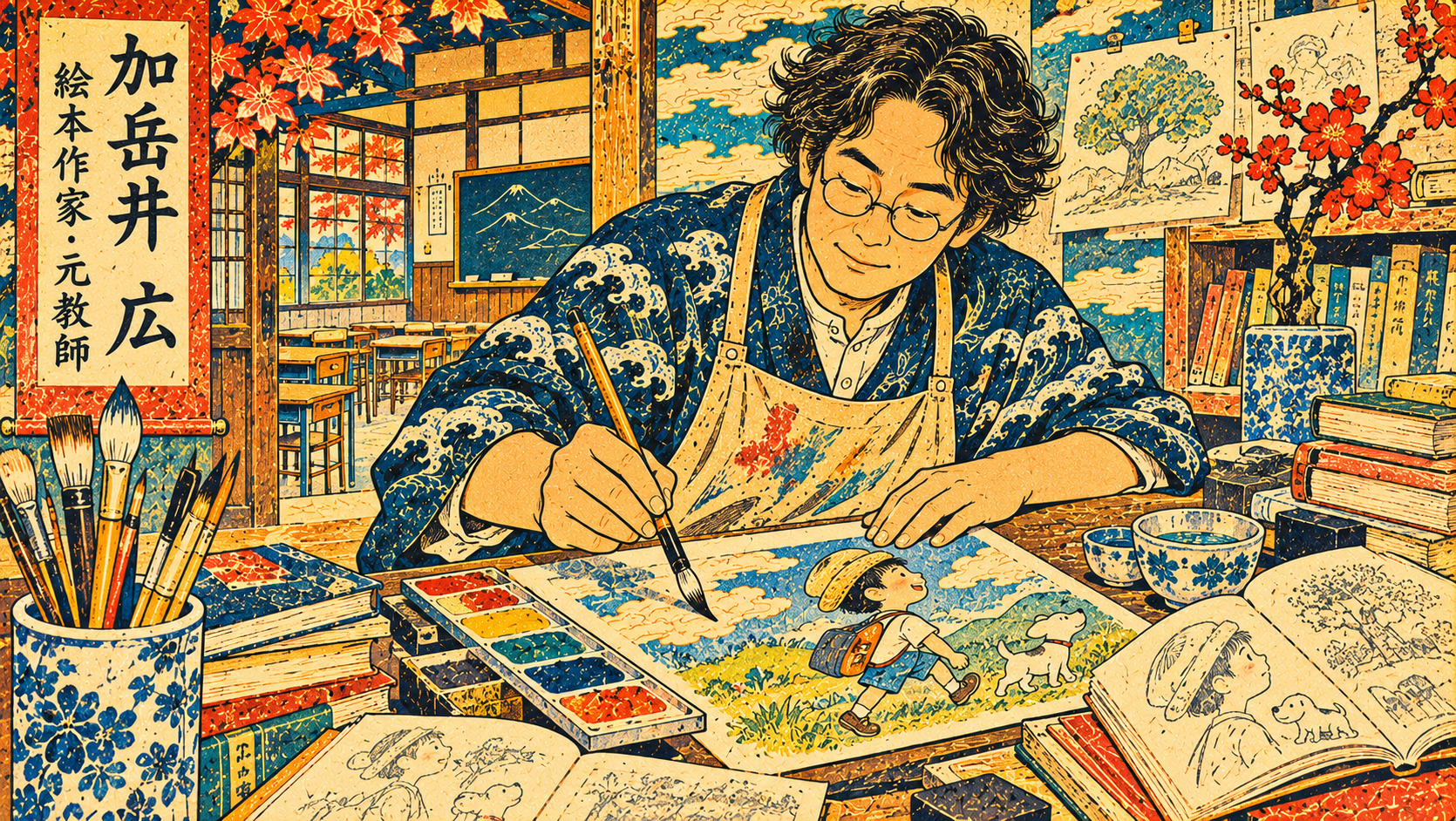
The drawings in a picture book can look deceptively simple. Behind them may lie years of observation, discarded ideas and experiments in how to communicate. That is the story now being told at the Tenshin Memorial Museum of Art in Kitaibaraki, where a retrospective of Hiroshi Kagakui opened on November 23.
The exhibition brings together approximately 200 original illustrations and, according to Ibaraki’s cultural information service, around 500 supporting creative materials. Teaching aids and recordings from his school years sit alongside the evidence of his publishing career. The combination makes this more than a celebration of a bestselling author: it offers a way to investigate how a teacher became an artist whose work found an audience far beyond his classroom.
The Ibaraki opening is the latest stop of a touring retrospective that has been presented since 2023, not a newly discovered collection. Its previous venue this autumn was Toyohashi in Aichi Prefecture. For international visitors, the show offers an unusually revealing introduction to a corner of Japanese popular culture that rarely makes international headlines.
The artist who spent nearly three decades teaching
Born in Tokyo in 1955, Kagakui graduated from Tokyo Gakugei University in 1980, having studied art education. He spent 28 years teaching children with disabilities in Chiba Prefecture. Outside the ordinary demands of teaching, he developed puppet performances and three-dimensional artwork.
His working life also spanned a change in Japanese educational terminology and institutions. In 2007, reforms reorganized schools previously categorized by particular disabilities into the special needs school framework. The current institutional term should not be taken to mean that his schools carried that designation throughout his career.
The exhibition’s teaching materials invite visitors to consider the practical demands of communication. A teacher may need to change the pace, scale or medium of a presentation in response to individual pupils. An object that can be moved, a pause that invites anticipation or a gesture that makes an idea visible can be just as important as a verbal explanation. These are also possibilities available to a picture-book artist.
A publishing debut at fifty
Kagakui entered commercial picture-book publishing in 2005 with Omochi no kimochi, a title that might be rendered in English as The Feelings of a Rice Cake. It earned him the 27th Kodansha Picture Book Newcomer Award. He was fifty years old.
The premise gives a familiar food an unexpected perspective. Mochi is deeply associated with Japanese domestic life and seasonal celebrations; treating it as a character reverses the ordinary relationship between people and their food. The humor requires little explanation once the reader accepts the reversal.
This was not the sudden invention of a creative identity. His previous work in art and puppetry meant he brought a substantial body of experience to his first published book. His career illustrates the difference between a late public debut and a late beginning in art.
How a page turn becomes a performance
Kagakui’s best-known books feature the daruma, a familiar Japanese figure traditionally associated with persistence and good fortune. In his hands the figure becomes the basis of playful visual surprises rather than a lesson in symbolism. The series began in 2008 and comprises Daruma-san ga, Daruma-san no and Daruma-san to.
The short grammatical particles in these titles establish different kinds of expectation. Ga introduces a subject, no suggests possession or association, and to can introduce companionship. Readers unfamiliar with Japanese need not master its grammar to appreciate the broader technique: a repeated verbal cue prepares the audience for a visual change.
A page turn is a form of editing. Unlike a continuous animation, a book lets a caregiver decide when the next image appears. The child can anticipate, interrupt, imitate or ask to repeat a sequence. In this sense the book is a small performance shared between people, and its apparent simplicity is part of its design.
Accessibility as a creative question
Kagakui’s background invites a wider discussion of what it means to make an artwork accessible. Accessibility does not require assuming that all children learn or respond in the same way. It involves making room for different ways of taking part.
A picture can carry meaning before a child can read independently. A recurring phrase can provide a recognizable cue. A physical gesture can communicate something that words alone do not. These features are useful artistic possibilities, not evidence that a particular book provides a clinical treatment or produces a specified developmental outcome.
It is also worth resisting an overly sentimental account of his teaching. Children with disabilities are participants in cultural life, not simply the recipients of adult generosity. The classroom experience documented by the exhibition can be understood as a relationship in which an artist learned from the people he was trying to reach.
A brief publishing career with a long afterlife
Kagakui died in 2009 at the age of 54, leaving sixteen picture books from a publishing career of approximately four years. His other titles include books built around bedding, food and everyday objects. The International Library of Children’s Literature places his work within the broader story of picture-book publishing during Japan’s Heisei era.
His publisher reports that the three-book Daruma-san series has exceeded ten million copies in cumulative circulation. That is a measure of publishing reach, not a count of unique readers. A single book can be shared by siblings, lent by a library or read repeatedly to a nursery class.
This kind of cultural longevity differs from the rapid attention cycle of many entertainment products. A new generation of children discovers the same work every year. Preserving illustrations, drafts and educational materials gives adults a way to recover the human history behind books that may otherwise feel as though they have always existed.
From bookshelves to museum galleries
The touring exhibition advertises interpretive resources including sign-language video, text and audio, with Braille material available on request. Visitors should check the arrangements at the individual venue. The approach is especially relevant to an artist whose career was shaped by special needs education.
Original art can reveal choices that are harder to see on the printed page: the placement of a figure, the relationship between empty space and movement, and the labor involved in producing a seemingly effortless image. Notebooks and teaching objects extend that view beyond the finished book.
Museums and publishers therefore play complementary roles. Publishers keep the work circulating among readers; exhibitions preserve and interpret the materials that explain its creation. Neither activity requires treating a children's book as less serious art because its intended audience is young.
Visiting the exhibition in Ibaraki
The exhibition runs through January 17, 2027, at the Tenshin Memorial Museum of Art, 2083 Tsubaki, Otsu-cho, Kitaibaraki, Ibaraki Prefecture. Opening hours are 9:30 a.m. to 5 p.m., with final admission at 4:30 p.m. Standard admission is ¥710 for adults, ¥350 for visitors aged 70 and over, ¥470 for high school students and ¥240 for elementary and junior high school students.
The museum generally closes on Mondays. During this exhibition it also closes December 29 through January 1 and January 12; it opens on the January 11 public holiday. Concessions and free admission arrangements are detailed on the museum website. Consult the official schedule before traveling.
The setting itself adds a historical contrast. The Izura area is associated with Okakura Tenshin and the development of modern Japanese art. Here, the original drawings of books made for very young readers take their place in a museum dedicated to artistic achievement. Kagakui’s legacy asks a compelling question: what if the ability to make another person laugh, without demanding that they understand the world in exactly the same way as we do, is itself a demanding artistic achievement?
Primary sources and references
- Tenshin Memorial Museum of Art, Ibaraki — exhibition and visitor information
- Ibaraki cultural information network — exhibition holdings
- Bronze Publishing — author profile
- Kodansha — author biography
- International Library of Children’s Literature — Heisei-era picture-book authors
- Bronze Publishing — Daruma-san series
- Bronze Publishing — memorial biography
- Official touring exhibition — schedule and accessibility
- MEXT — reforms in special needs education