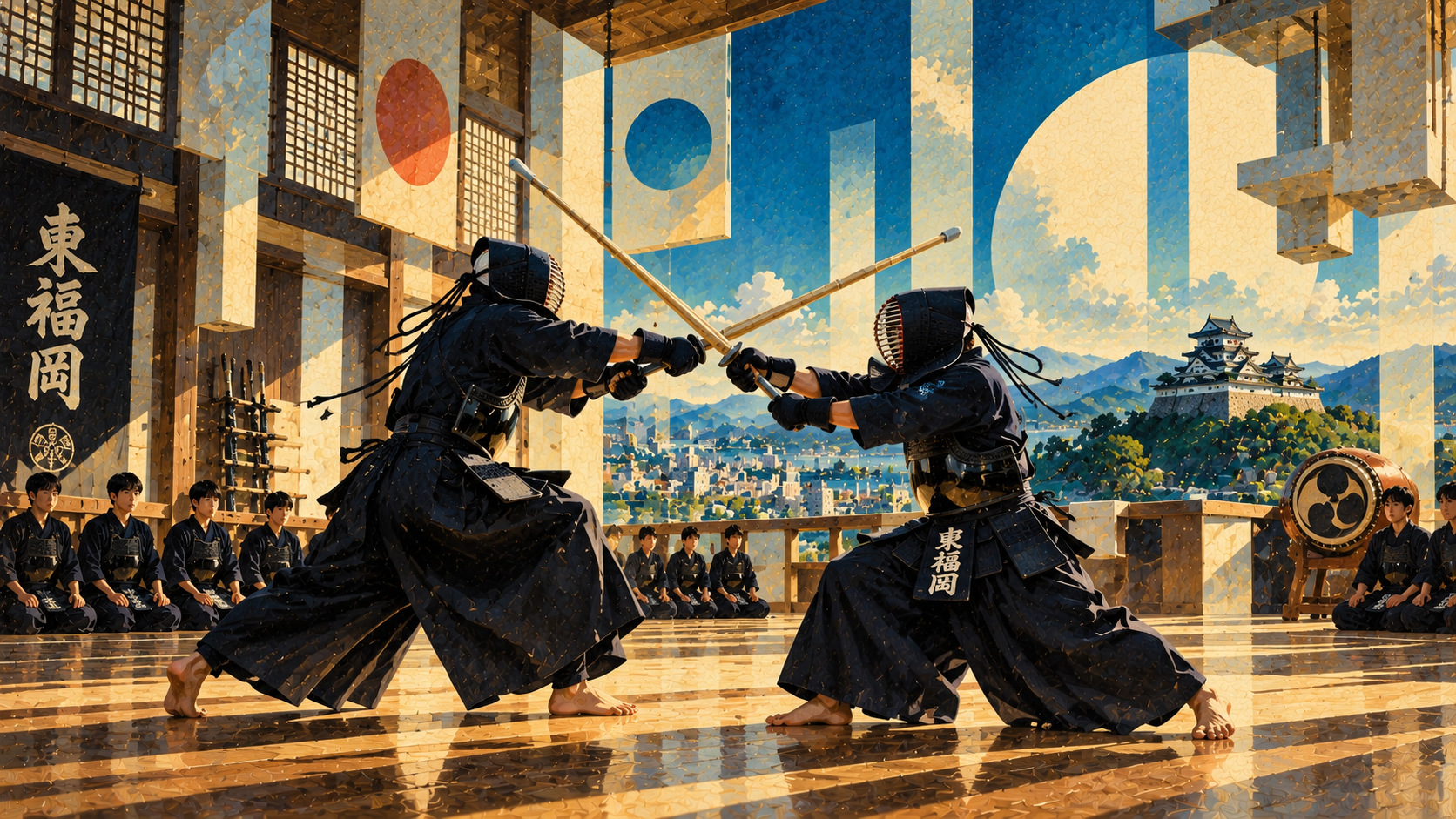
An eight-year wait to return to nationals. Then two titles in one summer.
A double national title, earned in August
Higashi Fukuoka High School entered the 2026 national high-school kendo championship in Nara after an eight-year absence from the Inter-High stage. It left with something the program had never achieved: the boys’ team championship. Third-year student Hashimoto (橋本大治) also won the individual title. Those results were decided in August, not during the October recognition event that has brought the victory back into the prefectural news.
Why the story is back on October 25
On October 21, Fukuoka Prefecture announced a ceremonial visit scheduled for Monday, October 26, from 1:00 to 1:20 p.m. at the prefectural offices. The delegation is to include principal and board chair Tokuno Shinichiro, coach Gibu Junichi, captain Kitahara Haruto and team members. They are expected to report the achievement to Vice-Governor Ueda Tetsuko. The scheduled visit should not be described as already completed.
The numbers behind the title
In the boys’ team final, Higashi Fukuoka beat Miyazaki’s Nissho Gakuen High School by four individual bouts to none. The national federation records Meihō of Oita and Shimabara of Nagasaki as the other semifinalists. Higashi Fukuoka’s school report also records a 3–0 semifinal victory over Meihō. These are unusually clear results in an event where each exchange is decided by exceptionally tight technical standards.
Hashimoto’s second championship
The individual title belonged to Hashimoto (橋本大治) (橋本大治), a third-year student. He defeated other competitors through the bracket before meeting Umaki (馬木洸虎) of Nitta High School in the final. The official standings list Hashimoto first and Umaki second. His individual victory is distinct from his contribution to the five-fighter team title.
Two Hashimotos, different achievements
The school named Hashimoto (橋本大治), a third-year student, and Hashimoto (橋本洸人), a second-year student, among the tournament’s outstanding athletes. They are different competitors. Reporting only a surname, or conflating the individual champion with the younger team member, would obscure both contributions.
From an eight-year drought to first place
The path began in late May at the prefectural qualifier in Kasuya. Higashi Fukuoka captured the boys’ team championship and Hashimoto (橋本大治) won the boys’ individual category. The school called it the first Inter-High berth since 2018. Less than three months later, the program claimed its first national team championship, while Hashimoto completed the individual double.
What counts as a point in kendo?
To an unfamiliar viewer, the contest can look like a spectacular exchange of bamboo-sword strikes. But a point, or ippon, requires more than contact. The All Japan Kendo Federation specifies spirit and posture, the correct portion of the shinai and target, proper blade alignment, and zanshin: continued awareness after the strike. Kiken-tai-itchi refers to the coordination of intention, sword handling and body movement. That is why a seemingly dramatic hit is not always awarded a point.
Kendo is both historical and modern
Kendo developed from Japanese sword traditions, but today’s regulated high-school competitions are not simulations of historical duels. Protective armor, bamboo swords, refereeing criteria and team formats belong to a modern educational and sporting system. Its language of respect, composure and discipline can be understood alongside the intensely competitive reality of national school championships.
Five athletes, one team result
An individual star helps, but no five-person national final can be reduced to one athlete. The school lists Kitahara Haruto, Hashimoto (橋本大治), Uchida Keisuke, Nakashima Chihiro, Hiroto Hashimoto, Kusunoki Ryusei and Arase Takemichi among its prefectural qualifying team members. The final national bout sheet records the order and individual outcomes. Each athlete’s role merits attention rather than turning the whole championship into a single-player story.
Fukuoka has more than one champion
At the same national championship, Fukuoka’s Nakamura Gakuen High School won the girls’ team title. That is important context: the prefecture’s achievement was not confined to one boys’ program. It opens a reporting avenue into regional coaching networks, school rivalry and the competitive level of Kyushu. Published results alone do not establish the specific training methods responsible for either school’s success.
What we do not yet know
Public records confirm the championship, venue, opponents and planned ceremony. They do not establish Hashimoto (橋本大治)’s postgraduation plans, a detailed weekly training regimen, or quotations from athletes explaining the final. No original interviews were conducted for this report. Those human details would strengthen a later profile, but inventing them would weaken the achievement.
The real measure of the achievement
The October 26 visit offers a public occasion to recognize the athletes. The lasting story is the transformation from an eight-year gap in Inter-High participation to a first team national championship and an individual title in the same summer. The official results give a reliable beginning; the next chapter belongs to the players and coaches who made it possible.
Sources and reporting notes
Results cross-checked against the national federation, school and prefectural school kendo records. No athlete or coach interviews were conducted. The October 26 ceremony remains scheduled.